Wednesday, July 26, 2006


2696 The real minimum wage
Dick Morris suggests it should have been indexed to the cost of living rather than givin one-shot increases, but figures the real minimum wage as:"Much of the debate over the minimum wage is, of course, obviated by the earned-income tax credit which kicks in for all minimum-wage mothers. The credit, plus Medicaid eligibility, plus food stamps, plus day-care allowances, plus rent subsidies, plus exemption from income taxes, means that those who earn the minimum wage really have a pre-tax income equivalent over $20,000."
Tell that to beginning librarians and school teachers who earned a master's degree to earn about that much.
2695 Trip Tale: Tallinn, Estonia
The five of us went through customs and boarded the hydrofoil for Tallinn, about a two hour trip (it's about 4.5 hours by ferry). The waves were high and it was really bumpy, but with the help of a motion pill and keeping my eyes shut the whole trip, I kept my breakfast. Not so the pretty young Swedish girl next to my husband.Little Estonia (at least its major city) has created a miracle in only 15 years of freedom from the Soviets. We were blown away by the restoration of its "old town," and the vibrancy of its newer areas. I'm sure it's going through some of the growing pains that countries experience as they transform themselves from totalitarian to democratic regimes, but compared to what we were to see in Russia the following week, it is really a transformation.
Riitta had been there under the old regime and she could hardly believe it. Old Town is now colorful gold, pink and blue buildings with red tile roofs and lovingly restored old Catholic, Lutheran and Orthodox churches open for tourists and worshippers. It was like a German city without the hordes of Japanese tourists.
 We docked at a huge decaying concrete "ice palace" built during the Soviet era. This ?? is on top--sort of looks like a Russian bear, but up close seems to be an ethnic-asian person inside a fish or animal skin.
 Although not as crowded as other European cities, driving is a bit dicey because before freedom 15 years ago, no one had automobiles--so it's sort of new to them.
 We skipped lunch in the pricey market place (for tourists) and Tomi led us to a lovely local restaurant with great food and reasonable prices, called H.H. Rüütel.
 Lower left of this photo shows some unrestored and crumbling buildings--what the whole town used to look like.
Tallinn, Estonia
Estonians
USSR
2694 The stem cell veto
There was a cartoon in the international ed. of the NYT last week that showed a distinctly Simian, slumping President Bush vetoing stem cell research with a reference to the flat earth society. If Bush's veto will make no difference in stem cell research (except to those of us with "narrow religious views" who believe it is immoral to create life for the purpose of destroying it to benefit someone else), where's the beef? There is plenty of private money for this, and no one has yet found any cure for any disease using the cell lines created before 2001 which are available. The media are creating yet another victim class--all the people who haven't yet benefitted from research that hasn't yet produced any cures!Also, according to New Atlantis, the U.S. isn't falling behind in stem cell research. "Far from showing the United States lagging behind in the field, they found that American scientists had by far the most publications—46 percent of the total, while the other 54 percent were divided among scientists from 17 other countries. They also found that the number of papers in the field published by Americans has increased each year, with a particularly notable growth spurt beginning in 2002. . . [the study showed] more than 85 percent of all the published embryonic stem cell research in the world has used the lines approved for funding under the Bush policy. Since this is almost twice the number of papers published by Americans, it is clear that a great deal of the work done abroad has also involved these lines, even though most of it could not have been funded by the NIH. The lines are used, in other words, because they are useful, not only because they are eligible for federal support."
The media--NYT, CNN, WaPo and their sibs and blogs--flog this story that the U.S. is falling behind, but like a lot of the other anti-Bush stories published by them, it's a lie.
stem-cell-research
George W. Bush
media bias
Tuesday, July 25, 2006
2692 Trip Tale: Visiting Suomenlinna, the Fortress
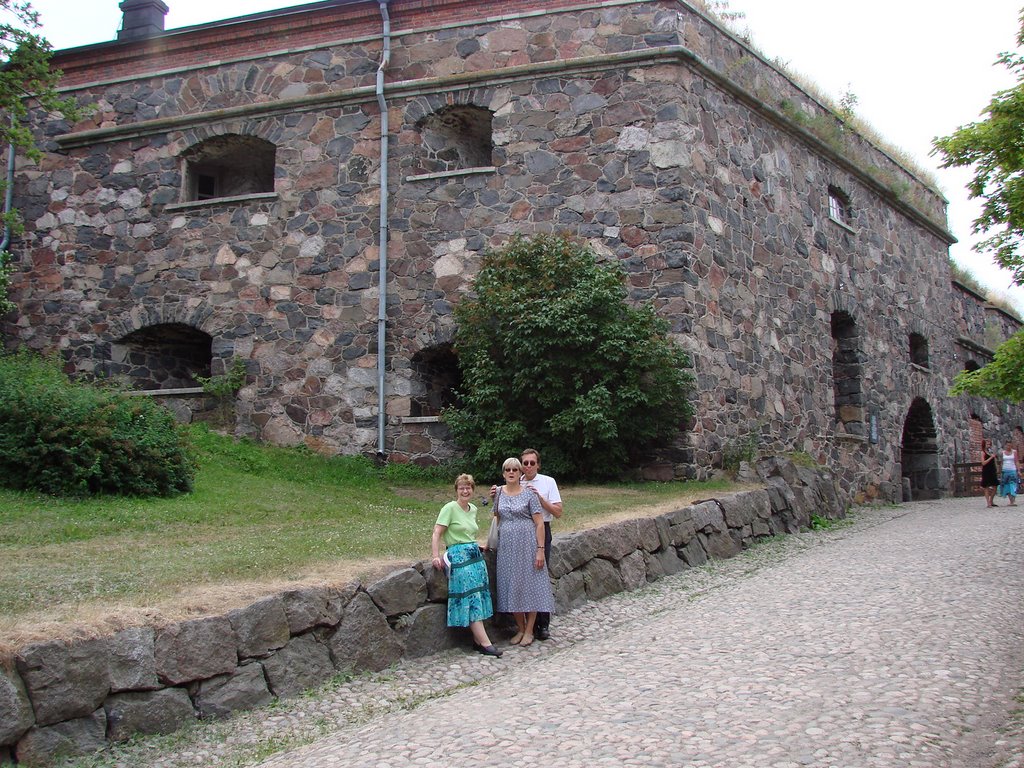
When Peter the Great built St. Petersburg in 1703 so he'd have a port on the Baltic, the Swedes decided to fortify Finland (which it ruled) and built Suomenlinna on the islands. The fortress was lost to the Russians in 1808. It fell into disrepair, but now is a historical preservation site with cobblestone and brick streets, old walls, ramparts, cannons, a working dock for repair of wooden ships, a museum, art shops and a nice little town library. About 800 people live on the islands, but at one time it was quite a bit larger. The ferry there is part of Helsinki's city transportation so it is very accessible and a delightful spot for either tourists or residents.With the long summer days, the island was filled with picnickers and families, sunbathing even as late as 8:30 p.m. We had dinner at a lovely white tablecloth restaurant called Walhalla, Charr with lobster mousse.


2692 The gasoline cost survey
Today I got an e-mail questionnaire from my congresswoman Deborah Pryce asking my opinion on gasoline prices. Although ANWR and more refineries were included as a choice (to solve the problem of high prices), I can't believe our congresspeople never mention the gasoline taxes (20% of the cost). So I reminded her of that option. I don't know why they even run that price gouging question past us! Yesterday in Bucyrus it was $2.85 a gallon. When it gets to $3, which it is around Columbus, and people just stop buying, then the supply increases, and the price goes down. Adjusted for inflation we're about where we were in 1981.In Norway which is an oil rich nation and now very wealthy with the highest standard of living in the world, I see tourists are advised to fix their own food if possible--$14.50 for a chicken breast if you cook it yourself. They put their oil money in a trust fund for the future, so they pay high prices now. Our Finnish friends all drive small, efficient cars, they conserve, they pay huge fees to have a license to drive, and they have an excellent public transportation system. And they are paying well over $5/gal for gasoline, a lot of which is taxes. And they are very unhappy that huge Russian transports are using their highways paid for with their gasoline taxes to haul automobiles from the Finnish port cities of Turku, Hanko and Kotka across the border into Russia.
Gas Prices
2691 Trip Tale: The new veterinary hospital in Helsinki
On Tuesday we toured what is probably the finest veterinary hospital in the world--at least until the next one is built--having opened just this past spring. "The Veterinary Hospital serves the Helsinki region in all small animal or horse medical cases and the whole of Finland as a place of treatment for referred patients. The design of the new hospital building takes into account the needs of the future inmates. Particular attention has been paid to the adaptability of the premises." Annual ReportRiitta was still on call when we arrived on Saturday, and had just completed two major surgeries, and was called in the middle of that night for a third. I don't know if doctors of human medicine spend as much worry and angst over their patients as we observed with Riitta, with frequent calls to the hospital to check on her horses. When we toured the small animal and large animal sections, we not only visited her patients, but saw where the surgery and care takes place.
Riitta is looking for an internal medicine person willing to come for 2-3 years who has a Dip-ACVIM. Because this is a Finnish hospital one of the staff perks includes a lovely sauna.
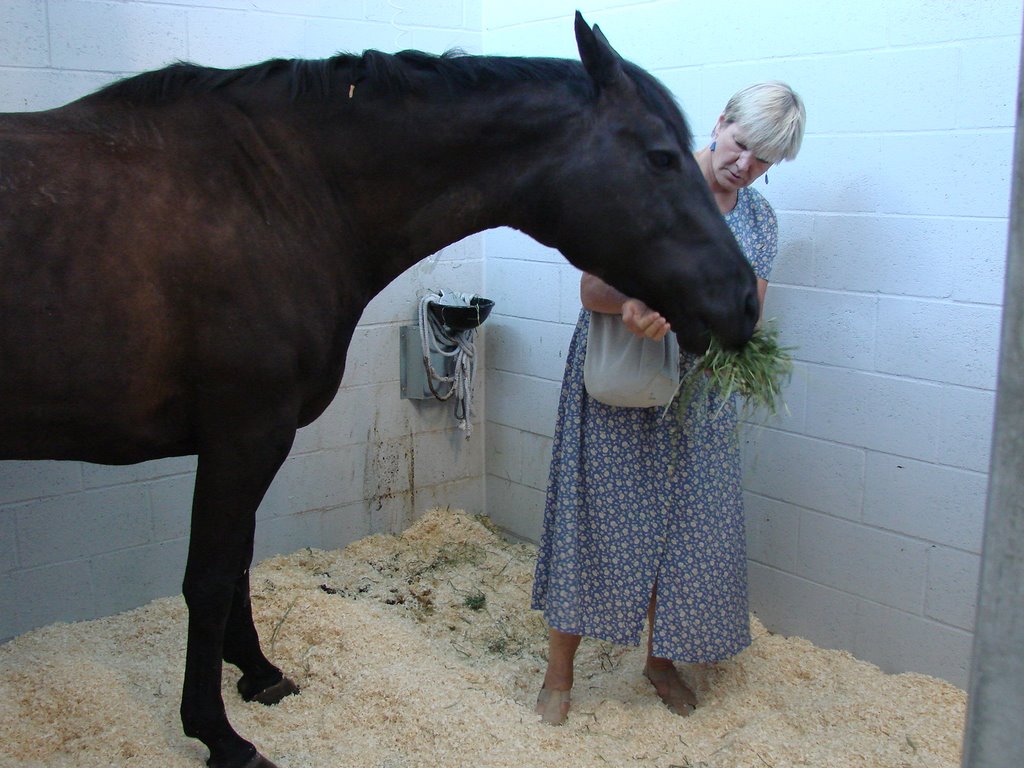 This was an extremely sick animal, but was still alive two weeks later when we left. I won't even describe the surgery or post the photos!
2690 Less Stress Chickens meet the same fate
One of the things I can’t resist (I should save this for a TT) is trying a new and interesting product--especially if it is at Trader Joe’s, which I consider a responsible chain for health, nutrition and price. So today I picked up Chicken Sausage mixed with fresh spinach and feta cheese (Han’s All Natural, Olympus brand). It has no antibiotics and no nitrates, and is “minimally processed” with no artificial ingredients. If you’re really picky, I’ll note that it has pork casing, and everything else on the label you can read without a chemistry degree.Anyway, I thought of Murray, from my hometown, who left a little story in my comments a few weeks ago about rescuing baby chicks from the local hatchery years ago when he was a child. They had been thrown out live into the trash can because of various imperfections. The chicken (sausage) I’m about to eat for lunch has been raised in a low stress, environmentally focused practice, and ate an all vegetable diet (don’t chickens eat bugs if they are free-range and happy?). But like Murray’s little peeps that survived to grow up to be halt and lame, but happy, their fate was the same. Low stress or not, it's a chicken's life.
2689 Learn a few Finnish phrases
Helsingin Sanomat (the on-line international edition), the main newspaper of Helsinki, is on midsummer vacation until the end of July. Just about everyone seemed to be on vacation--at the summer lake cottages, or little farms in the countryside. But here's a page I wish I'd found earlier, called Speak up in Finnish. It has recordings so you can hear how the phrases should sound.Finland
Helsinki
Finnish
Helsingin Sanomat
Monday, July 24, 2006
2688 On being illiterate
In Finland, I am illiterate. Finnish and Estonian are related languages--the Finns and Estonians may have been one people centuries ago, but their languages are not like any romance or germanic language. I think Finnish has 12 or 13 declensions for its nouns. Swedish is the second national language, and because it is germanic, you'll have a better chance trying to pronounce the street names and directions and store types in Swedish to figure them out than to try Finnish. In Copenhagen I looked through a Danish newspaper and could at least figure out pieces of it. Nothing in Finnish made much sense.On Wednesday I went shopping with Riitta for groceries and tried to find an English language publication. Truly, after three days of being unable to read, I was desperate. At the news stand my choice was between the international edition of Time Magazine and Vogue. It was a tough choice, believe me. But I paid 4 euros (about $5.00) for 52 pages of Time, 19 of which were photos of the World Cup. Photos I can figure out in Finnish. Five pages were devoted to bashing the "Bush Doctrine." No mention or credit for liberating the Iraqi people from a cruel dictator; no credit for identifying North Korea within months of taking office as part of the Axis of Evil; no mention that his neo-con advisors are former Democrats; or the 500 WMD that have been found; that the Iraqi people have voted in free elections. Although Bush has always acknowledged we were in for a long battle against Islamic terrorists, when he reiterates this, the MSM seems to think it is a victory for their side.
So what does Time recommend? Some Truman era reruns. They don't mention how extremely unpopular Truman was his second term--I think he was lower in the polls than Bush. Another article by Jos. S. Nye, Jr. pined nostalgically for the days of FDR and containment. Tell that one to the Estonians and the millions of other east Europeans who died in the Gulags waiting for the Americans to come and free them. Sixty years ago we sold out 40 million East Europeans to the USSR; let's not repeat that mistake by selling out the Iraqis.
Even so, it was good to be able to read again.
2687 Trip Tale: Touring Helsinki, pt. 2
After visiting the Uspenski Orthodox Cathedral we visited yet another church, this one very modern and built inside blasted rock, Temppeliaukio Church of the Rock, designed by Timo and Tuomo Suomalainen. There was a beautiful string quartet playing when we slipped inside.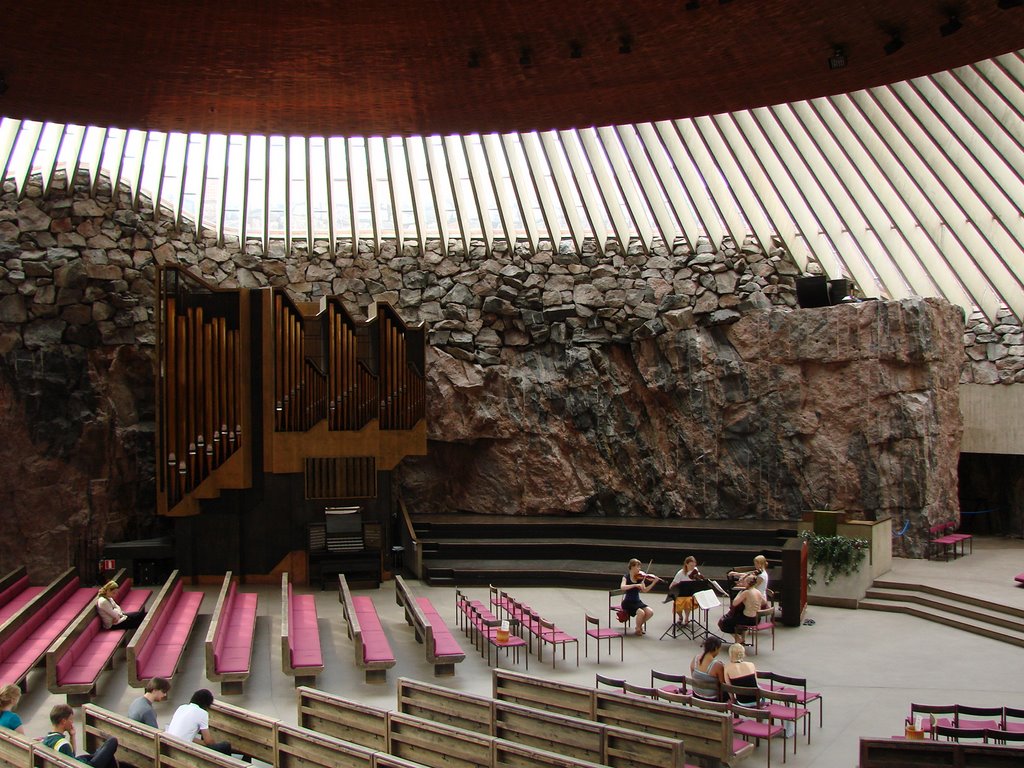 Church of the Rock
From there we went to Finlandia Hall and viewed the problem of replacing the marble skin on the famous building designed by Alvar Aalto.
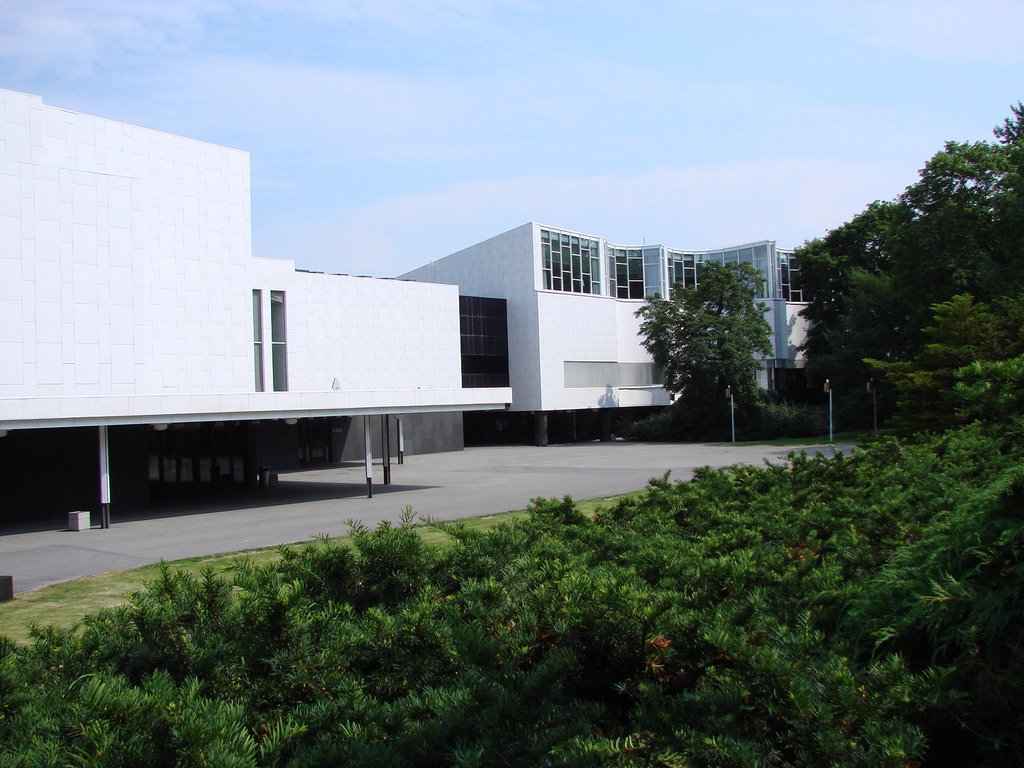 The severe winters cause the marble sections to buckle giving it a basket weave appearance, rather than smooth. If you buy a souvenir piece of marble, be sure to check it through in your luggage, not your carry-on. It sets off alarms. Ours is at the Helsinki Airport.
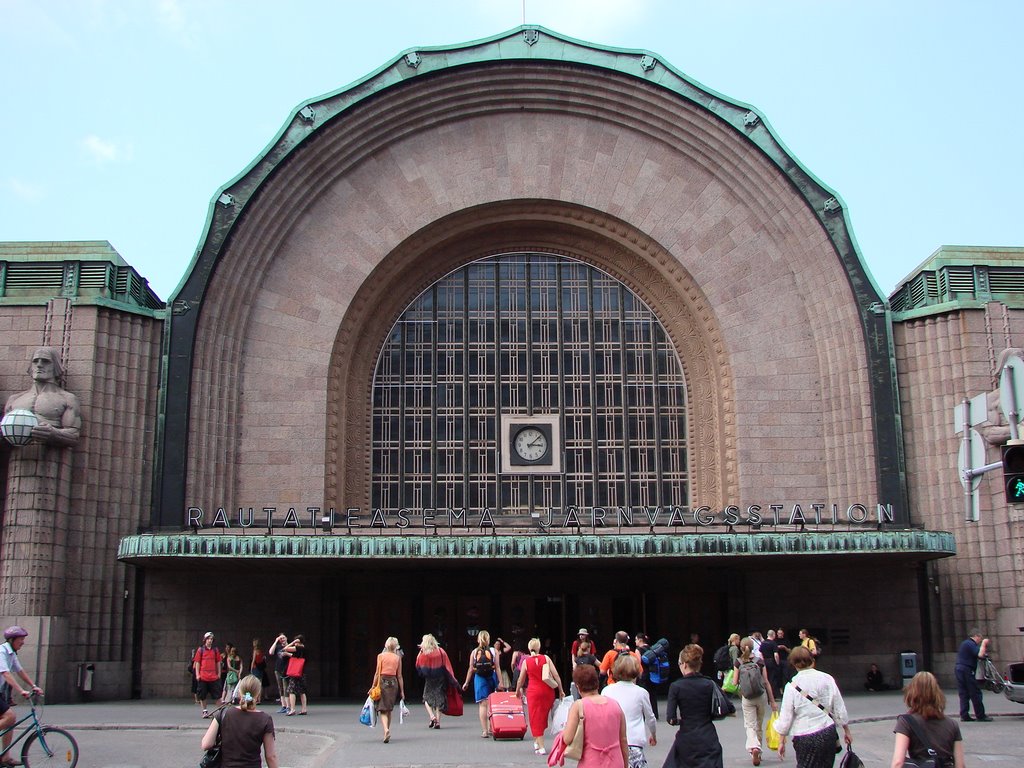 Next it was off to the Helsinki Train station to see where we would pick up our tickets for Russia, but also to look at the architecture. It was designed by another famous Finnish architect, Eliel Saarinen, whose home we visited the following Friday. He later moved to Michigan.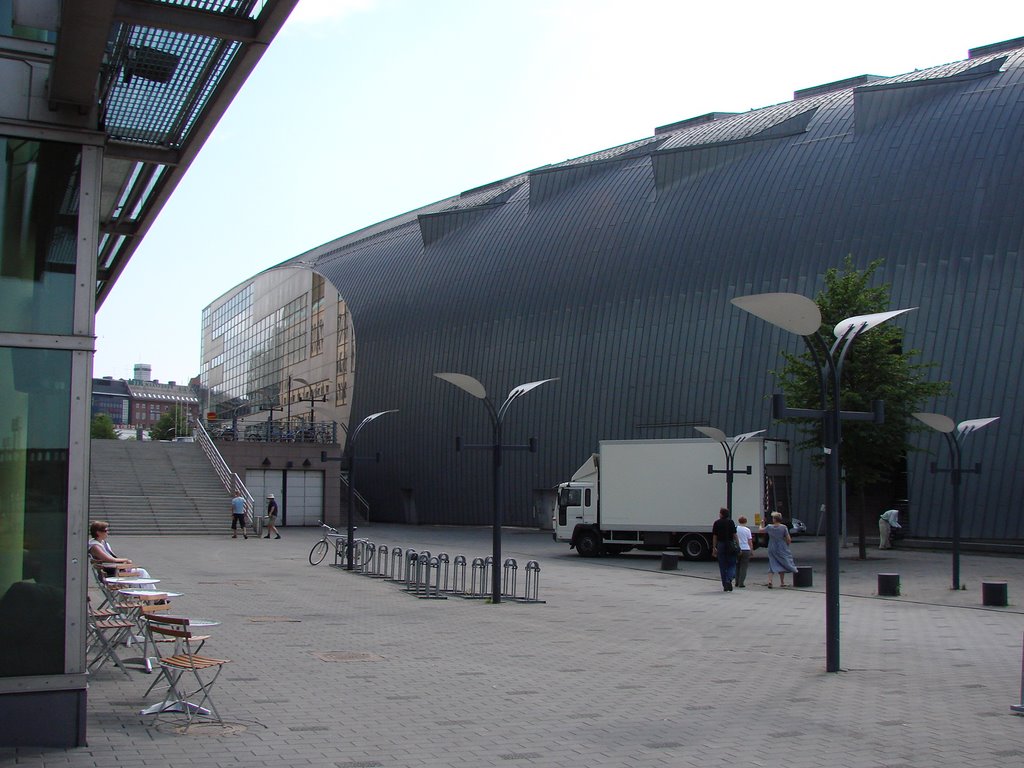
We looked at the Stephen Holl designed Museum of Contemporary Art, but it was closed on Monday. This is probably not the best view--sort looks like a downed blimp here.
View pt. 1 here.
Finland
Helsinki
Finnish architecture
2686 Trip Tales: Finland and Russia Compared
The border between Finland and Russia is like snapping a plumb line--neat and tidy as a post card on the west and trashy on the east. And it only gets worse as you move further east, because the USSR took that border area from Finland after WWII. We took the Sibelius train from Helsinki to St. Petersburg, a 5 hour trip, with a one hour stop in Vyborg ((Russian: Выборг; Finnish: Viipuri; Swedish: Viborg; German: Wiburg) while the Russians in smart green and white uniforms took our passports and reviewed them. This is the area that caused Finland and Germany to be on the same side during WWII--the Finnish people had all been removed by the Soviets, and they were fighting to get it back. After the fall of the USSR, many Russian Finns were "repatriated" and invited to live in Finland, but many of the younger ones are "russified," and don't speak Finnish or Swedish, and the older Finns still harbor hatred for the Russians.We couldn't get a good photo of Vyborg, the old part of the city being some distance from the train station. But it is very old, and at one time was quite populous.
Finland is awesome--it's called "tiny," but only in population. It's really large and quite empty. Lakes and trees everywhere. Global warming--a few thousands years ago the glaciers melted--left lots of boulders. It lost 20% of its land area to USSR and has so overpowered its former enemy in every area that counts that it is stunning to see. Perhaps no better lesson of the failure of Communism than stepping from Finland into Russia.
Even so, I think the press is biased and negative here in the U.S., but it's nothing like the English language press in Europe. At least here, you might get a column by Medved or Sowell. Europeans and ex-pats never ever get another viewpoint. They are still hostages of the left in that area.
For American liberals who yearn for the good old days of "containment" as a meaningful foreign policy (as opposed to Bush's regime change) put in place by FDR and Truman, it would be good to remember the millions and millions of east Europeans and Finns who lived out their lives in Siberia. That policy didn't work so good for them.
Finland
Helsinki
USSR
Vyborg
2685 Trip Tale: The flag exchange
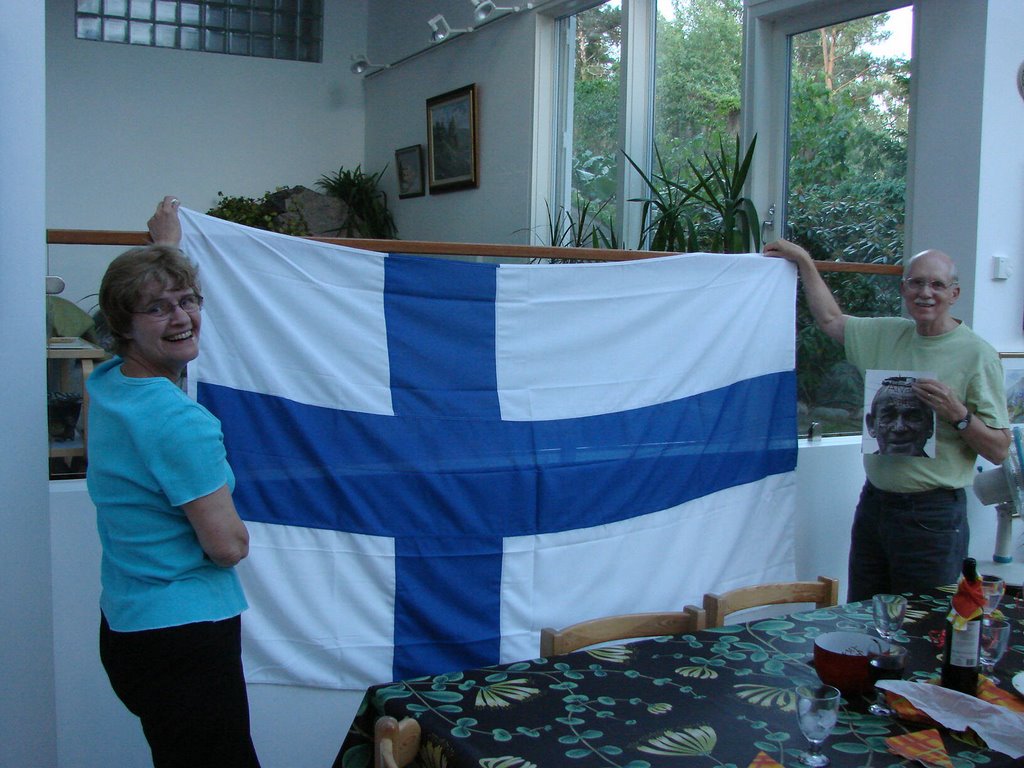
When Martti and Riitta, our hosts in Finland, left the USA in 1981, we had a going-away party for them with friends from our Lutheran church, which they also attended. We gave them a large US flag, specially stitched by the local Flag Lady.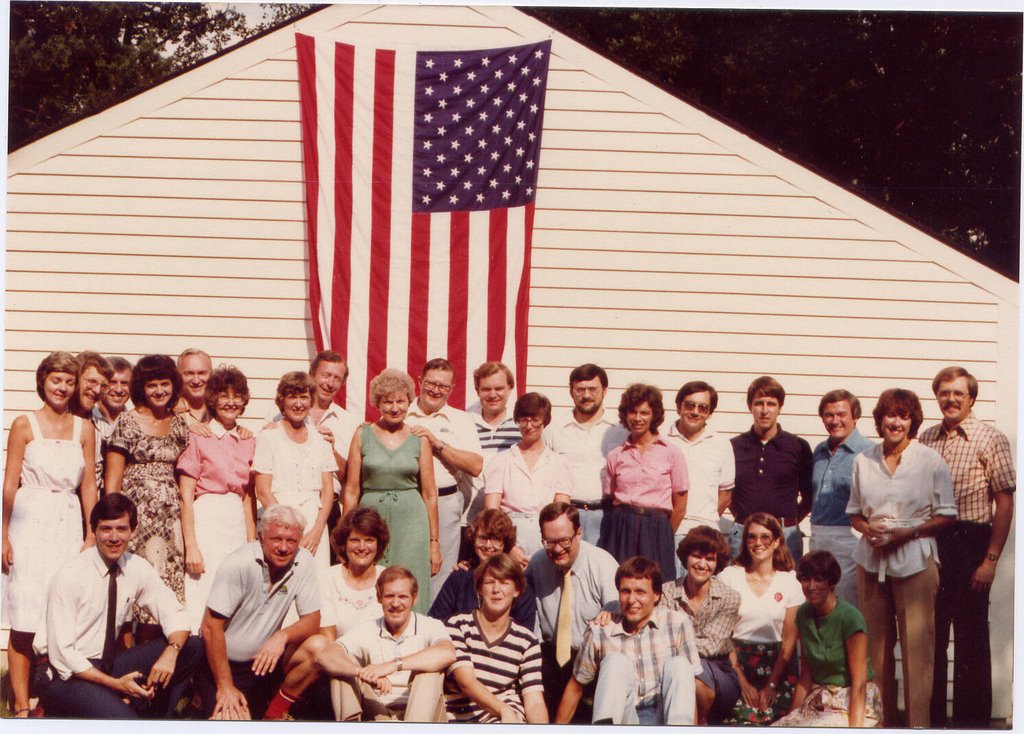
Finland
Helsinki
Finnish flag
Sunday, July 23, 2006
2684 Maybe I should stop more often?
I just checked my stats for this past week when I could't blog. They were better than when I do.Page Views
Total ...................... 117,933
Average per Day ................ 225
Average per Visit .............. 1.4
This Week .................... 1,572
Sigh.
 Visiting the library on Suomenlinna, an island fortress built in the 17th century by the Swedes (who used to control Finland). Now on the UNESCO World Heritage List. It was lost to Russia in 1808.
2683 Trip Tale: Touring Helsinki, pt.1
Our first full day in Helsinki was packed with many local sights and sites. First we stopped at "Fire Island" (don't know its Finnish name) where Martti had designed a housing complex on the former site of the North Korean Embassy. It had a setting to die for--at least in the USA, in central Ohio, where lake sites are at a premium.Then it was on to the Central city, Senate Square, where you'll see all the tour buses stop filled with Russians, Koreans, Japanese, Germans and Italians. I believe it was two weeks ago that the New York Times ran a wonderful article about Helsinki in its travel section. Here we visited the gorgeous Lutheran Cathedral and walked across the street to visit the Helsinki University Library, probably not a stop for most tourists, but I enjoyed it. It is high-tech and high-touch, with computer terminals, digitized collections, and also wonderful old books.
 Tuomiokirkko (The Lutheran Cathedral), Helsinki, exterior
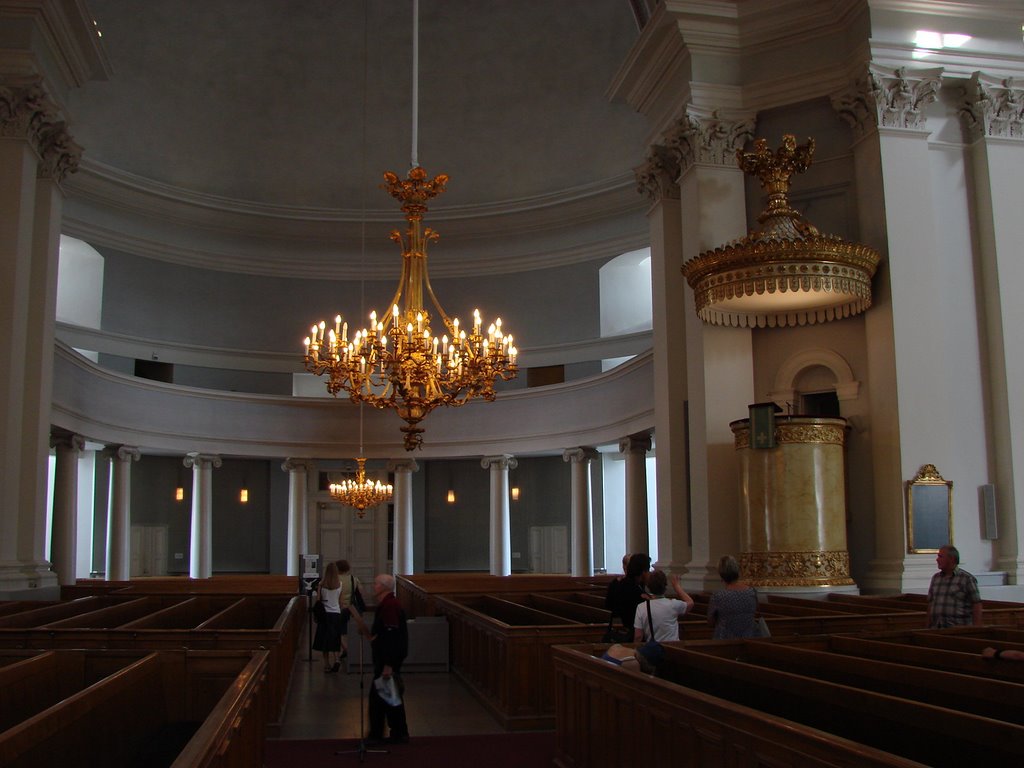 Cathedral, Helsinki, interior. There was no "night" while we were there, but this photographer caught a good night shot.
 Inside the Helsinki University Library, or National Library of Finland. Read about digitizing the "national memory" here.
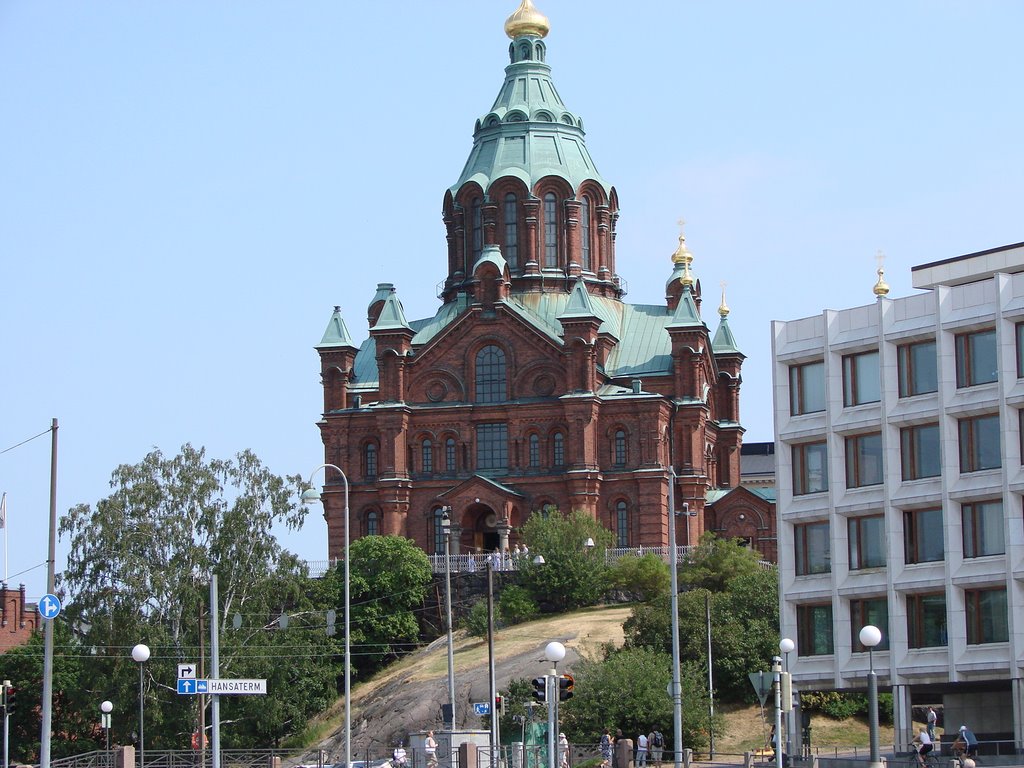 Then we walked along Esplanadi Boulevard through Kauppatori, Market Square (looking at the interesting merchants' offerings and climbed the hill to Uspenski Cathedral (Finnish Orthodox).
Finland
Helsinki
Finnish architecture
2682 Trip Tale: Our hosts
Twenty five years ago we promised Martti and Riitta that we would visit them in 1985 for our 25th wedding anniversary. We were a bit late by visiting in July 2006, but that only sweetened it. We had become acquainted in the late 1970s when Riitta was getting her PhD in equine orthopedics (horse bones) at Ohio State, and her husband Martti, who didn't have a work visa but was studying architecture, volunteered at my husband's firm. They also became active in our Lutheran church and made many friends there. She is now a successful surgeon and department chair, and his home, residential, and commercial designs in Finland are some of the best I've ever seen in the 40+ years I've been following my husband around.How delightful to visit them now with three grown children, the oldest also planning to be an architect, and see our hosts well-established and successful in their careers. If we had come earlier, we would have missed a lot--such as the family home which Martti has redesigned and completed in the last two years after the death of his parents (his father designed and built the original house in the early 1960s). Knowing friends' children is great, but meeting them as adults is even better in some ways, because they will be adults much longer than they were children (and they can help you with tour planning, rubles exchanges, and language). So, I think it is best that we visited in 2006 (when they were having a terrific, but warm, summer) rather than in the 1980s or 1990s.
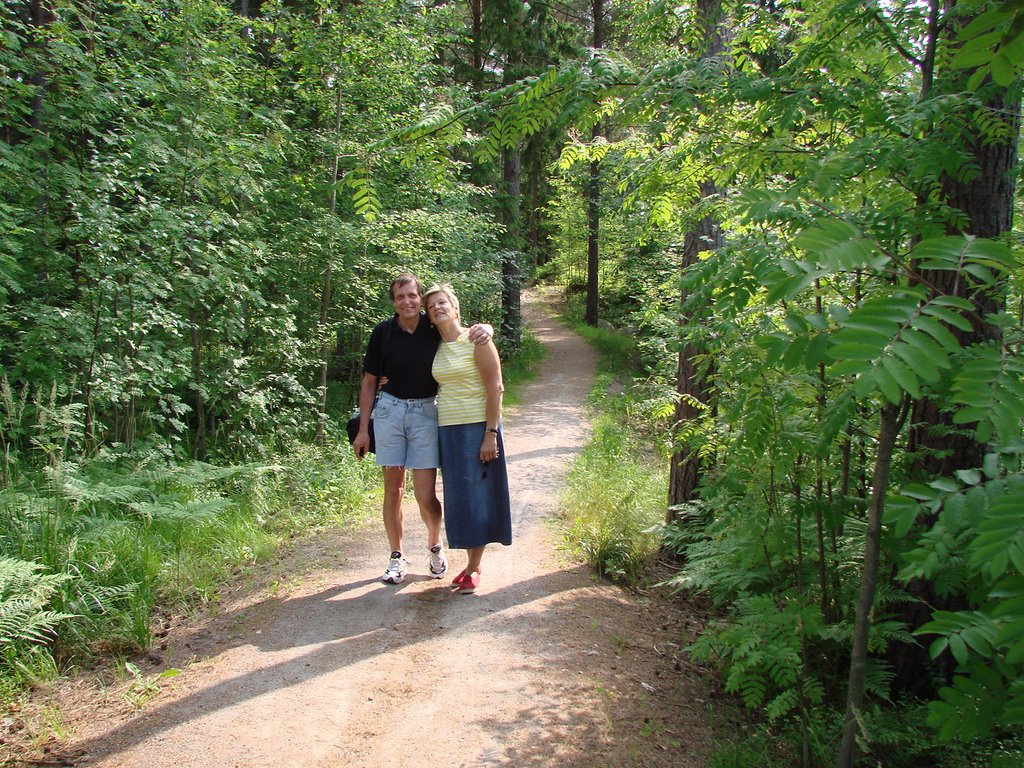 Here they are walking through the small forest with us near their house, down to a public beach. They live on the island outside Helskinki proper where they grew up. One of the streets in their area has four homes designed by Martti.
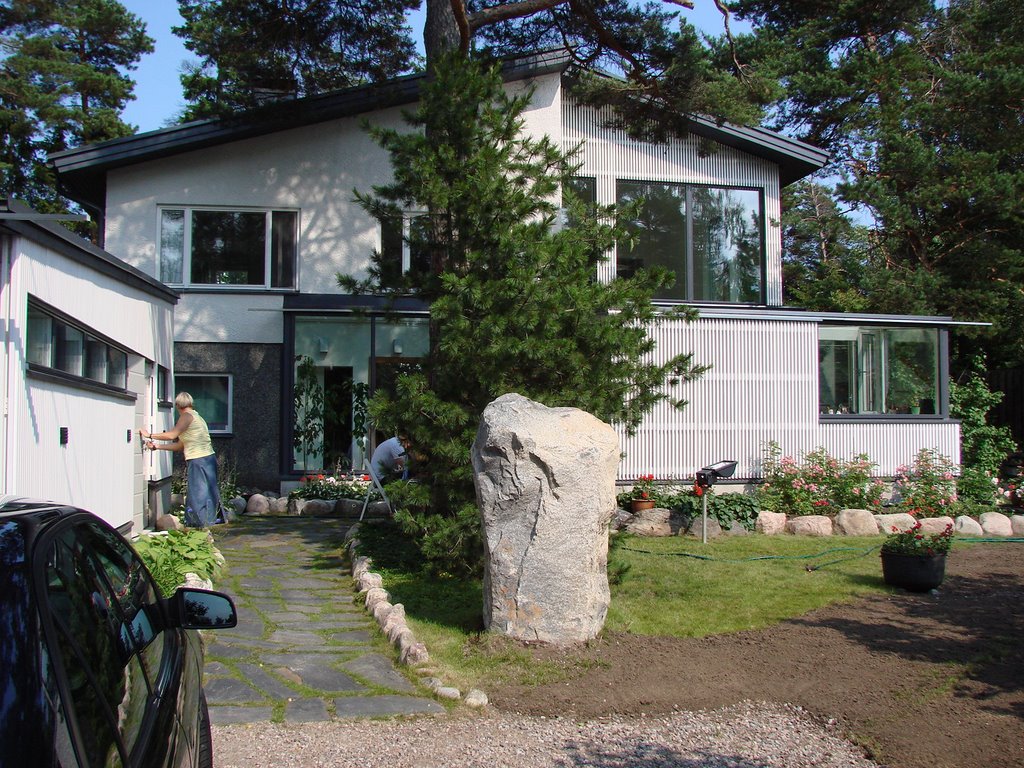 The main house in which they live was originally a two level on a steep hill and Martti redesigned it, incorporating the large boulder on which it sat into the new living room wall. The house now has four levels. Finland has long summer days (didn't really get dark while we were there), but very short days in winter, so the house has a lot of glass to take advantage of the sun when it is available.
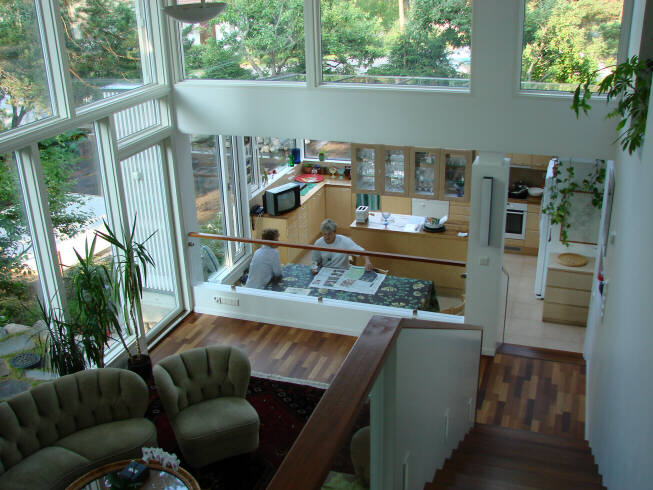 This photo is from the master bedroom level, looking over the living room into the kitchen where Riitta and I are at the table. You can see that much of the living room is glass, as is the kitchen ceiling. The period furniture of Martti's parents was reupholstered for use in the new living room. The white walls and wood cabinetry and floors set off a riot of color in flowers and plants.
Brief comments during the time we were in Helsinki when I could use a computer, here, here, and here.
Other entries I wrote about the Helsinki, Finland area
The flag exchange
Finland and Russia compared
Helsinki, pt. 1
Helsinki, pt. 2
Illiterate in Finland
The new veterinary hospital
Suomenlinna, a fortress
Saarinens' summer home
Technorati Tags:
Finland
Helsinki
Finnish architecture
Monday Memories
Sunday, July 16, 2006
2681 Back from the lake via Parvoo
We Christians believe we will have a resurrected body someday, and I think God has planned for us to exist someplace like the Southern Karelian forest in Finland. I've never seen such a lovely place--the pine and birch brush the heavens, the water is crystal clear, and our host designed and built a fabulous cottage and separate sauna house. Indoor plumbing would have made it perfect, but even that was nicely designed. I have much to blog about when I get home, and I'll select a few of the hundreds of photos my husband has been taking. I even have one of me in the only 1950s full coverage swim suit still on the racks.We came back via Parvoo, the second oldest city in Finland with wonderful old wooden buildings. For you anti-Walmart folks, yes, they bulldoze forests here too for shopping centers. There are fabulous shopping malls, some with consumer items I've never seen or knew I needed!
Tomorrow we're off to St. Petersburg, Russia. I understand that my buddy George is there.
Thursday, July 13, 2006
2680 Today we're off to the countryside
Our hosts have a summer cottage about 2 hours north of Helsinki on a lake and that is where we go today. Yesterday we were in Tallinn Estonia. This country has only had its freedom from the Soviets for 15 years, but the economy seems to be booming. Those of my readers (and you know who you are) who are closet marxists are just blind I suppose. It is wonderful see a country that had been so beaten down as Estonia was just bloom from the ashes of Communism. We had a little extra time and toured a small museum dedicated to the Soviet years.On Tuesday we toured probably the finest veterinary hospital in the world--until the next one is built because they all build on the shoulders of the one before in technology. But not all vet hospitals have a sauna for their staff! We're also having some fine architectural tours since that is our husbands' interests.
Not much computer time, so this may be it for the trip. Our tickets to St. Petersburg are causing a bit of a problem. Hope we make it! Goodness, I heard so much Russian being spoken in Tallinn.
Sunday, July 09, 2006
2679 We're here in Finland
We arrived about noon Sunday. I didn't sleep on the plane so I'm about to crash. We are enjoying our Finnish friends wonderful hospitality and plan to do some interesting sight seeing this week. We've met all 3 kids, and her mother, and toured the house Martti recently renovated. The guys are both architects, so that's seems to be keeping them busy and we've walked through a lovely forest over to a street where Martti has some homes. I've never seen so many lakes in my life!Probably won't be doing much blogging--the keyboard is different. No MM or TT this week. Just hoping I can find some coffee in the morning.
Saturday, July 08, 2006
Interrogating the historical literature
Chapter 11 can be a form of bankruptcy, but it is also an interesting chapter in "Companion to American Immigration" (Blackwell, 2006), my summer reading. I must leave it at home as we fly off to Finland and Russia. Read the whole entry at Illegals Now.Jeffrey Melnick, author of Chapter 11
begins with the obligatory "mythic images," of American immigration, all inaccurate according to Melnick, but they only get a brief paragraph. He quickly moves on to genocide, mass enslavement, annexation, violence, and pernicious cultural works that destroy everyone they touch. He is a master at "interrogating the historical literature." That's where you take every historical monograph written before 1960 (but ignore original sources), tie them to a chair in the faculty lounge and torture them until they spill their guts about how awful the United States is, was, and forever will be. It's like the torture and interrogation (called deconstructionism) the feminists perpetrate on novels of the 19th century, only more violent. You make the literature say things it would never even whisper if it weren't bound and beaten by faculty seeking tenure at any cost.
Subscribe to:
Comments (Atom)


 Posts
Posts


