Showing posts with label new word. Show all posts
Showing posts with label new word. Show all posts
Wednesday, November 26, 2025
Word of the year is Parasocial
BBC – “Parasocial” is the Cambridge Dictionary’s Word of the Year, defined as a relationship felt by someone between themselves and a famous person they do not know. Its examples include the parasocial interest displayed by fans when singer Taylor Swift and American footballer Travis Kelce announced their engagement. The term dates back to 1956, when American sociologists observed TV viewers engaging in “para-social” relationships with on-screen personalities. Chief editor Colin McIntosh said it had recently been used to describe “a type of relationship, between a person and a non-person, for example a celebrity”. “It was originally coined as an academic word and was confined to the academic sphere for quite a long time,” he added. “It’s only fairly recently that it’s made a shift into popular language and it’s one of those words that have been influenced by social media.” The Cambridge Dictionary said its word of the year is “parasocial” – beSpacific


Friday, December 01, 2023
Today's New Word--casque
1: a piece of armor for the head : HELMET
2: an anatomical structure (such as the horny outgrowth on the head of a cassowary) suggestive of a helmet
2: an anatomical structure (such as the horny outgrowth on the head of a cassowary) suggestive of a helmet
Our bird calendar provided us with a very strange one; Oriental Pied-Hornbill (Anthracoceros albirostris). It looks strange to us, but the females seem to like it.

A close look at an Oriental Pied Hornbill - Bird Ecology Study Group (besgroup.org)
The 13 Hornbills of Indonesia (rekoforest.org)

Monday, December 21, 2020
Gelid—will probably not use this
The Merriam-Webster word of the day is Gelid. Never heard of it, and after reading the explanation, I doubt I would ever use it since I’ve gone 80 years without it.
“Gelid first appeared in English late in the 16th century, coming to our language from Latin gelidus, which ultimately derives from the noun gelu, meaning "frost" or "cold." (The noun gelatin, which can refer to an edible jelly that undergoes a cooling process as part of its formation, comes from a related Latin word: gelare, meaning "to freeze.") Gelid is used to describe anything of extremely cold temperature (as in "the gelid waters of the Arctic Ocean"), but the word can also be used figuratively to describe a person with a cold demeanor (as in "the criminal's gelid stare").
| Examples of GELID |
| "A fleet of military aircraft and navy and merchant ships continue searching the gelid waters north of Antarctica for a Chilean Air Force cargo plane that went missing on Monday evening with 38 people on board." — Pascale Bonnefoy and Austin Ramzy, The New York Times, 11 Dec. 2019 "Back at school, January is gelid. The roads around campus are two inches deep in slush left behind from a New Year's Day snowstorm." — Koren Zailckas, Smashed, 2005 Latin and typing were the most useful classes I ever had in high school. Every job I ever had and all during my retirement (now 20 years) I have appreciated what I learned then. |
Tuesday, August 11, 2020
New words for 2020
What new words or phrases have you learned during the pandemic and the riots? Here's mine:
diaper wrap (mask)
slave muzzles (mask)
Barista Bolsheviks (I assume this is white rioters, but not sure)
Luxury Communism (I think this refers to the rich and privileged ANTIFA crowds subsidized by Soros)
Cancel culture (throw out all history of people or events and replace with communist themes)
Wednesday, March 25, 2020
Jibe and Gibe—what’s the difference?
These seem to be pronounced the same: jybe. Gibe was the MW world of the day for March 25. Makes me think I’ve been occasionally misspelling, but not sure I ever heard the meaning of gibe.
“Confused about jibe and gibe? The distinction actually isn't as clear-cut as some commentators would like it to be. Jibe is used both for the verb meaning "to be in accord" or "agree" (as in "the results do not jibe with those from other studies") and for the nautical verb and noun referring to the act of shifting a sail from one side to the other ("jibe the mainsail," "a risky jibe in heavy seas"). Gibe is used as a verb and noun for derisive teasing or taunting. But jibe is also a recognized variant of gibe, so it too has teasing or taunting uses. Gibe has been used occasionally as a variant of jibe, but the use is not common enough to warrant dictionary entry, and is widely considered an error.”
Monday, January 20, 2020
Intercalate, new word
I haven’t found many new words lately, but here’s one—I knew the concept but didn’t have a word for it.
“Intercalate was formed from the Latin prefix inter-, meaning "between" or "among," and the Latin verb calāre, meaning "to proclaim" or "to announce." It was originally associated with proclaiming the addition of a day or month in a calendar. An instance of intercalation occurred in the earliest versions of the Roman calendar, which originally consisted of 304 days and 10 months and was determined by the lunar cycle (the remaining 61.25 days of winter were apparently ignored). According to some Roman legends, it was Numa Pompilius, the second king of Rome, who intercalated the months January and February. Eventually, the word's use broadened to include other instances of introducing new elements or layers into a preexisting system.”
|
Friday, December 27, 2019
Punctilio, today’s new word
Usually, the M-W Word of the day is familiar to me, so I don’t spend a lot of time on it, but this one I don’t recall using or even seeing. Punctilious, yes, and according to the explanation, they come from the same Latin root, pungere.
Definition:
1. a minute detail of conduct in a ceremony or in observance of a code;
2. careful observance of forms (as in social conduct)
“We'll get straight to the point: there are a number of English words that come from Latin pungere, meaning "to prick" or "to sting." Punctilio is one of these words. It traces back to pungere by way of Italian puntiglio (meaning "small point," "point of honor," or "scruple"), Spanish puntillo (the diminutive of punto, meaning "point"), and Latin punctum (also meaning "point"). The adjective punctilious, meaning "marked by or concerned about precise accordance with the details of codes or conventions," is a close relative of punctilio. Do you have any guesses for other pungere derivatives? Punctuate, puncture, compunction, punctual, and pungent are some of the more common ones.”
Definition:
1. a minute detail of conduct in a ceremony or in observance of a code;
2. careful observance of forms (as in social conduct)
“We'll get straight to the point: there are a number of English words that come from Latin pungere, meaning "to prick" or "to sting." Punctilio is one of these words. It traces back to pungere by way of Italian puntiglio (meaning "small point," "point of honor," or "scruple"), Spanish puntillo (the diminutive of punto, meaning "point"), and Latin punctum (also meaning "point"). The adjective punctilious, meaning "marked by or concerned about precise accordance with the details of codes or conventions," is a close relative of punctilio. Do you have any guesses for other pungere derivatives? Punctuate, puncture, compunction, punctual, and pungent are some of the more common ones.”
Friday, July 05, 2019
What’s is an inkhorn?
I might be ostentatious, but I'm not an "inkhorn." I prefer plain English. In fact, I'd never heard the word inkhorn used this way.
"Picture an ancient scribe, pen in hand, a small ink bottle made from an animal's horn strapped to his belt, ready to record the great events of history. In 14th-century England, such ink bottles were dubbed (not surprisingly) inkhorns. During the Renaissance, learned writers often borrowed words from Latin and Greek, eschewing vulgar English alternatives. But in the 16th century, some scholars argued for the use of native terms over Latinate forms, and a lively intellectual debate over the merits of each began. Those who favored English branded what they considered ostentatious Latinisms "inkhorn terms" after the bottles carried by scholars, and since then we have used inkhorn as an adjective for Latinate or pretentious language." Merriam Webster Word of the Day.
Anglo-Saxon, the language of the Germanic barbarians who invaded the British Isles, was useful for swearing, cursing, naming common things like animals, counting money and time, but for just about everything else, Latin and French words needed to be imported by the Normans (originally were Vikings) when they invaded Britain in the 11th century (which is also the origin of both my maiden and married names). I also don't do a lot of swearing and cursing. In fact, none.
As of January 1, 2019, there were (estimated) 1,052,010.5 words in the English language. (Global Language Monitor) Shakespeare invented about 1700 words, and the KJV Bible changed the language forever. Today the internet accounts for many changes like OMG and BFF.
Thursday, May 09, 2019
Merriam Webster new word Stratagem
1. a. an artifice or trick in war for deceiving and outwitting the enemy
b. a cleverly contrived trick or scheme for gaining an end
2 . skill in ruses or trickery
Stratagem is not a “new” word in my vocabulary exactly, but I doubt I use it much. Strategy, yes, I do use that. But with the deception going on in Congress, it might be more useful. Investigating Americans because they don’t like them and having no crime to punish seems like a poor stratagem on which to build a campaign.
“A stratagem is any clever scheme—sometimes one that's part of an overall strategy (i.e., a carefully worked out plan of action). The word stratagem entered English in the 15th century and was originally used in reference to some artifice, such as a military plan or maneuver, which was designed to deceive or outwit the enemy. This military sense can be traced back to the word's Greek ancestor stratēgēma, which is itself based on stratēgein, meaning "to act as a general." Stratēgein, in turn, comes from stratēgos (meaning "general"), which comes from stratos ("camp" or "army") and agein ("to lead"). Stratēgos is an ancestor of strategy as well.”
Sunday, April 28, 2019
Our language is always changing
640 new words were added in April to the Merriam-Webster dictionary. I've been saying one of them incorrectly: I say, "to-go cup" when I’m at Panera’s with my friend Adrienne, and apparently the approved, in the dictionary term is "go-cup."
My senior class high school English teacher, Mrs. Price, insisted we buy Merriam-Webster Collegiate dictionaries, and I'm still using that model (I have the 11th, which you can buy for about $30 or download for free, and I got mine for $1 at a used book store), and I have the 2nd International unabridged Merriam Webster (about 25 lbs) for interesting browsing which my grandmother gave my parents for x-mas in the 1950s. One of my cousins probably has their mother’s copy. Grandma was big on giving presents like magazines, books, and art supplies. My mother continued that tradition with her grandchildren. You can never know too many words.
https://www.merriam-webster.com/words-at-play/new-words-in-the-dictionary?
https://collectingmythoughts.blogspot.com/2008/11/friday-family-photo-its-dictionary.html
Saturday, December 08, 2018
Latinx and other made up words
More phony words from leftists. ". . . Latinx Pop Culture class take us on a journey into his co-curated exhibit, Tales from La Vida: Latinx Comics, at the Billy Ireland Cartoon Library and Museum at Ohio State." (announcement from Ohio State University)
Wikipedia: “Latinx is a gender neutral term sometimes used in lieu of Latino or Latina. The -x replaces the standard o/a ending in Spanish and Portuguese forming nouns of the masculine and feminine genders, respectively. The term is a political neologism that has gained traction among advocacy groups combining racial and gender identity politics.”
The Census Bureau made up the words Latina and Latino and Hispanic to reflect the ethnicity/heritage of someone from Mexico, Central America, South America (except Brazil) and some of the islands (not those with French or Dutch colonial history), but not Spain the nation. When the Left decided gender, a grammar term, was actually biological bad science, that got messy. Spanish is a language with gender sensitive nouns and adjectives so the mighty American Left which speaks English, a Germanic language, has decided gender in fake Spanish needs to go.
“In 2015, over 9,000 Latinx people were diagnosed, and nearly 80% of these were among MSM. The CDC has estimated that if such rates persist, one in four Latinx gay and bisexual men will have HIV in their lifetimes.” (Resource Center for Latinos)
Friday, March 10, 2017
Today's new word--Metabolomics
Metabolomics is the large-scale study of small molecules,
commonly known as metabolites, within cells, biofluids, tissues or
organisms. Collectively, these small molecules and their interactions
within a biological system are known as the metabolome. https://www.ebi.ac.uk/training/online/course/introduction-metabolomics/what-metabolomics There is a whole course at free at Creative Commons on this subject, which I looked up because it came up in an article about blood pressure and potatoes at World's Healthiest Foods.
"One medium potato (5.3 ounces or about 1 cup) contains almost 30 milligrams of vitamin C, which is half of what you need in a day. It has more potassium (620 milligrams) than a medium banana. We should get about 4,700 milligrams of potassium each day to protect our heart, keep our blood pressure in a good range and ensure that our muscles don’t cramp and our nerves send the right messages. Only about 1 percent of Americans meet their potassium needs.
The potato is a good source of vitamin B6, meeting almost one-third of our daily needs. This vitamin is needed to utilize protein and carbohydrates in our diet as well as to manufacture most protein-related compounds, such as hormones, in our body. A fresh potato is low in sodium, fat-free and gluten-free.
The sweet potato is promoted as much healthier than the potato. The USDA Food Database shows the sweet potato is slightly higher in calories, carbohydrates, fiber, natural sugars, calcium and vitamin A. Vitamin A is the biggest nutritional difference from the regular potato. But the regular potato is lower in carbohydrates and higher in protein, iron, potassium, vitamin C, niacin, vitamin B6 and folate. Yes, the sweet potato is healthy and so is the potato." http://www.duluthnewstribune.com/features/3776076-nutrition-humble-potato-nutrition-powerhouse
"UK scientists at the Institute for Food Research have identified blood pressure-lowering compounds called kukoamines in potatoes. Previously only found in Lycium chinense, an exotic herbal plant whose bark is used to make an infusion in Chinese herbal medicine, kukoamines were found in potatoes using a new type of research called metabolomics.
Until now, when analyzing a plant's composition, scientists had to know what they were seeking and could typically look for 30 or so known compounds. Now, metabolomic techniques enable researchers to find the unexpected by analyzing the 100s or even 1000s of small molecules produced by an organism.""Do potatoes have a potential for helping lower blood pressure," World's Healthiest FoodsA powerhouse of nutrition:
"One medium potato (5.3 ounces or about 1 cup) contains almost 30 milligrams of vitamin C, which is half of what you need in a day. It has more potassium (620 milligrams) than a medium banana. We should get about 4,700 milligrams of potassium each day to protect our heart, keep our blood pressure in a good range and ensure that our muscles don’t cramp and our nerves send the right messages. Only about 1 percent of Americans meet their potassium needs.
The potato is a good source of vitamin B6, meeting almost one-third of our daily needs. This vitamin is needed to utilize protein and carbohydrates in our diet as well as to manufacture most protein-related compounds, such as hormones, in our body. A fresh potato is low in sodium, fat-free and gluten-free.
The sweet potato is promoted as much healthier than the potato. The USDA Food Database shows the sweet potato is slightly higher in calories, carbohydrates, fiber, natural sugars, calcium and vitamin A. Vitamin A is the biggest nutritional difference from the regular potato. But the regular potato is lower in carbohydrates and higher in protein, iron, potassium, vitamin C, niacin, vitamin B6 and folate. Yes, the sweet potato is healthy and so is the potato." http://www.duluthnewstribune.com/features/3776076-nutrition-humble-potato-nutrition-powerhouse
Tuesday, February 14, 2017
Today's new word: pathbreaking
I like to blog about "new words." They are only new to me. When I go back and review those posts, I see I never use them as delightful and interesting as they are and have to relearn the meanings. But today I came across the term "path-breaking" in an article lauding the contribution of an OSU couple in astronomy--$2.8 million. It sounded awkward, so I looked it up, and found it was being used in 1913 in the title of a book about woman's suffrage on the west coast. So I downloaded and started to read it. That's why it's so dangerous to wander around the internet. I have so many books in my TBR pile I don't need to be downloading anything . . .
Saturday, May 14, 2016
Today's New Word--Leonine Sacramentary
"The oldest of the Latin sacramentaries or liturgical books. It was erroneously attributed to Pope Leo I and was in use from the fourth to the seventh centuries. It contains neither canons nor the Ordinary of the Mass, but many propers, collects, prefaces, secrets, postcommunions, and orations, together with ordination forms. Many of these prayers are still in use today." https://www.catholicculture.org/culture/library/dictionary/index.cfm?id=34561
"The popular, though incorrect name for the earliest surviving collection of Roman Mass formularies and ordination prayers that scholars have called the Sacramentary of Verona (Sacramentarium Veronense ). The name "Leonine Sacramentary" is misleading, since it is neither a sacramentary, nor was it composed by Pope Leo I. More accurately, it is a compilation of individual libelli missarum in a single manuscript. It is a unicum, i.e., it exists in a single MS, Codex LXXXV (80) of the Chapter Library at Verona. E. A. Lowe dates it, on palaeographical grounds, as written in the first quarter of the 7th century. J. Bianchini published it in 1735, in v.4 of his Anastasius Bibliothecarius, under the title Sacramentarium Leonianum. In 1748 L. A. Muratori reedited it under the same title, but in 1754 J. A. Assemani, who gave it the title Sacramentarium Veronense, vulgo Leonianum, edited it again. In 1896 C. L. Feltoe published a handy, but inaccurate, edition, with the old title. The most recent edition is that of K. Mohlberg, who has rightly again called it Sacramentarium Veronense (Rome 1956). …" http://www.encyclopedia.com/article-1G2-3407706637/leonine-sacramentary.html
I came across this term in reading something from the Prayer Book Society, which "exists to promote Anglican belief and worship as expressed in the Common Prayer tradition and Anglican formularies since the first Book of Common Prayer of 1549 in the Church of England, on through the 1928 Prayer Book down to the present day." http://www.pbsusa.org/
"The popular, though incorrect name for the earliest surviving collection of Roman Mass formularies and ordination prayers that scholars have called the Sacramentary of Verona (Sacramentarium Veronense ). The name "Leonine Sacramentary" is misleading, since it is neither a sacramentary, nor was it composed by Pope Leo I. More accurately, it is a compilation of individual libelli missarum in a single manuscript. It is a unicum, i.e., it exists in a single MS, Codex LXXXV (80) of the Chapter Library at Verona. E. A. Lowe dates it, on palaeographical grounds, as written in the first quarter of the 7th century. J. Bianchini published it in 1735, in v.4 of his Anastasius Bibliothecarius, under the title Sacramentarium Leonianum. In 1748 L. A. Muratori reedited it under the same title, but in 1754 J. A. Assemani, who gave it the title Sacramentarium Veronense, vulgo Leonianum, edited it again. In 1896 C. L. Feltoe published a handy, but inaccurate, edition, with the old title. The most recent edition is that of K. Mohlberg, who has rightly again called it Sacramentarium Veronense (Rome 1956). …" http://www.encyclopedia.com/article-1G2-3407706637/leonine-sacramentary.html
I came across this term in reading something from the Prayer Book Society, which "exists to promote Anglican belief and worship as expressed in the Common Prayer tradition and Anglican formularies since the first Book of Common Prayer of 1549 in the Church of England, on through the 1928 Prayer Book down to the present day." http://www.pbsusa.org/
Thursday, March 10, 2016
Todays new words--pericopes and icipits
I knew what the Lectionary is, sections of scripture read in church or privately in a systematic or topical way so that all the Bible is covered in 3 years. One of the 3 synoptic gospels is featured, and John is interspersed. It is an ecumenical effort, at least for Protestants. It's not unusual for our church, UALC to wander off the path and have a sermon series unrelated to the Lectionary. However, I was unfamiliar with how the Lectionary is in turn divided.
"Individual readings in the Lectionary are called pericopes, from a Greek word meaning a "section" or "cutting." Because the Mass readings are only portions of a book or chapter, introductory phrases, called incipits, are often added to begin the Lectionary reading, for example, "In those days," "Jesus said to his disciples," etc." USCCB
Wednesday, March 09, 2016
Today's New Word--Apostle
We--at least I--think we know what an apostle is, at least in the Christian meaning. But do we really? It's not the same as a disciple--one of the 12, otherwise Paul couldn't be an apostle.
"By combining material from various texts, scholars conclude that an apostle was one who had seen the risen Jesus and who had a personal commission from Jesus to proclaim the gospel. The number who could claim the title is not determined, but that the title was important is clear from Paul's insistence on his right to be called an apostle. If there are any officers of the Church in the New Testament, they are apostles. . .
The Greek word, apostolos, from which our English word "apostle" comes, means in classical Greek literature a naval expedition and, in later literature, a delegate or a messenger. There is no parallel in Greek to the religious use of the word; but in Judaism the corresponding Aramaic word was a title given to men sent from Jerusalem to Jewish communities abroad. This may have influenced the Christian use of the word." John L. McKenzie, Authority in the church, Sheed and Ward, 1966.
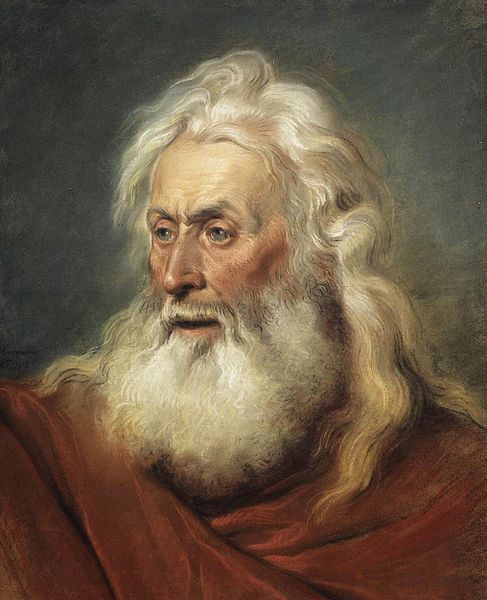 | |
| Head of an apostle by Jean-Michel Moreau, public domain |
Monday, March 07, 2016
Today's new word--verisimilitude and book club selection
Definition: In a literary work, verisimilitude is likeness to the truth i.e.
resemblance of a fictitious work to a real event even if it is a
far-fetched one.
I heard this word used in a Ted Talk I was watching by Laura Bates, author of Shakespeare saved my life; ten years in solitary with the bard, the book our Book Club will be discussing today. However, she showed a brief video of Larry Newton, featured in her book, speaking about Shakespeare's impact on his life, and he used the word, verisimilitude. I thought that if a guy whose last full day in school was somewhere around mid-elementary, and he could use the word, perhaps I should use it, or at least know how.
https://www.youtube.com/watch?v=lahX4dq8OAE
http://www.npr.org/2013/04/22/178411754/teaching-shakespeare-in-a-maximum-security-prison

I heard this word used in a Ted Talk I was watching by Laura Bates, author of Shakespeare saved my life; ten years in solitary with the bard, the book our Book Club will be discussing today. However, she showed a brief video of Larry Newton, featured in her book, speaking about Shakespeare's impact on his life, and he used the word, verisimilitude. I thought that if a guy whose last full day in school was somewhere around mid-elementary, and he could use the word, perhaps I should use it, or at least know how.
https://www.youtube.com/watch?v=lahX4dq8OAE
http://www.npr.org/2013/04/22/178411754/teaching-shakespeare-in-a-maximum-security-prison
"A literary agent contacted Bates after seeing an MSNBC broadcast on the Shakespeare program. She told Bates, "There's a book here. You need to write this book." Bates turned to her hundreds of recorded hours with Newton and to her memories and notes from teaching the inmates and began to write.
Reviews by Booklist and Kirkus have praised the book. The reviewer at Booklist called it, "A powerful testament to how Shakespeare continues to speak to contemporary readers in all sorts of circumstances." The Kirkus review described it as "An eye-opening study reiterating the perennial power of books, self discipline and the Bard of Avon."
Bates worked with about 200 prisoners in segregation at Wabash Valley during the program. She examined the records of 20 who spent the most time studying Shakespeare. Before Shakespeare, the men had more than 600 write ups, with most of those falling into the Class A felony and violent felony categories. After studying Shakespeare, Bates examined the inmates' records for a similar number of years and found only two violations for cell phone possession."
https://www2.indstate.edu/news/news.php?newsid=3505
Sunday, March 06, 2016
Today's new word--SACERDOTAL
I came across sacerdotal in one of the letters of the church fathers, I think it was Irenaeus. This is another word I've seen many times, was sort of confused about the meaning and had no idea how to pronounce because in English, the C has no sound of its own--it is either an S sound or a K sound. So yes, it is the S--as in sassy. So just picture this as Saserdotal, and you've got it. And the root is in so many words.
From the Merriam Webster web site: "Sacerdotal is one of a host of English words derived from the Latin adjective sacer, meaning "sacred." Other words derived from "sacer" include "desecrate," "sacrifice," "sacrilege," "consecrate," "sacrament," and even "execrable" (developed from the Latin word exsecrari, meaning "to put under a curse"). One unlikely "sacer" descendant is "sacrum," referring to the series of five vertebrae in the lower back connected to the pelvis. In Latin this bone was called the "os sacrum," or "holy bone," a translation of the Greek hieron osteon."
Thursday, April 09, 2015
Depending on how you count, it’s close to a million

http://www.slate.com/articles/life/the_good_word/2006/04/word_count.html
Global Language Monitor estimates * that—as of this writing—there are exactly 988,968 words in English. GLM has done a remarkable job suckering even the respectable press into believing that we're on the verge of adding the millionth word to English—at which point we'll presumably see another flurry of articles about GLM. Even so, its claim is a bogus one.
Thursday, January 22, 2015

Subscribe to:
Posts (Atom)


 Posts
Posts


