Wednesday, March 18, 2009

If it's Thursday, is this Bethlehem?

    Oh little town of Bethlehem,
    how strange you seem from the bus.
It certainly doesn't look like the Bible stories we heard in church (and in school) or the carols we sang. But we knew it wouldn't. Still, it's a shock. Early tradition says Jesus was born in a cave, although that's not the Biblical account. I think people hid in caves to worship after converting, however. Anyway, another church over another sacred place--Justin Martyr mentions it in the mid-2nd century, as does the Protoevangelium of James (2nd century). Origen notes that the cave of Jesus' birth was pointed out in his day, and that was most likely where the Byzantine church was erected.

That said, we didn't see anything fearful and awful the way some Christian and anti-Israel tourists have reported--at least I didn't. Maybe it looks worse if you walk in. Our Israeli guide had to leave us, and a Palestian guide boarded the bus. Tourism is an essential industry but we saw many small store front and kiosk type businesses. We had a wonderful Palestinian Christian guide who was so informative and kind. He also pointed out to us the area believed to be the fields of the shepherds "keeping watch over their flocks by night." We had a bit of a wait at the guard house to enter the Bethlehem section, but I think that was a paper work snafu, or an irritable employee.


The entrance to the Church of the Nativity is so small, only a child could walk upright--a good message.


A member of our group (bus 5) read the Christmas story from Luke, and we all sang "Silent Night," the prettiest I've ever heard.

I'll do a bit more research when I get back from our Easter travels. Some of our photos from this church are a bit fuzzy, and I may have to borrow some from others on our bus.

Church of the Holy Sepulcher and The House of Caiaphas

The Church of the Holy Sepulcher according to tradition is built on the hill of Christ's crucifixion and the tomb of his burial--although there are disagreements. The other location of the tomb was found in the 19th century, so on strength of tradition, it would be the Church. It was first built in 330 AD, destroyed in 614, rebuilt, destroyed in 1009 and rebuilt by Crusaders. The line to visit the tomb (there's a rotunda over it) was too long, so we didn't stay. (And neither did Jesus, come to think of it.) But we were close! In fact, Israel is so small, you're never far from anything or anyplace even if you're not sure of the location.
    "The Church of the Holy Sepulchre was built by Constantine I the Great during the fourth century, after he became christian, and turned Christianity to the official religion of the Roman empire. In the year 326, Constantine I sent his mother, Helena, to seek the Crucifixion location in Jerusalem. Helena found the place and also found the remains of the cross itself. In that same place, 7 years later, Constantine I founded the Church of the Holy Sepulchre in the year 333." Trekker
The facade is from the crusader era. The architecture and art is a real hodge podge, reflecting the many Christian groups and cultures that have cared for this church. Byzantine, medieval, Crusader, and modern elements mix and each Christian community has decorated its shrines in its own distinctive way.

This is possibly the place of the crucifixion; we waited to be able to touch it.

This is thought to be the stone where Jesus' body was prepared for burial.

After Jerusalem's occupation by the hands of Tslah A-Din in the year of 1187, The Holy Sepulchre Church was given for safe keeping to two Moslem families, the Nusseibeh and the Joudeh families, who own the place today, and currently hold the keys to the church.

Church of St. Peter on the eastern slopes of Mount Zion was erected in 1931 to commemorate Peter's denial of Jesus and his remorse.

Beneath the church are a series of carved-out chambers from the Second Temple period which Catholic tradition says is the site of the palace of Caiaphas, and therefore Jesus may have been imprisoned in one of these caves.
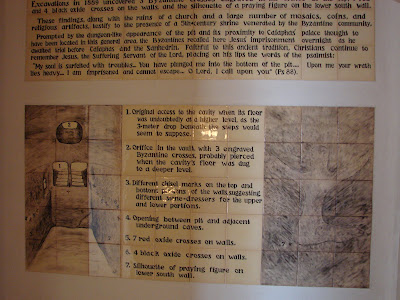
Click to enlarge for the explanation why this is thought to be Caiphas' house where Jesus was imprisoned and where Peter denied his Lord.

According to the Wikipedia site, a Byzantine shrine dedicated to Peter's repentance was erected on this spot in 457 AD, but was destroyed by Muslim invaders in 1010. The chapel was rebuilt by Crusaders in 1102 and given it's present name. After the fall of Jerusalem the church again fell into ruin and was not rebuilt until 1931. Today a golden rooster protrudes prominently from the sanctuary roof in honor of it's biblical connection.

I know that these are not in chronological order; we saw these on Wednesday March 11, scenes of the last hours of Jesus' life, but on Thursday March 12 we traveled to Bethlehem for his birthplace, and also then saw Gethsemene. Others in our tour group (about 170 of us from Upper Arlington Lutheran Church and Annunciation Greek Orthodox Church of Columbus plus friends and relatives) saw these sites in different orders.

St. Anne's church and the Pool of Bethesda

The Church of St. Anne is a 12th-century Crusader church of Romanesque architecture, built between 1131 and 1138, and erected over the traditional site of the birthplace of Anne (Hannah), the mother of Mary. In 1192, Saladin turned the church into a Muslim theological school, which is commemorated in an inscription above the church's entrance. It was restored in the 19th and 20th centuries, but most of what remains today is original.


The church is right next to the Bethesda Pool, believed to be the site where Jesus healed a paralytic (John 5:1-15). There are also ruins of a Roman temple to the god of medicine and remains of a Byzantine church built over the temple.


    Some time later, Jesus went up to Jerusalem for a feast of the Jews. Now there is in Jerusalem near the Sheep Gate a pool, which in Aramaic is called Bethesda and which is surrounded by five covered colonnades. Here a great number of disabled people used to lie--the blind, the lame, the paralyzed. One who was there had been an invalid for thirty-eight years. When Jesus saw him lying there and learned that he had been in this condition for a long time, he asked him, "Do you want to get well?"

    "Sir," the invalid replied, "I have no one to help me into the pool when the water is stirred. While I am trying to get in, someone else goes down ahead of me."

    Then Jesus said to him, "Get up! Pick up your mat and walk." At once the man was cured; he picked up his mat and walked." John 5:1-9

Wednesday, Ashdod and Jerusalem

On Wednesday, March 11 we arrived in Ashdod. Our handout says this Mediterranean port city was a major Philistine city in ancient times, the archeological remains here have uncovered no fewer than 23 cities since the Bronze Age. Modern Ashdod was founded in 1956 and during the recent past it has had many new immigrants--70,000--mainly from the former Soviet Union, swelling the city's population to 190,000, becoming the 5th largest city in Israel. I found the port area very impressive.

From Ashdod we started out for Jerusalem, a 5000 year old city revered by Jews, Christians and Muslims. I'm not sure how many buses we had (we were bus 5), but we had different routes so that we weren't all jammed up in one place. Some of us saw the Western Wall on Wednesday, some on Thursday, same with Bethlehem.


Here we are at the Western Wall (also called Wailing Wall), the holiest of Jewish sites, a remnant of the Herodian retaining wall that once supported the Second Temple destroyed by the Romans in 70 AD. In 1967 after the Six Day War, Israelis leveled the neighboring Arab district to create the Western Wall Plaza and made the wall higher by digging down to expose two more tiers of stones buried over the centuries.

The men and women pray in separate sections (women need to be modestly covered); some sitting and rocking back and forth reciting the Psalms or Lamentations. This photo is of tiny pieces of paper with prayers put into the cracks in the walls. Every years thousands of people insert these prayers for peace and health, or give thanks and praise for answered prayer. If you're in my family, your name was placed there with a prayer for peace.

According to tradition, The Via Dolorosa (Path of Sorrow or "Way of the Cross") is the route the Lord Jesus walked, from his trial by the Romans to his crucifixion and burial. It begins near Lions Gate (St. Stephen's Gate), in the Muslim Quarter, and ends within the Church of the Holy Sepulcher, in the heart of the Christian Quarter. This route is marked by the 14 Stations of the Cross.
    "As they led him away, they seized Simon from Cyrene who was on his way in from the country, and put the cross on him and made him carry it behind Jesus. A large number of people followed him, including women who mourned and wailed for him. Jesus turned and said to them, "Daughters of Jerusalem, do not weep for me; weep for yourselves and for your children. (Luke 23:26-28).


Eighth station of the cross where Jesus spoke to the women.

Capernaum and River Jordon


The city of Capernaum was built on the northern shore of the Sea of Galilee, about two miles west of the Jordan River. This ancient town is not mentioned by name in the Old Testament, but is referred to as our Lord's own city, where it became the center of His Galilean work and ministry. Jesus traveled there from Nazareth, to the borders of Zebulun and Naphtali, and called his first disciples, Andrew, Peter, and the two sons of Zebedee (Matt 4:13-22). He taught in their synagogue (Jn 6:24-59), and it was here that Peter found the coin from the mouth of the fish, upon the command of Jesus, to pay the tax-gatherers (Matt 17:24-27). He resided for a time at Peters house in Capernaum, teaching and healing the sick (Lk 4:31-41). Once He had left, He rebuked the city for their unbelief (Lk 10:15).

Recently there have been excavations that have uncovered the 2-story synagogue. Today, near the synagogue, there is an octagonal Byzantine church with a mosaic floor built upon the site believed to be the house of Peter.

This seems to be the only photo we have that shows "bus five," the group we traveled with up to Cairo. I think we're sitting in the ruins of the synagogue.

Recent excavations beneath the church has revealed houses dating back to the first century. Some believe that one of these houses could very well be the house of Peter.

I'm not sure what I was expecting, after having heard about the River Jordan all my life, but it looks like any little stream in the Midwest. This is the spot where I dipped my hand into the water, made a sign of the cross on my forehead, and prayed. Lutherans don't rebaptize, but many in our group did go into the water and prayed with our pastor. People who do wish to be baptized can rent a gown--not sure if they also rent clergy.

I think this group was Chinese and they were singing beautiful hymns by the water.

It was nearing dusk after a time in the gift shop, so we boarded the bus after a busy day and returned to the ship and the moon over the Sea of Galilee was the prettiest sight I've ever seen--but the bus was moving to fast to get a good photo. When we docked on Wednesday, we were in Ashdod, ready to go to Jerusalem.

Haifa, Sea of Galilee, Mount of Beatitudes

Tuesday was an exciting day--we are in Israel! Haifa is Israel's third largest city (250,000 people, 5 religions) and our gateway to Israel. In Roman times, the country was divided into Judea, Samaria, and Galilee, which comprised the whole northern section of the country, and was the largest of the three regions. Herod Antipas, son of Herod the Great, ruled Galilee as tetrarch. The Galilee area was the home of Jesus during at least 30 years of his life. The first three Gospels of the New Testament are mainly an account of Jesus' public ministry in this province, particularly in the towns of Nazareth and Capernaum. Galilee is also cited as the place where Jesus cured a blind man.


The Sea of Galilee is about 1-1.5 hour drive from Haifa. It was a beautiful spot, and we enjoyed our visit at a kibbutz for lunch.


The Sea of Galilee is fed by the Jordan River, rainfall and springs on the northern side. It's actually a lake, the Kinneret and is 13 miles long and 7 miles wide. Storms come up quickly and violently, especially from the Golan Heights to the east.

Where we ate lunch after our boat ride on the Sea of Galilee.

We had the joy of seeing whole families dressed for Purim, the festival of Esther--aren't the kids adorable?

The "Sermon on the Mount" is recorded in Matt 5-7 and Luke 6, but we don't know exactly where it was. One possibility is Mt. Eremos, between Capernaum and Tabgha. Tabgha is the traditional location for the calling of the disciples. The mountain is topped by a Catholic chapel built in 1939 by the Franciscan Sisters (Antonio Barluzzi, architect). The woman in the foreground was the oldest in our group--98 years old, and planning to attend her sister's 100th birthday party later this year.


I think this is the Church of the Loaves and Fishes at Tabgha. A church was first built here in the 380s, was enlarged, and in 1982 was replaced by the modern building.

Museums in Greece and Turkey

We visited a museum in Corinth, Greece on Friday and one in Turkey on Monday. The antiquities and ruins in both countries are so rich and so layered, a quick tour can't do them justice. The museum in Corinth "contains collections of prehistoric finds, various items ranging from the Geometric to the Hellenistic period, Roman and Byzantine finds, excavation finds from the Asklepieion of Corinth, and a collection of sculptures and inscriptions." I have to admit, after awhile, I can't tell a Roman statue from a Greek statue from an Egyptian statue. And as much as I admire the artistic talent in the mosaics, I wonder about the unnamed thousands who must have toiled over them, regardless of the culture. In Corinth I mainly remember it started to rain and I went in the museum to get warm.


They didn't want us to use flash in the Corinth museum, so these were our two best.


Our pastor, Paul Ulring, in the Turkish Archeological Museum admiring a mosaic.

These cats were not strays.


You need to keep your head when traveling.

On to Antioch and Tarsus, birthplace of Paul

On Monday March 9th we docked at Mersin, Turkey, around 7 a.m., boarded our buses with box lunches, and then reboarded the ship at Iskenderun, Turkey. For this visit, see Acts 11:19-26, Acts 13-18, and Acts 22:3.


Here I am at St. Paul's house in Tarsus, which is under glass. Tarsus was the most important commercial port in Cilicia, and according to an internet site a few decades before Christ, the Romans granted it the status of a free city with certain privileges. How clever of God to chose a Jew and a Roman citizen to spread the faith. We gathered in a public square near by for another performance by our Greek actor playing Paul.


Here's my husband at St. Paul's Well, in a courtyard believed to be the site of his house (these are approximate, but how far could we be?) And now we've walked where millions of Christians have come over the years.


Tradition says that these caves were the homes of early Christians. Our guide (a Muslim) told us The Cave Church of St. Peter is the very first Christian church, and this is where Christians were first called by this name (Acts 11:26). It is located just outside Antioch (modern Antakya) Turkey, the base of many of Paul's missionary journeys and probably where the Gospel of Matthew was written.


Worship services are still held here on certain holy days.