The Ross Hips, pt. 1

A hip roof, if the house were square, would look like this. A hip roof is practical and solid, ideal for stormy, windy, rainy areas and hurricane alleys. Also their overhangs can provide a lot of shade. Usually, the early 20th century hip roof, two story houses in Lakeside have a triangle shape to the street (the width), and a trapezoid shape for the length, the lots being much deeper than they were wide. On the east end of Lakeside which is some 30-40 years younger than the west end, there are 20 houses I'm calling them "Ross Hips" because W.D. Ross of Fremont, Ohio, built them beginning around 1907, maintaining them as rentals until his death in the 1940s. At that time they passed to his sons until sometime in the 1950s. One son, Harry Ross, wrote the book "Lake Erie and its Islands."
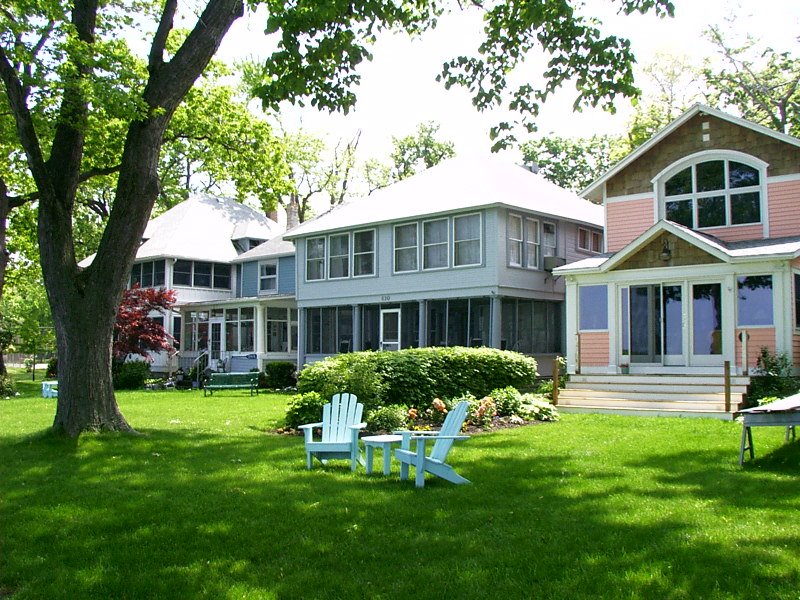
I think for the era in which they were built, and the general modesty, culture and goals of Lakeside, they were really quite magnificent. All have been remodeled, reshaped and most covered in vinyl siding during the last 90-100 years, but if you look at the roof and the lines you can still see what Lakesiders experienced for many years.
William DeWitt (W.D.) Ross was a teacher and superintendent of schools in Fremont, following in the footsteps of his father, William Ross, the longest serving superintendent (until 1906) and for whom Ross High school is named (Port Clinton
News Herald, Aug. 30, 2006). He was a graduate of Oberlin and attended the University of Chicago. He gave up teaching after 10 years due to illness and began developing the east end of Lakeside around 1907. In the archive records (a big thank you to Jan Stephenson who found his obituary and the lot transfer records for me) are recorded the various lot sales and the advertisements for Ross Cottages, each of which had its own name. An obituary for W.D. reports that he died in October 1943, and within 5 hours of his death, his wife Evalyn also died. The properties passed to his sons, and then in the later 1940s and 1950s, were sold outside the family. However, some of the early transfers were also recorded in the name of his mother, his wife and his sister-in-law.
The houses on Plum and Ross Court facing Perry Park and the tennis courts down to the lakefront were apparently some of the earliest built. They had wonderful open porches with an angled window on the first floor to take advantage of the view. There had been a power plant on this site and there are no lot numbers recorded when he purchased the large tract. At some point there had been a bicycle racing track on this land.

From the clothing in this undated photo, I'd guess this is pre-WWI.

And here they are 100 years later.

The second house from the left has a gable roof and is not a Ross house. Notice the angled windows--many Ross houses even south of 2nd had these to provide a lake view. These houses all had a bathroom and kitchen, fireplace, electric lights, plastered walls, and were furnished to sleep 8-10, with living room and dining room and kitchen equipment. Quite different from "old" Lakeside where some homes had no interior walls, no indoor bathrooms, and resembled "wooden tents."

Except for having its porch enclosed, "The Noreaster" facing the lake still looks much the same today. The one next to it has had a gabled 2nd floor porch added which really changes its look. Shutters, of course, were never original to this style of architecture, but are a common "update." All the houses have had the porches enclosed, some more successfully than others. Many have managed to save the angled window, although sometimes if the porch was extended, it now resides inside the porch or was cut down to peek hole. Wood steps rotted, so most Lakeside homes now have concrete steps, which shift and move, or begin lifting the porch as tree roots get under them.
When we bought our 1943 cottage in 1988 thinking we'd remove the inappropriate 1980s factory built porch, we learned the previous owner had a variance, and we wouldn't be able to replace it if we removed it. So sometimes you have to stay with a remodel or do-over due to code changes.




 Posts
Posts


