Church of the Holy Sepulcher and The House of Caiaphas
The Church of the Holy Sepulcher according to tradition is built on the hill of Christ's crucifixion and the tomb of his burial--although there are disagreements. The other location of the tomb was found in the 19th century, so on strength of tradition, it would be the Church. It was first built in 330 AD, destroyed in 614, rebuilt, destroyed in 1009 and rebuilt by Crusaders. The line to visit the tomb (there's a rotunda over it) was too long, so we didn't stay. (And neither did Jesus, come to think of it.) But we were close! In fact, Israel is so small, you're never far from anything or anyplace even if you're not sure of the location.
"The Church of the Holy Sepulchre was built by Constantine I the Great during the fourth century, after he became christian, and turned Christianity to the official religion of the Roman empire. In the year 326, Constantine I sent his mother, Helena, to seek the Crucifixion location in Jerusalem. Helena found the place and also found the remains of the cross itself. In that same place, 7 years later, Constantine I founded the Church of the Holy Sepulchre in the year 333." Trekker

The facade is from the crusader era. The architecture and art is a real hodge podge, reflecting the many Christian groups and cultures that have cared for this church. Byzantine, medieval, Crusader, and modern elements mix and each Christian community has decorated its shrines in its own distinctive way.

This is possibly the place of the crucifixion; we waited to be able to touch it.

This is thought to be the stone where Jesus' body was prepared for burial.

After Jerusalem's occupation by the hands of Tslah A-Din in the year of 1187, The Holy Sepulchre Church was given for safe keeping to two Moslem families, the Nusseibeh and the Joudeh families, who own the place today, and currently hold the keys to the church.

Church of St. Peter on the eastern slopes of Mount Zion was erected in 1931 to commemorate Peter's denial of Jesus and his remorse.

Beneath the church are a series of carved-out chambers from the Second Temple period which Catholic tradition says is the site of the palace of Caiaphas, and therefore Jesus may have been imprisoned in one of these caves.
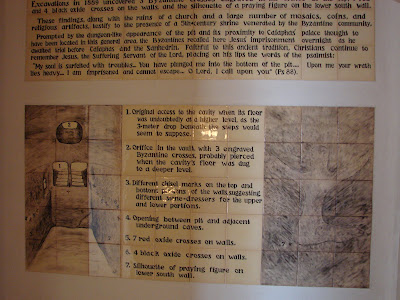
Click to enlarge for the explanation why this is thought to be Caiphas' house where Jesus was imprisoned and where Peter denied his Lord.

According to the Wikipedia site, a Byzantine shrine dedicated to Peter's repentance was erected on this spot in 457 AD, but was destroyed by Muslim invaders in 1010. The chapel was rebuilt by Crusaders in 1102 and given it's present name. After the fall of Jerusalem the church again fell into ruin and was not rebuilt until 1931. Today a golden rooster protrudes prominently from the sanctuary roof in honor of it's biblical connection.
I know that these are not in chronological order; we saw these on Wednesday March 11, scenes of the last hours of Jesus' life, but on Thursday March 12 we traveled to Bethlehem for his birthplace, and also then saw Gethsemene. Others in our tour group (about 170 of us from Upper Arlington Lutheran Church and Annunciation Greek Orthodox Church of Columbus plus friends and relatives) saw these sites in different orders.
 With Dottie on Mars Hill
 Resisting in one of the approved shopping sites
 Gene, also an architect, inspecting the softness and quality of Turkish rugs, while the rest of bus 5 boldly looks on
 Clothing contrasts in Turkey, the traditional woman
 Our neighbors and fellow members of UALC on the Sea of Galilee
 Mentors and friends for over 30 years
 At the Church of All Nations
 At the foot of a pyramind, early for the peace demonstration
 Always, always listen to your tour guide. Don't even make eye contact. This guy stole 50 euro from us.
 Joyce and I window shopping in Cairo before the stores opened. The painted sign probably says SALE!
 Cairo Kitties waiting for lunch. I think there were 7 or 8 in that bin.
 Some in our group used the hotel pool; some just used it for drinks.


 Posts
Posts


