Tuesday, January 03, 2006

1975 Sorry, no more room for tools!

PubMed has a new tool bar to install, but now that I've got the lower level of the condo clean and neat and all our tools in a nice arrangement, I don't think I'll clutter up my computer screen with one more tool bar. I love my Google tool bar, though.

Check out the NLM Technical Bulletin for details.

1974 Journalist gives up job to become a Marine

A 32 year old Wall Street Journal reporter in poor physical condition decided to go for it and become a Marine officer after living in China for 7 years and reporting on the tsunami last December. He'd been disgusted and sicked by the murder of a colleague and the beheading of Americans. He wanted to become part of something bigger than himself and so he trained and disciplined himself until he could pass the requirements. What made him give up what some would see as a wonderful career? On December 15 he wrote his story in the WSJ:


"It's a cliché that you appreciate your own country more when you live abroad, but it happens to be true. Living in China for the last seven years, I've seen that country take a giant leap from a struggling Third World country into a true world power. For many people it still comes as a surprise to learn that China is chasing Japan as the second-largest economy on the globe and could soon own a trillion dollars of American debt.

But living in China also shows you what a nondemocratic country can do to its citizens. I've seen protesters tackled and beaten by plainclothes police in Tiananmen Square, and I've been videotaped by government agents while I was talking to a source. I've been arrested and forced to flush my notes down a toilet to keep the police from getting them, and I've been punched in the face in a Beijing Starbucks by a government goon who was trying to keep me from investigating a Chinese company's sale of nuclear fuel to other countries."


HT to our Blue Star Mom, Beth.

1973 When Bess Myerson became Miss America

You'll enjoy this story of how Bess Myerson made the day for a young Jewish soldier stationed in India, a long way from home--the Bronx. He's a very experienced writer and editor, but a little new to blogging.

1972 And that's no bull

Speaking of the New Year, maybe it's time for a new screen saver? How about something really cute, like some Angus art work by a famous animal artist, Frank C. Murphy. You can get left leaning bull, or right leaning bull, it's entirely up to you. Aren't these heifers just too cute?

Check here for more Angus clip art

1971 Tag for the New Year

The Soul Sings has tagged me, and here are the rules.

Rules: “The first player of this game starts with the topic “five weird habits of yourself,” and people who get tagged need to write an entry about their five weird habits as well as state this rule clearly. In the end, you need to choose the next five people to be tagged and link to their web journals. Don’t forget to leave a comment in their blog or journal that says “You are tagged” (assuming they take comments) and tell them to read yours.”

1. I add up the purchases in my head (rounding to the nearest dollar) as I place items on the conveyor belt at the grocery store. I'm almost always within 50 cents of the correct total, but I've never been able to balance my check book.

2. I collect first issues of journals and write about them, but mostly I look at them in a pile under the small couch in my office, and do nothing with them.

3. I leave my home very early in the morning to buy a cup of coffee. I'm not on my way anywhere except the coffee shop, and I've done this for the last 50 years or so. Wasn't so bad when coffee was a quarter. Now it probably amounts to a mortgage payment in a year's time. I write about what I see and hear at coffee shops.

4. I analyze library databases as I use them, and usually e-mail the contact person about the screwed up mess in the numbering of series or complain about the terrible printing options. I was just looking at Annals of the American Academy of Political and Social Science at OSUL and OhioLINK and almost had a meltdown. Sometimes I write about that too.

5. I have 5 or 6 places for loose change, but have forgotten where most of them are. It's like found money (actually it IS found money) when I come across the receptacle. Most recently I cleaned out a pink mitten that had no mate, but did have $3.00. Although it's not exactly a New Year's resolution, I'm planning to do some drawer cleaning to go along with our big December clean out, so I expect to claim some lost funds.

And now I'll tag Pat in NC, who is pretty in pink, and Beth, a proud military mom, and Cathy, who is incredibly crafty, and Joan, who is Beth's sister, and Eric, who needs a little encouragement (he took my blogging class).

If I had 6 habits, I'd mention that I shamelessly promote my blogs.

Monday, January 02, 2006

1970 Don’t ask don’t tell--Christians in U.S. history.

This is a paragraph from an Ohio history teachers’ website. I was looking through it after reading about John Bennington Mahan whose story is told in our January book club choice, “Beyond the River” by Ann Hagedorn. Virtually all the abolitionists were devout Christians, and often they were battling Christian slave holders. The abolitionists' homes and businesses were destroyed, their lives and families were threatened, they were whipped, imprisoned and "egged." Both sides used the Bible to defend their own morality. The slaveholders were motivated by economics, but why leave out what motivated the abolitionists? They believed in the common humanity of blacks and whites; that Jesus had died also for the black slave, that they were their brothers and sisters, and that slavery was an abomination in the eyes of the Lord, a insult to a holy God. Their commitment and beliefs are reduced to “conscious choice to break the law” in this passage--sort of a "values clarification" exercise. Mahan died a few years later, probably as a result of his imprisonment.

“Rev. John Mahan, Rev. John Rankin, and others in Brown County, Ohio were not just making a choice to help slaves to freedom; they were making a conscious choice to break the law. The case of abolitionist John Mahan illustrates the fine line between —doing the right thing“ (his conscience) and —breaking the law,“ his capture, arrest, trial, and the results that followed. People involved with the Underground Railroad broke the law every time they helped a runaway. This not only put them in danger of going to jail but also their family (some were left destitute).” Case histories, Underground Railroad


1969 What's private is also political

How many times have we heard or read that abortion should be private and not political? That's because the unborn in the minds of many are either property of the mother (but not the father), or a parasite living off the good graces of another.

Liberals are outraged by Alito's ruling that it was not an undue burden for a married woman to notify her husband that she was having an abortion. Now that notification didn't save the child's life, did it?

So the story of the antislavery saints of Ohio, "Beyond the River," reminds me a lot of the current "private vs. political" struggle.

"Their response was to tighten restraints, to raise the walls of confinement higher, to argue for laws to protect their human property, and eventually blame anti-slavery crusaders for fomenting revolt."

Anti-abortionists are painted as the personification of evil woman haters by the pro-abortionist camp--and nothing Alito has done or stands for will ever be more important in their minds than abortion--not civil liberties, or the death penalty, or the 2nd amendment, or the 10 commandments in schools or Christmas trees in the public square. Just as in the early 19th century when slavery threatened the union, it has come down to one issue again in the early 21st century. And Christians are complicit now as then.

"Even though members of the church agreed with him [John Rankin, a Presbyterian minister] that the Bible was opposed to slavery, to say it publicly was a radical move, . . .never [to be] discussed from the pulpit." p. 31

Sunday, January 01, 2006

Advent Carol Service

Although Advent season is over, I'm listening to the Advent Carol Service from the Chapel of St John's College, Cambridge on the BBC radio player which was originally broadcast November 27. I can't give you a link or I'll lose my station. It is really quite lovely, and may perhaps be more welcome now than before. I think I started here, after reading Tom Roper's site.

Nine Ten Planets

This story of the discovery of the 10th planet in our solar system is not new, but was one of the top stories of 2005. There's just a lot I learned in school or from my doctors or in graduate school or from politicians that just isn't true or factual, but we used to believe it. Wonder what's next? Evolution?

1966 Parting company

We accidentally received a copy of YouthWorker Journal yesterday and I blogged about that at Church of the Acronym.

Saturday, December 31, 2005

Wishing you a safe and happy New Year

Our friends Tom and Pat are coming over from Indianapolis. The guys have been friends since their teen years, and Tom was the best man in our wedding. Our children are about the same age, and some day I hope to see their son Mike's name on the title page of a novel. Their daughter Rachel teaches in an urban school in Indianapolis.

We'll either go to a movie or a jazz concert--it's their call, then either to Old Bag of Nails or Rusty Bucket--our call--for something to eat, and then downtown to look at the lights, which so far, we've managed to miss. I think there is a Ferris wheel at Skate on State something set up to draw people downtown during the holidays. Hope we aren't too late.

I hope you have a wonderful, healthy, prosperous 2006.

May your investments do well,
your medical visits few,
May your friends be many
and love always surround you.

At least, that's what matters when you're my age!

1964 Why AmVet's won't take TV and microwaves

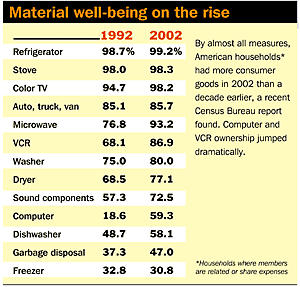
Am Vets picked up just about everything we put out yesterday--nothing was broken, and everything was in good condition and resaleable at their shop. But they will not take a TV or microwave. Too many poor people already have them. They didn't say that, but take a look at this.


HT Randy who found it at the Christian Science Monitor.

"The Census report also compares, from 1992 through 1998, people's perceptions of whether basic needs were being met. More than 92 percent of Americans below the poverty line said they had enough food, as of 1998. Some 86 percent said they had no unmet need for a doctor, 89 percent had no roof leaks, and 87 percent said they had no unpaid rent or mortgage."

Gee whiz. I know middle class folks who have unpaid rent and mortgages!

1963 Thorncrown Chapel receives AIA award

We had a wonderful trip to visit Frank Lloyd Wright and E. Fay Jones buildings last summer, about which I blogged here. The American Institute of Architects has awarded the Thorncrown Chapel in Eureka Springs, Arkansas, which we visited, the 2006 Twenty-Five Year Award for architectural design that has stood the test of time for 25 years.

"The small but soaring glass and cross-braced pine chapel, designed by the late E. Fay Jones, the 1990 AIA Gold Medalist, nestles into an 8 acre woodland setting on a sloping hillside in the Ozark Mountains. It stands 48 ft. with 24 ft. wide by 60 ft long dimensions for a total of 1,440 sq. ft. Its 425 windows, make of 6,000 sq. ft of glass, filter woodland light across its upward diamond-shaped pine trusses to form ever-changing patterns of light and shadow throughout the day and night." AIA Columbus, Dec. 29, 2005.

Approximately 5,000,000 people have visited Thorncrown which is the built dream of Jim Reed, who purchased the land in 1971. When raising money for the chapel, the banks told him that tourists wouldn't come to a glass chapel in his back yard in Arkansas. The Reeds son Doug Reed is currently one of the three pastors at the chapel which is supported by donations. Jim Reed died in 1985 and Jones died in 2004.

Jones's other chapel in the Ozarks, the Mildred B. Cooper Chapel, is also a delight, and one of my blogger links, Hokulea recently visited there for a Christmas service that sounded really special,

"Today the church pianist had a small gathering in her place of employment. She is the manager of the Mildred B. Cooper Memorial Chapel check out the website and catch a glimpse of the gem of our lovely village. The place seats about 100 and was fills with people, most involved with the choirs of their churches. We sang for two hours watching the glorious winter sunset throught the barren trees. It was a delight."


1962 Why New Orleans failed long before Katrina

New Orleans used to have a thriving African American community, according to this article by Joel Kotkin which compares the paths to growth between Houston and New Orleans. It probably answers my general question in my blog about the robust U.S. economy about why so many cities with entrenched poverty also elect Democrats year after year and keep slipping backward.

“But during the 1960s, the push for economic growth that created an upwardly mobile working class was replaced—in New Orleans as well as most other cities —by a new paradigm that emphasized politics. Political agitations promoted various forms of racial redress, and the rights of people to receive government welfare payments. By the late 1970s, African Americans in many American cities had gained more titular power than they’d ever dreamed of, including the mayoralty of New Orleans.

The new political gains of black Americans were widely regarded as a major step toward an improved social status. This coincided with the rise of a new form of urban boosterism—which showcased downtown renewal districts and insisted that the dramatic decline of city quality of life during the 1960s and 1970s had been reversed in the 1980s and 1990s. Urban elites, including in New Orleans, burbled about the vigor of their cities. Right through last year’s Gallup poll, leaders and residents of the Crescent City had (along with San Francisco) one of the highest levels of municipal self-esteem in the country. That now appears sadly delusional.

The truth is that, rather than improving conditions for average residents of their cities, many urban politicians and interest groups have promoted policies that actually exacerbated a metastasizing underclass. Urban liberals tend to blame a shrivelling of Great Society programs for problems in cities. Observers such as former Houston mayor Bob Lanier have suggested, however, that the Great Society impulse itself is what most damaged many cities—by stressing welfare payments and income redistribution, ethnic grievance, and lax policies on issues like crime and homelessness, instead of the creation of a stronger economy.”

Sadly, the needed tax and business and local government reforms will be ignored and instead:

". . .our urban leaders and their enablers—from rich developers to social agitators—will insist their old strategies are working. The media will likely echo their press releases. This will work only until our cities crumble under pressure, as in New Orleans, explode from within, like Paris, or simply become irrelevant anachronisms at the margins of modern society."


Read the whole article in either html or a pdf file complete with pictures.


Friday, December 30, 2005

1961 Remember stories and theater on radio?

Today I followed a link at Jay Kegley’s blog to a free radio site, LibriVox, which provides totally free audiobooks from the public domain. Volunteers record chapters of books in the public domain, and then LibriVox releases the audio files back onto the net (podcast and catalog). Their objective is to make all books in the public domain available, for free, in audio format on the internet.

From that site I clicked through several other free audio sites, including old radio theater. "Bookworm" showcases writers of fiction and poetry. Podiobooks.com will feature your book if you are an author--a good way for you to get an audience. FreeAudio.org was featuring The Law by Frederic Bastiat. “The Law is one of the most important books ever written on the uses and abuses of law. While short, The Law has proven itself time and time again to be life changing to those who read it.” I’d never heard of it, but am finding it very interesting. This site seems to feature titles important to liberty and freedom, and includes Frederick Douglass’ autobiography.

You can spend hours mining these sites for novels, short stories, poetry and essays.

1960 Before and After the Clean-up

It may be difficult for you to see the difference in these photos, but let me assure you, except for one small tray (filled with rolled pennies, WWJD bracelet, buttons from shirts no longer worn, a high school ID photo, and pens that don't work) which my husband wouldn't give up, these shelves are now functionally organized.

Before the great clean out


After the reorganization


See the mat board in plastic peeking from behind the shelf? It is now resting comfortably in a flat file, which took days to purge. All the books from the bottom shelf (if we could learn to paint by reading books, we'd be making a fortune, but have instead spent one on books) have been moved into the art studio to shelves that were liberated of old notebooks stuffed with specs that were out of date. Then 15 years of American Artist were moved and are neatly shelved by year and month instead of jabber jibber. See all those cameras? They used to be all over the place, sometimes in a case, sometimes not. Now they have friends to keep themselves company. See those little plastic film containers building pyramids like cheerleaders? In the trash--we had about 50. See the box on top of the shelf. It contained slides which have all joined their slide friends in another cabinet behind those louver doors (the kitty litter is also behind those doors and that artificial floral arrangement is to pretend you can't smell it).

Now on the other side of the room is the larger 36" shelf we swapped with our son, and a few items, like those photo boxes were moved there. This shelving unit contains a lot of reference material--magazine photos, Christmas cards, sketches, etc. Also, loaded carousels for painting reference--probably every barn in northern Illinois is in there. The paintings on the wall are mine--all of Lakeside, OH. A mirror would have been nice, but after getting rid of so much stuff, I didn't want to start buying again.


Well, what do you think?


1959 Year-end assessments of the economy

Those of us concerned about the poor will be delighted to read all the year end assessments of the economy. If you were Kedwards people who believed all the sour economic news floated by the DNC during the election of 2004 please know nothing helps the poor more than a good economy--although it does hurt Democrats if they aren‘t in charge because then people aren't beholden to them.

Now that we’re retired on pensions and moving to the bottom quintile again, where we were in our early 20’s, I’m very happy with the thriving economy and am puzzled that liberals who claim to care so much are so unhappy. And it is a mystery to me why the cities with the highest poverty rates keep returning local Democrats to office to run things. You can fool some of the people all of the time, I suppose.

“Remember the 2004 debate over the "jobless recovery" and "outsourcing"? Here's the reality: The great American jobs machine has averaged a net increase of nearly 200,000 new jobs a month this year. Some 4.5 million more Americans are working today than in May of 2003, before the Bush investment tax cuts. The employment expansion in financial services, software design, medical technology and many other growth industries dwarfs the smaller job losses in the domestic auto industry.

Critics of the U.S economic model charge that income gains for workers still have not caught up with the losses from the 2000-2001 high-tech collapse. Now they have. The Treasury Department reported last week that "real hourly wages are up 1.1% versus the previous business cycle peak in early 2001." Workers are now earning more per hour in real terms than they did at the height of the 1990s expansion.” Rodney Dangerfield Revisited in today’s WSJ

Kiplinger’s Personal Finance, Jan. 2006 reports a very positive picture: "As we begin the 50th month of economic growth this new year, not too much has changed. You can expect 3% growth in 2006 to follow the 3.6% of 2005 -- an excellent showing considering the massive hurricanes, record oil prices and relentless Federal Reserve Board interest-rate hikes. . . The U.S. will create two million new jobs in 2006, on top of 1.8 million in 2005, enough to hold the unemployment rate to 5%. With jobs plentiful, employers will add nearly 4% to paychecks. . . Corporate America's balance sheets and profit margins are the strongest they've been since the 1960s, with only a few industries, such as airlines and U.S. automakers, in trouble."


1958 Mere Magazines

In today's Wall Street Journal Dr. Thomas P. Stossel of Harvard Medical School takes on the hypocrisy of some of the top medical and science journals. Recently, some high profile U.S. journals like JAMA, NEJM, and Science have been caught with their data down, publishing articles from India, China and Korea ranging from cloning to stem cell research to nutrition after heart attacks that would never meet FDA scrutiny in the USA because of the limited clinical trials and bad data. His gripe with these journals' editors is that they quick to criticize the pharmaceuticals (i.e. big business that took the risks) but seem to be blind to the power trail in academe or their own flubs.

"Many [academics] would run over their grandmothers to claim priority for a discovery, impose their pet theory on the field, obtain a research grant, win an award or garner a promotion. . . We exercise our ambitions by publishing research papers in journals."

And he concludes: "If reporters understood that journals are magazines, not Holy Scripture. . ." Oh I love that.

I can't find a free link to Dr. Stossel's article, but here's one he wrote for Forbes with similar information and different details called "Free the Scienctists."


1957 Book Club selection for January

This coming month's selection is "Beyond the River" by Ann Hagedorn. The subtitle: the untold story of the heroes of the underground railroad. The action takes place in Ripley, Ohio, across the river from Kentucky--a free state and a slave state. I'm not far into the book, but the writing is good and draws the reader into the story immediately with setting the scene and building the characters. However, when I read about this era, which according to Hagedorn begins in the 18th century with people who were against slavery and believed they were born to change the world, I can't help think of our current battle between the pro-life and pro-choice forces. What is a life and what is its value. There are many paragraphs that with a few word changes could describe our politics today, where every court nominee depends on what was said about abortion 20 years ago in some clerking memo.

"As news of the Missouri Compromise reached Carlisle, Kentucky, where [John] Rankin lived, and nearby Concord, where he preached, Rankin felt the pulse of his community quicken. He sensed the anger in the hearts of slave owners and the frustration among antislavery advocates when he stood at the pulpit seeking to prove that slavery was as great a crime against the laws of God as murder, and arguing that every slaveholder must free his slaves to adhere to the teachings of the Scriptures..."

Also, I'll need to check my Family Tree database. John Rankin was born in East Tennessee in 1793, and that's where my family's ancestors settled after service in the Revolution (Scots-Irish who hated the British), and I think I remember some Rankins in the family.

Thursday, December 29, 2005

1956 Bush book critics

Over the holidays, the President is reading "When Trumpets Call, Theodore Roosevelt After The White House," by Patricia O'Toole, and "Imperial Grunt, The American Military On The Ground," by Robert Kaplan. A talk show hostess like Oprah can recommend anything and the MSM falls all over her. But every time it is reported in the news that the President is reading a particular title, some literary snob jumps in and makes snide remarks about his choices, his ability to read, his grades in college, or his conclusions.

The president enjoys reading biography, history, military science and economics, and Literary Saloon reacts predictably--doesn't think he can read two books, and doesn't believe he is an avid reader. She/He probably believed Kerry's opinion about the worst economy since the Depression. If you hate Bush, you'll believe--or not believe--anything. This summer when he was reading "The Great Influenza: The Epic Story of the Deadliest Plague in History," "Salt: A World History" and "Alexander II: The Last Great Tsar" journalists and critics were "reading" all sorts of strange things into his choices. Oh yes, and they criticize him for not watching their newscasts. Reads and doesn't watch TV. Sounds smart to me.

But at least "Saloon," the blog of Complete Review, knows what it is: "The Complete Review makes no claims whatsoever to any form of objectivity in its reviews and opinions. We acknowledge that the biases and personal views of the editors colour all aspects of this site." That's refreshing, isn't it?