Showing posts with label Appalachia. Show all posts

Thursday, January 17, 2019

Data on employment

I don’t know why, but Mercer County Ohio seems to have the lowest unemployment rate in the state, 2.4. It’s on the Indiana border, which seems to have a lower unemployment rate than Ohio, and did all during the very slow recovery. The highest unemployment rate in November 2018 was Monroe County, at 7.1. It is located on the eastern border of  of Ohio, across the Ohio River from West Virginia. As of the 2010 census, the population was only 14,642, making it the second-least populous county in Ohio. If you want to be alone, this is your county--the county averages thirty-three people per square mile. Major employers are the county government, the schools and nursing homes.

I found this by looking at “Local Area Unemployment Statistics Map” of the Bureau of Labor Statistics, and clicking on Ohio, then placing the cursor over the various counties which were shaded according to unemployment rates, with the lightest color being the least unemployment.  https://data.bls.gov/map/MapToolServlet    From there you can go to https://www.census.gov/quickfacts/fact/table/US/PST045218 and type in the county name in the search window for more facts about the county.

Since I’ve never applied for unemployment I do wonder why some counties that are high are right next to counties that are low, but generally those counties in Appalachia are higher than the counties next to Indiana. Poor transportation?  Low education rates?  Monroe’s graduation rate is 87.9 and Mercer’s 92.7—both above the national average.  Health insurance?  Monroe County has 7.8% who don’t have insurance, and Mercer 5.6%.  Both counties are over 97% white.  But the poverty rate in Monroe is 15.2 and Mercer is 6.9, and disability is much higher in Monroe, 13.7 compared to 6 for Mercer.

See?  Even with the employees furloughed, there’s a lot of information out there from the U.S. Census.

Tuesday, December 17, 2013

Eula Hall interview

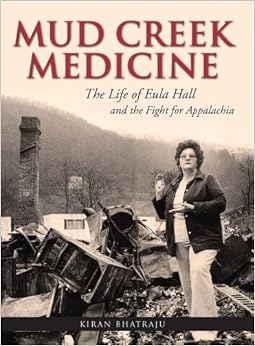
Recently I received a notice of a new book about Eula Hall who has run a medical clinic in Kentucky since 1973, Mud Creek Medicine: The Life of Eula Hall and the Fight for Appalachia.  Upon checking, I found a 1988 interview for an oral history project, Appalachia Oral History Collection, Family and Gender in the Coal  Community Oral History Project.  I think you’ll enjoy it.

Interview with Eula Hall, June 14, 1988

"Whether it is the trailblazing, family feuds, coal miners' strife, moonshinin', or just folksy charm, the personal stories of individuals found in the hills of Appalachia often do rise to the heights of drama and intrigue, and reach to the depths of the American experience. Eula Hall's life is no exception. Eula's story is of a woman of remarkable strength, shaped by her community above all else. It is a story that should appeal to those with no connection to Appalachia, and to those who simply want to leave the world a better place than they found it. From a rugged mountain youth to hired girl to organizer, health care entrepreneur, and iconoclast, Eula's story echoes the story of America in the twentieth century, in all her rage and glory. She is the quintessential Appalachian-American poverty warrior combined with bucolic self-sufficiency, and she represents a dual ethos of community and individualism that is unique to the mountains.

"Eula, like so many quiet civic heroes, didn't do it for fame because, in her words, 'Fame ain't worth a damn'; didn't do it for accolades because 'We need action, not awards'; and sure as hell didn't do it for money because she's 'been rich without money since birth.' She fought on, and risked her life at times, as the sign outside the clinic reads: 'For the People.'" Pages: xvi – xvx Mud Creek Medicine

Butler Books, 2014.

Wednesday, March 17, 2010

Happy St. Patrick's Day


Of course, today "everyone is Irish," but some of us really can trace our ancestors across the pond to Ireland. Mine beat the crowd of the famine ships of the 19th century and crossed in the 1730s, signing on to fight in the American Revolution against their hated British rulers, stopping a generation or two in Pennsylvania and Virginia, and then moving on to Tennessee, with later generations leaving Appalachia for Illinois, Texas and California as various misfortunes gave them a push to seek a better land and life. After 7 or 8 generations in the U.S., my German-English and Scots-Irish bloodlines got together in an outdoor farmhouse wedding in August 1934, and the rest is my history, as we say.

At the coffee shop I was refilling my cup and next to me was a young man with a blinking St. Pat's pin on his baseball cap (hate to see people wearing those inside). "Any Irish in your genealogy?" I asked. He said he didn't think so but wasn't sure (most 20-somethings don't know much about genealogy, so it really wasn't a fair question). "My mom's Hungarian-German, but my dad's adopted, so we don't know anything about his family." I didn't pursue that story line--after all, we are total strangers, and for all I know his parents could be divorced or deceased. But here's my opinion.

If his grandparents were willing to adopt his father, a life changing event for him over which he had no control, then it's perfectly OK for his dad to "adopt" his ancestors from his adoptive parents' genealogy. Over this he does have a choice. It's not fair that the state of Ohio still has laws hiding his father's past, but there are a few things his father does control, and that's to climb that family tree with all its roots and branches, his grandparents, great-grandparents, great-greats, cousins, nephews, nieces and so forth.