Showing posts with label Champaign. Show all posts

Wednesday, September 30, 2020

My tale of two rich men, us and taxes on real estate

My uncle Gramps was the husband of my dad’s sister, Marion, who owned the Tot and Teen shop in Mt. Morris.  Nice guy, but I didn’t spend a lot of time with him. My fondest memory of him was winter 1963 or 1964, when he helped me with my taxes. I think I’d brought all the records home (to my parents) for Dad to help. Gramps came over and showed me how, with our duplex rental property, we would owe no taxes on the income. I found it stunning then, and even now, that by listing all our expenses and claiming something new to my vocabulary, depreciation, we owed nothing. The tax laws are made for the rich by the rich, but occasionally the little guy gets a boost.

President Trump, whom the New York Times is trying to smear without the word illegal appearing anywhere in the story,  created jobs, he provided services, and he took advantage of all the “loopholes.” So did Jeff Bezos, the richest man on the planet, who owes no income taxes at all, and who coincidentally owns the Washington Post, also a Trump hater.

I once asked my mother why my uncle was called Gramps, since at that time he may have been 40 something and had no grandchildren, and she said she didn’t know but that was his nickname at Mt. Morris College where my parents and he met (my aunt would have been in high school so I assume they met later).

I hated being a landlord. We met some really nice tenants and with some we have stayed friends. But it only takes one or two bad ones to make you resolve to never do it again. But that duplex, purchased in 1962, for $14,000, put us on a financial footing that blesses us to this day. We took a mortgage for $10,000 and Dad held the second mortgage. The rent, as I recall was $70/month and that covered the mortgage and  the utilities—so we essentially were living rent free. We sold it on land contract in 1967 when we moved to Columbus, and that payment covered our car loan and the mortgage. When the new owner paid off the loan a few years later, someone at the bank discovered an error in our favor, and as I recall we had a nice settlement.

Owning and living in your own home does nothing for your own wealth, but owning real estate and renting it or using it for some other investment does. My father always said the cost of your home always had to include what the down payment and improvements could have earned doing something else.

Marion and Gramps


Monday, January 01, 2007

Monday Memories

In honor of the Dream Girls movie, which I wrote about here, I'll throw in a memory from the mid-60s when we were briefly landlords. The movie is based on the Broadway musical, which is loosely based on the lives and careers of the women in the Supremes.

Our first home in Champaign, IL, purchased in 1962, was a duplex--not a real one--it had been converted from a one family house, so the renters had 2 bedrooms, living room, bath and kitchen upstairs, and we lived downstairs. After we bought our home on Charles St. in 1965 we rented both units, and that paid for both mortgages.

Although we really didn't want to rent to female students (we preferred married couples), after a few weeks of no rent for one unit, we relented. Not. A. Good. Idea. Oh, did they party (we found out later from the other renter). And didn't pay their rent. Finally, they just left, owing back rent. When we let ourselves in, things were a terrible mess. Spoiled food. Dirty clothes. And bills from the local hospital for food poisoning. Also bills for pregnancy testing and services. We weren't the only people in town these girls stiffed. I called their parents (on their university records) who were clueless--thought they were enrolled at the university living in a dorm. They had left behind all the "free" records on a membership in a record club (33 1/3 at that time), including the first by the Supremes. We may still have it somewhere.

This record by the Supremes was a keepsake of our years as landlords and I got a lot of enjoyment from it. Wikipedia lists the songs as:

Side one
"Love Is Like an Itching In My Heart" (Holland-Dozier-Holland)
"This Old Heart of Mine (Is Weak For You)", (Holland-Dozier-Holland, Sylvia Moy)
"You Can't Hurry Love" (Holland-Dozier-Holland)
"Shake Me, Wake Me (When It's Over)" (Holland-Dozier-Holland)
"Baby I Need Your Loving" (Holland-Dozier-Holland)
"These Boots Are Made for Walkin'" (Lee Hazlewood)

Side two
"I Can't Help Myself (Sugar Pie Honey Bunch)" (Holland-Dozier-Holland)
"Get Ready" (Smokey Robinson)
"Put Yourself in My Place" (Holland-Dozier-Holland, John Thornton)
"Money (That's What I Want)" (Berry Gordy, Jr., Janie Bradford)
"Come and Get These Memories" (Holland-Dozier-Holland)
"Hang on Sloopy" (Wes Farrell, Bert Russell)


My visitors and those I'll visit this week are:
Anna, Becki, Chelle, Chelle Y., Cozy Reader, Debbie, Friday's Child, Gracey, Irish Church Lady, Janene, Janene in Ohio, Jen, Katia, Lady Bug, Lazy Daisy, Ma, Mrs. Lifecruiser, Melli, Michelle, Paul, Susan, Viamarie.

Saturday, January 15, 2005

731 Real estate values

I love to read real estate ads. The hyperbole, the squish words--vintage, curb appeal, redefines elegance. Today I saw a photo of a vintage house in a university town (Ann Arbor) that looked like a clone of our first home in Champaign, Illinois not far from the university. It even had a bump out dining room window. It was selling for about $450,000, and the ad said it had been magnificently updated.

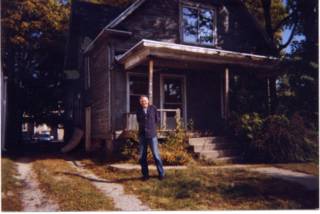
With David's family Christmas letter, he included a photo of our old house--the one that looks like the Ann Arbor house. He was in Champaign last year to give a lecture, and had stopped at the house for a photo op. He and wife Gina had been our upstairs tenants and neighbors and friends. The house was probably 50 years old when we bought it, and time has not been kind. We added a second front door so the upstairs tenants had a private entrance, and we painted it charcoal gray with white trim (a popular color scheme in 1964). It had lovely wood work the color of my grandmother's home of the same era, with glass door book shelves, huge windows in the kitchen, a dining room with a built in china cabinet which was the largest room in the house, a basement with a dirt floor, and a gravel driveway with no garage.

The photo showed a home that looked like it hadn't been painted since we did it in 1964; the formerly gracious front porch had lost its columns and railing; ugly oversized windows had been put in the front, second floor room; the bushes were overgrown; and a mattress was leaning against the side of the house.

It was a plain, utilitarian house with painful, unhappy memories, but because it was an income property (I was 22 when we bought it), it put us on a solid financial footing that carried us through the ups and downs of the next forty years.

I salute you, little duplex on White Street. You deserved better.


White St. House in 2003


White St. House in 1964

Monday, November 03, 2003

67 The ghost of William B. McKinley


In #65 I said I don’t believe in ghosts, however, Mr. McKinley seemed everywhere when I was at the University of Illinois. I lived in Hannah McKinley Hall (see blog 54), attended McKinley Presbyterian Church, recovered from mono at McKinley Hospital, walked on McKinley Avenue, and taught Spanish at Urbana High School which had a McKinley field. Who was this mysterious McKinley whose name was everywhere?

William B. McKinley was the son of a Presbyterian minister who made his fortune in public works. After learning the banking business with his uncle, in 1884 he entered the field of public utilities, building the first water works to supply Champaign and Urbana. Soon after, he also built the first electric lighting plant for the two cities, housing the generators in the water works buildings. In 1890, he bought, electrified, and expanded the horse car line between Urbana and Champaign. He also bought the gas and electric plants in Defiance, Ohio, and built a street railway there. In 1892, he sold his utilities holdings in Champaign-Urbana, and bought and electrified horse car lines in Springfield, Ohio and Bay City, Michigan. He became involved in rail lines in many Illinois and some Indiana cities.

In 1902, William McKinley running as a Republican was elected to a seat on the University of Illinois Board of Trustees. He served in that post until 1905 and first ran for Congress in 1904. The Champaign and Urbana newspapers supported him, and he was elected easily and then reelected three times. McKinley ran the re-election campaign of William Howard Taft in 1912 against independent candidate Teddy Roosevelt and Democrat Woodrow Wilson. He served seven terms in the U.S. House of Representatives (59th through the 66th Congresses, missing the 63rd). In 1921 he was elected to the Senate.

William McKinley believed that the wealthy had an obligation to pay back to the community in both service and dollars. He donated nearly $1 million for the hospital, the University YWCA McKinley Hall and the McKinley Presbyterian Church, 809 S. Fifth St., Champaign, to honor his parents, according to an article in the Daily Illini. McKinley Foundation at the Presbyterian church had speakers, retreats, dinners and activities for students.

McKinley Health Center was named for his father after he donated $250,000 in 1925 to build and equip a hospital for students and staff. McKinley Athletic Fields at both the Urbana and the Champaign High Schools were named for him and there is also a Champaign street named for his father. There is a chair in economics named for William B. McKinley at the U. of I. funded by an endowment.

Senator McKinley also donated money to Blackburn College in Carlinville, IL. When he died in 1926, several months away from completing his Senate term, McKinley's gifts to Blackburn totaled $150,000. His last gift was the money to build the charming brick home found on the corner of Nicholas Street and College Avenue where the President lives. He also donated the pipe organ at the Presbyterian Church of Petersburg, IL in 1917 in memory of his father.

It's a stretch to call him a ghost, especially since I don't believe in ghosts, but an assignment is an assignment. Besides, he sheltered me, took care of me when I was sick, ministered to my spiritual needs, walked with me, and hung around when I was teaching. Perhaps he qualified as a ghost.

Sources: Twin Cities Traction by H. George Friedman, Jr., 2001
http://www-faculty.cs.uiuc.edu/~friedman/champaign-urbana/Chapter18.htm
Biographical Directory of the U.S. Congress 1774-present
http://bioguide.congress.gov/scripts/biod