Showing posts with label Monday Memories. Show all posts

Monday, March 21, 2022

Found in Grandma's Bible--If we only understood

On Sunday morning I wanted to check how the word "charity" was used in I Corinthians, and looked at my grandmother's Bible, a 1901 American Standard Version. By 1901, the American Edition used the word "love" and not "charity" as in the 1611 King James Version. And although the copyright date was 1901, it had really been revised in 1885. (Long story).  I'm not sure this was her study Bible which she had used when they went to Chicago for a spring class at Bethany Seminary because it only had a few notes in the margins in what looked like her "older" frail handwriting after she'd had a slight stroke in the 1930s.  But I found a yellowed clipping, probably from the Brethren Gospel Messenger printed in the 1930s.  It was a poem by Rudyard Kipling.  

IF WE ONLY UNDERSTOOD

If we knew the cares and trials.
Knew the efforts all in vain,
And the bitter disappointment,
Understood the loss and gain--
Would the grim eternal roughness
Seem— I wonder— just the same?
Should we help where we now hinder?
Should we pity where we blame?
 
Ah! we judge each other harshly,
Knowing not life’s hidden force;
Knowing not the fount of action
Is less turbid at its source;
Seeing not amid the evil
All the golden grains of good;
And we’d love each other better
If we only understood.

Could we judge all deeds by motives,
that surround each other’s lives,
See the naked heart and spirit,
Knowing what spur the action gives,
Often we would find it better,
Purer than we judge we should,
We would love each other better
If we only understood.
(By Rudyard Kipling)

In the 19th and 20th century newspaper editors did not always check the sources of material that fit the space, if it was credited at all. So I decided to Google the title of this poem. The first version of this I found was at a website called Virginia Chronicle which had microfilm copies of serials published in Virginia. I found the poem attributed to Kipling in the Highlander Recorder, Monterey, Virginia, for Friday, September 30, 1927, however a few lines in the third verse were slightly different. Also, a version of it appeared in the May 25, 1915 Salina [KS] Semi-Weekly Journal.

So I continued to look, and found DiscoverPoetry.com website which seems to be for children. It had a poem by the ever famous "anonymous" which had the verses and lines arranged differently, plus it had four verses. https://discoverpoetry.com/poems/anonymous/if-we-understood/

Could we but draw back the curtains
That surround each other's lives,
See the naked heart and spirit,
Know what spur the action gives,
Often we should find it better,
Purer than we judged we should,
We should love each other better,
If we only understood.

Could we judge all deeds by motives,
See the good and bad within,
Often we should love the sinner
All the while we loathe the sin;
Could we know the powers working
To o'erthrow integrity,
We should judge each other's errors
With more patient charity.

If we knew the cares and trials,
Knew the effort all in vain,
And the bitter disappointment,
Understood the loss and gain—
Would the grim, eternal roughness
Seem—I wonder—just the same?
Should we help where now we hinder,
Should we pity where we blame?

Ah! we judge each other harshly,
Knowing not life's hidden force;
Knowing not the fount of action
Is less turbid at its source;
Seeing not amid the evil
All the golden grains of good;
Oh! we'd love each other better,
If we only understood.

Then I found that version as a hymn by Anonymous in "The New Gospel Song Book: a rare collection of songs designed for Christian Work and Worship," Firm Foundation Publishing House (1914) p. 118

The poem "If" by Kipling is quite famous, but I can find nothing in his list of works resembling this poem, which apparently really is by Anon/Author unknown and misattributed to him.  But Grandma and others suffering through the Great Depression and a few American editors loved it.

Monday, December 16, 2019

Wealth, income and living standards—not the same

"The humblest working-class American today enjoys a standard of living and an array of amenities and comforts — from air travel to contact lenses to overnight package delivery — far superior to most of what even a billionaire like John D. Rockefeller could have commanded a century ago." Don Boudreaux, George Mason University, via Jeff Jacoby.

Ask anyone my age about this. After WWII my parents moved from their comfortable 2 bedroom 1 bath home in Mt. Morris to Forreston for dad's job with Standard Oil.  It was a farmhouse on the west end of town, 4 bedrooms, no bathroom (had an outhouse), and a hand pump for cold water in the kitchen. I'm sure my mother was horrified with 4 children, but it was 1946 and a lot of people were in the same situation. She rolled up her sleeves and learned carpentry and plumbing and we soon had a functioning bathroom and kitchen. A year later we moved to a nicer home with 1.5 baths, beautiful wood work, and a nice office for my father.  The economy was booming, and we were moving on up.

Monday, December 31, 2018

Baby new year 2019—Monday Memories

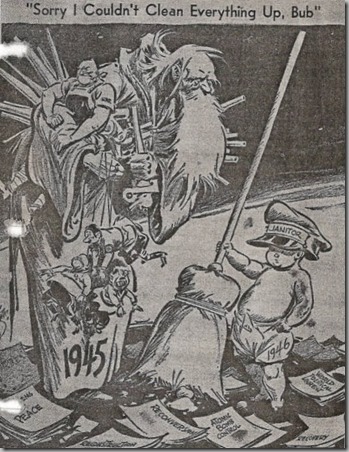
My mother kept a "commonplace book," in which she pasted poems, cartoons, articles from magazines, and things she'd hand copied or typed from books. I see familiar names--McCall's, Chicago Daily News, Farm and Ranch, Christian Herald, and Rockford Morning Star. As a child I would sit and look through it often--a small, 3-ring black leather notebook. I particularly enjoyed the poem, "For a female cat named Horace," because it reminded me of my friend's cat "Butch" who populated Forreston, IL with kitties and the one about how to make a recipe taste like mother's--walk 5 miles before dinner. She may have been saving clippings in a box for years, but the first item was the baby New Year 1946 with a broom greeting old man 1945 giving him a terrible mess. So here it is again, Mom, for 2018-2019. The world is still a mess and we need you.

1946 cartoon

I wrote about her commonplacebook in January  2010, and noted:

“Her final hand written entry (in the scanned copy) is undated; but it was near the end of her life--perhaps the end of 1999. She died in January 2000. There is no attribution other than her name.

    If
    Each day we fill a page
    The year a volume makes
    These last ten books are very full
    of joys
    changes
    sorrow
    growth.
    Gently place this year on the shelf--
    if there is room.
    Close the decade.

Monday, January 15, 2018

Beyond Impressionism, Monday Memories

Yesterday after the 9 a.m. service at UALC we went to the Columbus Museum of Art with Joan and Jerry and Howard and Betty, and thousands of others to see the last week of "Beyond Impressionism." (Ends Jan 21) Columbus is the only American city to host this wonderful show drawn entirely from a private European collection. Betty is a 35 year CMOA docent, so she gave us a lot of details and information. We also enjoyed a wonderful meal in the Schokko Art CafĂ©, but we hear it is closing in a week. I had the most delicious corn chowder, something I never get at home.  Worth the trip is the wonderful James R. Hopkins "Faces of the Heartland" exhibit featuring his paintings of the Cumberland Falls area of Kentucky 100 years ago. Years ago we vacationed in that area and even tried to do some paintings of the Falls. 
The busy day at CMOA and the final week of this show was featured on one of the local news shows last night. It's sort of fun to be cheek to jowl in a museum with a lot of screaming children. Hopkins was an OSU art professor and you can see some of his paintings in the Faculty Club. http://www.columbusmuseum.org/art/james-r-hopkins-faces-of-the-heartland/


Good fences make good neighbors


I’m old enough to have actually attended a poetry reading by Robert Frost, one of the 20th century’s most famous and favorite poets, when I was a student at the University of Illinois. My date that night was someone I'd met at Chinese Student Club, and I'm not sure if he understood anything, but he was polite and listened carefully.  In high school I can remember our English teacher, Mrs. Price, reading to us, “Mending wall.”  One of the most famous lines is, “Good fences make good neighbors,” but the poem actually begins with “Something there is that doesn’t love a wall,” which is his real message.  https://www.poetryfoundation.org/poems/44266/mending-wall

Frost tells of meeting a neighbor who owns the property on the other side of the wall in the spring to repair the damage to their wall of boulders and stones, each one walking his own side, and in some areas because of the terrain, no wall is needed.  But Frost wants to ask his neighbor, why do we need a wall, we don’t have cows who can escape or wander away? “Something there is that doesn’t love a wall” and causes it to fall, like the hunter and his dogs chasing and shooting rabbits, or maybe elves? His neighbor seems to move in darkness, just repeating what his father said, “Good fences make good neighbors.” So it isn’t Frost who says this—he’s too cosmopolitan and sort of sees his neighbor as a rube—it’s his old neighbor born and raised in the 19th century quoting his own father whose wisdom and fears go back even further. (It’s actually an almost universal proverb common in many languages.)

So with all the talk about a wall--it’s called a fence in the legislation  Democrats Obama, Schumer, Clinton and Pelosi voted for—what does it keep out and what does it keep in? But like Frost’s neighbor there are reasons, seen and unseen, to believe we need walls.
  • Those who are anti-wall would not deny a security firewall for the Wi-fi at their office or home. It keeps others from cyber mischief, or stealing bandwidth or passwords and codes. 
  • Those who are anti-wall would not deny themselves a guard dog—maybe a Rottie or shepherd mix, or more than one—to protect their home and children.  They may just have a small poodle or Chihuahua to make noise and alert them someone is on their property.
  • Those who are anti-wall have keys or codes to lock their house, their car, their safe, their work files. Yet all those things may first be secured within a gated community, and some gated communities have a guard in addition to walls, fence, gate, treacherous terrain and alarm bells.
  • Those who are anti-wall would not deny us privacy and safety within our own person.  We have Constitutional guarantees that wall off government from telling us where we can go to church or what we can think or say. 
  • Those who are anti-wall believe we have a right to personal behavior codes of modesty and safety that wall off our bodies and which should protect our sexuality and personhood from rape, assault, insult and bigotry, some are even codified in law, even if they aren’t in common sense or tradition.
  • Those who are anti-wall are also in the midst of a big cultural controversy brought about because the only wall left for sexual behavior seems to be “consent,” and that’s a "he said, she said" unwritten law wall. A pat, slap or flirt of 20 years ago has become grist for a law suit or career failure. There were/are no clear boundaries.
And then there are the municipal invisible fences or walls, like when I drive one mile north on a snowy day, I clearly know where Upper Arlington ends, and Columbus begins because the streets aren’t plowed.  There’s no sign or fence, but there is an invisible and actual boundary which provides different schools, tax rates, building codes, environmental regulations and city services which in turn put different values on homes and a variety of rents on businesses, insurance rates, and regulations for shopping centers. 

The Scioto River has a bridge, as does the Olentangy, and they have flood plains which prohibit building, but the real wall is the different township lines and city limits jurisdiction of Hilliard, Columbus, Upper Arlington, Grandview Heights, Clinton Township and Dublin. The birds and wildlife go back and forth freely, and to some degree, so do the people.  These communities with their visible, invisible and natural boundaries all cooperate on certain things, but no one I’ve ever met who lives in them has suggested we just become one big municipal blob called simply the Columbus Metropolitan Area, even if map makers and politicians think of us that way.

Back to Robert Frost.  Although he lived in a rural area when he wrote “Mending wall” he wasn’t a farmer, and he culturally wasn’t rural. He was born in San Francisco, had lived in the Boston area and had been living in Europe before purchasing his New Hampshire farm.  He’s sort of poking fun at the ideas of his neighbor’s concept that the wall actually improve their relationship.  Would Frost have purchased property where no one knew the boundary?  Were there once cows or sheep kept by former owners, but they were stolen or wandered away before the wall? Were the boulders and stones he and the neighbor replace when they’ve fallen down, once brought there by a glacier and by repurposing them into a wall, was the land made more useful?

And of course, by living in a rural farmhouse surrounded by a fence and inhospitable terrain as well as peace and quite, Frost himself built another kind of wall, at least temporarily, so he could write, teach and lecture. And become famous.

Monday, October 23, 2017

Monday Memories--the Tulamo anniversary tour

Dinner at Houlihan's Oct. 22
The Tulamos have been with us eight days out of their 6 week tour of the United States to celebrate their 40th wedding anniversary.  We met about 38 years ago when Riitta was a student at the veterinary college at Ohio State University.  We helped them find an apartment, loaned them a bicycle, brought them to church with us, and enjoyed many happy holidays and family occasions with them.

We picked them up on Monday evening at the airport and came home for dinner. On Tuesday we went to the Columbus Museum of Art (see earlier blog).  On Wednesday Steve and Valerie Regoli picked them up at our home in the morning and brought them home late at night. On Thursday and Friday we went to Lakeside to see the cottage where we spend our summers.  In looking at our cottage guest book we saw it was Oct. 19, 1991, they had been there on a previous trip back to the states (but it was very cold that year).  That night we ate at Cleat's. The weather couldn't have been better and after a visit to the lighthouse on Friday we had a picnic on the Lakefront. Friday night we went out to eat with our daughter and son-in-law at the Rusty Bucket in Upper Arlington to celebrate his birthday.  On Saturday we drove to Circleville to the pumpkin show--something like 400,000 people show up to look at one block of pumpkins and 10 blocks of carnival rides and food. On Sunday after church we had a brunch for 18 at our home and invited the few people still around who knew them almost 40 years ago, and on Monday they visited the studio in German Village of a cartoonist Bob knows.  That evening we went out as their guests to Houlihan's for dinner--a final anniversary dinner, which they've done in each location they've visited--Napa Valley in California, Colorado, Minneapolis, Wisconsin. Now they are off to Boston for some final sight seeing.
Group selfie at dinner, Oct. 15
Group selfie at the lake, Oct. 18
At Lake Erie Oct. 18
 Our shoes at Marblehead
Boats docked at Cleat's, Oct. 18
Brunch for Tulamos Oct. 21


Monday, September 25, 2017

Monday Memories--jury duty September 2002

From a letter. "I am on jury duty for two weeks and have been selected for a jury, but we’re not meeting until 1:30 this afternoon.  It seems like a strange way to run a circus, but apparently the judges are several weeks on civil and then on criminal, so our judge this week has been moved to criminal, so our case is being squeezed in to her new schedule.  This is the county, so there are about 90 people called for each week and you are on duty for two weeks. On the first day several women in our group went to City Center for lunch.  The orientation told us to get to know each other, and it seems a very compatible group. It is interesting to see the different ages, races, genders sitting around chatting like old friends. I'm feeling really patriotic. We get pep talks from court workers, lawyers and judges when they see us wilting from the waiting and the heat. I read on the bulletin board in the jury room that only 45% of Americans are called for jury duty and only 17% ever actually sit on a jury. Most cases go to mediation or are settled before they come to trial. The biggest challenge is getting there and parking.  I practiced several times the week before.

Now that I'm getting really good at navigating the streets of downtown Columbus, dodging the utility trucks tearing up streets, the orange barrels, and the construction sites, I have time to actually read the names of streets as I pass on my way to the construction site called Rt. 315. One main street is called "Commit to be Fit." It was apparently renamed by our mayor who is unhappy that we have won the honor of 5th fattest city in the USA.

 But I came down with a cold late Thursday.  Fortunately, my case didn’t meet on Friday, so I just laid around most of the week-end.  I had to cancel my birthday dinner with Phoebe and Mark, but Phoebe stopped by Sunday with a nice present, and on Saturday Mark brought me a box of Puffs and some tapioca.  Because of my heart medicine I’m not suppose to take any over the counter cold remedies.  So I just have to snuffle and sneeze through the testimonies."

Update 2017:  The case for which I was seated involved Ohio's infamous Scott-Pontzer insurance law which was finally reversed in 2003. It was incredibly confusing and caused me to lose chunks of faith in our laws and our jury system. It was referred to as the Golden Turkey award and had allowed employees and their families injured on their own time in their own cars to collect from their employers’ auto insurance policies

https://www.clevescene.com/cleveland/absurd-at-any-speed/Content?oid=1481862

Monday, September 18, 2017

Monday Memories--my ablation and hospitalization


From a letter. "I had my ablation (AV node reentry slow pathway) on January 18th [2002].  Then while I was wearing a Holter monitor on the 29-30th, it picked up some serious a-fib again (this was my fault for doing too much while we were moving to our condo and having the house closing).  Apparently the pulmonary veins don’t know the ship has left the dock and they continue to do what they’ve always done.  So it was back to the hospital for 3 days to be put on Rythmol. It sure is good to be out of the hospital!  The doctor didn't make rounds until about noon, so I didn't get out until about 1:30 Friday. I had lunch there--it was pretty good, a vegetable lasagna.

I only got 2 hours sleep each night.  The woman in my room was on some sort of machine suctioning fluids and gurgling--sounded like a creek running through the room.  A long time smoker, she had emphysema and an aneurysm. Plus, because her surgery was so serious, there were always medical staff trooping in and out, and when they weren't testing her, they seemed to be taking my blood pressure or temperature or giving me medication, but not all at once, just spacing it out so I couldn't sleep. Anyone who can survive in a hospital must be pretty darn healthy. I felt sorry for this woman's daughters though. They had flown in from different states, and would sleep in the lounge and then come in and try to watch her. They were exhausted, and of course, it is pretty boring just sitting. And they frequently had to alert the nursing staff to problems, so I think it is very important that family be around when there is surgery recovery.

My first morning there, about 5 a.m., I was watching two male staff, one teaching and one learning, drop off our medication.  They unlocked the two boxes for 4007 for bed A (Bruce) and bed B (her name), and I heard the one tell the other “this is for Bruce,” and he pulled out box B, looked at the name, and put mine in it, thus mixing up our medication.  The learner was definitely old enough to need glasses and he had a white pony tail hanging from his almost bald head. So when the RN came in I told her.  She went over and unlocked the boxes, looked at the names, and switched them.  The next morning, I noticed he was wearing glasses.

Holly brought in dinner Thursday night to the hospital, and all the stuff for a manicure (a huge bag of colors to choose from) and gave me a nice relaxing manicure. So that evening I had Bob, Lindsey, Holly, and Mark and Phoebe at my bedside, but only one chair. Phoebe brought me tapioca from the Chef-o-Nette which is located in our old neighborhood.  Either the manicure or the tapioca could be a special gift to anyone in the hospital.  Holly has artificial nails, but knows how to do it. Phil stopped in on Thursday and Friday morning and brought me Caribou coffee from my favorite coffee shop."

Monday, September 11, 2017

Monday Memories--Aunt Muriel September 2002

From a letter.  "Aunt Muriel called twice this month to wish us a Happy Anniversary and also on my birthday.  I said something about my last letter, but she didn’t receive it for two weeks.  I looked back in the computer, and I’d written it Sept. 4.  Even allowing that maybe it sat a day or two, it seems even by pony express it should’ve made it to Illinois by the 11th.  I said to Bob that sometimes I don’t know how she stays so perky.  She no longer has parents, husband or siblings, and most of her contemporaries have passed away. I think she and Mom lived next door to each other for 40 years, and as a teenager she lived with my parents.  I was the one to tell her of the death of her last surviving cousin, making her the only surviving cousin out of 28.  Fortunately Diane and Frank live close by--I think they visit almost every week-end.  She is really wonderful to her mother.  Just a rock."

Monday, September 04, 2017

Monday Memories--Book club memories 2002

From a letter. "I had book group here September 9. I finished the book, “John Adams,” that Monday morning!  I made my mother’s apple walnut “Autumn bread” recipe and Phoebe’s cheese ball with crackers.  The leader, Carolyn A. did a fabulous job.  She’s been a John Adams fan for 20 years, and brought along all her other books about him, many of which had wonderful illustrations.  Our next selection for Oct. 7 is “Peace like a River” by Leif Enger.  I’ve been taking it down to jury duty, but haven’t made much progress.  In December I’ll be leading “The Persian Pickle Club” by Sandra Dallas, a wonderful story about women in the Depression.  Everyone loved the condo [we'd moved in January 2002].  It was still light enough they could see the grounds.  One lady asked me if we overlooked a park.  It really is that lovely.  I must get busy and finish the decorating.  It is hard after you live with it for awhile, because you sort of don’t notice some of the oddities.  This group formed in 1979, and still has about 3 or 4 of the original members, and some who’ve been with it for 19 or 20 years.  I didn’t join until I retired in 2000, so I’m a real novice at reading on command.   One woman said that when they started they had 20 women and 24 babies."

From a letter.  "Book group meets tonight, [November 4, 2002].  I stop at Adrienne’s about 2 miles north, and she’ll drive us up to Muirfield (northwest of here) to the hostess’ home.  The book is Anne Tyler’s “Back when we were grown ups,” and I can’t say I enjoyed it much.  I hope someone else has something to offer.  I can’t imagine a woman taking so long (she is 53 when the novel opens) to figure out her 4 daughters are all losers. With names like Patch, No-No, Biddy, and Min-Foo, what can you expect? Although people usually talk about Tyler’s humor, I thought the only funny part was when she gets together with her old boyfriend from high school/college for dinner (she is a widow and dumped him to marry her husband) and finds out what a dud he is too.  She had sort of romanticized the memory of their time together. I sort of felt they deserved each other--she’s been wearing a fake happy face for 30 years and he’s been following rigid routines and is mad because she walked out on him."

Monday, August 28, 2017

Monday Memories--sailing

Saturday, August 26, Bob went sailing with Tom, our neighbor, Jim another neighbor and Tom's brother Steve.  He often goes out with Jack, Tom's 12 year old son on the sunfish, but Tom also has a 32' sailboat with a cabin with bathroom and shower, small kitchen.  They were out about 2.5 hours.  I went to the end of the dock to see them (Bob called), but they didn't get very close.


Monday, July 03, 2017

Monday Memories of a great Sunday

Is it too early to recall what a lovely day Sunday, July 2, was at Lakeside?

After enjoying a brunch at the Patio, we all went our separate ways for awhile--me to a nap after I made a pot of soup, Bob went down to the lake to help with Kids' Sail, and Dan and Joanie (our niece and nephew) went up to try out the new pool which had been dedicated the day before. Then at 6 p.m. the Central Ohio Brass Band played at the gazebo in Central Park and the lake looked fabulous.  After that we had a stroll along the lakefront to look at the sculptures people make from the rocks. Then an evening to good conversation on the porch.  A perfect summer day.

So many people waiting--someone had to leave to get in.

And Danny didn't have his sun screen!

Steele Memorial with Central Ohio Brass Band

Enjoying the concert and the beautiful view

Hollyhocks and rock sculptures along the lakefront


Monday, June 12, 2017

Monday Memories--Letter from Dad, June 18, 2001

A letter from Dad.  He always left the correspondence up to Mom, but I did have a few notes from him after her death in January 2000, and found this one recently.  I had been writing him frequently, maybe once a week.

Monday, June 18, 2001
Dear Norma,
As I promised I’m going to write you a letter, so you can tell all your friends.  I’m going to go from Sunday backwards, instead of starting a week ago and go forward like you do.

Church 9 a.m.   June 17
Home at 10:45
Over to 408 Sunset at 12 noon.  Drove to Byron, but before getting out of the car, Ruth said, “This is on me.  I’m filling in for Norma and Joanne.  They would pay if they were here.” Back to Mt. Morris by 2 p.m.
At 3:00 Ruth and I went to the Baptist Church dedication.  The old one burned 2 years ago and they have been worshiping in the Leaf River Grade School since.  I don’t know why the Baptists have all the good speakers and we have none.
Back at 408 by 6 p.m.  Home by 7:30.

Saturday June 16
Went to Rockford to see J. Groenewold. Then to K’s Merchandise to buy electric razor 10 a.m. Home by 12. Nothing except weeds and napping rest of the day.

Friday, June 15
Took Gene and Betty to VFW in Oregon for Fish Fry. I’m sure they liked it.  They have a meal every Friday night as a fund raiser.
Tomorrow night Ruth and I are going to “Good Samaritan” supper as a fund raiser for Pinecrest.  Tickets on Ruth $100.00.

Thanks for all you and Bob have done to make my life at 11 West 1st the joy that it has become. You two were a great help in my adjusting to life without Olive.  I still miss her every day.
Love, Dad

Monday, June 05, 2017

Monday Memories--The Methodists are Coming, June 1995

The Methodists were coming to Lakeside for their Annual Conference in June 1995--thousands descend--first West Ohio and then East Ohio, or the other way around. One used to be German speaking the other English, but I don't remember which is which.  It is the only time we rented, and it meant Spring cleaning and putting all our personal effects away.  I must have gone up and down the basement steps 50 times (would have been smarter to just go to the laundromat) with bedding, blankets, rugs, and towels. The house is tiny, but the basement is even smaller, and the steps are at a terribly steep pitch. And spiders love it there, so I also swept and debugged the basement. The plastic cover on the deck furniture looked scummy, so I washed that in the machine with Clorox, then the deck looked sort of greenish in spots so I scrubbed it with a Clorox solution. Bob spent the day mowing, clipping, weeding and washing windows. The closets and drawers were stripped and their contents go into the cedar chest. Phoebe and Mark had a few items stashed under beds, so those were removed to a box on the front porch. Two shelves in the linen closet were emptied for the guests, and the medicine cabinet cleaned out. Cupboards were emptied so the Methodists have room for food, and somehow, it is just a good time to make a clean sweep of things, which meant 4 bags of trash. How we accumulated so much in a house we don't live in, I don't know. We finished about 6 p.m. and cleaned up and walked down to the Patio Restaurant for dinner, because I'd had to clean out the refrigerator, too.

The cottage was Grand Central Station that June day in 1995. I decided I should get hot, sweaty and dirty more often, because company shows up. Mike and Donna Conrad had purchased a lovely wooden bench at Wal-Mart and couldn't get it in their car, so I drove Mike there in our van to pick up the bench. Bob had to measure a cottage for which he's doing construction documents, and two unhappy clients showed up (not unhappy with him but with the contractor). And a contractor stopped by. Then Mike showed up with a plate of cookies from Donna, and a another neighbor brought over a kitty litter container she thought we'd like. Her husband, who is an auctioneer, had picked up a bunch of them.

So I've decided what I need in Columbus is a visit from some Methodists! Once a month, say the 15th, I'll declare it "The Methodists are Coming" day, and I'll do one area a month. Five areas upstairs, and seven areas downstairs. I haven't seen my kitchen counter since Phoebe and Mark's wedding, so in honor of the Methodists, I'll probably start in the kitchen. Today I washed 175,000 margarine tubs. I could swear they reproduce. I didn't start buying soft margarine until after the kids were gone, but those babies sure do accumulate!

On Memorial Day Week-end, Mark's parents had stopped by at Lakeside, so we had 8 for dinner. We created a "children's table" on the deck and Phoebe and Mark and Phil and Tiffany sat out there, and Paul and Marylyn and we sat in the kitchen. Marylyn is going to a workshop for choir directors the last week in June, so they had driven over from Cleveland to look for a cottage to rent.

(Notes from a letter to my parents in June 1995)

Monday, May 29, 2017

Monday Memories--Medical Library Assocation June 1-5, 1996

I got back from the Medical Library Association Annual Meeting in Kansas City about 1 p.m. on Tuesday afternoon.  I was there only 4 days, and chaired two meetings.  Glad that's over.  I know there are people who enjoy that sort of thing, but there are people who like to eat snails and jump from airplanes too, so go figure! 
Kansas City is a lovely city--seems much larger (is) and more cosmopolitan than Columbus, and much more self-aware.  The architecture is varied and dynamic and they've made a big effort to restore various areas.  The train station which used to see 250,000 people a day is empty but I think they are looking for a use for it--maybe a museum.  You get the feeling that KC is your last chance at urban living before hitting the plains, and maybe it was at one time.  The airport is miles and miles from the city, so although my airfare was pretty reasonable, a cab ride to the city is $30.  I found two other librarians at the airport, so we shared a ride. 
I shared a room with Vicki Kok from Virginia and Pat Mullen from Oklahoma.  Our hotel (Westin) was part of an 85 acre urban renewal complex maybe 20-25 years old now with attached shopping mall.  It looks just like Boston and San Antonio and Detroit in that sense.  All the stores and the merchandise are just the same if you stay in a hotel/mall complex.  As a chair of my section, I was invited to the president's reception which was held at Linda Hall Library, a huge privately endowed public library that specializes in the sciences.  I had wanted to see it for about 20 years, and was not disappointed.  It was fabulous.

Instead of going somewhere, our "tour" this year was a Missouri extension agent with his otter; “Reintroduction of River Otters in Missouri” by Glenn D. Chambers, Missouri Department of Conservation and Paddlefoot Productions Incorporated. He and his wife travel around with their two otters and demonstrate their behavior and talk about their habitat to school children.  He estimates he has talked to over 250,000 children in the last 4 years.  It was a very interesting program--I'd never seen an otter, and I guess they were almost extinct (fur trappers and draining swamps about eliminated them) in Missouri at one time, and now have about 800 in the wild.  He got two babies and they "imprinted" to him--he slept with them for the first several months.  He did this because his "real" job is a photographer, and in order to photograph otters in the wild he need some who weren't afraid of him.  He takes them out in the wild and photographs them, and then calls them in and they run and jump in their cages.  He was really great--drawled like a good 'ol boy but you knew he was one really smart guy--has done work for National Geographic and has a movie coming out. 

We had another program given by a guy from St. Louis about the Internet, "The Future of Veterinary Medicine on the Internet" by Ken Boschert, American College of Laboratory Animal Medicine, Division of Comparative Medicine, School of Medicine, Washington University. 

I already knew most of the stuff he talked about and he was doing 3 presentations that week, so it sounded a little canned.  Anyone who talks about computers in a way that I understand--well, I know he's not talking at a very high level, because I really struggle to keep up.


(from a letter to my parents)


Monday, May 15, 2017

Monday Memories of Kindergarten and Alameda

I'm looking at my kindergarten photo from Webster Elementary school in Alameda, California. I used Google to see if it still exists, but it closed in 1958 having served the Webster Housing Project, opening in 1944. I assume that project was all military family housing. I remember it as a wonderful, racially mixed neighborhood with people from all over the country and many nationalities. Families came there uprooted with fathers off to strange lands.

Looking at the photo more closely I begin to see the differences (all white children in my class although there were blacks in the school) and memories come to mind of the families who were terribly poor. No lunch programs in those days, but we did get free milk which tasted wretched. Wonder what was in it, because I liked milk. The school was a one floor plan with canopies outside joining the buildings to shade the sidewalks.  There were African American and Filipino children in my school and I’d never seen either, being from rural Illinois. Recess was on concrete instead of grass. Right from the beginning I loved school, except nap time on little rugs we brought from home. How boring.

My earliest Christmas memory is 1944 in Alameda, California. Dad was in the Marines and Mother had driven across the country in our 1939 Ford with four small children and my Aunt Muriel to find housing, schools, new helpful neighbors, and what I thought was a very exciting life. My recollection is singing carols in the fog--recalling that it wasn't like Christmas in northern Illinois. The community got together at a school to sing carols. Money was so tight, but Mom did her best. Not sure what the gifts were, but one was a little white glass cat which I still have.

Strange that with so little and living in constant fear of attack, we were all united then. Material riches certainly did not bring Americans any peace, even if we did win that war.

Monday, May 01, 2017

Monday Memories-- Medical Library Association, Washington D.C. May 15-21, 1992

I arrived in Washington around noon on Thursday, May 14, and was picked  up at the airport, then we rode the metro to a shopping area and had lunch at Slades.  We went to choir rehearsal at Immanuel Presbyterian and also got to see a video tape of the Spring musical.  Really cute.  We saw the famous Falls, after which I assume the towns are named. We ate those yummy cinnamon biscuits in the morning after our walks (surely they cancelled each other out).  There is a very convenient shopping center, Loehmann's Plaza, next door to the apartments where she lives.  Friday we toured Alexandria, an old restored village with lots of cute unique shops. We explored the Torpedo Factory with its wonderful crafts people and had lunch at a little deli overlooking a river (not sure which one).  We shopped on Saturday and bought yummies to eat at a health food grocery. That night we went to see a Goldie Hawn movie, "Crisscross," that was sort of a downer--not her usual comedy stuff.

The area she lives in is really lovely, and Virginia is so pretty in the spring.  She says I missed the peak color, but for one who has lived all her adult life in central Illinois, central Indiana and central Ohio, it looked pretty darn peaky to me! Sunday we went to Boulevard Baptist church where she plays the organ and in the afternoon went to a play, "How to succeed in business."  Karen picked me up there and we whipped into DC on a parkway that Karen knew about so I could register at my hotel and attend the conference of the Medical Library Association.

Washington is such an impressive city--there must be a million things to see and do there.  But the extent of my sight-seeing was one quick walk to the zoo, which was close to the hotel, and a 2 1/2 hour trolly/bus tour around the famous places.  I did get out and walk around the Vietnam Memorial.  It was good to see my friends from the other Veterinary Medicine libraries.  We only see each other once a year, but we have our electronic mail on the computer and a newsletter, so we keep in touch. The group visited the Zoo and talked to the veterinary staff and attended many meetings, none memorable enough to include either then or now!

One highlight of the meeting was when Compact Cambridge (an abstracting indexing service located in Cambridge, MA) took us all the Kennedy Center Tuesday evening for either a performance of the symphony, an opera, or a cabaret.  I saw "Pump Boys and Dinettes" and it was just fabulous.  It was rock, rock-a-billy, gospel, blues, honky tonk, and ballads, all taking place in a gas station with an adjoining dinette.  The actors were so versatile.  We had the best time. After the play we had a chocolate extravaganza, with fabulous desserts. 

The conference met Sunday through Wednesday. The veterinary medicine librarians met with the pharmacy librarians.  In 1993 the conference was planned for Chicago, (see my blog here) and I decided to fly out in the afternoon instead of the evening.  It is just too hard to get going the next day. This year I was back at work for 1 1/2 days, then we had a 3 day holiday, and then a 4 day week.  So I needed a little more adjustment time.

Later in May 1992, the Mid-Ohio  Health Sciences Librarians had their spring meeting in Columbus.

On Wednesday, the Mid-Ohio Health Sciences Librarians met for their spring meeting and we first had a guided tour of  "In Black and White" at the Wexner Center, our very controversial arts center here at Ohio State.  No, it wasn't a show about race, but fashion and the curator was Charles Kleibacker, Designer in Residence in Ohio State's Dept. of Textiles and Clothing (he died in 2010).  The show brings together actual examples of fashion from the 1920's to the 1990s by designers such as Chanel, Dior, Galanos, Givency, Armani and Mackie.  Everything was either black or white, even the sets.  Samples of designer's studios and workrooms were also worked into the show.  One thing was apparent--if the fabric is lovely and the design good, the dress is timeless.  The dresses from the 20's and 50's looked just as good as the day they were first paraded down a runway in Paris.  (Images of Kleibacker shows)

Then as an unexpected bonus, we slipped into a lecture by designer Shannon Rodgers, (d. 1996) who designed clothes for many movies.  He was designing back in the 1930's so he was in his 80's, but his presentation was very interesting and witty.  He was still working for the fashion museum at Kent State.  He did a mini-fashion show for us with three models.  One was wearing what he designed for Rosalynn Carter, one he did for Dinah Shore, and various other famous people. The Wexner Center is so impossible to show anything in, that a special exhibition space had to be designed to fit within the exhibit area, and that was interesting too.

After the show, we all walked to a campus dive/restaurant to have our business meeting.  As 15 middle-age librarians trooped in, all the tie-dyed, earringed -shaved heads turned to stare. We librarians really know how to shake up a place. The food was great.

(Notes on this memory are from my 1992 letter to my parents about MLA and Mid-Ohio.)


Monday, April 10, 2017

Monday Memories--September 2003

Winds of war.  I think I know how this current situation in Syria will play out.  Big stories about WMD. Photographs of the horror.  A Republican president responds initially with support of both parties.  After action is taken, Democrats will decide to back off and stab the president in the back demoralizing the troops and giving comfort to the enemy.

I came across a letter from September 2003 while cleaning out my paper files.  I noticed this comment--not mine--about the media, especially the Washington Post, which I think has really become a useless source of information since Bezos (Amazon) bought it and even some thoughts on North Korea.  It seems things weren't much different almost 14 years ago.
"The Post bashes Bush every chance they can, though they were behind him on the war.  Their feature political cartoon is hilarious, and never flattering to the President.  He is always pictured with huge ears.  I have never noticed his ears--they must be somewhat large?  All these hearings, and everything else connected with the war makes me feel like "haven't we been there, done this before?" . . . Wonder if any of the boys on the Hill are thinking creatively about finances, or will we, as taxpayers, continue to pay the tab.  WWII has been over a long time, and all we need is one hit from N. Korea and it would take out a lot of our guys with little warning.  We just don't have the manpower to have troops stationed all over the world trying to keep a lid on things."
Not remembering that the Post had ever supported Bush, I attempted to track down what the Washington Post editorial board had said about the war in February 2003, and found another source that quoted it asking how anyone could doubt the seriousness of the WMD charges. The actual link didn't connect because later WaPo became very critical of Bush so I think the link was disabled at their end. These days, WaPo might as well be a mouth piece from a foreign, hostile government.

The news is on in the background as I draft this.  It really does sound like nothing has changed.

Monday, April 03, 2017

Everything changed after 1995--Monday Memories

The pre-Christmas holiday in 1995 was wonderful at my sister-in-law Jean's home in Indianapolis.  Even Bob's brother Jimmy DeMott was there with his girlfriend, Nancy, and his children.  My mother-in-law June was doing well considering that the year before she had almost died of a bleeding ulcer and her husband had died in October.  We were, of course, sad at the loss of my father-in-law Jim DeMott that holiday and we had been making weekly trips that fall to Indianapolis to be with Bob's mother. But it was good to have everyone, including lively little Caleb and Jake, together.

Yet, after that holiday season, with the warm "Christmas card" memories, everything seemed to change. It was one funeral and life change after the other, like someone wound up a toy too tight and it spun out of control.

In less than two months, my sister Carol Yoder died of a diabetic stroke and most of my family made the trip to Sarasota to say good bye and then to Mt. Morris for burial.  We helped my parents move from their home of 38 years a few blocks away into a retirement apartment at Pinecrest in Mt. Morris.  Bob's Aunt Babe died in May 1996 and my Aunt Marian died in September of 1996.  Then I was hospitalized and diagnosed with a heart problem.  Sam Calabretta, the architect who brought us to Columbus in 1967 and changed our lives, died in January 1997.  My mother had surgery for colon cancer in June and I hurried back to Illinois.  My boss at the OSU Libraries, Jay Ladd, died that summer.  Our daughter had surgery for thyroid cancer in February 1997.  My mother-in-law June moved into assisted care, then a nursing home, and died in September 1998.  My Uncle John Dickson died in January 1999, and Bob's dear Aunt Roberta DeAngelis, his father's older sister, died in July 1999.  Our son Phil got married in February 1999 and my sister came back to Illinois to marry in August 1999 as my parents also celebrated their 65th wedding anniversary.  My Uncle Leslie, Mom's brother, died that November.  Orville Ballard, Dad's dear friend and also his uncle and best man in his wedding, died in January 2000.  It just a few weeks and then my mother died on January 24, 2000.  Aunt Esther Corbett, whose nick-name was PeeWee, died a few weeks later in California.  In February 2000 divorce stole a beloved nephew of 16 years from the family. Then we returned to Mt. Morris to help Dad move again after he bought my grandparents' former home, a Lustron, in April 2000.  It was there we celebrated our 40th anniversary in September 2000 as I retired from my library career at Ohio State University.  In January 2002 we moved from our home of 34 years on Abington Road into a condo, same community, but a few miles north.  Then I had a heart ablation to correct the problem diagnosed in 1996 while we were unpacking.  In April we moved Dad to a care facility in Franklin Grove, IL because his congestive heart failure diagnosed in June 2000 worsened, and he died May 18, 2002. In 2003 we traveled to California to celebrate with the Bruce relatives and siblings Dad Bruce's 90th birthday, and he died in April 2005.

In ten short years we had become the older generation of our extended families.

The day we moved Dad into the Lustron

Monday, February 20, 2017

Monday Memories--moving the books out

My friends and I compare notes on how we're doing in clearing out the clutter. Three are planning moves to retirement apartments; we're not there yet, but we want to do some rearranging. Our photo albums are taking over the house--I think I counted 70! We did a massive sweep about 11 years ago, but it all came back.  Before I got sick in January, I'd started on the books again, and then last week renewed the effort.  The books have been rounded up and herded into the garage, tied with some twine, and Christmas ribbon, but there's not much change on the shelves. They'll go to the church, the cancer resale shop, the public library, our son, and the sailing books we'll take to the lake next time to see if a neighbor wants them.  A lot of cookbooks went this time.  That's unusual for me, but they were mainly just hanging around to remember the good times.  I have in that stack a 12 volume set of the Woman's Day Encyclopedia of Cookery that I bought one week at a time at the grocery store in the 1960s, and many Taste of Home Annuals. If you are looking for a new set of that encyclopedia, it goes for about $2,000 according to Amazon, or about $40 used.  I think there are volumes in my set that are "new."  I wrote a Thursday Thirteen blog about my cookbooks in 2006.  

Then I decluttered in 2009 about 8 years ago. Shelves looked pretty good, but still tight.

Another set (tied in red ribbon in the photo) is the Famous Writers school of writing, 3 volumes plus an annual. I found them at a used book store about 20 years ago when I was doing more writing, but never really used them. Lots of famous names. According to Wikipedia, as many as 90% never finished the course, so perhaps this was from a disgruntled student. There was eventually a law suit. But I think there should be 4 volumes.  Going through the architectural journals I found an annual that included some places we've been like Thorncrown Chapel.

The bookshelves with all those titles removed, still very full.