"I didn't hear about WWI memories [from my parents] until sometime in the early 1990s. I had interviewed my father for an oral history to include in a family recipe collection for a reunion of the descendants of his parents who had died in 1983. I had interviewed my mother about her parents' personal library for two articles I wrote. Both recalled in their 80s the first Armistice Day (now called Veterans' Day) even though they were 5 and 6 years old. I imagine they listened in on adult conversations and caught the fear and dread that gripped their communities. My mother's father who was 44 was registered for the draft. And although I haven't seen the record, I would assume my father's father, who was a much younger man (25), did too.
There were no radios or television, and newspapers would have been too slow. So the plan was to ring bells when word came to the nearest town that the armistice had been signed. The church bells would be rung; then each farmer would begin to ring the bells they used on the farm; then the next farmer a few miles further away would hear and begin ringing his bells. Both my parents had exactly the same memory of that first Armistice Day--hearing bells tolling throughout the countryside from all sides. The war was over."
Showing posts with label Veterans' Day. Show all posts
Showing posts with label Veterans' Day. Show all posts
Thursday, November 11, 2021
The eleventh hour of the eleventh day of the eleventh month--Veterans' Day
As we were driving back from the lake today, I apologized to my husband for telling him a story I've told many times. When I finished he said he'd never heard it. Here it is from my blog, November 11, 2009:


Monday, November 11, 2019
Veterans Day, 2019
When we were kids, November 11 was called Armistice Day—because it was the 11th hour of the 11th day of the 11th month of 1918—the end of World War I. And oh my, how many wars since then! My parents remembered and told stories about the first Armistice Day since they were about 5-6 years old and remembered the celebrations. I like to think of them running around as kids, in adjoining counties—Lee and Ogle--but not knowing each other, listening to the farm bells, celebrating what they probably didn’t understand. But since both my grandfathers had been registered for the draft, at least they could put that worry aside.
Dad, being deceased, technically is not honored today—that’s for Memorial Day, but he “was inducted into the Marine Corps in March, 1944, at San Diego, California. After completing his training, he was assigned to the U.S.S. Mayo and made two trips across the Atlantic and one trip each to Okinawa, the Philippines and Japan. He was discharged in December, 1945.” [War Record of Mt. Morris] It is my recollection he was home in time for Christmas that year, and I think Mom went all out—we got the doll house (to share) and the sled (to share). I’m not sure what he gave my brother, but we three girls each got pure silk hand bags—mine was red and yellow—I had it well into adulthood packed away, but have no idea where it is now. Dad had worked for Standard Oil before going into the service, and he still had a job, but not the same territory, so he was driving every day to the area around Forreston and Freeport, and that’s why we moved in 1946 (or could have been early 1947—memory is a bit rusty).
The Mt. Morris Index kept up with all the soldiers away from home and although we have none of his letters I was able to include one of his letters to the Index about a mix-up in his mail, August 1944 when he was still a private in one of my memory compilations of 2002. The information from the Index I found in a file folder Dad kept in his desk on Lincoln St.--they would be 75 years old if someone in the family still has those newspaper clippings. There are a few references to our family which moved to Alameda, California, while he was stationed in California. I think the editor (Tommy ?) did that for all the men who were in the war. In the June 29, 1945, clipping it mentions he was a payroll clerk on the Mayo. He told me years later that because he could type (won a prize at Polo H.S.) he wasn’t in combat. I’d always figured it was because he had 4 children and was in his 30s—much older than most of the men! He had a leave he spent in Mt. Morris because his ship was docked in Boston, but we were on the road with our mother returning from California, and didn’t get to see him.
Wednesday, November 11, 2009
Veterans Day
The eleventh hour of the eleventh day of the eleventh month. I've told the story of how my parents, who were very young children, heard about the end of WWI. Because WWII was the defining event of their young married life, I'd never thought to ask them about WWI, until. . .  Dad's brother John was inducted into the Army in December, 1942. He served with glider troops in North Africa and Sicily. In England during preparation for the invasion of France, he served as glider instructor. He took part in the invasion of Normandy and was wounded then and again in Belgium. He was discharged in June 1945. Uncle Russell, Dad and John's younger brother (probably still a teen) served in
Sitka, Alaska, and then was with the first wave of Marines who stormed Iwo Jima and was wounded; he was awarded the Purple Heart. Dad's cousins Andy, Bill and Phil were in the Army serving in Europe, Philippines and Korea; his cousin Wayne and brother-in-law Glaydon (Gramps) were in the Navy and served in the Pacific; cousin-in-law Harlan served in the Army in New Guinea and the Philippines; brother-in-law Johnny was in the Coast Guard; brother-in-law Charlie was also in the service, but I don't know the branch. Another brother-in-law, my mother's brother Clare, was in the Army Air Force and died in the China, Burma India Theater in 1944.
Dad served on the U.S.S. Mayo and made two trips across the Atlantic and one trip each to Okinawa, the Philippines and Japan. Not bad for a farm kid who had probably not been further away from home than Chicago and never learned to swim.
All but two of these men were from the same town and all are deceased now. [Service records and photos of over 400 men and women for a town of less than 3,000 appear in "War Record of Mount Morris" edited by Harry G. Kable, 1947.] Even the town band was part of the National Guard and served in the Fiji Islands. (From a blog I wrote 11/10/05)
Dad's brother John was inducted into the Army in December, 1942. He served with glider troops in North Africa and Sicily. In England during preparation for the invasion of France, he served as glider instructor. He took part in the invasion of Normandy and was wounded then and again in Belgium. He was discharged in June 1945. Uncle Russell, Dad and John's younger brother (probably still a teen) served in
Sitka, Alaska, and then was with the first wave of Marines who stormed Iwo Jima and was wounded; he was awarded the Purple Heart. Dad's cousins Andy, Bill and Phil were in the Army serving in Europe, Philippines and Korea; his cousin Wayne and brother-in-law Glaydon (Gramps) were in the Navy and served in the Pacific; cousin-in-law Harlan served in the Army in New Guinea and the Philippines; brother-in-law Johnny was in the Coast Guard; brother-in-law Charlie was also in the service, but I don't know the branch. Another brother-in-law, my mother's brother Clare, was in the Army Air Force and died in the China, Burma India Theater in 1944.
Dad served on the U.S.S. Mayo and made two trips across the Atlantic and one trip each to Okinawa, the Philippines and Japan. Not bad for a farm kid who had probably not been further away from home than Chicago and never learned to swim.
All but two of these men were from the same town and all are deceased now. [Service records and photos of over 400 men and women for a town of less than 3,000 appear in "War Record of Mount Morris" edited by Harry G. Kable, 1947.] Even the town band was part of the National Guard and served in the Fiji Islands. (From a blog I wrote 11/10/05)
- "I didn't hear about WWI memories until sometime in the early 1990s. I had interviewed my father for an oral history to include in a family recipe collection for a reunion of the descendants of his parents who had died in 1983. I had interviewed my mother about her parents' personal library for two articles I wrote. Both recalled in their 80s the first Armistice Day (now called Veterans' Day) even though they were 5 and 6 years old. I imagine they listened in on adult conversations and caught the fear and dread that gripped their communities. My mother's father who was 44 was registered for the draft. And although I haven't seen the record, I would assume my father's father, who was a much younger man, did too.
There were no radios or television, and newspapers would have been too slow. So the plan was to ring bells when word came to the nearest town that the armistice had been signed. The church bells would be rung; then each farmer would begin to ring the bells they used on the farm; then the next farmer a few miles further away would hear and begin ringing his bells. Both my parents had exactly the same memory of that first Armistice Day--hearing bells tolling throughout the countryside from all sides. The war was over."
 Dad's brother John was inducted into the Army in December, 1942. He served with glider troops in North Africa and Sicily. In England during preparation for the invasion of France, he served as glider instructor. He took part in the invasion of Normandy and was wounded then and again in Belgium. He was discharged in June 1945. Uncle Russell, Dad and John's younger brother (probably still a teen) served in
Sitka, Alaska, and then was with the first wave of Marines who stormed Iwo Jima and was wounded; he was awarded the Purple Heart. Dad's cousins Andy, Bill and Phil were in the Army serving in Europe, Philippines and Korea; his cousin Wayne and brother-in-law Glaydon (Gramps) were in the Navy and served in the Pacific; cousin-in-law Harlan served in the Army in New Guinea and the Philippines; brother-in-law Johnny was in the Coast Guard; brother-in-law Charlie was also in the service, but I don't know the branch. Another brother-in-law, my mother's brother Clare, was in the Army Air Force and died in the China, Burma India Theater in 1944.
Dad served on the U.S.S. Mayo and made two trips across the Atlantic and one trip each to Okinawa, the Philippines and Japan. Not bad for a farm kid who had probably not been further away from home than Chicago and never learned to swim.
All but two of these men were from the same town and all are deceased now. [Service records and photos of over 400 men and women for a town of less than 3,000 appear in "War Record of Mount Morris" edited by Harry G. Kable, 1947.] Even the town band was part of the National Guard and served in the Fiji Islands. (From a blog I wrote 11/10/05)
Dad's brother John was inducted into the Army in December, 1942. He served with glider troops in North Africa and Sicily. In England during preparation for the invasion of France, he served as glider instructor. He took part in the invasion of Normandy and was wounded then and again in Belgium. He was discharged in June 1945. Uncle Russell, Dad and John's younger brother (probably still a teen) served in
Sitka, Alaska, and then was with the first wave of Marines who stormed Iwo Jima and was wounded; he was awarded the Purple Heart. Dad's cousins Andy, Bill and Phil were in the Army serving in Europe, Philippines and Korea; his cousin Wayne and brother-in-law Glaydon (Gramps) were in the Navy and served in the Pacific; cousin-in-law Harlan served in the Army in New Guinea and the Philippines; brother-in-law Johnny was in the Coast Guard; brother-in-law Charlie was also in the service, but I don't know the branch. Another brother-in-law, my mother's brother Clare, was in the Army Air Force and died in the China, Burma India Theater in 1944.
Dad served on the U.S.S. Mayo and made two trips across the Atlantic and one trip each to Okinawa, the Philippines and Japan. Not bad for a farm kid who had probably not been further away from home than Chicago and never learned to swim.
All but two of these men were from the same town and all are deceased now. [Service records and photos of over 400 men and women for a town of less than 3,000 appear in "War Record of Mount Morris" edited by Harry G. Kable, 1947.] Even the town band was part of the National Guard and served in the Fiji Islands. (From a blog I wrote 11/10/05)
Saturday, November 07, 2009
Veteran's Day is coming
We've already had our parade here in Columbus, but November 11 is the actual day we honor our veterans. I hope to find a few new photos.
But today I came across this story again, "World War II Rescue of Prison Ship Survivors" and it was as interesting as when I first linked to it in 2005--maybe more so as people psychologize a mass murderer at Ft. Hood, and weep for and provide free legal services for the detainees at Gitmo who are too vicious to be released either to their home countries or our prisons set up for run-of-the-mill criminals.
But today I came across this story again, "World War II Rescue of Prison Ship Survivors" and it was as interesting as when I first linked to it in 2005--maybe more so as people psychologize a mass murderer at Ft. Hood, and weep for and provide free legal services for the detainees at Gitmo who are too vicious to be released either to their home countries or our prisons set up for run-of-the-mill criminals.
- Aside from having been in the water for four days without any food and practically nothing to drink, these men had been slaves in the Malay Peninsula for three years, since Singapore fell, and they themselves were in no darn physical shape to withstand any hardships, so our immediate problem was to get them below and get them in a bunk and give them some food. We did that - prepared some soup and broth for them - I remember that night we gave them some bread, it was the first white bread they had had in three years. We gave them some broth, warm water, tea, and they were still very active all that night - we finished recovering them just about dark, and all that night they were very active, talked, told us stories of how their ships had been sunk in a convoy, and how thankful they were, and about their life in the Army beforehand. But next morning, when we went down to look at them, boy, they were really tired out, there wasn’t a one of them rolling around a bit, it had been quite a mental strain and they keeled over completely.
The story they told us was that they, some of them, hadn’t even been in the Army two weeks and they were shot right up to Singapore to reinforce the garrison up there. After they got there, about three days, Singapore fell and they were taken prisoners, put up into various parts of the Malay Peninsula, and their most recent job had been to build a railroad down the Peninsula. They, all during this time, had suffered quite a few hardships. They had no food that they were used to at all, they had rice only. They had practically no medical care, they had no clothes, they all went barefooted. Everyone of them on board had malaria, most of them had pellagra, beriberi, bad cases of scurvy, and then they had salt-water sores on them that they got when they were in the water before being recovered. Our pharmacist’s mate was really faced with a problem, he had to make immediate inspection of all of them to find anybody who had serious injuries that he could fix up and then he had to slowly work through the rest of the crowd and fix up the little scratches and bruises and cuts and things like that, which he did. We were running sort of short of medical supplies too, I know, we didn’t have enough gauze or bandage to take care of these 73 men. About 10 or 12 cases were critical. We had to put them in bunks in the after battery with a special nursemaid - they were actual bad patients, where to others, boy, you should have seen them stacked up back there. We put two in each bunk and four in each torpedo rack in the after torpedo room and we were very profusely apologizing for the lack of space we had to offer them and they were very profusely saying, “That’s all right, you should have seen the space we’ve been living in,” because they said that they use to just stack them in the these troop-transports, everywhere they would go; when they would ride in trucks anywhere, they would just stack them in like bundles, and then didn’t mind this little space at all.
Sunday, November 11, 2007
Veterans' Day
Today is the 89th anniversary of the end of World War I--the eleventh hour of the eleventh day of the eleventh month. I've told this before, but on that first armistice day the signal in the rural areas of Illinois was the bells ringing. My parents were both little children living on farms in adjacent counties (Lee and Ogle) in Illinois. Both had exactly the same memory--as each farmer heard the bell, he'd start ringing his bell, then the next farm would pick it up, and thus the whole countryside learned the war was officially over. Now it is a memorial for veterans of all wars (Memorial Day in May is for those who died in or as a result of battle).
Google, which often dresses up for other occasions, finally acknowledged it--the helmets are definitely WWI vintage.

When I was in Illinois over the 4th, we found our father's name at the new veterans' memorial in Forreston. We talked about all the surnames we recognized, even from the Civil War era (we're really not that old, but knew the family names).
The U.S. Army in WWI, 1917-1918
Army Art of WWI
My other blogs about this day
Veterans' Day 2006
Uncle Clare
Happy Birthday Marines
Armistice Day, 1918
List of US military conflicts
Friday, November 10, 2006
Friday Family Photo--Veterans Day
Tell them of us, and say,
For your tomorrow
We gave our today
Kohima Epitaph
Across the nation we're observing Veterans Day, November 11, which memorializes the end of WWI (armistice was the eleventh hour of the eleventh day of the eleventh month in 1918), and honors all veterans of the armed services. Today's photos are my Uncle Clare looking sharp and spiffy in his dress uniform in New Orleans and home on leave with his parents. He was 32 when he went into the Army Air Force in 1942. I think he could have had an exemption because he was a farmer and essentially was managing the Illinois and Iowa farms for his parents who were 68 and 66, and doing all the physical work on the home place. But I think he also saw the war as an opportunity to do some of the things he'd always dreamed of--he was a fabulous mechanic and loved airplanes. I have a dim memory of my mother telling me he couldn't be a pilot because of a hearing problem, but was trained for photographic mapping, and was an aerial engineer for the 24th Mapping Squadron of the 8th Photo Group, Reconnaissance (10th Air Force) which served in the China, Burma, India theater.


On a Geocities site I found the following information about this squadron: "The 8th Photographic Reconaissance Group arrived in India on 31 March 1944, assuming operational control of the 9th Photographic Reconaissance Squadron, 20th Tactical Reconaissance Squadron and 24th Combat Mapping Squadron on 25 April 1944, with the 40th Photgraphic Reconaissance Squadron joining the unit on 6 September 1944.
The main mission of the units attached to the 8th Photographic Reconaissance Group was to gather phtographs to be used in making target maps, assessing target damage and identifying potential targets"
Clare and a pilot were killed in an explosion when the plane hit a gasoline supply, through the stupidity of his commanding officer who insisted the men go up in a blinding storm. No one else in that unit lost his life and we found out how Clare died when a great nephew attended one of their reunions. I'm glad my grandparents never knew since they suffered this loss so terribly the rest of their lives (died in 1963 and 1968).
Searching the internet I found lists of accident reports, alphabetic by name of the soldier or civilian--thousands and thousands died in accidents--and his name is listed. Also found this report of USAAF Serial Numbers, "64105 (F-7A, 8th BRG, 24th CMS) w/o on takeoff accident at Hsing Hing, China Oc 29, 1944" which I assume was his plane since nothing else matches the date.
Originally buried near Chengtu, China after his death on October, 29, 1944, Uncle Clare came home on the Honda Knot in 1947 (I found this information on a Lee County, IL obituary web site) with over 200,000 dead soldiers and sailors with fighter escorts and awaiting dignitaries. While we waited in rural Illinois to bury him with other family in Ashton, he was being welcomed home in San Francisco:
"In San Francisco, a similar ceremony took place under an overcast October sky as the army transport ship Honda Knot slipped through the frigid waters beneath the Golden Gate Bridge into San Francisco Bay. An aerial escort of forty-eight fighter planes flew over the vessel before dipping their wings in salute and banking away. Surface ships from the Coast Guard and the Navy approached the Honda Knot and led her through a misting rain to anchorage off Marina Point, where a gathering of five thousand mourners waited to pay tribute to the war dead that the ship was delivering home to American soil from the Pacific theater. A navy launch approached the Honda Knot and offered another massive wreath from President Truman. Dignitaries in the audience included Army General Mark Clark, who had led American troops in Italy during the war, and the Secretary of the Navy John L. Sullivan, who honored these fallen heroes, many of whom had passed under the Golden Gate Bridge on ships bound for the Pacific war. Six of the 3,012 flag-draped coffins aboard the Honda Knot were removed the next day to lie in state in the rotunda of San Francisco’s city hall, where ordinary citizens of a sorrowful nation paid their last respects. The six dead represented servicemen from the Army, the Navy, the Marine Corps, the Air Force, and the Coast Guard, along with a civilian, all killed in the war. From the early morning until late that night, thousands of mourners filed by the coffins of knelt in prayer by their sides. The arrival of the Honda Knot and the Joseph V. Connolly officially initiated what one observer called the "most melancholy immigration movement in the history of man," the return to the United States of 233,181 American dead after the end of World War II. America's army of fallen warriors was coming home from the four corners of the earth, from Guadalcanal and Australia, from New Guinea, Japan, China, and Burma in the Pacific theater. From the Mediterranean theater men were returned from Libya, Sicily, Italy, Yugoslavia, and Romania. The bodies of men who had died in France, Belgium, Luxembourg, and Germany also came home. David Colley site
Clare is listed on this memorial site for the 10th Air Force.
Update: The National Archives has a site for WWII Honor List of Dead and Missing. You select by branch of the military, then by state, then by county. I found Uncle Clare, although his name was misspelled.
Veterans Day, War Memorials, World War II, Army Air Force, 10th Air Force, China Burma India Theatre
Thursday, November 10, 2005
1756 Happy Birthday Marines
Semper Fi, and thank you all veterans and current armed forces members for your service this Veterans' Day.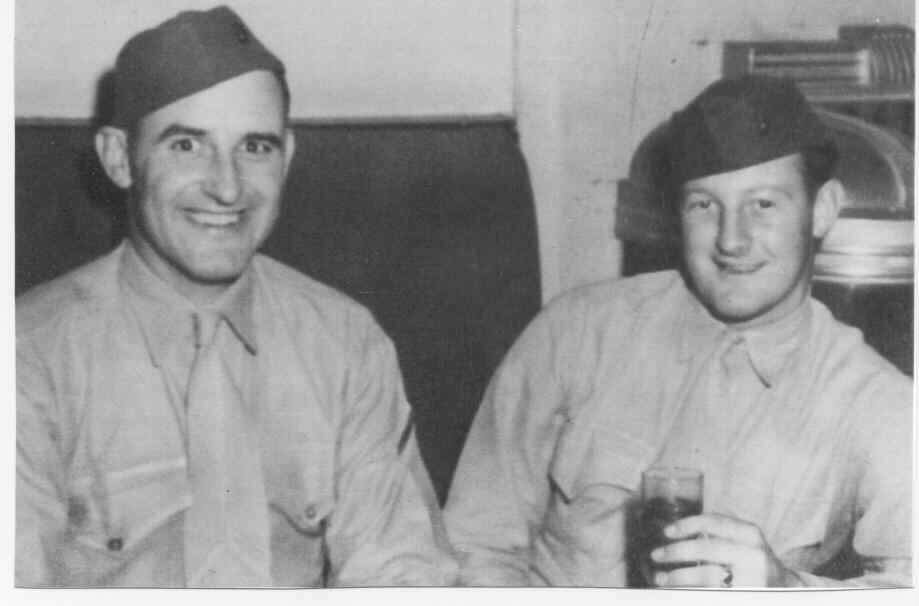
"On November 10th, 1775, the Second Continental Congress resolved to raise two battalions of Continental Marines marking the birth of our United States Marine Corps. As Major General Lejeune's message reminds us, the ensuing generations of Marines would come to signify all that is highest in warfighting excellence and military virtue. Each November as Marines the world over celebrate the birth of our Corps, we pay tribute to that long line of "Soldiers of the Sea" and the illustrious legacy they have handed down to us." Message from M. W. Hagee General, U.S. Marine Corps
Dad's brother John was in the Army and took part in the invasion of Normandy and was wounded then and again in Belgium; Russell served in Alaska and then was with the first wave of Marines who stormed Iwo Jima and was wounded; their cousins Andy, Bill and Phil were in the Army serving in Europe, Philippines and Korea; cousin Wayne and brother-in-law Glaydon were in the Navy and served in the Pacific; cousin-in-law Harlan served in the Army in New Guinea and the Philippines; brother-in-law Johnny was in the Coast Guard; brother-in-law Charlie was also in the service, but I don't know the branch. Another brother-in-law, Clare, was in the Army Air Force and died in the China, Burma India Theater.
Dad served on the U.S.S. Mayo and made two trips across the Atlantic and one trip each to Okinawa, the Philippines and Japan. Not bad for a kid who had probably not been further away from home than Chicago and never learned to swim.
All but two of these men were from the same town and all are deceased now. [Service records and photos of over 400 men and women for a town of less than 3,000 appear in "War Record of Mount Morris" edited by Harry G. Kable, 1947.] Even the town band was part of the National Guard and served in the Fiji Islands.
Subscribe to:
Posts (Atom)


 Posts
Posts


