Showing posts with label vinegar. Show all posts

Monday, January 01, 2018

A busy New Year's day

I started the day out right--I cleaned my coffee maker with vinegar and water.  So many germs can grow in your automatic coffee pot, you should clean it often. The smell is strong enough to open your sinuses!

Follow these steps to a quick coffee maker cleaning:

  1. Empty your coffee maker, rinse the carafe and ensure that the filter basket is properly set and empty. Remove the permanent coffee filter as well as the water filter, if applicable.
  2. Fill the water reservoir with a solution of equal parts of water and regular white household vinegar.
  3. Run it through a drip cycle.
  4. When the cycle is finished, turn off your coffeemaker but allow the water/vinegar to sit in the carafe for a few minutes, to remove any scale deposits, then discard the solution.
  5. You should run clear water (no vinegar) through your coffee maker at least twice, allowing your brewer to cool down between cycles. This will remove any lingering vinegar residue.

  1. This is a good time to thoroughly wipe the exterior of your coffee maker and clean the removable filter basket, permanent filter and carafe with hot soapy water. A change of water filter is also a good idea if your brewer has one.
  2. https://www.thespruce.com/clean-coffee-maker-with-vinegar-1907384?
Then I signed up for a class at Coursera, an online education site from colleges and universities all over the world.  I picked "Understanding clinical research: behind the statistics."  I worked in the Veterinary Medicine Library for 14 years and although I still love reading the medical literature, my eyes glaze over when it comes to statistics. There are several levels of classes, and I chose this one also because it is free unless you want credit.  I don't plan on needing a credit course, so free is good.

https://www.coursera.org/learn/clinical-research/home/welcome

I've printed off the "keynotes" which go along with the videos and text--85 pages.  I also signed in to my "peer" group, which aren't really my peers--medical students, pharmaceutical reps, doctors, etc. But they are from all over the world--one poor guy is from Syria and living in Ukraine!  And I'm off!

And I spent some time looking at old Fulton J. Sheen videos.  His may be the best explanation of Communism and prophecy of the future ever. Bishop Fulton J. Sheen did this program in 1955. He was a hater of Communism, but lover of the Russian people. He reads from Dostoevsky who in 1871 predicted what was to come for his country, and possibly ours. He died in 1979, and since he was from central Illinois, his pronunciation sounds fine to me. "Warshington."  https://www.youtube.com/watch?v=GE9FNwG5myA

Sunday, June 19, 2016

Practical uses for leftover pickle brine

1. A Post-Workout Drink
Many sports medicine professionals swear by pickle juice as a method for staving off muscle cramps and replenishing lost electrolytes after intense workouts, according to NBC News.
Indeed, studies have confirmed that in large enough amounts pickle juice can be an effective treatment for workout-induced muscle cramps.
2. A Vinegar Substitute
Pickle juice is great in marinades, salad dressings, and even bread dough! For recipes that include pickle juice, check out The Kitchn’s guide to culinary uses for pickle juice.
3. Hangover Cure
Alcohol is a diuretic. Drinking lots of it will basically leave you dehydrated. Fortunately, pickle juice can help to get your sodium levels back to where they need to be. Just take a sip before you got to bed.
4. PMS Remedy
It works the same way as it would for a post-workout cure because it helps to hydrate the body and alleviate cramping. Simply drink 1/4 cup of pickle juice.
5. Heartburn Relief
The vinegar in pickle juice can help with heartburn just like how Apple cider vinegar can help as well. Take a sip before every meal and see if you notice a difference.How To Recycle The Brine
One of the most popular ways to use leftover pickle brine is in recipes for pickling other foods! You can re-use pickle juice as a quick way of pickling more cucumbers, or other vegetables like radishes, summer squash, or even hard-boiled eggs in the refrigerator. Just make sure the juice is clear and doesn’t look cloudy or murky.
 
Food In Jars recommends that you only re-use pickle brine up to three times – after that, too much brine volume as been lost, and a scum may start to develop in the brine, making it less than healthy.
 
Now that you know several ways to use pickle juice, there’s no need to throw out this useful liquid again! Whether you drink it straight up or in a cocktail, use it in a recipe, or recycle it to make refrigerator pickles, there’s plenty of use for leftover pickle brine.

Saturday, August 24, 2013

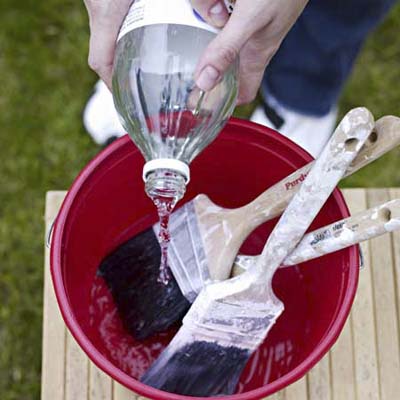
Old paint brushes

cleaning brushes in a bucket of vinegar

I was trying to remember this today. From Old House Magazine website:  “Soak gunked-up nylon brushes in hot vinegar for up to 30 minutes to remove paint and soften the bristles. Afterward, wash them in hot, soapy water, brushing off paint as needed, then rinse and let dry—good as new.”  Now if we tried this with gunked up window hardware, would it work?

Wednesday, February 07, 2007

Things I wonder about--the tomato

Every morning I drink 6 oz. of tomato juice with a Tbsp. of vinegar. Very tastey. It's much lower in calories than orange juice and has 90% of the daily requirement for Vit. C, plus a bunch of other good stuff you won't even notice. Cold tomato juice gives me a stomach ache so I buy the little unbrand 6 packs and don't refrigerate them. What puzzles me is why a 1/2 cup of spaghetti sauce or a 1/2 cup of stewed tomatoes is so much lower in percentage of vitamin C. I've read labels of tomato products that have virtually zero vit. C listed.