I usually ignore these memes, but I read it today, and it sort of sobered me. Especially thinking about those 99%. How many of these ring true for you, 99 % of those born between 1930 and 1946 (worldwide) are now dead. If you were born in this time span, you are one of the rare surviving 1% ers of this special group. Their ages range between 77 and 93 years old, a 16 year age span.
INTERESTING FACTS ABOUT THE 1% ers:
You are the smallest group of children born since the early 1900's.
You are the last generation, climbing out of the depression, who can remember the winds of war and the impact of a world at war that rattled the structure of our daily lives for years.
You are the last to remember ration books for everything from gas to sugar to shoes to stoves.
You saved tin foil and poured fried meat fat into tin cans.
You can remember milk being delivered to your house early in the morning and placed in the "milk box" on the porch.
Discipline was enforced by parents and teachers.
You are the last generation who spent childhood without television; instead, you "imagined" what you heard on the radio.
With no TV, you spent your childhood "playing outside".
There was no Little League.
There was no city playground for kids.
The lack of television in your early years meant that you had little real understanding of what the world was like.
We got "black-and-white" TV in the late 40s that had 3 stations and no remote. (Kids were normally the remote.)
Telephones were one to a house, often shared (party lines), and hung on the wall in the kitchen (no cares about privacy).
Computers were called calculators; they were hand-cranked.
Typewriters were driven by pounding fingers, throwing the carriage, and changing the ribbon.
'INTERNET' and 'GOOGLE' were words that did not exist.
New highways would bring jobs and mobility. Most highways were 2 lanes (no interstates).
You went downtown to shop. You walked to school.
The radio network expanded from 3 stations to thousands.
Your parents were suddenly free from the confines of the depression and the war, and they threw themselves into working hard to make a living for their families.
You weren't neglected, but you weren't today's all-consuming family focus.
They were glad you played by yourselves.
They were busy discovering the postwar world.
You entered a world of overflowing plenty and opportunity; a world where you were welcomed, enjoyed yourselves.
You felt secure in your future, although the depression and poverty were deeply remembered.
Polio was still a crippler. Everyone knew someone who had it.
You came of age in the '50s and '60s.
You are the last generation to experience an interlude when there were no threats to our homeland.
World War 2 was over and the cold war, terrorism, global warming, and perpetual economic insecurity had yet to haunt life.
Only your generation can remember a time after WW2 when our world was secure and full of bright promise and plenty.
You grew up at the best possible time, a time when the world was getting better.
More than 99% of you are retired now, and you should feel privileged to have "lived in the best of times!"
If you have already reached the age of 77 years old, you have outlived 99% of all the other people in the world who were born in this special 16 year time span. You are a 1% 'er"!
* * * * * *
My parents didn't get a TV until they could get color transmission from Rockford, IL--I think it was 1957 and I was already away at college.
No, don't remember Little League, but we had community "commercial leagues" sponsored by local businesses, and the American Legion sponsored teams. There was a Corbett Oil team (my dad sponsored it). For younger kids I think there were "junior" teams. Anyone else remember that?
Yes, I remember party lines. We were 59-L. My older sisters (teens) were telephone operators so we knew the gossip.
Walking to downtown and school was about same distance. Small and smaller towns.
Playgrounds were school grounds. Easy to get to. Also, streets and sidewalks were safe. If you were playing soft ball you'd just yell, CAR.
Not sure our lives overflowed with plenty, but I do remember our first refrigerator which replaced the ice box. Big boxes were fun.
Yes, polio was huge in my memory. Affected family and friends.
I don't recall a time of no international threats. We had duck and cover drills and classroom movies about "the bomb." All the theaters had WWII movies. Plus we had parents who remembered the Depression and lived accordingly.
And, although I never thought much about it at the time, we had pretty clothes. Today's closet for a young girl is full of sweats, T-s, and ugly shoes.
Showing posts with label 1950s. Show all posts
Showing posts with label 1950s. Show all posts
Thursday, August 22, 2024


Tuesday, August 15, 2023
It costs less to thrive today
I've often been suspicious of the memes that claim no one can afford the middleclass lifestyle enjoyed in the 50s-60s when many families had only one earner--the dad. I'd scratch my head and thought about the average home size in the 1950s--1,000 sq. ft. and the average cost of a 2-3 bedroom, 1 bathroom house, about $10-11,000 ($140,000 today). And the gardens that produced for Mom's canning after all the work she put in to get it to that stage; and the clothes lines that dried the clothes from our labor intensive wringer washer; and our party line telephone we used for taking Dad's orders from his customers; and all the painting, wallpapering, plumbing and carpentry my Mom did. I thought about the higher tax rates, both federal and local, as people were rebuilding their lives after WWII and the Korean War. Did anyone have health insurance? We didn't (except polio insurance, fortunately since my sister Carol got it and the family, not the nation was quarantined). We all had 2 vaccinations--small pox and later polio by 1955. And we only went to the dentist when the tooth hurt, and only to the doctor if bleeding or vomiting. Vacations? Never knew anyone who took one. Credit cards hadn't been invented yet. One car for our family of six. But we never went without--we all went to church camp; we all had music lessons; we visited our grandparents every weekend. Our parents stayed married despite all these "hardships" of only one phone and no TV and they didn't take out college loans for us.
What's unique about this article is it shows that the middle class really is thriving, but it's all how you look at the statistics about square footage, consumer goods, taxes, and abundance. This author compares the cost to 1985 instead of 1955, but the message works for 70 years as well as 40. Nice that you don't have to be a victim, which seems to be the big message these days.
What's unique about this article is it shows that the middle class really is thriving, but it's all how you look at the statistics about square footage, consumer goods, taxes, and abundance. This author compares the cost to 1985 instead of 1955, but the message works for 70 years as well as 40. Nice that you don't have to be a victim, which seems to be the big message these days.
Friday, January 21, 2022
The One percenters--an internet meme sent by a friend
Some of you are younger and not in the 1% age group. I decided to send it as a history lesson of what life was like then.
Yes, I am one of the One Percenters and thank God every day that I do remember all of this - the Good and Not So Good. Let us continue to Stay Safe-Healthy-Strong to enjoy each day.
One percenters . . .The 1% Age Group.
This special group was born between 1930 and 1946 = 16 years. In 2021, the age range is between 75 and 91.
Are you, or do you know, someone "still around?"
Interesting Facts For You . . .
You are the smallest group of children born since the early 1900’s.
You are the last generation, climbing out of the depression, who can remember the winds of war and the impact of a world at war which rattled the structure of our daily lives for years.
You are the last to remember ration books for everything from gas to sugar to shoes to stoves.
You saved tin foil and poured fried meat fat into tin cans.
You saw cars up on blocks because tires weren't available.
You can remember milk being delivered to your house early in the morning and placed in the "milk box" on the porch.
You are the last to see the gold stars in the front windows of grieving neighbors whose sons died in the War.
You saw the 'boys' home from the war, build their little houses.
You are the last generation who spent childhood without television; instead, you “imagined” what you heard on the radio.
With no TV until the 1950's, you spent your childhood "playing outside." There was no Little League.
There was no city playground for kids.
The lack of television in your early years meant that you had little real understanding of what the world was like.
On Saturday mornings and afternoons, the movies gave you newsreels sandwiched in between westerns and cartoons.
Telephones were one to a house, often shared (party lines), and hung on the wall in the kitchen (no cares about privacy).
Computers were called calculators; they were hand cranked.
Typewriters were driven by pounding fingers, throwing the carriage and changing the ribbon.
'INTERNET' and 'GOOGLE' were words which did not exist.
Newspapers and magazines were written for adults and the news was broadcast on your radio in the evening.
The Government gave returning Veterans the means to get an education and spurred colleges to grow.
Loans fanned a housing boom.
Pent up demand, coupled with new installment payment plans opened many factories for work.
New highways would bring jobs and mobility.
The Veterans joined civic clubs and became active in politics.
The radio network expanded from 3 stations to thousands.
Your parents were suddenly free from the confines of the depression and the war, and they threw themselves into exploring opportunities they had never imagined.
You weren't neglected, but you weren't today's all-consuming family focus.
They were glad you played by yourselves until the streetlights came on.
They were busy discovering the postwar world.
You entered a world of overflowing plenty and opportunity; a world where you were welcomed, enjoyed yourselves and felt secure in your future although the depression poverty was deeply remembered.
Polio was still a crippler.
You came of age in the 50's and 60's.
You are the last generation to experience an interlude when there were no threats to our homeland.
The second world war was over, and the cold war, terrorism, global warming, and perpetual economic insecurity had yet to haunt life with unease.
Only our generation can remember both a time of great war, and a time when our world was secure and full of bright promise and plenty.
You grew up at the best possible time, a time when the world was getting better.
You are "The Last Ones."
More than 99 % of you are either retired or deceased, and you feel privileged to have "lived in the best of times!"
Amen! It’s great being part of the 1% Special Group! And I'll drink to that . . . yes it was good times . . .
Yes, I am one of the One Percenters and thank God every day that I do remember all of this - the Good and Not So Good. Let us continue to Stay Safe-Healthy-Strong to enjoy each day.
One percenters . . .The 1% Age Group.
This special group was born between 1930 and 1946 = 16 years. In 2021, the age range is between 75 and 91.
Are you, or do you know, someone "still around?"
Interesting Facts For You . . .
You are the smallest group of children born since the early 1900’s.
You are the last generation, climbing out of the depression, who can remember the winds of war and the impact of a world at war which rattled the structure of our daily lives for years.
You are the last to remember ration books for everything from gas to sugar to shoes to stoves.
You saved tin foil and poured fried meat fat into tin cans.
You saw cars up on blocks because tires weren't available.
You can remember milk being delivered to your house early in the morning and placed in the "milk box" on the porch.
You are the last to see the gold stars in the front windows of grieving neighbors whose sons died in the War.
You saw the 'boys' home from the war, build their little houses.
You are the last generation who spent childhood without television; instead, you “imagined” what you heard on the radio.
With no TV until the 1950's, you spent your childhood "playing outside." There was no Little League.
There was no city playground for kids.
The lack of television in your early years meant that you had little real understanding of what the world was like.
On Saturday mornings and afternoons, the movies gave you newsreels sandwiched in between westerns and cartoons.
Telephones were one to a house, often shared (party lines), and hung on the wall in the kitchen (no cares about privacy).
Computers were called calculators; they were hand cranked.
Typewriters were driven by pounding fingers, throwing the carriage and changing the ribbon.
'INTERNET' and 'GOOGLE' were words which did not exist.
Newspapers and magazines were written for adults and the news was broadcast on your radio in the evening.
The Government gave returning Veterans the means to get an education and spurred colleges to grow.
Loans fanned a housing boom.
Pent up demand, coupled with new installment payment plans opened many factories for work.
New highways would bring jobs and mobility.
The Veterans joined civic clubs and became active in politics.
The radio network expanded from 3 stations to thousands.
Your parents were suddenly free from the confines of the depression and the war, and they threw themselves into exploring opportunities they had never imagined.
You weren't neglected, but you weren't today's all-consuming family focus.
They were glad you played by yourselves until the streetlights came on.
They were busy discovering the postwar world.
You entered a world of overflowing plenty and opportunity; a world where you were welcomed, enjoyed yourselves and felt secure in your future although the depression poverty was deeply remembered.
Polio was still a crippler.
You came of age in the 50's and 60's.
You are the last generation to experience an interlude when there were no threats to our homeland.
The second world war was over, and the cold war, terrorism, global warming, and perpetual economic insecurity had yet to haunt life with unease.
Only our generation can remember both a time of great war, and a time when our world was secure and full of bright promise and plenty.
You grew up at the best possible time, a time when the world was getting better.
You are "The Last Ones."
More than 99 % of you are either retired or deceased, and you feel privileged to have "lived in the best of times!"
Amen! It’s great being part of the 1% Special Group! And I'll drink to that . . . yes it was good times . . .
HT to Jan Fritz, member of my church
Friday, July 24, 2020
Remembering our “golden” past of the 1950s
It’s interesting that even liberals who see everything in the 21st century as dark, racist and the fault of the GOP, can think of the 50s-60s in Mt Morris, Illinois (or Oregon, or Polo, or Columbus, Ohio) as a time of a golden era. I read a lot of blogs, and that misty, foggy view is common among 70-80 year olds. My husband whose high school was larger in acres and people than Mt. Morris, thinks the same thing. Of course, it’s not true; go through your high school annuals and you’ll see people who were white, but were marginalized because they were fat, or ugly, or low intelligence or unathletic or who never got the help they needed or who dropped out of school after 7th or 8th grade at age 16 or 17.

The U.S. in 2020 is so much less racist, less unfair, with more opportunity and ladders to success for the poor than we enlightened folk of the 50s could have ever imagined. We had devoted, but poorly paid teachers, and today the average hourly wage for a public school teacher is over $67/hour—far more than accountants, architects, librarians, farmers, and muffler repairmen. And statistically, there are far fewer poor and marginalized all over the world. Unfortunately, there’s something about being human – enough is never enough. We’re greedy and ungrateful to God for all he supplies. Slavery is also a bigger trade in the 21st century than it was in the 18th yet, U.S. and Europe are expected to take the blame for what happened 300 years ago. Life will never be fair. Some things at the micro-level are better, but the macro tells a more ominous story. And people still use the specter of slavery to grab power as well as to build your smart phone.
The U.S. federal social statistics are difficult to read because they always move the goal, but in 1959, families in poverty in the U.S. were 20.8%, and families headed by women were 49.4% (that was a much smaller numerical figure then). In 2018, the last year for compiled stats, poverty for families was 9.7% and for families head by women 26.8%. https://www.census.gov/data/tables/time-series/demo/income-poverty/historical-poverty-people.html The federal government aid has done a lot to dismantle the economic model of the family, but a lot of economic aid is poured into that mistake, and the female headed households are not the victims they used to be, despite the gap. And as I’ve noted before, I still remember the first time I saw a black man in a TV series (Bill Cosby, I Spy) and the first time I saw a black man as a retail clerk in a major chain (Penney’s, Champaign, IL, early 1960s).
So let’s keep some perspective. And watch for the power grabs of today, much of it happening very quickly in the fog of the pandemic.

(I think this is 1954, confirmation class Trinity Lutheran for 1957 graduates)
The U.S. federal social statistics are difficult to read because they always move the goal, but in 1959, families in poverty in the U.S. were 20.8%, and families headed by women were 49.4% (that was a much smaller numerical figure then). In 2018, the last year for compiled stats, poverty for families was 9.7% and for families head by women 26.8%. https://www.census.gov/data/tables/time-series/demo/income-poverty/historical-poverty-people.html The federal government aid has done a lot to dismantle the economic model of the family, but a lot of economic aid is poured into that mistake, and the female headed households are not the victims they used to be, despite the gap. And as I’ve noted before, I still remember the first time I saw a black man in a TV series (Bill Cosby, I Spy) and the first time I saw a black man as a retail clerk in a major chain (Penney’s, Champaign, IL, early 1960s).
So let’s keep some perspective. And watch for the power grabs of today, much of it happening very quickly in the fog of the pandemic.
Wednesday, December 18, 2019
Are you smarter than a 7th grader?
This was a comment on a post about impeachment on Facebook.
“Jack is in 7 th grade and the other day he was the only one in his history class that knew that The House and Senate make up Congress. So what does that tell you. I really don’t put that in the schools though. What’s wrong with parents? Because they probably don’t know either. Look how many people think The President is going to be removed from office.”
I’m looking back to 7th grade (1952), and I’m not so sure I knew who or what made up Congress. Did you? Harry Truman was president. That was about as far as class discussions went on politics. My parents had a mixed marriage—one Democrat, one Republican—don’t recall a political discussion in our house.
Friday, October 26, 2018

Monday, January 01, 2018
A busy New Year's day
I started the day out right--I cleaned my coffee maker with vinegar and water. So many germs can grow in your automatic coffee pot, you should clean it often. The smell is strong enough to open your sinuses!
https://www.coursera.org/learn/clinical-research/home/welcome
I've printed off the "keynotes" which go along with the videos and text--85 pages. I also signed in to my "peer" group, which aren't really my peers--medical students, pharmaceutical reps, doctors, etc. But they are from all over the world--one poor guy is from Syria and living in Ukraine! And I'm off!
And I spent some time looking at old Fulton J. Sheen videos. His may be the best explanation of Communism and prophecy of the future ever. Bishop Fulton J. Sheen did this program in 1955. He was a hater of Communism, but lover of the Russian people. He reads from Dostoevsky who in 1871 predicted what was to come for his country, and possibly ours. He died in 1979, and since he was from central Illinois, his pronunciation sounds fine to me. "Warshington." https://www.youtube.com/watch?v=GE9FNwG5myA
Follow these steps to a quick coffee maker cleaning:
- Empty your coffee maker, rinse the carafe and ensure that the filter basket is properly set and empty. Remove the permanent coffee filter as well as the water filter, if applicable.
- Fill the water reservoir with a solution of equal parts of water and regular white household vinegar.
- Run it through a drip cycle.
- When the cycle is finished, turn off your coffeemaker but allow the water/vinegar to sit in the carafe for a few minutes, to remove any scale deposits, then discard the solution.
- You should run clear water (no vinegar) through your coffee maker at least twice, allowing your brewer to cool down between cycles. This will remove any lingering vinegar residue.
- This is a good time to thoroughly wipe the exterior of your coffee maker and clean the removable filter basket, permanent filter and carafe with hot soapy water. A change of water filter is also a good idea if your brewer has one.
- https://www.thespruce.com/clean-coffee-maker-with-vinegar-1907384?
https://www.coursera.org/learn/clinical-research/home/welcome
I've printed off the "keynotes" which go along with the videos and text--85 pages. I also signed in to my "peer" group, which aren't really my peers--medical students, pharmaceutical reps, doctors, etc. But they are from all over the world--one poor guy is from Syria and living in Ukraine! And I'm off!
And I spent some time looking at old Fulton J. Sheen videos. His may be the best explanation of Communism and prophecy of the future ever. Bishop Fulton J. Sheen did this program in 1955. He was a hater of Communism, but lover of the Russian people. He reads from Dostoevsky who in 1871 predicted what was to come for his country, and possibly ours. He died in 1979, and since he was from central Illinois, his pronunciation sounds fine to me. "Warshington." https://www.youtube.com/watch?v=GE9FNwG5myA
Monday, September 25, 2017
School closing due to heat
I don't know how many MMHS graduates remember this, but they actually did close the school one September in the 1950s because it was too hot. I was there. Of course, our homes didn't have AC or fans either, but . . . Today Columbus is sending the kids home early due to the heat.


Saturday, August 26, 2017
Mona Lisa smiles
Earlier this year our daughter gave us Roku, a device that allows streaming if you have an internet connection. I selected quite a few movie channels, but most were just awful. In fact, I didn't know there were so many terrible movies until I started browsing my Roku possibilities. Finally, I found a channel with Roku with some good movies (free), FXM. We watched Mona Lisa Smile with Julia Roberts (2003) last night because I didn't care much for the program at Hoover in Lakeside. We'd seen it when it was fresh, but since it is a period piece (1954) it doesn't age, even if its view of the early 50s is a bit prejudiced (said to be based on H. Clinton's recall). True, college women thought a lot about marriage in those years (at least I did in the late 50s), and we'd joke about the PHT degree, putting hubby through, but when I see the serial relationships and rape charges today, or educated women starting families at 40, are college students so much better off or prepared for life's challenges in 2017?
http://www.rogerebert.com/reviews/mona-lisa-smile-2003
Ebert opines: "Julia Roberts is above all an actress with a winning way; we like her, feel protective toward her, want her to prevail. In "Mona Lisa Smile," she is the conduit for the plot, which flows through her character. The major supporting roles are played by luminaries of the first post-Julia generation, including not only Dunst, but Julia Stiles as Joan Brandwyn, a girl smart enough to be accepted by Yale Law but perhaps not smart enough to choose it over marriage; Maggie Gyllenhaal as Giselle Levy, who is sexually advanced and has even, it is said, slept with the studly young Italian professor, and Ginnifer Goodwin as Constance Baker, who is too concerned about her looks."
It was certainly better than this Rolling Stone review: "The girls are played by a who's who of young Hollywood womanhood — Kirsten Dunst, Julia Stiles, Maggie Gyllenhaal — each given one emotion to play and each forced to stare at Roberts in awe for showing them the way. That Mike Newell (Donnie Brasco, Four Weddings and a Funeral) directed this insulting swill is beyond depressing. Women of the Fifties, rise up in protest."
https://www.chicagoreader.com/chicago/history-versus-her-story/Content?oid=914311
http://www.threemoviebuffs.com/review/mona-lisa-smile.html
http://www.rogerebert.com/reviews/mona-lisa-smile-2003
Ebert opines: "Julia Roberts is above all an actress with a winning way; we like her, feel protective toward her, want her to prevail. In "Mona Lisa Smile," she is the conduit for the plot, which flows through her character. The major supporting roles are played by luminaries of the first post-Julia generation, including not only Dunst, but Julia Stiles as Joan Brandwyn, a girl smart enough to be accepted by Yale Law but perhaps not smart enough to choose it over marriage; Maggie Gyllenhaal as Giselle Levy, who is sexually advanced and has even, it is said, slept with the studly young Italian professor, and Ginnifer Goodwin as Constance Baker, who is too concerned about her looks."
It was certainly better than this Rolling Stone review: "The girls are played by a who's who of young Hollywood womanhood — Kirsten Dunst, Julia Stiles, Maggie Gyllenhaal — each given one emotion to play and each forced to stare at Roberts in awe for showing them the way. That Mike Newell (Donnie Brasco, Four Weddings and a Funeral) directed this insulting swill is beyond depressing. Women of the Fifties, rise up in protest."
https://www.chicagoreader.com/chicago/history-versus-her-story/Content?oid=914311
http://www.threemoviebuffs.com/review/mona-lisa-smile.html
Friday, May 19, 2017
McCarthyism is baaaaack
History really does repeat itself. I remember Joseph McCarthy--I was in high school and we'd discuss it in class. He led the investigation that people like to refer to as McCarthyism--making accusations of subversion or treason without proper regard for evidence--looking for (Russians) aka Communists in the government, business and entertainment fields. The difference between what he did in the 1950s and what the Democrats are doing today is that there really were Communists in the government, especially in FDR's administration, and the entertainment industry. We had real traitors. The truth gradually dribbled out over the years as they wrote their memoirs, and people felt freer to discuss it. It’s the hysteria I remember. And that’s what we hear today. In order for it to be McCarthyism, it must be from people within the government. And it is, with the press piling on.
Friday Family photo--Good bye vintage clothes
For many years I've had a clothing stash of dresses I've enjoyed wearing. It's time to send them along to wherever old clothes go to die, some over 60 years old, some made by my mother. I was going to try to find some cute young thing with a 23" waist to model them, so I could take a photo, but decided to search my photo archives to see ME wearing them.
I think the oldest dress I have isn't in the closet, but on a shelf. And I don't actually have my dress from 5th grade, but I do have my cloth doll's matching dress. Both were made by my mother and were identical. I think the reason the doll dress survived almost 70 years is because by the time Mom made it, I was no longer playing with dolls. Mother made the Sue doll with the yellow yarn hair, but our neighbor Ruth Crowell who had no children made the "white doll," which has always been called that. I never gave it another name. I also never played with it, so it survived. It was Blue Doll I loved to death. The chair in the photo is from my great-grandmother's home near Ashton, IL, was painted by my grandmother, and then it was refinished and recaned by my mother in the 1970s. The secretary was made for my husband's grandparents over 100 years ago and is now in our son's home.

 I don't think I ever had a purchased, commercially made formal. This lovely white faille with a bright red bow was made for the 1955 Christmas dance at my high school. I'd also just had a new hair cut, going from long to short, so I was feeling like a model. Phoebe modeled it in 1981, probably 8th grade, but even at 13 she was bigger than I was at 16.

 My mother made these jackets for me before I left for college. I actually wore the red and grey one to a 1950s birthday party for my sister-in-law Jeanne last year and since scarlet and grey were the OSU colors, I also wore it a few times in the 1990s. My sister Carol had a similar corduroy jacket in brown and yellow; she was attending Goshen College in Indiana and I was attending Manchester College 50 miles away. Mom also made twin bed coverlets and bed skirts for our dorm rooms--mine were pink and grew, all the rage in 1957, but I'm not sure about Carol's.

 Our first big date was for the St. Patrick's Ball at the University of Illinois in 1959 for which I wore a borrowed red lace dress belonging to dorm mate Sally Siddens who didn't have a date. But for that dance the next year I wore this beige, brown and gold jersey dress with a big crinoline. Since I was well over 140 lbs then, I thought it might fit me for a 50s party in 2016, but couldn't even get close to zipping it.
 When I got married in 1960, I'd planned to make my "going away" dress, but not only was I not a good seamstress, but I chose a difficult fabric--silk. So a week before my wedding I bundled everything up and took it back to Mt. Morris where my mother finished it for me. I bought a hat that matched perfectly.

 My niece secretly mailed my wedding dress to my daughter for our 50th wedding anniversary party in 2010--I was so thrilled to see it after 50 years. But then there was a problem about what to do with it. She didn't want it back! So it resided with my other dresses for 6 years in a bag in the closet, until I finally took it to the cancer resale shop.


 I have two items in the closet for which I have no photos. In 1963 I
bought a light blue and white, 3 piece knit suit, and still have it.
And my favorite winter coat was red and its with the vintage clothes.
The dry cleaners ruined the buttons, so I didn't wear it after 1968.
Both the suit and the coat showed the influence that Jackie Kennedy had
on women's fashion in the 1960s. I think the coat was probably purchased
in 1962 or 1963.
I have two items in the closet for which I have no photos. In 1963 I
bought a light blue and white, 3 piece knit suit, and still have it.
And my favorite winter coat was red and its with the vintage clothes.
The dry cleaners ruined the buttons, so I didn't wear it after 1968.
Both the suit and the coat showed the influence that Jackie Kennedy had
on women's fashion in the 1960s. I think the coat was probably purchased
in 1962 or 1963.

For a New Year's Eve party in 1965 I made a snappy red wool dress with a ruffle, sewn in my kitchen at 108 E. White St. in Champaign. We didn't have many occasions to go to parties, so I later took the ruffle off and wore it as a jumper for a number of years. The photo with the children and the deruffled party dress is their birthdays in 1969.
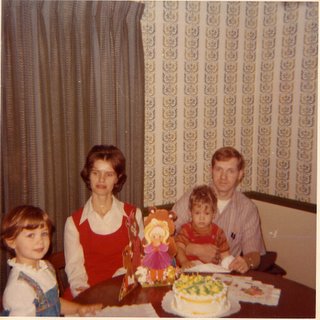
 I made Phoebe and me matching dresses for her baptism in 1968, and her dress is packed away with her baby clothes and stored in her basement, and my dress is in my closet. White flocked sheer cotton. It was a hot day in June. Because I was baptized in Church of the Brethren, as were my parents, grandparents, and great grandparents on both sides, and their practice is to baptize adolescents and adults, we had no sweet little dresses passed down from grandmother to mother to baby.


 For our 10th wedding anniversary party, I wore this black pants suit--the only slacks among the vintage dresses. They were all the rage then, and I loved it. I wore again in the 90s for some retro event at OSU--don't remember what it was. But it's still in the closet.
 Here we are in formal wear for a 1974 Christmas party with Couples Circle 50 of First Community Church. That was also one of my favorite hair styles. I think Jane Fonda made it popular. Bob was so thin in those days, we bought that suit in the Boy's Department of Lazarus.
 The class of 1957 had its 30th class reunion in 1987, and I wore my all time favorite, a teal and coral floral polished cotton. I'm in the front row seated far left. Big shoulder pads, full cut skirt. Loved that dress. I was a very bad time in my life, but when I wore that dress I felt like a princess. We don't dress up any more for our class reunions.
 I had a lovely deep teal silk, with soft pleats at the waist, self belt, probably purchased around 1985 or 1986. It is a size 8 which is how I'm guessing at the year. I was taking an aerobics class and was quite trim in those days. My daughter wore it, and my teal suit (obviously liked that color) to have her senior photos taken. I can't find a photo of my wearing it, but I remember wearing it to an AIA party we went to with Ken and Connie Becker.


Big hair, big shoulders. I'm not sure what year I bought this lovely cream colored silk 2 piece with a full, flowing skirt, but it made a wonderful dance dress, something we were still doing in those days. This photo is from 1988, so it was toward the end of its era. But I peeked inside the storage bag, and there is was. Can't show it off with this head shot.
 For several years our church, UALC, sponsored a wonderful Christmas dinner with musical entertainment. In 1991 we took Ron and Nancy Long, old friends from FCC and Lakeside, as our guests. I had a black velvet outfit with beads and bangles that I just loved. Some years later, I separated the top and bottom, and bought a near skirt for it that wasn't so tight and uncomfortable. Still have the top in my vintage closet. I also have a lovely silk dress the same color as Nancy's in my vintage collection (see above), but don't seem to have a photo of me wearing it. Those deep jewel colored silk dresses were very popular for several years.
 In 1993 the Corbett descendants of Joe and Bessie had a family reunion in Mt. Morris, over 100 attending, and we stayed at a B & B in Franklin Grove where this photo was taken with our son-in-law Mark. This is not what I wore to the reunion, but it definitely was on the trip and in the vintage closet. Linen and polished cotton in coral and taupe with applique on bodice.
 Later that year I wore my pink pleated, two piece Mother of the Bride dress at our daughter's wedding. The next year I wore it again at a niece's wedding in Florida, however, MOB dresses don't have many uses. Usually, they are too fancy. Also had pink shoes, pink hose and pink purse dyed to match.
 The oldest dresses I have in my "currently still wearing" closet will be 8 years old this summer having purchased them in 2010. Last fall I sent to the resale shop my sheer black dress I worse at my sister-in-law's wedding in 2006 (seen above in the photo with the mannequin, so that's where we are today. No more vintage closets.
Today I attended the funeral of Kathy Heinzerling who was at some of the parties where I was wearing these dresses 40-50 years ago. Appropriate for walking down memory lane.
I think the oldest dress I have isn't in the closet, but on a shelf. And I don't actually have my dress from 5th grade, but I do have my cloth doll's matching dress. Both were made by my mother and were identical. I think the reason the doll dress survived almost 70 years is because by the time Mom made it, I was no longer playing with dolls. Mother made the Sue doll with the yellow yarn hair, but our neighbor Ruth Crowell who had no children made the "white doll," which has always been called that. I never gave it another name. I also never played with it, so it survived. It was Blue Doll I loved to death. The chair in the photo is from my great-grandmother's home near Ashton, IL, was painted by my grandmother, and then it was refinished and recaned by my mother in the 1970s. The secretary was made for my husband's grandparents over 100 years ago and is now in our son's home.


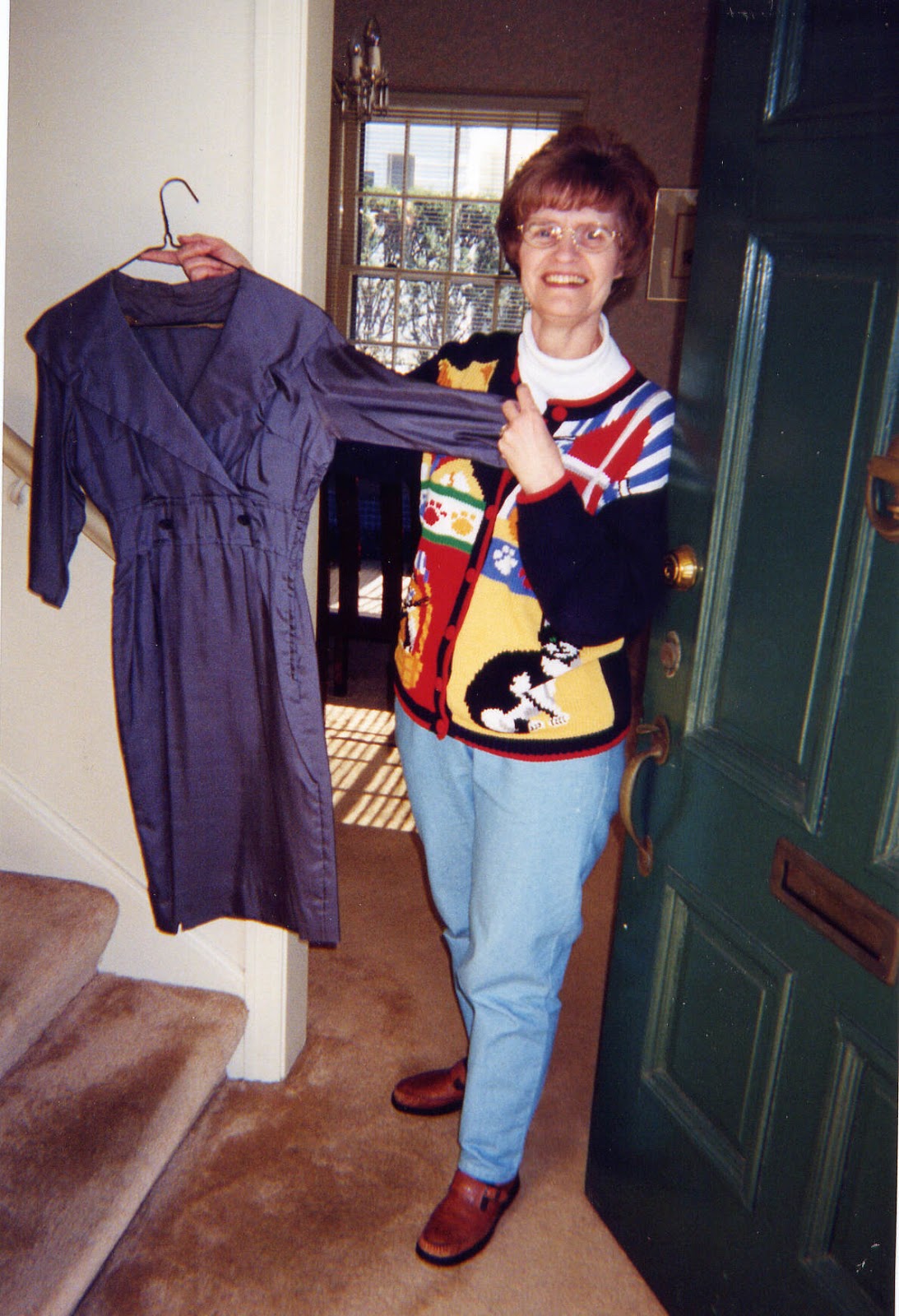


This pale blue sheath I bought in 1957 in Ft. Wayne, IN, when I was a student at Manchester College. Don't recall the event, probably a lecture since MC didn't sponsor dances, but I wore it many years. Here we are in 1962 with our son Stanley.


For a New Year's Eve party in 1965 I made a snappy red wool dress with a ruffle, sewn in my kitchen at 108 E. White St. in Champaign. We didn't have many occasions to go to parties, so I later took the ruffle off and wore it as a jumper for a number of years. The photo with the children and the deruffled party dress is their birthdays in 1969.


Big hair, big shoulders. I'm not sure what year I bought this lovely cream colored silk 2 piece with a full, flowing skirt, but it made a wonderful dance dress, something we were still doing in those days. This photo is from 1988, so it was toward the end of its era. But I peeked inside the storage bag, and there is was. Can't show it off with this head shot.


Today I attended the funeral of Kathy Heinzerling who was at some of the parties where I was wearing these dresses 40-50 years ago. Appropriate for walking down memory lane.
Tuesday, February 07, 2017

Monday, February 06, 2017
Yes, definitely

Our party line was 59-L. Gayle might remember this. In Oakwood Hall where we both lived, the pop machine (bottles) began spitting them out with no one inserting coins. Lots of squealing brought the crowd running. I think she was the hall monitor.
Saturday, November 12, 2016
November 12 is National Pizza Day
Neil Cavuto says today is National Pizza day. Works for me.
"National Pizza Day is dedicated to appreciating pizza, a baked flatbread that is topped with tomato sauce and cheese. Many toppings and sauces can be added to pizzas, including vegetables, meats and seafood. Pizza was invented in Naples, Italy around the 10th century, and has since grown to become one of the most popular foods in America."I think I first tasted pizza in 1956 on a date with a guy from Oregon, IL named Leonard with an Italian last name who played trombone. I thought it was so awful I think I only ate one or two pieces, and that was just to impress him. Tried it again in college, and then gradually developed a taste. Like for dinner tonight.
 |
| photos from Iaconos Pizza, which we love |
Thursday, July 21, 2016
How taste in beauty changes
Blue hair. That's what we called women over 65 when I was a kid. It was mean, but that's how kids are. And green hair was for a bad blonde rinse poorly applied. Now hair is lime green, purple, burgundy and polkadot, but on young women. What skin shade looks good with purple hair? And men wear orange running shoes with pink shoe laces and man buns. A nose ring used to be for bad tempered bulls, now they're for baristas serving $5 cups of latte. When I served coffee in the 1950s it was ten cents and if you smiled you could get a quarter tip. A nose ring would have gotten you fired. Tattoos used to be for tough guys, usually military, now they are walking art galleries with skin as the canvas stretched across big bellies and skinny calves and no one knows who the artist is.

Tuesday, May 03, 2016
EATING IN THE FIFTIES
- Pasta had not been invented. It was macaroni, noodles or spaghetti.
- Curry was a surname.
- A take-away was a mathematical problem.
- Pizza? Sounds like a leaning tower somewhere.
- Oranges only appeared at Christmas time.
- All chips were plain.
- Oil was for lubricating, fat was for cooking.
- Tea was made in a teapot using tea leaves and never green.
- Cubed sugar was regarded as posh.
- Chickens didn't have fingers in those days.
- None of us had ever heard of yogurt.
- Healthy food consisted of anything edible.
- Cooking outside was called camping.
- Seaweed was not a recognized food.
- 'Kebab' was not even a word, never mind a food.
- Sugar enjoyed a good press in those days, and was regarded as being white gold.
- Prunes were medicinal.
- Surprisingly muesli was readily available. It was called cattle feed.
- Pineapples came in chunks in a tin; we had only seen a picture of a real one.
- Water came out of the tap. If someone had suggested bottling it and charging more than gasoline for it, they would have become a laughing stock.
- The one thing that we never ever had on/at our table in the fifties...was elbows, hats and cell phones!
Saturday, February 20, 2016
Dressing for the 1950s
Today we are going to a party for which we're supposed to dress in 50s attire. Because I have a clothing archive, I actually own outfits from the 1950s, even my wedding dress made by my mother in 1955 for my sister. The problem as I see it is that I don't have a 1950s body! I actually weigh less than I did when I wore one dress--a floral jersey--to a dance around 1959, and it's in the closet, but my waist is about 5" larger and I can't zip it. It even has a sewn in crinoline. And I just don't have any saddle shoes or white bucks. The photo below is authentic 1955 clothing styles in Mt. Morris, Illinois. Looks like it might have been early spring and I jumped the gun a bit and am wearing a cotton skirt. Perhaps it was new (Mom made it). I never seemed to be together where fashion is concerned.
 So I will be authentically dressed for this party in an unconstructed gray and red plaid jacket my mother made for me for college, and a flared gray wool skirt I found last week at Volunteers of America for 75 cents that is mid-calf. The previous owner had taken the waist in about an inch in two places, but it had the dry cleaner tag still on it, so I just let out the stitching. It's a little snug, but I can breathe. Pencil straight skirts were popular, but also flared skirts as you can see from the photo. It's been awhile since I wore wool, both pieces feel a bit scratchy. We looked through my husband's high school annuals and examined closely the photos. My goodness! Young women dressed with pride and flare in those days! There's not much you can do with torn jeans and saggy t-shirts with political slogans.
The photo below is what I'm wearing and was probably taken 6-8 years ago when I was rearranging storage and had it out of the garment bag. I probably even wore it to work a few times in the 90s because OSU colors are scarlet and gray and that was the custom on Fridays before a football game.


The photo below is what I'm wearing and was probably taken 6-8 years ago when I was rearranging storage and had it out of the garment bag. I probably even wore it to work a few times in the 90s because OSU colors are scarlet and gray and that was the custom on Fridays before a football game.

Thursday, February 11, 2016
Can Bernie and the Socialists offer free college?
I haven’t visited Manchester University (in Indiana) since the 1990s, and was amazed then at the buildings (not necessarily growth) especially in sports facilities and library, but now when I look at the web site it’s even more so. I was thinking this morning that the “new women’s dorm” where I didn’t live (I was in the old dorm--Oakwood), would now be about 60 years old if it hasn’t be razed, and looking back, that in 1958 when I was a student, a comparable building would have been late 1890s!
Every college seems to have a bad case of Keeping up with the Jones’s to attract students with first class amenities. It's breathtaking when I walk across the campus at Ohio State--especially the sports and recreation facilities. Plus, there’s been huge growth in non-academic staff and departments to keep up with federal regulations on diversity/gender, health, testing, psychological development, etc. and to spend the ever growing federal aid to education.
My college expenses in 1957-58 and 1958-59 were right around $1,000, although I did have occasional part time jobs at the schools. I had saved enough for my freshman year by working while in high school. I doubt anyone could do that today. My father would have considered it an insult if a child of his needed a government loan. Very different today. But he also considered a married daughter the responsibility of someone else, and for my senior year (I was married), I borrowed money from him for tuition.
A few years ago I checked and Manchester was about $30,000 a year (although with aid and scholarships it’s difficult to know true cost, just like health insurance). University of Illinois from which I got my B.A. and MLS was higher (was the same back in the 50s), but probably in $35,000 range.
Whether talking education or poverty or environment, progressives/socialists/Democrats push government programs, then years later sound the alarm that they aren't working or are too expensive, blame the situation on the Republicans for not giving them more money to throw at failing programs, when in fact, they created the situation (although Republicans always go along and renew the funding). So it is with soaring education costs. They are reaping what they have sown, and found it bitter or poisonous.
A note of history: "Mount Morris College in Mount Morris, Illinois [where I grew up and both my parents and grandparents met], merged with Manchester College in 1932. Founded as a Methodist seminary in 1839, Mount Morris had been purchased by representatives of the Church of the Brethren in 1879 and operated under the name of the Rock River Seminary and College Institute until 1884, when the name was changed to Mount Morris College. The merger of Mount Morris College and Manchester College came about when the Church of the Brethren decided its educational program would be strengthened by pooling its resources in a smaller number of colleges [and after MMC suffered a terrible fire on Easter Sunday 1931]" from Manchester's website.
A note of history: "Mount Morris College in Mount Morris, Illinois [where I grew up and both my parents and grandparents met], merged with Manchester College in 1932. Founded as a Methodist seminary in 1839, Mount Morris had been purchased by representatives of the Church of the Brethren in 1879 and operated under the name of the Rock River Seminary and College Institute until 1884, when the name was changed to Mount Morris College. The merger of Mount Morris College and Manchester College came about when the Church of the Brethren decided its educational program would be strengthened by pooling its resources in a smaller number of colleges [and after MMC suffered a terrible fire on Easter Sunday 1931]" from Manchester's website.
Thursday, October 22, 2015
Sounds like my mom
![12075076_10205634038306772_6500640645549617743_n[1]](https://blogger.googleusercontent.com/img/b/R29vZ2xl/AVvXsEgnm2Cwkua7ZB017EatzcQnYMx3f7iOiY89E-XgXBb6-64sfSJbE0B81UIRVNyiHFnq0TowoUiq4wZkEUNwsFksqBYzoy5tr5oaYgu830jTxYFgaH9e7E5AHi9KMOs8Z12tqccWAg/s1600-h/12075076_10205634038306772_6500640645549617743_n%25255B1%25255D%25255B3%25255D.jpg "12075076_10205634038306772_6500640645549617743_n[1]")
My mother (1912-2000) had this attitude about all housekeeping skills, and particularly was careful to look nice when Dad came home from work. When I think back to some of the complex outfits she made for her four children, I think this must have been part of the routine. Her mother had used a dressmaker or shopped in Chicago, so Mom didn’t learn sewing as a child, but it was necessary when the children came along during the Depression. We even had little dresses made from feed sack fabric. I never had a holiday or prom dress bought from a store—Mom made them all, a pale green organdy, the pink crystalline below (from my sister’s wedding) and a two piece with green linen top and white flocked skirt with pink flowers. She made my blue silk going away dress for my wedding (I had started it, but didn’t use the advice from Singer, and she had to finish it).

1955 bridesmaid dress, also prom 1956; my sister Carol had the same dress in yellow, and Mom made the wedding dress (which I then wore in 1960)

Dolls from the 1940s which I still have.

My brother Stan in cover-alls made from my father’s military clothes

Pattern of one of my favorite aprons I wore for 40 years made by Mom

My high school graduation dress which included a jacket
Sunday, March 22, 2015
Good advice for most projects
![10429412_10155078912610015_3226025113438292865_n[1]](https://blogger.googleusercontent.com/img/b/R29vZ2xl/AVvXsEioFn6eipPMwTL0zZR1r968JW6NfitYu4xoXbqZP2B9YrHOqA28RquKYnK5DweWUYIUqHzY9zJq1nvpoZYfLPhyphenhyphenke9j-PNfYV4N1_7VExaYs3qL6sXFIKkRb2EkOe-aXNMkcFN5Zg/s1600-h/10429412_10155078912610015_3226025113438292865_n%25255B1%25255D%25255B3%25255D.png "10429412_10155078912610015_3226025113438292865_n[1]")
The original copyright for my Singer Sewing Book is 1953. It has similar pithy words of wisdom.
- "The psychiatrists say that ugly dresses have caused more complexes than have "prettier sisters" or "scolding mothers." Every child has the right to becoming, yes, pretty, clothes." p. 165 [What would we do without the advice of psychiatrists?]
- "There is real advantage in teaching children to sew--boys and girls. No matter what they do with their hands later, whether they become artists or sculptors or electricians or radio or television repairmen--technicians of any kind--if the muscles of the fingers and the hands are trained to sew, this training can be beneficial." p. 166 [Now we have video games for eye-hand coordination.]
- "Boys require only slightly less fabric than girls." p. 164 [Even in the days of poodle skirts?]
- "When sewing for children, study color in relation to their skin color, eyes and hair." p. 163 [Years before Color me Beautiful!]
- "Use both hands when you sew." p. 153 [I'd never thought of doing it any other way, did you?]
- "Look your prettiest for this try-on [basted garment]. A dress in its fitting stage is no doubt passing through its one ugly hour." p. 50
- "An itinerant tailor, Ebenezer Butterick, through the urging of his wife, Ellen, was the first to make patterns available in the United States to women who sew. He made patterns and rented them to customers. . ." p. 35 [Behind every good man . . .]
- "There is no reason for anyone's not making a beautiful seam, because it takes so little time to learn to stitch straight and to "power" evenly." p. 5 [Is that possessive pronoun necessary in this sentence?]
Subscribe to:
Posts (Atom)


 Posts
Posts


