1303 You have what?

Seen at Paula's site, and Doyle's.
 Our tour plan included a drive by photo op of the Richard Lloyd Jones Residence designed by Frank Lloyd Wright in Tulsa, OK. Jones was his cousin and a newspaper editor, and he lived in the house (built in 1929) until his death at 90. The house is huge--10,000 sq. ft. on 4 acres. Privately owned, it is NOT open for tours.
We also drove through the Oral Roberts University which may win a prize for the ugliest, most ostentatious architecture in the USA (just my opinion). We said good-bye to our capable, knowledgeable driver at the airport and while checking in discovered our plane would be about an hour and 15 minutes late making it virtually impossible to catch our flight out of Detroit to Columbus. But they held the plane for us while we galloped through that massive airport in Detroit, and we settled in for a quick hop home.
It was a fabulous trip, and now we're back at Lakeside.
As I mentioned before, in the morning we met in the lobby and walked to the Bartlesville Community Center designed by William Wesley Peters (1912-1991), a sharp (or round) contrast of curves, circles, and ovals. For a small town of 35,000 Bartlesville has a wonderful musical and artistic life. It is the home of OK Mozart established in 1985, and many home-grown and out-of-town shows. The 1800 seat theater is marvelous.
Next we toured the art museum which is in the Price Tower. In addition to many Wrightean displays of furniture, there was a visiting photographic exhibit of architectural photography. Then it was back on the bus. We had lunch at a locally renowned restaurant, Dink's Pit Bar-B-Que(really yummy), that our driver Bob knew about (local boy from Fort Smith). Then we set out to see if we could spot another home designed by Wright for Price's son, but the current owners don't allow visitors.

More welcoming was the the director of operations at Oklahoma Weslyan College where we toured La Quinta Mansion, a home built in the 1930s for another oilman, H.V. Foster. He made his money in oil leases with the Osage Indians. However, it was only used briefly as a home, and since 1939 has been the main building of several different schools, OWC being the most recent (a holiness denominational college). I was particularly interested in this tour because it housed the library collection (really poor and dated in my opinion) and they were shifting it to allow the mansion to be restored in certain areas. Having shifted probably over 100,000 volumes in my library career for either dumping, wall painting or title changes, I could empathize.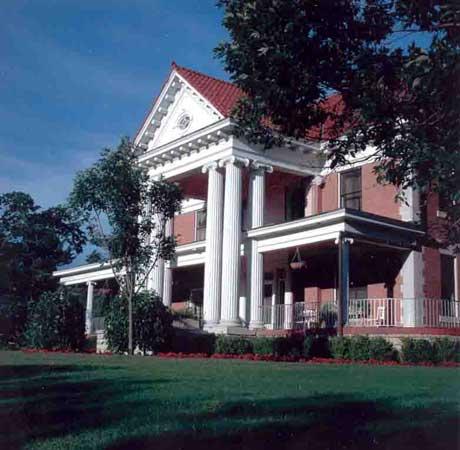 Next we toured the Frank Phillips Home. It was modest as mansions go (26 rooms), but the Phillips (as in Phillips 66) had two other homes. The grounds, which included a four car garage with a museum and servant quarters and a greenhouse, were lovely. It had remained in the Phillips family a long time, but is now maintained by the historical society.
I don't know what you would have done after a day of touring in 100+ degree heat, but I went back to our fabulous FLW room and took a nap to prepare for our lovely night out (actually up, to the 15th floor) at the Copper Restaurant + Bar. Our three tables of congenial tour friends enjoyed a dinner of salmon and chicken on rice and a chocolate dessert that was to die for. If you are ever in Bartlesville, this is the place to eat, trust me.
 And we crazies who fly and drive around in 100 degree+ heat looking at buildings had the thrill to actually spend two nights in a Wright building. There are 21 high-design guest rooms and suites, with all the interiors done by Wendy Evans Joseph. If they find someone with deep pockets, maybe we'll go back someday to see the expanded art museum by Zaha Hadid. After unpacking and settling in our rooms, we went to Patsy's "hospitality suite" for snacks, wine and cheese, and lots of laughs. She plans these trips and always does a wonderful job.
The editor of C&RL News sadly writes here:
“My children have a genetic disease. It is rare, not well understood, and there is no treatment or cure. However, the most disturbing obstacle we face is the wall around published scientific research. Information critical to health and biomedical research is held hostage by questionable and arcane publishing practices. It is time for publishers, both private and academic, to redesign their business models in response to a new age of information sharing and a stronger sense of the scientific commons.”
What puzzles me is that her journal, and most library journals, do NOT have open access (except for editorial remarks like hers) even though librarians beat the drum for everyone else to provide free information.
Yes, NIH is tax supported, but so are libraries and librarians salaries.


 Posts
All Comments
Posts
All Comments


