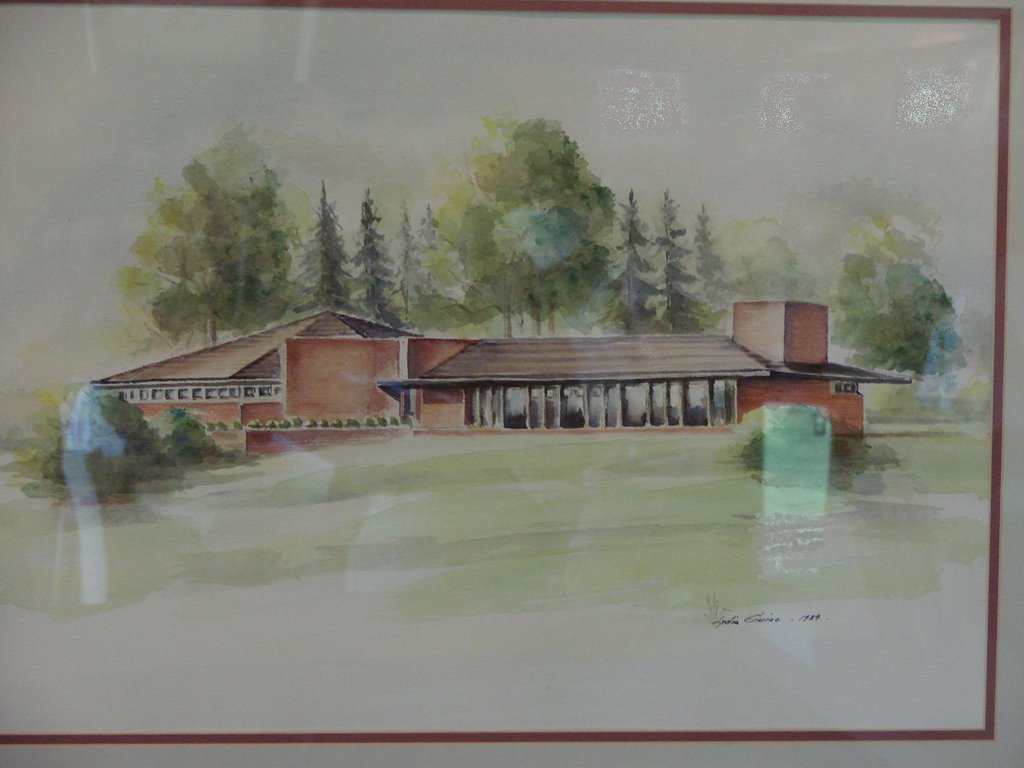
Taliesin West was architect Frank Lloyd Wright's winter home and school in the desert from 1937 until his death in 1959 at the age of 91. Today it is the main campus of the School of Architecture at Taliesin and houses the Frank Lloyd Wright Foundation. The Foundation has attempted to keep it looking much as it did in the 1950s, and it is a very popular tourist destination. We'd visited a number of FLW buildings and homes 10-15 years ago, in Ohio, New York, Oklahoma, and Illinois so we loved being able to see this final phase of his career.
Sunday, May 05, 2019
Arizona trip, Day 1, April 2, Taliesin West
Taliesin West was architect Frank Lloyd Wright's winter home and school in the desert from 1937 until his death in 1959 at the age of 91. Today it is the main campus of the School of Architecture at Taliesin and houses the Frank Lloyd Wright Foundation. The Foundation has attempted to keep it looking much as it did in the 1950s, and it is a very popular tourist destination. We'd visited a number of FLW buildings and homes 10-15 years ago, in Ohio, New York, Oklahoma, and Illinois so we loved being able to see this final phase of his career.
Monday, March 17, 2014
Monday Memories, pt. 3—Fallingwater and Kentuck Knob—Frank Lloyd Wright
Sunday morning, March 16, after our tour of the Hardy Art Collection at the Chateau in Nemacolin, we boarded our bus for Fallingwater, one of Frank Lloyd Wright’s most famous houses in our area of the country, and then from there continued on to Kentuck Knob. Fallingwater had just opened for the season, and was snow free, but very chilly. The water was running free of ice, and we could hear it even in the house.
It was designed for the Edgar Kaufmann, Sr. (1885-1955) family of Pittsburgh of department store fame. Edgar Jr. inherited the property and gave it to the Western Pennsylvania Conservancy to make available to the public.
Fallingwater stands as one of Wright's greatest masterpieces both for its dynamism and for its integration with the striking natural surroundings. Fallingwater has been described as an architectural tour de force of Wright's organic philosophy. Wright's passion for Japanese architecture was strongly reflected in the design of Fallingwater, particularly in the importance of interpenetrating exterior and interior spaces and the strong emphasis placed on harmony between man and nature. Wikipedia.
Kentuck Knob video, 2010. 10 miles south of Fallingwater, completed in 1956 for the Hagan family. Now owned by the Palumbo family of England. The trees were planted after it was built. The land had been clear cut for farming many years ago. Of course, we were not allowed to take interior photos which is the policy of most historical places and museums.
Sunday, January 06, 2013
Found. Frank Lloyd Wright leather bound sketchbook
I’ve been shifting, repacking, tossing and trimming. I had boxes of notebooks. I found this one, c 2004 stored with the other $4.00 ones. But it’s for sketching and not blogging, which is probably why I never used it. The design is May Basket, the same as one of our pillows.
Friday, June 19, 2009
Frank Lloyd Wright on What's my Line
Our local architectural tour group is planning a trip to Buffalo August 14-16, but we have a conflict and won’t be going this year. It’s a fun group and great prices, if you're interested. Buffalo is a fabulous city for architecture. Contact Patsy Frost at Schooley Caldwell, pfrost@sca-ae.com if you’d like to be included. The bus holds 36. Our main interest as a group is visiting Frank Lloyd Wright sites/designs, but we see other things too. In Buffalo the group will visit the Martin House Estate, the new Greatbatch Pavilion there, the Mausoleum in Forest Lawn Cemetery, the Heath House and the Davidson House, with stops at the newly restored Erie Canal Harbor area and the Butler mansion; they'll stop at Oberlin to tour the Weltzheimer House on the way back to Columbus.Anyway, FLW was on What’s my Line, and at the end after they’d guessed who he was the host asked him if he’d done anything recently, and he mentioned the Price Tower in Oklahoma. We stayed there when we toured in 2006.
Sunday, October 19, 2008
Penny wise and pound foolish
I don't live there, so I don't know why Illinois is in such tough economic shape. Democrats? Unions? High taxes on new business? Young people leaving the state? Illegals slurping up the social services? Obama's policies when he was in the legislature upping the ante for health insurance? All the taxes going to Washington, DC then riding the rails back to Chicago?Anyway, we never got over to see Frank Lloyd Wright’s Dana-Thomas House, which ranks 114th on the list of the AIA’s America’s Favorite Architecture. We love FLW's architecture, but the buildings don't wear well, and are horribly expensive to renovate and maintain. Now it's on the chopping block with other historic sites and parks and is set to close December 1. Not sure how they'll keep it from deteriorating.
I looked at the Democratic House web site, but they sure aren't taking any responsibility. Not sure it's been updated since March. Then at the party site, I clicked on press releases, but it was under construction. Couldn't find much except links to other Dem states.
They're just like the Ohio Democrats who took over in 2006. Same message, lots of promises, but absolutely no progress except in voter fraud and scandals in the governor's staff, both of which went up.
- "With your help, we can build on the remarkable Democratic successes in the 2006 elections and retain our majorities in the Illinois House of Representatives and Senate
- In an effort to reduce congestion, cut down on emissions and invest in Illinois jobs, Governor Rod R. Blagojevich today unveiled a new Illinois Tollway Improvement Plan which will include the introduction of Green Lanes and interchange construction. Building on the successes of the Tollway’s current Congestion-Relief Program, the second phase – Tomorrow’s Transportation Today – is a $1.8 billion project designed to continue congestion-relief efforts, improve the environment and enhance mobility across Northern Illinois.
Saturday, August 26, 2006
2795 FLW Tour: Dayton Medical Clinic
After Springfield and Sidney on our Frank Lloyd Wright July tour, it was on to Dayton, Oh to visit a FLW medical bulding, which although nearly 50 years old, still works surprisingly well.


In the guide book this is called the Meyers Medical Clinic, but is now the home office of James Apesos, MD, a plastic surgeon.
After Dayton it was a beautiful drive through lush Indiana farmland to Columbus, Indiana. The previous Friday we had been at the Finland summer home of Eliel and Eero Saarinen, and now we were in Columbus, IN where Eliel designed perhaps the first modern American church.
We checked in at our B & B (the former city hall, converted in the mid-1980s) designed by another well-known architect, Charles F. Sparrel, who did many Columbus buildings in the 1800s, and walked to our restaurant. It was a very busy day!Other entries about this tour here, here, here, and here.
Frank Lloyd Wright
Dayton, Ohio
Columbus, Indiana
Tuesday, August 01, 2006
FLW tour group, 2006
We were a melting, but hardy group standing on the deck of the Boulter House in Cincinnati. The heat was oppressive, and the sun brutal. Twenty-six and a half folks talking nothing but architecture for three days. Well, the four year old found other things to talk about. I missed one of the group photos because I'd gone back to the bus to sit in the air conditioning. We are third and fourth from the right in the back in this photo.
Frank Lloyd Wright
Boulter House
Wednesday, June 07, 2006
2548 Our Summer Frank Lloyd Wright Tour
We'll be doing another Frank Lloyd Wright tour this summer--this time in Ohio and Indiana. Ohio has some really interesting restorations. This three-day tour includes FLW’s Burton J. Westcott House in Springfield, OH which we've already seen, but is worth going to again. He brought the Westcott Motor Car Company to Springfield (founded by his father in Richmond, IN). The house was completed in 1908 and is in a neighborhood of large Queen Anne, Victorian and Romanesque Revival houses. I'll bet the neighbors weren't thrilled.We'll also visit the Meyers Medical Center in Dayton, which is now called the Plastic Surgery Pavilion (1956). In Cincinnati we'll see the Cedric G. Boulter house near the Gaslight District, the Gerald B. Tonkens home dating to 1955 in Amberley Village (Usonian) and the William Boswell residence (from 1957, completed in 1961) in Indian Hill, recently renovated. We'll also visit Louis Sullivan’s People’s Federal Savings and Loan Association in Sidney.
Overnight accommodations in Columbus, Indiana, will be at The Columbus Inn, listed in the National Register of Historic Places, and formerly Columbus City Hall. I don't know if you've ever been to Columbus, IN, but it is a small city with amazing architecture. We were last there in 1968. The second night will be spent in Historic Madison, Indiana, at the Hillside Inn, nestled in the rolling hills of Southern Indiana and overlooking the majestic Ohio River.
There will also be architectural/historical walking tours in Springfield and Columbus, Indiana, a trolley tour of historic downtown Madison, Indiana, and a tour of the Contemporary Arts Center in Cincinnati.
Monday, July 25, 2005
1296 Bartlesville and Frank Lloyd Wright [Friday]
As we drove into Missouri to get a better road, the "boomtown" atmosphere of NW Arkansas disappeared as did the ubiquitous Wal-Mart Superstores (I did not see any other place to buy groceries). Oklahoma flattened out and we tried to remember the words of the song when we started seeing cornfields. At 6 p.m. we rolled through Vinita, and the temperature sign said 106--and that was not the heat index, but the temp. Because my family drove to California on Rt. 66 in the 1940s, it's possible this was my second visit to Vinita.
The hot, tired Ohio travelers became quite energized as we saw the Price Tower over the trees of Bartlesville, Oklahoma, home and headquarters of Phillips 66. With its green copper louvers and peculiar triangular shape, it is every bit as impressive as the magazines have reported. If you've got the time here is a really brief video clip--and our hotel room looked exactly like that as did our dinner at the Copper Restaurant. Wright actually envisioned this building for Manhattan in 1925 as a multi-use site--shops, housing and work, but it was not realized. At the end of his career, he had the opportunity to have his dream built--like a tall tree in the rolling hills of eastern Oklahoma. (For some great photos see the June 2003 Architectural Digest.) The building was completed in 1956 for client H.C. Price. The building was purchased by the Phillips Petroleum Company in the 80s, and recently restored as an inn, restaurant and art museum.
And we crazies who fly and drive around in 100 degree+ heat looking at buildings had the thrill to actually spend two nights in a Wright building. There are 21 high-design guest rooms and suites, with all the interiors done by Wendy Evans Joseph. If they find someone with deep pockets, maybe we'll go back someday to see the expanded art museum by Zaha Hadid. After unpacking and settling in our rooms, we went to Patsy's "hospitality suite" for snacks, wine and cheese, and lots of laughs. She plans these trips and always does a wonderful job.In the morning we met in the lobby and walked to the Bartlesville Community Center designed by William Wesley Peters (1912-1991), a sharp (or round) contrast of curves, circles, and ovals.
Thursday, October 21, 2004
548 Revisiting the Robie House
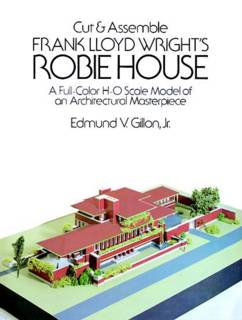
For days my very patient, focused, meticulous husband has been in his studio playing "paper dolls," or "paper house" as the case may be. When we were in Chicago we visited Frank Lloyd Wright's Robie House (see my blog about the trip here). Last week he started putting together a paper model--I think it has 138 pieces, many very tiny, requiring intricate folds and careful cutting with the x-acto knife. He has spent untold hours on a project that would have had me in a puddle of frustrated tears in 15 minutes. Don't ever buy this for a child!
Robie House Cut and Assemble
"From the Publisher: Now model builders as well as lovers of fine architecture can construct an accurate three-dimensional model of the Robie House, and thereby discover for themselves the harmonious interrelationships of parts and numerous other design details that make this home a world-famous architectural masterpiece. Printed in full color on sturdy card stock, the two-foot long model comes complete with step-by-step instructions and exploded diagrams. A series of multi-level horizontal planes includes balconies, platforms, a porch and entrance court, while easy-to-follow directions clearly explain how to cut, fold and glue walls, doorways, windows, roof and other features."
The Amazon site lets you click through a few pages and enlarge. This is not a project for sissies!
Sunday, August 08, 2004
415 Update on Trip to Buffalo
Day Two, Friday
When you tour Frank Lloyd Wright sites, you get an earful of his colorful history which included financial disasters, personal tragedies, love affairs, devoted students, and love-hate relationships with his clients. His career took place during a time when people communicated in letters, not by phone or e-mail. This exchange between Wright and his client William Heath in 1927 about a proposed gas stations for Buffalo is a classic example of what researchers have to work with:"Dear Mr. Wright: Your letter of the 12th received, you say herewith sketches etc., but the herewith were not therewith, whereof we do not know wherewith they are; so we can not return them or comment upon them."
The long letter is quoted in the excellent article "An Ornament to the Pavement: Frank Lloyd Wright's Buffalo Gas Station," by Patrick J. Mahoney, Western New York Heritage, Summer/Fall 2003, Vol.6,no.3, pp. 18-35. Mr. Mahoney, a practicing architect, is the Vice President of Graycliff Conservancy and our very informative tour guide when we visited that home south of Buffalo on the cliffs of Lake Erie in Derby, NY.
We'd arrived at Graycliff at the end of a busy, exciting Friday that had started with a tour of the Butler Mansion, across the street from our hotel. Buffalo at one time was the 10th wealthiest city in the United States, according to our local tour guide, Marilyn. On Thursday evening after we'd checked in, she gave us a walking tour of the historic district, Allentown, where we saw many colorful turn of the century (the last one) homes, more modest than the mansions lining Delaware Avenue, but certainly quite posh and lovingly restored.
On Friday morning we had the Butler Mansion tour, now used as Jacobs Executive Development Center, which has been through extensive renovation. It was designed by McKim, Mead & White and the original drawings which were discovered in 1990 were on the wall.
We visited two neighborhoods that had FLW homes (no tours, private residences), the Davidson residence (1908) and the Heath residence (1904). We toured Forest Lawn Cemetery, which offers historic tours called "Sunday in the Cemetery." We were there to see (but not photograph) the construction of the only mausoleum designed by FLW. It was not built because of the client's financial losses during the Depression. It is now under construction and the 24 crypts will be sold to help finance it.
Then we had lunch at Ulrich's Tavern, Buffalo's oldest tavern, sort of a German-Irish, blue collar-white collar pub that only locals like Marilyn can find. From there we drove to the restored Larkin Warehouse. The owner gave us a tour of this wonderful old warehouse now used for law offices and businesses. Larkin was a soap manufacturer that developed a marketing scheme that used premiums which soon became an industry in and of itself. An area of the first floor has been set aside as a museum of Larkin products and premiums. This is also the site of FLW's famous Larkin Administration Building. The link will provide its interesting design, history and demise, which I encourage you to read. The closest we could get to this masterpiece was to visit this pier.
Day 2, Afternoon and Evening
Then we drove to the lovely old community of East Aurora, NY to visit the Roycroft Arts and Crafts Community. Wright and the executives and their families of Larkin were all bound together. One of the Larkin executives was Elbert Hubbard, a brother-in-law of the founder, John Durrant Larkin. Hubbard was the brains behind the premiums with soap marketing scheme. After making his fortune, he sold his share, and founded Roycrofters in 1893. He and his wife died when the Lusitania was sunk in 1915. Hubbard wasn't divine (as he claimed in his personal credo), but his influence on the arts and crafts movement and Frank Lloyd Wright was significant.From East Aurora we drove to the lovely "Old Orchard Inn" built in 1880, snuggled in the hills of western New York, with some exciting moves by our bus driver Roseanne, who didn't like narrow roads or low viaducts. We didn't have much time as we needed to be at Graycliff before dusk, but we had a wonderful meal--ham or chicken, with carrots, potatoes, salad, and drinks.
After snaking our huge bus out of the Inn's parking lot and detouring around underpasses Roseanne thought were too low, we finally got to Graycliff where the pleasant staff gave us flashlights, because we were losing the sun setting over the glorious Erie. No photos allowed on the inside, but we got some good shots of the outside of the Martin's summer home (another Larkin executive who first brought FLW to Buffalo) and the chauffeur's cottage.
Frank Lloyd Wright had a 33 year relationship with the Martin family, and designed the home of Darwin and Esabelle Martin in Buffalo. She apparently thought the house not easy to live in and too dark, so she wanted something to capture the sunlight on this cliff on Lake Erie because her eyesight was failing. Our tour group had visited this site in 1995 when it still belonged to a Hungarian group of monks and was in very poor condition. It is being lovingly restored by the Graycliff Conservancy. Our 2 hour "hard hat tour" was superbly led by Mr. Mahoney, whose personal collection of FLW drawings hung in the visitors' center and gift shop.
An exhausted, but fat and happy tour group, returned to the hotel in Buffalo, to rest up for day 3.