Tuesday, December 13, 2005

1884 War's trauma wears on the children left behind

is the headline in the USAToday (December 13, 2005) with a color photograph. In March 1944 my father enlisted in the U.S. Marines. Things didn't look good either in Europe or the Pacific for the U.S. The same nay-sayers were around that we hear today. I don't remember being resilient or fearful, either one. But I know this. I looked to my mother and other adults like grandparents, aunts (all the uncles were gone to war) and neighbors for clues on how to behave and what to think. How do we know that children are helped by being asked to express their fears publicly about their mothers and fathers in uniform? We didn't draw pictures of airplanes and bombs to send to dad--we drew flowers, blue skies, and houses, with happy children. I'm sure the Marines were teaching him about bombs and guns--we needed to remind him why he'd enlisted.

My mother must have been fearful--I regret that of all the things we talked about over the years, I never thought to ask that. I can't imagine how she made it financially with four small children, let alone emotionally. But looking up at her from the vantage point of a four year old, I saw only confidence, resolve, determination, integrity, honesty and love. She was who she was and she never changed the whole 60 years I knew her.

One day Mike Balluf, whose father was in the Navy, and I were riffling through the trash behind his house (he lived directly behind me). We pulled out a beautiful, dark brown ceramic teapot. We didn't have anything this pretty in our house, so I carried my wonderful find home to show my mother. She turned it over, saw the "Japan" mark (I probably didn't know how to read), and put it in our trash. You don't always have to talk an issue to death for children to learn that war is serious stuff.

Sarah Silverman rude, crude and salacious

I'm just repeating the words of the reviewers who love her--this Jewish comedienne is rude, crude and salacious. I'll never attend her shows or watch her on TV just on the basis of the title of her show: Jesus is Magic. With her fog screen of excuses, which includes all of those from the last 25 years, "It's your right to be offended," and "You can't please everyone" I know where she's going without paying an outrageous price to hear myself insulted. If you think insults of other's race, ethnicity, religion, culture, sexuality and gender are amusing, well, welcome to the 1950s. It was consider a hoot back when I was growing up, and I'd hoped we were past that. But I suppose each generation has to reinvent humor. She's bound to grow up (or is that down?). Although Richard Pryor didn't--setting himself on fire free basing, years of womanizing and developing MS didn't change his style of hanging over the edge of hell.


Monday, December 12, 2005

1882 My Best Questions

I ask a lot of questions on my blogs--it's just my style of writing. Then I answer them, because most of you don't stop long enough. Here's a selection of my best of the best questions from May-June 2005. If you click the question, you can read the whole entry.

What would you call a group of librarians?
Somewhere I've seen a collective noun for a group of librarians congregating. Everything the librarian tells you has previously been worked out in a meeting--even the pauses and punctuation. What would be your vote? (listed some choices like peep, mob, brace, pride, etc.)

What woman would admit to this?
I've often wondered if later in life, while living maybe in San Diego or Houston, a woman would admit to a past of being [the Forreston] Sauerkraut Queen or maybe the Ogle County Pork Queen (another biggie in our farming county)?

Where do I join?
The National Coalition to End Judicial Filibuster. Where do I join? In fact, let's not stop with the judiciary, let's dump the filibuster altogether. Can you think of another organization that uses this? And it is misused by both parties--I'm not pointing fingers at the Democrats, at least not in this paragraph.

Guess the trendy car ads
Guess which ad goes with the car of your dreams. My favorite ad (although not the car), is definitely #9. It’s edgy--like a Laura Bush joke. Answers at the bottom of the page.

Do you save ribbons, bows and paper from Christmas and holidays?
Do you save ribbons, bows and paper from Christmas and holidays? Goodness. I have enough bows to last until 2047! And those cute little gift (reusable) bags--I had no idea I had so many. Birthdays. St. Pat's Day. Valentine's Day. Christmas. All purpose. I'm guessing I found about 25. And the gift boxes. Did I fear if I bought a piece of jewelry, it would come box-free?

Is there ever enough storage?
. . . in Ohio, we have $100,000 basements. At least that's what you're led to believe if you sell a house without one. For 34 years we lived in a lovely neighborhood of more expensive homes because our two-story, colonial house was slab on grade. When we put it on the market in 2001 we were always told how much it could have sold for if only we had a basement. . . We thought we'd left basement woes behind us, but the other night my husband took a phone call from someone interested in buying that house (it has been on the market because the new owners are divorcing). Would you believe the guy wanted to know if he could jack up the house and put a basement under it?

Would you spend $40,000 a year to send your daughter to Smith if you couldn't even figure out the restrooms?
Roger Kimball who wrote about tenured radicals 15 years ago when things were simple (plain vanilla Marxism) suspects, that along with Mark Twain's demise, the death of the counterculture is greatly exaggerated. I agree with his solution. Dump tenure which has become a means to stifle dissent and fresh ideas. Seems to be the only way.

Where do you cut costs?
Economically, it makes absolutely no sense for me to leave the house every morning at 6 a.m. and drive to a coffee shop. If you don't do this, you could exclaim, "But that costs you nearly $600 a year, when making it at home is about five cents a cup." Very true. But I read 2 or 3 newspapers, and see 4 or 5 people I know, chat with various folk, so as a social informational event, it's pretty cheap. Compare that $600 to a golf hobby, and you can see it is really pretty cheap.

What do children in Third World Countries ask for?
Yesterday's question in VBS was something along the lines of "If you could have anything you asked for, what would it be." Apparently, only one little girl (probably watches beauty pageants on TV) thought beyond material needs and did indeed ask for world peace, according to my husband who teaches the class. Most asked for material things, but not a bike or a pony like my generation would have done (we were self-centered too), but a house! One little girl asked for a shopping mall! Now THAT is materialistic. "What do you suppose children in Third World countries ask for," my husband mused.

Which Democrat will drive more people way from the party?
Diarrhea-of-the-mouth Dean or Tokyo-Rose-in-Drag Dick? It's been many a year since I lived in Illinois, but my recollection of those days is that about a third of Chicago was Estonian, Latvian, Lithuanian, Polish, Ukrainian, Belarus, Slovak, Czech, Hungarian or European Jew. About half my classmates at the U. of I. were children of the escapees from Hitler or Stalin. Some had lost their accents, but they never lost their memories of starvation, forced marches, refugee camps, and grandparents, aunts, uncles and cousins they'd never see again. And if their memories ever did dim in the usual frivolity of the teen years of dating, music and partying, you can bet your ass mascot their parents would remind them.


Sunday, December 11, 2005

1881 Unintended Consequences, pt. 2

I ’ve been thinking a lot about unintended consequences after reading about polio epidemics following on the heels of the improved sanitation provided by flush toilets and toilet paper. Most recently, we’ve seen some unintended consequences in connection with Hurricane Katrina from personal and government generosity.

An outpouring of generosity for the gulf coast victims resulted in a corresponding shortage for local charities and foundations in our closer-to-home neighborhoods. I watched the Charity Newsie guys collecting on the streets yesterday, wondering if they were freezing their buns off and getting less.

Jobs are going begging in the hurricane areas as people wait until the FEMA money runs out before looking for work. Businesses can’t reopen with out workers, and residents won’t return home if there is no economy to support the rebuilding efforts.

Mega churches are drawing huge crowds, but destabilizing and blighting older neighborhoods as churches move further out for more land. (Sort of the WalMartization of religion.)

More insulation and tighter buildings in response to higher fuel costs has resulted in more allergies and respiratory problems.

Improved highways, better gas mileage and safer cars resulted in business loss and decay to small town and rural businesses as people drive to distant shopping malls or larger towns.

Improved air conditioning and cheap energy have created building growth in formerly uninhabitable areas, like coastal areas (recently hit by hurricanes), deserts, bringing damage to environment and loss of life in storms.

Health concerns and animal products and the popularity of vegetarianism have created a greater demand for fruit and vegetables resulting in more food poisoning from crops contaminated by animal runoff and greater use of herbicides and pesticides.

Harvesting of rare plants for medical research and homeopathic medicines are contributing to the destruction of rain forests.

The invention of canned milk many years ago made it convenient for women not to breast feed resulting in lowered immunity in infants and toddlers and more women entering the work force. This continues to this day in poor countries where it is watered down.

Summer breaks were created in the school calendar because child labor was needed on the farm in the 19th and early 20th centuries, but schools still let out for the summer months resulting in significant loss of learning even though we outlawed child labor years ago.

Introduction of the potato to Ireland so improved nutrition among the poor that there was a huge increase in the population. Then the blight of that monocrop resulted in the starvation, malnutrition and emigration of millions.

Silent Spring by Rachel Carson was published and good intentioned protests caused American companies stop producing DDT. This resulted in the deaths of millions in third world countries from malaria and huge loss of GNP in malarial countries. "The Malaria epidemic is like loading up seven Boeing 747 airliners each day, then deliberately crashing them into Mt. Kilimanjaro." Dr. Wenceslaus Kilama

In 1996, manufacturers introduced 3,434 new “low-fat” or “nonfat” food products. In 2003, 700 “low-carb” or “no-carb” products hit the market and in 2004, 3,431 such products followed. This has resulted in more obese Americans, apparently from the unintended consequence of people consuming more calories in the search for satiation and flavor.

Green architecture--glazed windows, efficient lighting, reflective roofs, below grade buildings encourage larger homes being built further out due to their efficient use of energy resulting in no savings at all to the consumer and more urban sprawl.

The closing of energy consuming, polluting factories resulted in jobs going overseas to less restrictive areas and the deterioration of workers‘ life style.

Wind farms (aka tax farms or cuisinarts of the air) produce low emissions and cleaner air but very expensive kilowatts and result in the deaths of many birds and the rise of rodent populations. Or as they say, “How many dead birds equal a dead fish equal an oil spill?” They may also produce climate changes locally.

Modern refrigeration changed our diet and made us safer from food poisoning, but contributed to the growth of cities, the rise of large distant feed lots for cattle, the importation of off-season foods and the deterioration of the environment.

Modern air conditioning changed our driving, employment and entertainment. Outdoor landscaping for shade and front porches no longer were essential for comfort changing how we interact with our neighbors.

Bird feeders cause migrating birds to share diseases, change eating habits of local birds causing them to not eat insects, and attract rodents, like skunks. Increased insects and rodents may cause the rise of disease or increased use of pesticides.

Strong recycling codes and laws in the cities have resulted in trash being dumped in the rural areas because you can’t burn it or bury it.

Successful and cheap waste management systems of the early and mid-20th century using landfills and incinerators resulted in a throw away mentality for generations. American households throw out 467.2 pounds per year - not including what goes down the garbage disposal or into compost piles. Annual cost of food waste is more than $43 billion per year, broken down roughly as follows: meat - $14 billion; grains - $10 billion; fruit - $9.6 billion; and vegetables - $9.1 billion. (Biocycle, May 2005)

The Passion of the Christ the movie that earned $370 million at the domestic box office and drew in religious people who had for years complained about movies, did not bring people into the churches nor change what Hollywood offered once they found out what the people liked.

There’s much more--entire articles and books have been written on this topic. These are just the ones that came to my mind. Here’s an article on unintended consequences from the Concise Encyclopedia of Economics. You can also google this topic--unintended consequences + [whatever law, event or movement you think of]. Or just try inserting the word "google" after that plus sign.


Technorati tags:,

1880 Where's Canada

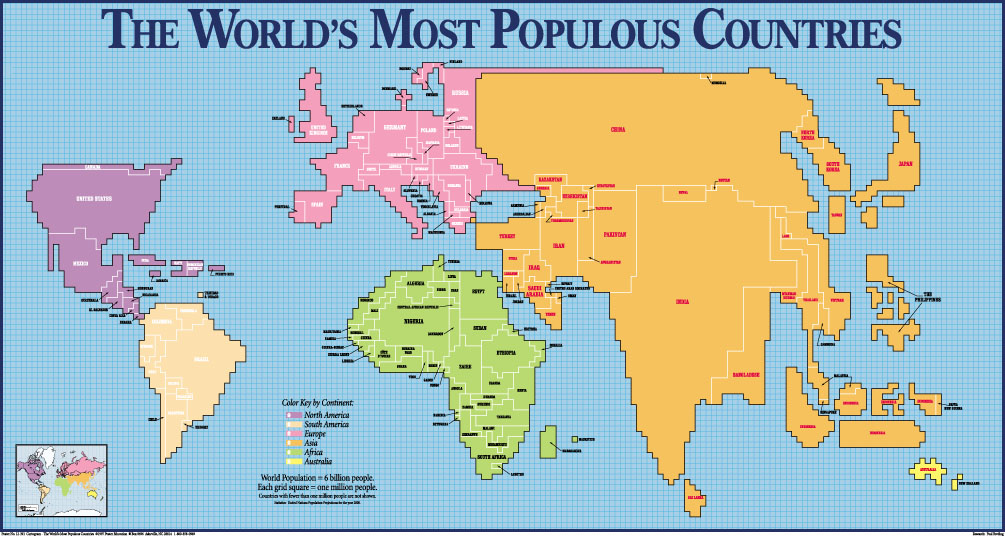
I used to have an up-to-date World Atlas that left out Brazil, so when I saw this the first thing I thought was "Where's Canada?"

Here's the link for a better view.

1879 Hears cheese and smells blogs

My cat is just amazing. She knows when I blog about cats and jumps in my lap. She doesn't come to the kitchen when I warm up coffee or look for the corn chips my husband has hidden, but the minute I reach for the cheese, she appears in the doorway with that, "You called?" look on her face.

1878 Pushed ahead in the queue

I added a new magazine to my hobbylog today, In the Beginning. I should have made it wait its turn--I have about 20 under my office couch patiently waiting to be added. But I'm sort of fond of Meredith Publishing, although not its best know product, Better Homes and Gardens, so I took Real Life Decorating to coffee the other day, and so it jumped ahead in the queue. I'm also trying to help Chuck set up a blog, and I think this one might fly--he knows how to type and he has something to say. It's a plan that often makes a successful blog.

Saturday, December 10, 2005

1877 Just like mother

When my college roommate and I got together in Seattle in 1996 we both said, "You look just like your mother." So we here in the U.S. (and probably Canada, too) look just like old momsy across the pond. If the government tries something and it doesn't work, the solution is to make it even bigger. Melanie Phillips writes about sex education in Britain, and the story is going to sound uncomfortably familiar.

"All the evidence suggests that its sex education policy is a disaster. Britain has the highest rate of under-age teenage pregnancies in Europe. The proportion of 13- to 15-year-olds who are getting pregnant is rising. Sexually transmitted diseases among young people are going through the roof."


So what should be done? Why begin even earlier, of course--with five year olds and compulsory sex education. In education, if it doesn't work, expand the program.

"No sooner will a child have found his or her coat-peg and be measuring up the competition for the climbing frame than some teacher will be rattling off where babies come from. So while many children are not taught to read properly at five — indeed, a disgraceful number can barely read and write when they leave primary school at the age of 11 — they will be given ‘more rounded’ lessons on sex and relationships. Is this not grotesquely inappropriate?"


So the gibberish about relationships and responsibility is just moved down a few years. Oh my. How do you clarify values that haven't even been instilled?

"The increase in sexual promiscuity among children and teenagers is not due to ignorance but to the deliberate destruction of the notion of respectability. Not only are official blind eyes turned to enforcing the legal age of consent, but sex education actually targets under-age children.

Moral guidance is nowhere. Instead, sex education seeks to ‘clarify’ the child’s own values. But children need clear boundaries of behaviour. Treating them as if they have adult values is to abandon and even abuse them."

1876 Why Santa must be a woman

I got a chuckle out of this one. In part:

"Another problem for a he-Santa would be getting there. First of all, there would be no reindeer because they would all be dead, gutted and strapped on to the rear bumper of the sleigh amid wide-eyed, desperate claims that buck season had been extended. Blitzen's rack would already be on the way to the taxidermist. Even if the male Santa DID have reindeer, he'd still have transportation problems because he would inevitably get lost up there in the snow and clouds and then refuse to stop and ask for directions. Add to this the fact that there would be unavoidable delays in the chimney, where the Bob Vila-like Santa would stop to inspect and repoint bricks in the flue. He would also need to check for carbon monoxide fumes in every gas fireplace, and get under every Christmas tree that is crooked to straighten it to a perfectly upright 90-degree angle."

Holiday Junction: I think Santa Claus is a Woman

1875 A multitude of topics

Isn't it strange that after I signed up for Holidailies, which tells me I absolutely must, have to, need to write a blog each day, I dried up. I guess I don't like the thought that it might be work.

I took a lot of notes today, but nothing really appealed. For instance, did you know that guano (bird or bat poop) has 54% protein and only 1% fat, compared to a Big Mac that is 23% protein and 33% fat. I think we do better using it as fertilizer and thus getting those benefits indirectly. Maybe Fear Factor could use this. BioEd I checked a site that sells it for fertilizer, and there is a difference between bat guano and bird guano-- bat guano is high ntrogen and marine sea bird guano is high phosphorus.
Best Quality Available. "Organic Guano Fertilizers add a complexity and fullness to the flavors of any produce."

Also I noticed an item that only 9% of the U.S. public believes the pharmaceutical industry is honest. I wonder what percentage is willing to give up their zocor or prozac, or coumadin, or tamoxifin or any of the other wonder drugs that are making our lives better and fattening our 401K and 403B and pension plans? Bat guano!

Also, the coffee plant Coffea canephora is almost a perfect gene-for-gene match for the tomato plant, Solanum lycopersicum. Coffee bean pizza, anyone? Actually, I'm not too surprised. The human genome sequence is almost 99.9% exactly the same in all people. It's that little .1% where all our differences and diseases occur. God, the designer is also a recycler. If it works, don't mess with it.

I started working on the topic, "unintended consequences," after reading that polio epidemics began because of health improvements in sanitation, like the flush toilet and toilet paper. I'd been noting some as I went along, but then tried the google search, "unintended consequences" + [topic like wind power]. I spent so much time reading the articles, I didn't get my blog finished. Virtually every technological advance and environmental proposal has unintended consequences that change lives. So maybe tomorrow.

For instance, you probably know about the potato famine in Ireland. But before that the introduction of the potato as a family food source made the Irish peasants the best fed in Europe and the population skyrocketed. When the blight killed the potato crop it sent 1.5 million Irish to the other countries, mostly Australia and the USA, and killed another million through starvation. Unintended consequences of introducing better nutrition.

Friday, December 09, 2005

1874 Blogflu Virus

Yes, there is a pandemic of bloggers falling into the culverts of the information highway. Today I clicked on Northern Lutheran, Off Shore Fisherman, and Infinite Library and all are dead. At least, if you said you were taking a break in August and didn't come back, that's a pretty strong message by mid-December, don't you think? Kind of suspicious too, because I think they were all Christians based on my subject arrangement. It's really tricky to lose a blogger. When Lutheran in a Tipi folded her tent, someone scooped up her URL, so when I didn't get her removed in a timely fashion, I was misleading some of my faithful readers. PJ had a great cooking blog and must have choked on something--she reappears once in awhile in my comment box. Of course, she actually earns a living writing. Six figures. Shoe of Librarians Happen truly has been ill (no joke here) and is no longer posting there, but I see her occasionally at LISNews. Babs was on the critical list, missing for a month, but now has her 2 year old posting for her. Ambra is as good as gone. Rosabelle hasn't posted a word since mid-November. And Murray hasn't posted a thing since January in "Brain Drain." I guess it was.

1873 Extreme knitters

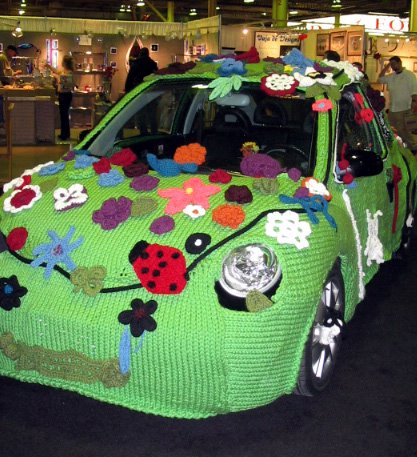
I have no knit projects to show you. I'm still waiting to learn "purl." The closest I've come is raving about Cathy. However, last night I was talking to Ken Becker, a local photographer who exhibits at Winterfair, and he told me about this:


Now this is what I'd call extreme knitting. A cozy for a VW Beetle. Nowadays, there is "extreme" everything. Our church has extreme worship. Sort of resembles this.

1872 Bless Your Feet

I’ve been looking for a reason to post a photo of my baby’s feet. Of course, he’s 37 and his little feet aren’t quite as cute as they used to be, but I liked this picture he took of dangling his feet over Lake Erie. If I'd been there, I would have said, "Now, honey, be careful." Some things just don't change.


But Sprittibee, a home schooling mom, has a really nice series on feet. Did you know there are 320 references to feet in the Bible? I sure didn’t. Click on over and I think you’ll find a good topic.

1871 Can't take my eyes off

a featured painting by Larry Lombardo in the Winter 2006 issue of Watercolor (American Artist) pp. 92-93. I'm not one to read a lot into a painting--I either like it or I don't. Often, I couldn't even tell you why. Sometimes it is the technique, sometimes the color, but Oh, I do love a good story.

Larry Lombardo lives in Pennsylvania, and according to his website, he began painting to keep his sanity while he was a stay at home dad. I read his explanation in the article of the painting titled, "The child has grown, the dream has gone," which is a teen girl in black goth and a older woman in a pastel dress sharing a park bench. He says, "I wanted the painting to show the extreme differences between the generations and the point at which the younger generation becomes the older generation."

That's just way too abstract for me.

Scenario 1: I see a woman about 80, who has lived through the Depression and WWII, perhaps a widow, with some health problems apparent from the painting (maybe some arthritis and vascular problems with her legs), sitting quietly enjoying the sunshine thinking about her life, remembering the good and the bad. Her skin and face are flawless, her hair perfect. At the other end of the bench is a sullen, slouching teen listening to her music, with zippers all over her clothes--a goth or heavy metal look, screaming in her slilent scowl, "I know nothing and I'm mad as hell."

Scenario 2: I see a grandmother and granddaughter, the younger one has turned off her music and is listening attentively to the older woman's advice, which she probably won't take. But it's a step, at least they are talking again. They used to be so close. When the younger woman was about 7 or 8, grandma could do no wrong, and she loved to spend the week-ends with her. But now, grandma is just an old fuddy-duddy like her parents who doesn't like her clothes or her metal-stud-faced boyfriend (he's not in the painting). Grandma's much more at peace than granddaughter--there's nothing she hasn't seen or done. Teen-baby stares at her with that "I can't believe it!" And she won't for oh, maybe another 10 or 15 years.

Lombardo has been a youth pastor, residential counselor, and a psychiatric assistant. He's particularly good, in my opionion, in capturing the expressions of older people. Like the middle-age, pudgy guy eating a do-nut looking at a row of motorcycles. Another good story.

1870 Unintended consequences

Polio has been a topic on this blog and my memory blog with my sister's illness and my cousin's death seared into my childhood memories. So this morning I read through reviews of two new titles on polio, Polio: an American story, and Living with polio: the epidemic and its survivors, both published in 2005. A few entries back I was commenting that people my age don't recall all the food allergies we see today, some of them fatal. So I was surprised to read that probably my grandparents weren't familiar with polio in the late 19th century either. As part of the introduction to the reviews the author writes:


Epidemic poliomyelitis first appeared in the United States a century ago, at a time when America was rapidly evolving from its post-colonial agrarian roots toward industrialization, urbanization, and the ascension of the middle class. Polio, a new "emerging infection," was an unanticipated consequence of the invention of the flush toilet and the adoption of the use of toilet paper. These hygienic advances brought about the control of most diseases transmitted by enteric bacteria, but they paradoxically increased the risk of paralytic disease by delaying poliovirus infection beyond the age at which infants are protected by maternal antibodies acquired by way of the placenta. (John E. Modlin, NEJM, 353;21, 2308-2310)


Technorati tags: , ,

1869 Booking Through Thursday on Friday again

Booking Through Thursday

  • What's on your book/reading wish list?

  • What books are you giving this year?


  • Before I'd ask for this, I'd suggest checking some of the used sites. I got a book I'd asked for last year, and haven't read it yet. It sounded soooo good in the reviews. Also got Memoirs of a Geisha one year, and haven't read that either (although I did take it to an airport once). But yesterday's review in the WSJ was very positive for Mozart: The Early Years, 1756-1781 by Stanley Sadie. The author has since died, so it will be a short series.

    All the relatives are receiving a copy of Cottage; America's favorite home inside and out by M. Caren Connolly and Louis Wasserman, published by Taunton, 2005, because one of my husband's cottage designs at Lakeside, OH is featured in the book. The other featured cottages are good too, of course. The Wassermans have done several books and they are all outstanding.

    Technorati tags: ,

    1868 Signed on for Holidailies

    At Blonde Librarian I noticed she was signed up for the sixth annual Holidailies project. "Holidailies is a free community writing project. All Holidailies 2005 participants promise to update their personal Web sites every day from December 7 to January 6. Portal participants post summaries of their entries, which are aggregated on the front page of Holidailies 2005, newest entries listed first." Well, it was December 8 by the time I heard (read) about it, so I won't get on the first page, but my site is listed with those who don't write a summary. Writing every day must be a problem for some bloggers, so they need an aggregator to push them along.


    Technorati tags: ,

    1867 Winter Wonderland--sort of

    We were supposed to get 4-6 inches last night but it looks like two. The town panics at the hint of snow. I was at my dentist's yesterday and he said he was planning to close Friday (today) because of the coming storm. It looks like more ice and blowing than actual snow. There was talk of school closings, but so far I don't know if that has happened. My husband leads a ladies exercise class and if the local schools close, the class is cancelled.
    We were in Cleveland last week-end and northern Ohio had had about 4 or 5 inches overnight and everything was clean and clear for driving by about 7 a.m. I'm sure they get amused at our wimpy efforts here in mid-state.

    However, we were out driving in it last night, and the Christmas lights and lawn decorations looked fabulous in the snow.

    Technorati tags: ,

    Thursday, December 08, 2005

    1866 Checking out what Technorati says about me

    Recently I added the Technorati search window over at the left. I wasn’t really sure what it would do, but I’ve found it more useful than the blogger search. Wondering what I’d written about economic issues, I tried several topics, poverty (4), income (13), quintile (3), social security (13), economy OR economic (20), finance OR financial (20). Some of these are false hits because if the word appears in the title, it turns up in the “recent posts” feature and fogs up the search a bit. I was pleased to find out I could use a Boolean operator if I capitalized it--I didn’t see any instructions but I know it is recognized that way in some databases. I’m not sure how many operators you can string together. I tried two.

    It was interesting to go back and reread some of the entries. For instance, our high tariffs and quotas were in the news shortly after the tsunami--then seemed to disappear.

    The USA and Europe, in order to protect their own workers, have punishingly high tariffs and quotas for some of these countries affected by the tsunami. After we clean up the ravages of the earthquake driven storm, we'll need to look at what our own policies are doing. I'm sure the message won't be lost on Muslim terrorists. Jan. 11, 2005

    And this item about why Democrats were fighting private investment accounts to save Social Security:

    It is possible that if George W. Bush is successful in creating a larger investor class, a group that goes across all the demographics of female, Hispanic, Black, middle-class, etc., the Democrats will lose their base. The investor class is self-identified as 46% of the total vote in 2004, and their world view tends to be conservative, middle-class, modest, and saving for the kids' college. And if they are Democrats, many of them voted for Bush. March 15, 2005

    And remember last week when that op-ed appeared in the WSJ about how the media just couldn’t print any good news? I commented on that last January:

    At the bottom of the page were tiny charts--eating out, up; federal debt, up; employment, up; satisfaction, up; foreclosures, down; delinquent loans, down.It sure is hard to report on bad news these days. Need to call in John Kerry and Ted Kennedy who managed to put a negative spin on the first free Iraqi election in history for help in composing those make-believe economy stories. John ("let's not over-hype this") Kerry's stock could have soared if he'd just complimented the Iraqis. But he was his usual pompous, my-way-or-the-highway, doomsayer self. January 31, 2005

    Technorati reports my rank is 1,828 with 4612 links from 467 sites. It records 22.6 million blogs.

    1865 The Mega-Church

    Here's a description of a mega church in Minnesota from one of my husband's architectural publications. I suppose it is intended for architects who need to be prepared that it's not your father's church.


    A typical megachurch features:

    - No pews. Instead, there are comfortable movie-theater-style cushioned seats. Stadium seating ensures good views of the stage.

    - No Bibles or hymnals. Parishioners sing hymns by following the words on a large screen.

    - Non-churchy architecture, without steeples. They look like high schools, malls, or convention centers.

    - Few symbols of religion. Stained-glass windows and even crosses are far less prominent.

    - A dizzying array of specialized services, with specialists in geriatrics, teens, addiction, and early childhood.

    - No asking for money during a service - a turnoff for newcomers. There never is "passing the plate."

    - High-energy music, with an in-house rock-style band on a stage ablaze with theatrical lighting.

    - No pulpits. The pastor speaks informally from a simple stand on the stage.

    - A fundamentalist and charismatic worship style, with a politically conservative viewpoint. Archi-tech


    I suppose our church doesn't qualify because we have 3 campuses and 10 services, and our buildings have stained glass and traditional religious symbols. Although one sort of looks like a theater (unfinished) until you see the altar and window. And we pass the plate and the peace, and have no political viewpoint at all. No issue sermons, ever. Lots of rock-the-house music, though. It drives me out of the building because it hurts my ears and sets my atrial fibrillation in motion. That music does appeal to the young people though, who are mostly deaf or on their way. More at my other, other blog.

    Technorati tags: ,