Interview with Doris Kearns Goodwin for Echoes Magazine, July and August 2025, p. 34. "Lincoln was worried as the Revolutionary generation was dying off, and it was a very tumultuous time. It was in the 1830s when there were abolitionists being killed and lynchings being done in the South. And Lincoln was afraid that when those people died, we would forget the ideals of the Revolution. He recommended that mothers read history to their children, that pastors talk about it from their pulpits, that we had to teach history in the schools--the history of the Revolution--so those ideals would remain strong in our countrymen's minds and hearts."
Showing posts with label Abraham Lincoln. Show all posts
Showing posts with label Abraham Lincoln. Show all posts
Sunday, September 21, 2025


Saturday, September 09, 2023
And there was light, book club selection September 11
For book club this month I'm reading Jon Meacham's "And there was light; Abraham Lincoln and the American Struggle." (Random House, 2022) By page 140 I was noticing a subtle hint of 21st century moral superiority and self- righteousness in the author's tone. I grabbed a second Lincoln book from my personal library, Ronald White, Jr.'s "A. Lincoln; a biography." (Random House, 2009) They are both massive books (676 pp. and 796 pp.) The bibliographies/notes sections are so huge and so different, it's almost impossible to check one against the other. I'm supplementing my reading with Paul Johnson's "A History of the American People," pts 3 and 4, which covers 1815-1870, which emphasizes links to England's history and our country's religious beliefs and formation. I was a little fuzzy on the Mexican War and the Nebraska-Kansas problem.
The bibliographies are incredibly difficult, but here are some rough, ballpark stats: Meacham cites Steven Douglas 27 times, White 106 times; Meacham cites Frederick Douglass 58 times, White 30 times. Both men were important, but for telling the story of pre-Civil War America and what Americans thought and believed, Steven Douglas is a better example of the pro-slavery forces Lincoln was up against convincing Americans (many of whom had never seen a black man or a slave) to stop the expansion and then ending slavery.I've come away from this reading experience with a suspicion that all great heroes of our history will never pass muster because of the 21st century's race problems. They won't survive the Obama presidency and the George Floyd riots which were far more damaging to our national fabric than January 6 riot. Statues will continue to be torn down and schools renamed.
In this era of abortion up to the day of birth, maiming children in sex change surgeries, border sex trafficking, and energy and welfare policies that hurt the poor some of our scholars, publishers and activists find 21st c. American morals and ethics superior to the 19th and 18th centuries!
Although White never hides Lincoln's failures, he faithfully follows through on an outstanding study of his growth, integrity, and complexity, as well as his evolution in religious values and struggles. Plus, he's readable. Meacham does say good things about Lincoln but always "balances" with what his detractors from 3 centuries had to say. Cherry pickers for CRT classes will love it. Does Lincoln's passion for saving the country and destroying slavery have to be explained through a (failed) 21st century racialist lens?
I noticed the similarities to what we are going through today. In passionate love for their country, Lincoln and Trump are pretty well matched, regardless of what you think of their causes. And I can't think of any president more vilified than Lincoln except Trump. Lincoln was ridiculed, damned, hated with a passion, lied about, and feared just like Trump is today. There was more than one assassination attempt. The Republican party was in its infancy in 1860, lively and eager, and in its dotage in 2016 and 2020, careless and timid. The Democrats were racists then and they are racists now. The stakes were different, but slavery was embedded in every aspect of American life, even for northerners. The danger from non-elected entities in the deep state are as stubbornly embedded in our way of life as slavery was then. The desire to control others' lives it still with us today. To challenge the deep state today is as dangerous as challenging slavery was then. And abortion, although not a cause for Trump, is OUR moral issue overshadowing all other events and decisions just as slavery was in 1830-1860.
Trinity Forum Conversations | Lincoln in Private: Leadership Behind Closed Doors with Ron C. White (transistor.fm)
Although White never hides Lincoln's failures, he faithfully follows through on an outstanding study of his growth, integrity, and complexity, as well as his evolution in religious values and struggles. Plus, he's readable. Meacham does say good things about Lincoln but always "balances" with what his detractors from 3 centuries had to say. Cherry pickers for CRT classes will love it. Does Lincoln's passion for saving the country and destroying slavery have to be explained through a (failed) 21st century racialist lens?
I noticed the similarities to what we are going through today. In passionate love for their country, Lincoln and Trump are pretty well matched, regardless of what you think of their causes. And I can't think of any president more vilified than Lincoln except Trump. Lincoln was ridiculed, damned, hated with a passion, lied about, and feared just like Trump is today. There was more than one assassination attempt. The Republican party was in its infancy in 1860, lively and eager, and in its dotage in 2016 and 2020, careless and timid. The Democrats were racists then and they are racists now. The stakes were different, but slavery was embedded in every aspect of American life, even for northerners. The danger from non-elected entities in the deep state are as stubbornly embedded in our way of life as slavery was then. The desire to control others' lives it still with us today. To challenge the deep state today is as dangerous as challenging slavery was then. And abortion, although not a cause for Trump, is OUR moral issue overshadowing all other events and decisions just as slavery was in 1830-1860.
Trinity Forum Conversations | Lincoln in Private: Leadership Behind Closed Doors with Ron C. White (transistor.fm)
Friday, July 10, 2020
“From Christ to Emancipation,” Townhall.com Wednesday, July 8
|
Thursday, July 02, 2020
Let’s deny both history and art
Art has to say a lot, and be useful and meaningful years later. In this statue the black man is shaking off the shackles and rising. Democrats have battled this every step of the way, and still are. Now the art has to go. They are afraid too many are escaping their grasp.
Let it be known everywhere,” [Frederick Douglass, noted black abolitionist] declared, “[that] we, the colored people, newly emancipated and rejoicing in our blood-bought freedom, near the close of the first century in the life of this Republic, have now and here unveiled, set apart, and dedicated a monument of enduring granite and bronze, in every line, feature, and figure of which the men of this generation may read, and those of after-coming generations may read, something of the exalted character and great works of Abraham Lincoln, the first martyr president of the United States.”
https://www.faithwire.com/2020/07/01/boston-taking-down-lincoln-emancipation-statue-after-unanimous-vote/
Let it be known everywhere,” [Frederick Douglass, noted black abolitionist] declared, “[that] we, the colored people, newly emancipated and rejoicing in our blood-bought freedom, near the close of the first century in the life of this Republic, have now and here unveiled, set apart, and dedicated a monument of enduring granite and bronze, in every line, feature, and figure of which the men of this generation may read, and those of after-coming generations may read, something of the exalted character and great works of Abraham Lincoln, the first martyr president of the United States.”
https://www.faithwire.com/2020/07/01/boston-taking-down-lincoln-emancipation-statue-after-unanimous-vote/
Friday, June 26, 2020
Destruction of the Emancipation statue
I watched a Black woman on TV "explain" to a crowd (mostly young white adults) why the Lincoln emancipation statue needed to be destroyed--it showed slaves subservient and didn't represent how they participated in the emancipation. I suppose there's an element of truth there, but it is art and it also didn't show Lincoln as a man much vilified for his beliefs, his lack of a formal education and his physical appearance.
It particularly did not show the many free Blacks of that pre-war time who owned slaves. They owned slaves at a higher rate than southern whites according to Henry Louis Gates, Jr. PBS host and Obama's friend and mentor.
I was probably in my 30s or 40s before I found out that before the Civil War freed Blacks in the U.S. owned slaves. I don't recall that was covered in American history in high school or college. But it wasn't until Prof. Gates wrote about it, that I learned that free Blacks owned slaves at a much higher rate than whites, something like 25% compared to about 1.5%.
Free American Blacks were voting before the Revolution (long before women) and most likely helped ratify the amendments and send the men to Congress. There were very wealthy free Blacks who owned a lot of property as well as small businessmen and craftsmen of all manner of the arts in the South.
That would be hard to show in a piece of art, but BLM leaders should at least acknowledge it and reject the white Marxists who are now in control of their movement.
Tuesday, February 12, 2019
210th anniversary of Lincoln’s birthday
“While the Civil War raged in late 1862, Union Gen. Ulysses S. Grant wanted to stop the trade of Southern cotton. A number of Jews were involved in the cotton trade, including some in black market activity, and on Dec. 17, Grant issued a shocking order calling for the expulsion of all Jews from a wide swath of the South.
Fortunately the order had little impact because of faulty army communications – and to President Lincoln. When Lincoln heard that Grant was attempting to banish Jews, he quickly reversed the order.
“To condemn a class is, to say the least, to wrong the good with the bad,” Lincoln said. “I do not like to hear a class or nationality condemned on account of a few sinners.””
https://www.jta.org/2019/02/12/opinion/when-president-lincoln-fought-for-the-jews?
Friday, February 10, 2017
Lincoln on slavery
In March 1860 Abraham Lincoln spoke at Yale on the campaign trail to the White House. Yale's student body was divided on the issue of slavery, an important plank in the Democrats' platform. "If Slavery is right, all words, acts, laws, and Constitutions against it, are themselves wrong, and should be silenced, and swept away. If it is right, we cannot justly object to its nationality—its universality; if it is wrong they [the Democrats] cannot justly insist upon its extension—its enlargement."
That's how I feel about legal abortion, both the federal and state laws; if Roe v. Wade is ever overturned, the issue just goes back to the states where it is still immoral even if legal. If abortion is right, then all acts and laws are wrong and have no meaning.
That's how I feel about legal abortion, both the federal and state laws; if Roe v. Wade is ever overturned, the issue just goes back to the states where it is still immoral even if legal. If abortion is right, then all acts and laws are wrong and have no meaning.
However, this statement by Lincoln was a paraphrase of a writer who influenced him and many abolitionists, Leonard Bacon, a Congregational preacher and writer who wrote it in 1846. The Congregationalists are now blended into United Church of Christ which has been supporting abortion since 1971. President Obama was a UCC member, but so was Harriet Beecher Stowe (Congregationalist).
Tuesday, November 19, 2013
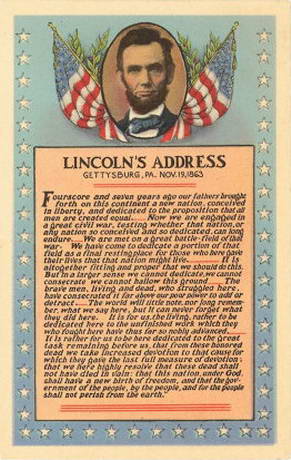
November 19, 1863, Gettysburg, Pennsylvania
President Obama is just not doing well with this Gettysburg Address thing. First he bails on attending the 150th event in Pennsylvania, offending even some of his strongest supporters (he had a meeting with some Wall St. CEOs scheduled for today, although he'd been invited over a year ago), then it comes out when he recorded the speech for Ken Burns to "mash" with other Presidents and celebs (a really odd collection including some of my least favorite TV reporters), he does so without the "under God" phrase, so Jimmy Carter got that part. Really, what is wrong with this man, who literally spoke from Lincoln's grave to get elected in 2008? It's like he carries a stick to poke us in the eye regularly.
Tuesday, October 18, 2011

Tuesday, August 25, 2009
Civil War speakers this week
 Craig Symonds, Professor Emeritus at the U.S. Naval Academy and the author of ten previous books, including Decision at Sea: Five Naval Battles that Shaped American History, yesterday examined Lincoln’s presidency through the lens of the naval side of the Civil War, and his relationship with his Admirals. Today’s lecture we learned about a new kind of warship with iron sides and revolving gun turrets used in the Union blockade of Southern ports and the Battle of Mobile Bay. Symonds is an outstanding, lively, well-informed speaker, and he never misses a step when asked questions from the audience. If he had notes, I didn't see them. If you ever have an opportunity to hear him, don't miss it, even to just enjoy a well-prepared, articulate speaker.
Two annoyances: first, so many people don't turn off their cell phones. How many calls can grandma get? So irritating. Then there's the "other" expert in the audience--this one about 2 row behind me with an extremely deep voice, that rattled and rumbled as he pointed things out in an audible whisper to the guys he was sitting with. If he's so smart, why isn't he on the speakers' circuit, or sitting in archives researching?
Reminds me of comments at my blog.
Subscribe to:
Posts (Atom)


 Posts
Posts


