Showing posts with label Mt. Morris College. Show all posts

Tuesday, May 27, 2025

Keeping in touch with the class of 1957

 I was talking to my brother in Illinois the other day while sitting in our driveway soaking up the beautiful weather. One of the advantages of our high-tech communication--cell phones. He mentioned that he and a few of his class members of 1959 had gathered recently--maybe 10 of them.  A few women from my high school class (1957) also met the week before for coffee.  An e-mail had gone out discussing some 1950s memories of the "campus" in our hometown.  It wasn't our high school campus, but the old college campus that our parents attended until it closed a year after a disastrous fire in 1930. It's still called the "campus."  One memory popped up of one of our more unusual classmates, Neal Johnston, who marched to a different drummer, and died in 2010. Here's his obituary from my class blog. MMHS1957: Neal Johnston, class member, dies May 24

My parents met on a "blind" date, but my Dad did change his school plans after that so he could attend Mt. Morris College after he and Mom met.  Today is her birthday.

Monday, April 09, 2012

Yearbooks and Annuals

I don't know what generates the ads on the right side of my screen on Facebook, but this morning noticed one for yearbooks. I have my four high school yearbooks, The Mounder, from Mt. Morris High School in Illinois, two Illios from the University of Illinois (I was married by the time I graduated and couldn't afford one for that year), one from Manchester College, The Aurora,  in Indiana, and three from Mt. Morris College, Life, 1929, 1931 and 1932, my uncle Clare's, my mother's and my father's. The college closed in 1932 and merged with Manchester. We also have my husband's yearbooks, The Arsenal Cannon from Arsenal Technical High School in Indianapolis, a school that was larger than the town of Mt. Morris, and Tech's memorial yearbook for the first 50 years. One of the best things about yearbooks is reading the crazy stuff people wrote in them!

Saturday, January 01, 2011

Happy New Year 1884


This is the cover of my grandmother's scrapbook--and I'm guessing the date, 1884, was fairly close to the time she started it. I've often wondered if the Studebaker Brothers were distributing some advertising material in preparation for buying up the Mt. Morris College Buildings. The following account is from the Brethren Encyclopedia, 1983.

"By 1883, Mount Morris [College] had entered a very difficult period. Leadership of the college was crippled by [President] Stein's sudden departure and [D.L.]Miller's lack of academic training. The college also faced a financial crisis, one which was so critical that negotiations were begun for the sale of the property to the Studebaker wagon manufacturing company. However, this move created concern and anger among students and the citizens of the town, resulting in the boards search for a president and another financial commitment to assure the college's future. J.G. Royer, superintendent of schools at Monticello, Indiana and founder of the Burnett's Creek Normal School, came to Mount Morris, invested heavily of his own funds in the college, and accepted the presidency of the institution. He served for the next twenty years as president of Mount Morris College and placed it on a firm foundation."

Mt. Morris the town (college closed in 1932) needs such a financial angel to rescue it today.

Monday, June 29, 2009

New trees for the campus

My high school friend and favorite Democrat, Lynne, tells me that four new trees have been planted on the former campus of Mt. Morris College (where my parents and grandparents attended and which closed in 1932 after a fire in 1931). There was a terrible storm in August 2008, and a large number of magnificent trees were lost--many were diseased and frail, but still beautiful and providing wonderful shade and respite. However, trees are not “natural” to this little mound in northern Illinois. According to the Mt. Morris Past and Present of 1900
    "The present site of Mount Morris, as stated before, was an open prairie, with not a tree or a shrub to be found. What is now the college campus was then the crest of a hill of considerable size, the country sloping from it in all directions. The early settlers say that before the view was obstructed by buildings and trees, the altitude of the hill was very perceptible. The prairie grass was very rank. In fact, in some places it grew so luxuriantly that it was almost impassable. Most of the ravines and hollows were in a wet, boggy state; and the streams and ponds retained the water from rains much longer than now, because of the absence of tiling in the lowlands. There abounded hundreds of springs, which have long since ceased to flow, owing to the rapid drainage now effected by the work of tiling and the development of the soil."
So, I don't know what the soil in mid-town Mt. Morris is like now, but I'm guessing it's well drained. (The local cemetery where most of my family--parents, great grandparents, sister, cousins, aunts and uncles, etc.--awaits the resurrection used to be called "burial at sea" just to give you an idea of how boggy it was.) However, last week I attended a program on the trees here at Lakeside, a totally different type of soil--very rocky, as this is called the Marblehead Penninsula on Lake Erie (a body of water that has changed shape and size many times since the glaciers passed through here). Our speaker said that for every inch of trunk, the newly planted tree needs 5 gallons of water a week, plus 5 gallons. So if the tree is 2 inches, it needs 15 gallons of water a week to get a good start. There is no way those new trees can get that much naturally. But he told about a wonderful contraption called a tree gator--looks like an ugly green bag attached to the trunk. It holds 5 gallons, and you move it from tree to tree each day, and start over the next week. It's drip irrigation and won't drown the tree the way an impatient employee or volunteer might.
    Newly planted trees are under severe water stress right after transplanting. And they will remain under water stress for the first several years after planting. Maintaining soil moisture is especially important during the first three years following transplanting. So how do you prevent transplant shock and avoid water stress on new trees? The answer is simple, Treegator® slow release watering system for trees. Treegator delivers a high volume of water directly to the root system of a newly planted tree.


Maybe this could be a project for the reunion committee.

Friday, December 07, 2007

Almost a Friday Family Photo

When I was a little girl, this major league pitcher for 14 years lived on our block, and played with the Philadelphia Athletics, Boston Red Sox, St. Louis Browns, and Boston Braves. I went to school with his children. I knew he'd gone to Mt. Morris College with my parents, but didn't know he'd graduated from Manchester College in 1934. In 2006 he was inducted into the Manchester College Hall of Fame which was established in 1994.

Friday, September 15, 2006

Friday Family Photo

This group of young college students, ca. 1895, were enjoying the social contacts made through their "boarding club," at Mt. Morris College in Mt. Morris, IL. I know they don't look thrilled to be there, but I think that's because photography still required the subjects to be quiet still. The older woman in the middle of the group is the "house mother," probably a local widow who opened her home and supplied the meals for a small income. Many of the student would have also roomed at homes in the community.


My maternal grandparents probably met this way, she is in the upper left, next to her future brother-in-law, and he is in the lower right. Grandma was from Ashton, about 20 miles away and probably used a train to travel back and forth, but Grandpa was from near Dayton, Ohio, (Jamton, which no longer exists) and I am told that he and his brother bicycled from the Dayton area to get to Mt. Morris. Bicycles were still fairly new then and long distance travel was not unusual, especially with clubs. Their materials and innovations and the rider's sense of freedom and independence really paved the way for the automobile, and many early bicycle makers became auto makers.

One of the things I find interesting in this photo is the clothing. It looks rather plain to us in the 21st century, but these young people were most likely members of the German Baptist Brethren (later called Church of the Brethren), but none are dressed "in order," the word "order" meaning discipline and separation. For men this might be suits without ties or lapels, and for women dresses with no adornment and prayer coverings over the hair. I would need to check with an historian of this group, but it is possible that they did not dress "in order" until they were baptised which may have been in adulthood.

After one year of college, Grandma went home to Ashton to manage her father's farm home because her mother died, but she did continue with her painting and took private lessons. Grandpa and his brother after two years of college headed west, taught school along the way in the Dakotas, worked as lumberjacks in the northwest, and tried to get into Alaska for the gold rush. Eventually the young adventurers returned to the midwest. My grandparents got together to renew a college friendship (he was probably out of money), and married in 1901.

Update: Modern view on anabaptist dress.


Friday, August 18, 2006

2770 Veritas Vincit

This Latin motto, "Truth Conquers," would make an interesting blog title, I thought. Upon checking, I discovered 5 other people thought so too and had used it in some form or other. So, I guess I won't use it. It was the motto for the college that used to be in Mt. Morris, Illinois. I looked at a site that reported on college mottoes, and this one doesn't seem to be in use any longer. Interesting.


When the Methodist Episcopal Church reprentatives drove a stake in the prairie at a high point where they would establish a seminary, there weren't any houses or settlers, although a few white families had been settling in the area. The village was laid out by the trustees of Rock River Seminary which owned all the land where the town now stands. But it was the local people, mostly recently arrived from Maryland who donated the money and the land, 480 acres, to induce the church to take on this challenge of establishing a school in the middle of nowhere. Alexander Hamilton's son had explored the area and Abraham Lincoln fought the Indians near by, but there wasn't much going on.

The college prospered for awhile, but the Methodists established another college in Evanston (Northwestern) and that sort of ate into the pool of potential students. But it did turn out about 7,500 students, a lot of them clergy, lawyers, politicians, editors and businessmen before it closed in 1878. It was reopened in 1879 by a group of Brethren businessmen as an institution for their young people (now Church of the Brethren), and it became Mount Morris Seminary and Collegiate Institute, and then Mt. Morris College. After a fire in 1931, the college closed in 1932 (there had also been a fire in 1912, but the college rebuilt). My parents were freshmen when it burned; my mother's parents had also met there. In 1994 the town school system merged with Oregon with high schoolers being bussed. In 2004 the elementary school was destroyed by fire, and now the little ones are bussed too. The original high school where I had classes for a year, later became a junior high, and it burned in 1989 (no longer in use as a school).

The current students have all adjusted--probably better than the adults. Just as my generation had no memory of the college except what our parents told us, so there will soon be young people who have no memory of a town school. It does seem odd now to me, an outsider for many years, that the little town created because people cared about education, doesn't have a college, or a high school or an elementary school.

Information from "Mt. Morris Past and Present" by Harry G. Kable, rev. ed., 1938 and photo from "The 1929 Life" of Mt. Morris College.

Monday, April 03, 2006

Monday Memories


Did I ever tell you that my Dad played football against the Gipper?

Not really, he played against Ronald Reagan, 40th President of the United States, who played George Gipp in the movie "Knute Rockne, All American." Win one for the Gipper became part of our language and Reagan used it also in politics. In addition to politics, President Reagan's career included lifeguard, broadcaster, movies and television, and motivational speaking, but during college he really did play football.

Reagan's boyhood home in Dixon, Illinois on the Rock River and my Dad's home in Pine Creek were just a few miles apart but in different counties. However, Dutch and Cub met through a mutual acquaintance when they were still in their teens. Dad was a poor farm boy about 16 and a senior in high school at Polo, IL. Reagan, who was two years older, was already attending Eureka College. A neighboring farmer thought Dad had potential because he'd seen how industrious he was (water boy for thrashers, selling cans of salve he'd ordered from a magazine advertisement, laboring in the fields with his farmer father). The neighbor knew the Reagan family from The Christian Church, so he arranged for Dad to meet Ron, thinking he might interest him in attending Eureka. Dad also had an offer of a small scholarship from the Polo Women's Club to attend the University of Illinois. I'm not sure what happened (a blind date with my mother, I think), but Dad ended up at Mt. Morris College with some financial help to play football.

Mt. Morris College slaughtered Eureka on November 15, 1930, 21 to zip, a story Dad enjoyed retelling when Reagan became famous (although Dad was a Republican, I sensed that he was not crazy about Reagan). To my knowledge, there are no photos of Dad and Reagan butting heads or tackling each other, but I like to think they are somewhere in the jumble of arms and legs in this photo with farm buildings in the background. Say, is that my mother over there on the sidelines, cheering on the team?
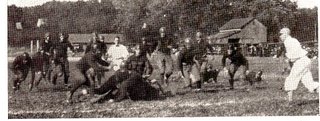


My mother was an excellent student who really wanted an education--both of her parents had also attended Mt. Morris College in the 1890s. Dad was smart, but I suspect he was there to have a good time and play football. There was a disastrous fire on Easter Sunday 1931 when most of the students were home on holiday. Although the college reopened for the 1931-32 school year, my mother's family couldn't afford the tuition so she went to work in Chicago as a domestic. Dad returned to school with a football scholarship--at least in the fall. In the 1931 final game with Eureka College, the score was 0-0. The college yearbook says Dad didn't play the last four games due to a heart problem.

President Reagan visited his alma mater often, 12 times between 1941 and 1992. Eureka College is still educating young people, but Mt. Morris College closed after almost 100 years when the class of 1932 graduated. Except for his time in the Marines during WWII, Dad lived in Mt. Morris the rest of his life.
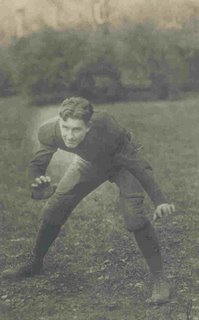
Dad, 1930, 17 years old

---------------
Lazy Daisy,
Barbara,
Yellow Rose,
Katherine,
Libragirl,
Kdubs
Shelli
Kimmy

If you've enjoyed my Monday Memory, please leave a comment and I'll link back to you here.
Click here for the Monday Memories code
Click here for Kimmy's MM banners

Trackbacks, pings, and comment links are accepted and encouraged!