Wednesday, January 19, 2005

740 How it used to be--1992

Billy Frolick writes an interesting bit of whimsy in the January 17 New Yorker about an 8th grader (written in first person) who has to choose a year from U.S. history and live for a week as if it were that year. He chose 1992. It is quite amusing, and informative, but probably not if you reached adulthood after 1995 (and I don't get many readers under 30). As a librarian, I smiled when he said he needed to go to the library to do some of his research instead of using the internet.

There's a good overview of what is happening to scholarly publishing and how it has changed since 1992 at the Social Science Research Network beginning with the procedure for writing and submitting to a refereed journal (which is still done), and the possibilities of putting it all out there today, where the authors primarily are making those decisions. Or as the author says, "You only need to know what you're looking for." The author, David Warsh, is a good example: the full version of what I read at another site, is located here.

As I noted in 736 free isn't always cheap, and I might add quantity is no guarantee of quality. Although "working papers" and departmental "pre-prints" have been around many years, the internet access has only added to the confusion. I think librarians will still be needed for many years--maybe now more than ever.

Tuesday, January 18, 2005

739 After dinner games and old TV shows

A few months ago we went out for dinner with Ned and Rosalee and then went to their house to play Boggle. It is a word game with a 3 minute timer. The words need to be at least 3 letters. Three minutes, three letters--sounds about like my attention span, so I went out an bought one for our house. My husband mentors a 4th grader in an urban school and has taken the game with him a few times.

So tonight we played Boggle after supper. We played 5 or 6 sets and I won. We had to get out the dictionary and even though we made up some words, when we checked, they really were words, like "thew." (He made that one up--I didn't think it was a word, but it was.) When I came up with "nosh" he thought I made it up. I told him it was like being at a party and hanging around the snacks eating all night, but having always been thin, he didn't believe me. So we had to look that one up too.

If the players pick out the same words, those are dropped from the score. But I won 68 to 18. I don't think you have to be particularly good with words since most of these are 3, 4 or 5 letter words, but you do have to think upside down, backwards and at an angle.

Also, for the exciting life of a retiree, this week I bought a Dick Van Dyke DVD from 1962--6 episodes for $2.00. I didn't remember any of these, and thoroughly enjoyed it. That was really a well written, beautifully acted show. Since I never watched TV much until I was married (my parents didn't own one), this series is one of the earliest I remember. My father-in-law worked for RCA, so my husband grew up with TV and remembers even the test patterns.

738 FOBT vs. colonoscopy

One of my Canadian readers (you know who you are) got here because I'd left a comment at his blog when he wrote about the FOBT. Now we regularly visit each other's blogs for topics other than fecal occult blood testing. However, today in the WSJ it was reported that those quicky smear tests done in a doctor's office failed to detect advanced precancerous lesions 95% of the time. That's code for, "they are worthless." Now, the home tests score a little higher. They get it right about 23% of the time. I haven't looked up the article in the Annals of Internal Medicine (one of my favorite journals, btw) to see if that was early or advanced. However, the colonoscopy can actually prevent cancer by finding polyps in the early stage so they can be removed. The sigmoidoscopy is in the middle manager range, but why would you even bother when you can go right to the top--or the bottom, as the case may be.

Monday, January 17, 2005

737 Bad hair day

I saw a woman at Meijer's today with my hair style--the one I had in 1966! I was so shocked, I braked the grocery cart and stared. It was one of those beehive thingies with the French twist in the back. I didn't know there were hair stylists alive who still knew how to do that. I rarely keep a hair style longer than a year. The one I have right now (different than the photo which was 2003) is about a year old, and I'm really bored with it.

When I was growing up, after I gave up French braids, my mother always cut my hair--she also permed it. Whew! Did those things smell. Then when I was in 8th grade we went to Rockford and I got a professional hairstyle, a snazzy two piece, lime-green and white, sleeveless dress with a straight skirt (my first), and white linen high heels, and poof, I had grown up overnight. In my memory, I was always letting my hair "grow out." However, I remember a haircut before the Christmas dance when I was a junior in high school, a hair set the morning of my wedding day, and a haircut and set to have my senior photo in college taken. I'm sure there were more trips to the "beauty parlor" than that, but it must have been "growing out" most of the time, because my old photos show a lot of pony tails and shoulder length hair.


8th grade Chicago trip

My husband had beautiful red curly hair when we met. However, very short hair was popular for men, so I had to take his word for it that he had curls. He said it was so wild and unruly when he was a child, he'd be sent out of class to comb his hair. Living through our children's teen years took care of most of his hair, and then about 10 years ago it lost most of its color.


On the beach

This painting of us on a beach of Lake Erie 30 years ago is by Ned Moore, one of the best watercolorists in Ohio. My husband still had his red hair, and my hair, as usual, was growing out, in braids almost to my waist. It is one of my favorites.

736 When free isn't cheap

No matter what your profession, you probably are inundated by information--most likely from some type of aggregator or news service which was supposed to make that sort of thing easier by sending only the abstracts and links you care about to your mailbox. It doesn’t, really--make it easier, that is. It’s too tempting to subscribe to several, and end up with 57 unread messages everyday, so I still rely on my links and my list of bookmarks (I’m power hungry, I suppose).

William Watson describes what he does with one of his services--I shouldn’t be surprised that I’m not the only one looking for the free information and skipping it when asked to pay. I’ll register for a paper (NYT, WaPo, LA Times, Chicago Trib) if it is free, and I’ll pass up the current issue of a journal if the archives are free. Library journals (of the profession pushing “information should be free” mantra) are almost never free. Even liberals want to be paid.

Anyway, Watson writes in this article:
“The way the SSRN works is if you like the abstract they've sent you, you can follow a handy link and download the full study. Most of the time the download is free but some of the institutes want money, usually $5 U.S. per study.I sometimes pay the five bucks but I must confess - truth in column writing requires it - that what I usually do instead is google the author's personal Web site to see if the paper is posted there. It usually is and - bingo! - the download is free. Think of it as Napster for nerds.”

And so he goes on to say open access is fine if you believe that journals with operating costs (like editors) provide no useful function, and that cheap drugs (he’s Canadian) are nice if you believe pharmaceutical research costs nothing. Free rides are not always free, is what I think he’s saying.

735 Washington Post gets it wrong he says

Kenneth Anderson comments, "The Washington Post, in its Sunday, January 16, 2005 editorial opposing the confirmation of Alberto Gonzales as attorney general, gets it wrong on the Geneva Conventions. My guess is that the editorial writers have never actually read the relevant article of the conventions, but instead have simply relied on press releases from various rights groups that tell the WaPo what it wants to hear. . ." After quoting the incorrect editorial, he continues:

"The Bush Administration was - and is - NOT in violation of Article 5 of the Third Geneva Convention. Read it. It does NOT say that a "competent tribunal" shall determine whether any doubt has arisen with respect to the POW status of a detainee. It says, rather, that "should any doubt arise" as to whether a detainee is entitled to POW status, then the person shall be treated as a POW until a competent tribunal shall determine his or her status. The question of who is entitled to determine whether any doubt has arisen is left open - it does not say that this matter must be determined by a competent tribunal. It leaves open the possibility that the President or the Secretary of Defense may determine, even for an entire group of detainees, that no doubt arises and hence no tribunal is required."

The content of Anderson's blog is Law of War and Just War Theory.

On January 7 Anderson noted: "I particularly reject Mark Danner's quite slippery op-ed piece in the NYT of yesterday, Thursday, January 6, titled "We are all torturers now." Cute, but sorry: we're not. What Danner does, quite inexcusably, is mingle the undeniable abuses of Abu Ghraib with the fact that the White House counsel sought, in the context of the interrogation of a known senior Al Qaeda chief, the outer limits of what could permissibly done in the way of questioning. I don't know, quite frankly, why one has a lawyer if not to ask what the outer limits of legal behavior are."

Noted at Pejmanesque.

Are all Bush's Hispanic nominees having a problem with confirmation or just the top rung? Apparently, Dr. Rice is a foot shuffling mammy to Bush haters and Hispanics are just illegal wetbacks not smart enough to check with lawyers.

Sunday, January 16, 2005

734 Miss Universe of 1957

A newsletter about collectibles and antiques comes to my e-mailbox. I read it mainly for the old recipes, but also I enjoy the little stories people tell about finding things, or trying to find the rightful owners of photographs and Bibles they've purchased at a sale. Jan, a reader, writes about finding some old Miss Universe brochures when cleaning out her aunt's house.

"My husband's aunt died and we were in charge of having an estate sale of all her belongings. I found so many wonderful things to keep that I pulled out of the house before the sale. One of these was a stack of Miss Universe program brochures from 1953 to 1959. This lady and her sisters were hostesses at the Miss Universe pageant in Long Beach, CA, and my husband remembers, as a young boy, these beautiful girls from all over the world staying at their house for a week during the pageant. Anyway, my hobby is selling on E-bay, and just for the heck of it one day I offered one of these brochures for sale. I was amazed that it went for over $100 - people were bidding like crazy for this program brochure that originally cost 25 cents at the pageant.

One day I offered the 1957 program brochure on E-bay as an auction. I got an email from a woman in South Dakota, and she asked me: "My mother was in the Miss Universe pageant that year. But she would never talk about that time in her life - it is like a closed chapter - and we would love to know about it. I don't suppose her picture would be in that book." She gave me her mother's maiden name, and I told her, "Sure, her picture is here, on page such and such." She was so excited to hear this and she won the auction and I sent her the program. I received an email from her telling me how delighted her sisters and she were to finally have this artifact from their mother's past!... Jan" The Collectors Newsletter #287 December 2004

Just out of curiosity I went online and looked at the Miss USA for 1957 and according to the website the Miss USA for 1957 was disqualified because she was underage, married for the second time and had two children! She was replaced by the first runner-up. No wonder she didn't talk about it!


Miss USA 1957 (for a day) of Miss Universe Pagent

Now it is possible that all the candidates of Miss USA are folded into that brochure, but apparently the 1957 event was quite a scandal. But I don't know why any candidate other than Leona Gage (Mrs. Ennis), the disqualified Miss USA, would not tell her daughters about it. There are several horror movies of the early 1960s with an actress named Leona Gage, and a book for sale at a used book site called My Name is Leona Gage, Will Somebody Please Help Me? It was published in 1965, and if the blurb on this paperback is true, life didn't go well for Mrs. Gage Ennis. "Her beauty attracted brutality; her love, rejection; her tenderness, contempt. Suicide, birth, stardom, drugs, beauty, madness- here is the fantastic true story of Leona gage." For someone who only had 48 hours of notariety, she was still apparently well known enough in 1965 to warrant a book. In 1999 someone was looking for her on a genealogy site--wanted to write a story about the 1957 pageant.

So it is possible that because the 1957 pageant was so famous, the bidders on E-bay weren't even who they said they were, but were doing a bit of a scam on Jan--maybe hoping she'd just give them the brochure. The names of all the contestants who placed are on the web, so it wouldn't have been difficult to provide a name for "good old Mom."

Update: Leona Gage died October 9, 2010. She was 71. Link.

733 Saying Good-bye

Vinni, one of my "faithful bloggers" linked over at the left of the page, has had to say good-bye to an old friend. He's sad, but it was time. She had a few years on him and some risky behavior. But check out that photo.

732 Read the labels for an education

Do you suppose the nerdy/artsy/fartsy types who design and edit webpages really do have a sense of humor? This little blurb just delighted me:

Prunes, or "dried plums" as growers now prefer to call them, have long been the butt of jokes.

About dried plums
When I stopped laughing I got down to the serious content of this blog--information contained in labeling.

This week I bought a package of Sunsweet "gold label" Lemon Essence Dried Plums in a foil, resealable bag. They are truly delicious.


However, the nutrition information of the label is really interesting. A serving size is 1.5 oz (7 dried plums), so I'm guessing 5 would be about an ounce. According to the package, an ounce of dried plums (5) has 16 times the antioxidants of an ounce of banana; 8 times the potassium of an ounce of apple; 6 times the B vitamins in an ounce of orange; 83 times the vitamin K in an ounce of banana (obviously not a good source of vit. K) and 5 times of fiber of an ounce of apple. I don't know about you, but 5 dried plums is plenty, but I've never eaten just an ounce of apple--I want the whole thing--same with a banana or an orange. I mean, did God outdo himself with the lowly little plum, or what?

Not only that, but the label says the dried plums will fit my active life style! They will go in my briefcase or purse and never bruise like an apple, they are always in season since they are dried, and always ready to eat. WOW! Plus, you can go to www.AmazingSunsweetTestimonials.com and read, well, amazing testimonials about prunes--I mean dried plums.

Saturday, January 15, 2005

731 Real estate values

I love to read real estate ads. The hyperbole, the squish words--vintage, curb appeal, redefines elegance. Today I saw a photo of a vintage house in a university town (Ann Arbor) that looked like a clone of our first home in Champaign, Illinois not far from the university. It even had a bump out dining room window. It was selling for about $450,000, and the ad said it had been magnificently updated.

With David's family Christmas letter, he included a photo of our old house--the one that looks like the Ann Arbor house. He was in Champaign last year to give a lecture, and had stopped at the house for a photo op. He and wife Gina had been our upstairs tenants and neighbors and friends. The house was probably 50 years old when we bought it, and time has not been kind. We added a second front door so the upstairs tenants had a private entrance, and we painted it charcoal gray with white trim (a popular color scheme in 1964). It had lovely wood work the color of my grandmother's home of the same era, with glass door book shelves, huge windows in the kitchen, a dining room with a built in china cabinet which was the largest room in the house, a basement with a dirt floor, and a gravel driveway with no garage.

The photo showed a home that looked like it hadn't been painted since we did it in 1964; the formerly gracious front porch had lost its columns and railing; ugly oversized windows had been put in the front, second floor room; the bushes were overgrown; and a mattress was leaning against the side of the house.

It was a plain, utilitarian house with painful, unhappy memories, but because it was an income property (I was 22 when we bought it), it put us on a solid financial footing that carried us through the ups and downs of the next forty years.

I salute you, little duplex on White Street. You deserved better.


White St. House in 2003


White St. House in 1964

Friday, January 14, 2005

730 Movie review of "Coach Carter"

Glenn Beck the past few days has been predicting the outcome of professional sports games by using the arrest records of the players. He thinks that if you want to get the job done in a contact sport, hire a crook (obviously, he is joking, but he's always a little over the top). For the Jets and the Steelers, he thought the Jets had a stronger criminal element because they had more assaults against women; the Steelers sort of wimped out with some marijuana and drug charges. Tough choice between guys who beat up women and guys who fry their brains.

A new movie, "Coach Carter," reviewed in today's WSJ is about a coach who is preachy and tough. He demands shirts and ties, push-ups and "Yes Sir." It's not an award winner, but the reviewer hopes student athletes and their parents will absorb the positive message. Boston Globe review here. Trailer here.

Maybe an OSU Alumnus will buy tickets (or rent the whole theater) for Maurice Clarett and his mother.

729 More wine words

Some weeks ago I wrote about the lovely descriptive vocabulary of wine connoisseurs. Last night, in keeping with my New Year's resolution to try to eat better using the government's new guidelines, I served grilled salmon, braised cabbage lightly buttered and salted, 1/6 of a cantaloupe with white grapes, sugar-free lemon pie with a cranberry/orange sauce, and a Pink Catawba wine (ca. $4.00 a bottle). I thought it was the best wine I'd ever had, and you can't beat the price. The pie was great, too.

In today's WSJ, the wine reviewer really outdid himself with a vocabulary to describe the $60/bottle wine (forgotten the name since as you can see, I don't buy expensive wine).

majestic
touches our soul
big, muscular
lemony acidity
rich earthiness
tastes brick red
tightly wound
complex and explosive
depth
lovely and complete
rose petals and finesse
hard as a rock
dry finish
massive, tough
soulful
intense and haunting
vibrant
bountiful


Sounds like it could be the manuscript for Paula's romance novel, instead of a bottle of wine, doesn't it?

728 Biased book reviews

I used to write book reviews for Choice magazine, and other less well-known publications, usually in the areas of animal health, and I used my name and position to establish my authority for recommending (or not) the title or software. In today's Wall Street Journal, James Bowman takes on two of the biggest, most influential (in library circles) review vehicles in the publishing world which is disgorging 500 books a day. Both shield the names of the reviewers. I write about this at my group blog journal of nbruce. As I've noted here before, research has shown that librarians are liberal, 223:1. I'm guessing a lot of the anonymous reviewers for Kirkus and Publishers Weekly are librarians or are writing for librarians.

Thursday, January 13, 2005

727 Secrets, Steps, Strategies, and Myths

With one of these four words in the title, you can boost your sales. I'm thinking of adding one or all four to my blog subtitle, or slipping them into a meta tag. All these books were big sellers in 2004. So now you know the secret.

Thin commandments; the 10 no-fail strategies for permanent weight loss

Dr. Ro's 10 secrets to livin' healthy

French women don't get fat; the secret of eating for pleasure

Weight watchers weight loss that lasts; breakthrough the 10 big diet myths

Your best life now; 7 steps to living your full potential

Perricone promise; look younger in 3 easy steps

The secret life of bees

726 Comfortable in the 21st century

It has finally happened. Writing 19-- seems odd. It's taken five years, but finally I'm comfortable in the 21st century.

There are still a number of Americans who are children of Civil War veterans--not grandchildren, but children. Just recently I've come across some articles about them. One is a black woman in Tennessee whose father was in the Confederate Army as the cook for his uncle. Lillie Harding Vertrees Odom's father was the son of a white woman and a black man, and was raised by his paternal grandfather who was also white. According to her, there was no favortism in the family, and when the war started he went too as his uncle's servant. Peter Vertrees, her father, died in 1926. I noticed her story at www.LISNews.com. Another story is about the 98 year old son of a Confederate veteran. In Wisconsin, Bill Upham was only 8 years old when his Civil War veteran father died--he was born in 1841. Story here. There was a 45 year age difference between his parents.

725 Today in the Obituaries. . .

In the Columbus Dispatch Obituaries for January 13 a local resident "fell asleep in the Lord," another "was promoted to Glory," one was "welcomed into Heaven," another was "reunited with his beloved" and several had a version of "went home to be with the Lord Jesus Christ." Mostly, people just "passed away," the ever popular euphemism for death, and a few "departed this life," which is a vague hint there may be another hope for the next flight. Eight years ago when I checked the obituaries, I discovered most people were dying without a verb to help them in their journey. So today's paper, although only a snapshot of what is happening this week, shows a slight increase in spirituality. The verbs are much more dynamic, descriptive and other-worldly. I wrote a poem about lack of verbs in obituaries in 1997.

Dying for a Verb
September 28, 1997
by Norma J. Bruce

Emmy Lou departed this world;
Frank entered his eternal rest;
Polly is at home with the Lord.

Ray’s gone to his home in glory;
Ted is asleep with the angels;
Ann Louise simply crossed over.

And I am left to wonder why
They sent him off without a verb--
“Ralph David, May 15, at home.”

When my earth's book is overdue,
Please open heaven’s library;
Let me live in God’s promises.

When finally I fold this tent,
Lease me a heavenly mansion
Renewable eternally.

When I slip out of the saddle,
Boost me up high to ride bareback
On a steed into the stronghold.

When the last crumbs have been swept up,
Seat me at the banquet table
To listen with the disciples.

When the final ticket’s been bought,
Give me the best seat in the house
To hear the angels’ choir sing.

When I’ve gathered up the harvest,
Fill my buckets, silos and bins
To overflowing with God’s love.

When the bow breaks in the treetops,
Bear me up on wings of eagles
Never faint, tired or weary.

Pine box, urn, or fancy casket,
Paragraph, note or just a line;
Don’t send me off without a verb!


At home with the Lord. Hope to see you there.

724 Hyphen happy editors

Today's American English writing standards require far fewer commas than when I was in school. Even when I wrote for my professional journals in the 1990s, the editors would always chop away at my commas. However, someone took those commas from the punctuation dump, whacked them around a little bit and retooled them into hyphens. The Wall Street Journal is quite vigorous about recycling commas into hyphens. Today I found in the International section:

far-reaching; ground-level; Soviet-era; free-market; Stalin-era; second-term; oil-rich; two-thirds; joint-venture; foreign-investment; often-ambivalent; watered-down; market-opening; mid-1980s; low-end; and Congress party-led.

On the technology page I found home-page restoration and tracking-cookie detection. The Op-Ed page included war-torn; import-hungry; record-breaking; and current-account in a three sentence paragraph. Or, as the WSJ would edit, "a three-sentence paragraph." When I got to the Money and Investment page I found health-care; continuing-education; credit-card; cost-cutter; waste-cutting; cost-saving; one-time; light-speed; business-related; and more-rigorous.

I thought I had figured out that hyphens were inserted to make a few nouns and adjectives that were clinging to each other into a single adjective, but upon careful reading, I discovered many inconsistencies. I propose an idea. Perhaps it is our German genes coming to the fore. In our cell memory (and about 1/3 of Americans can trace their ancestory to that part of Europe) we want to experience very-long, impossible-to-pronouce nouns. If you've got a better theory, I'm will to listen--just don't hyphenate it.

Wednesday, January 12, 2005

723 How to fold a shirt

I haven't tried this yet, but I understand it works. How to fold a shirt.

722 Jogging my memory for exercise

A reader has asked me why I don't write more blogs about our hometown. So I decided to pull out my freshman yearbook to see if anything rang a bell. I have recorded these remarks exactly as written, with blanks, missing words, misspellings and grammatical errors. One is from the reader who suggested I write about home. The challenge, if he decides to take it, is to determine which one is his (at age 16)?

Good luck and have fun when you deliver papers.

Best wishes to a swell girl, but you really were a pest.

How’s your horse?

How about the times at G.A.A.?

Good luck to a neice girl.

Remember the talks about “you know who.” Was I a help?

We didn’t even have fun at your house, did we?

Best of luck in trombone playing.

Since I can’t of anything to write I’ll just say Good Luck. So Good Luck.

Good luck to a swell girl with only three more years of slavery.

Don’t flirt with any boys while you have a boyfriend.

We’ll suffer together through hic, haec, hoc again this year.

To a wonderful girl--I hereby nominate you for student council next year.

Remember when I had that party out to my house? I was with ____, and you were with___ ? (blanks are actually in the original and I have no idea who this person is talking about)

Remember the real cool parties we have had. All we do is sit around and eat and “gab.”

Set besides you on the bus.

My old study hall neighbor. We got along pretty good when you & Sara weren’t jabbering.

So there you have it. Memories from the old, home town.


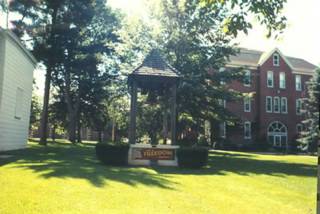
"The Campus"

Update: He e-mailed me the correct answer. After 50 years, he was able to identify his own comments dashed off at a yearbook signing event (I think we didn't get the yearbook until summer so the Spring events would be in the book). It's also quite possible he wrote the same thing in every girl's yearbook, which made it easier to remember.

721 Why would anyone want to be alone?

He's devoted and in his face, breathing his exhaled air and ripping up dog cages like they were tinker toys. Brando, who never wants to be alone again, is featured in Ken Foster's story at Urban Dog. There's something about Brando that reminds me of Rosa, my son's dog, who eats bedspreads and wallboard, and tops it off with a piece of carpet for dessert, with a side order of phone cable. "But Mom, she's just a puppy," he's been saying for a year and a half. I noticed a link to Urban Dog at Book Moot and decided to investigate.


This is NOT Rosa, but is a Chocolate Lab (brown hair, brown skin).