Friday, May 20, 2005

1059 The Shopping Adventure

A few people are coming for brunch on Sunday so I needed some items and some kitty litter. Only one Kroger, the one south and west of the University carries "our" brand. While noticing the new construction on the campus I got in the wrong lane, and turned down another street, thus taking me past a huge new apartment complex near Krogers that I hadn't seen before. This area when it was on the rural far northwest side of Columbus was settled by African Americans in the late 19th century. Gradually, the white suburbs grew up around it and its little church, and from what I could see, it has now been pretty much obliterated by progress--and they probably got a hefty price for the lots.

That Kroger has also changed since the last time I bought kitty litter. I spent a lot of time just wandering the aisles looking at dishes, small kitchen appliances, and the new book and magazine sections, much fancier than the old ones. It had everything imaginable--even a Starbucks--except the one item I really needed, Half n half. I got so carried away looking at the goodies I also forgot to pick up the white flour for the apple pie.

When I got to the check out I asked for a courtesy card, and was told "We don't do that any more, but you can type in your phone number." "I don't have a Kroger card and don't want one." So I tapped the guy in front of me and asked if he'd slide his card through for me. And he did (he gets the goody points for my purchase). The flustered clerk then told me I wasn't allowed to do that (it was done by then). I told her it still recorded the purchase, so why did it matter. She had no answer, but I think she thought it was cheating. She then told me I could go to the office and get an application, and again I repeated, "But I don't want a Kroger card."

Oh well, I suppose I could try stealing the kitty litter. It might be easier than going through this routine each time. Loyalty cards are the 21st century's wooden nickle. I do let them stamp my coffee card at Panera's, but no one asks me to fill out an application to get it. They sell that information, you know--probably a bigger profit than Half n half.

1058 Reducing Radiation Exposure

“Use of a custom-designed lightweight tungsten-antimony shield during chest computed tomography (CT) examination reduces the radiation dose delivered to female breasts by 43% to 73%, without compromising diagnostic information or image quality, according to the results of a study presented here at the annual meeting of the American Roentgen Ray Society 105th Annual Meeting.”

Story at Medscape.com, now celebrating its 10th anniversary

1057 Flush out the Perps

Library books and some Portage County taxpayers are victims of the stacks urinator in two public libraries. Sounds like a guy thing, although I've seen pictures of women urinating standing up, so you never know. Blake reported this at LISNews.com. This has as much appeal for library users as the unfiltered terminals with porn that librarians seem unable to handle.

Thursday, May 19, 2005

What color are you?

you are palegreen
#98FB98

Your dominant hue is green. You're logical and steadfast, focused on figuring life out and doing what makes sense. You value being trusted because you know you're taking the time to figure things out and everyone should just follow you.

Your saturation level is lower than average - You don't stress out over things and don't understand people who do. Finishing projects may sometimes be a challenge, but you schedule time as you see fit and the important things all happen in the end, even if not everyone sees your grand master plan.

Your outlook on life is bright. You see good things in situations where others may not be able to, and it frustrates you to see them get down on everything.
the spacefem.com html color quiz

1055 The next bogus news story

It's just a hunch here, but I'm thinking the next news story proven to be bogus and blown out of proportion (with fewer casualties than the Koran flushing story) will be the one about pushy Christians at the Air Force Academy. It seems to have originated with a female Lutheran Chaplain, if the one I saw on TV is the person referred to here.

"A chaplain at the Air Force Academy has described a "systemic and pervasive" problem of religious proselytizing at the academy and says a religious tolerance program she helped create to deal with the problem was watered down after it was shown to officers, including the major general who is the Air Force's chief chaplain."

I'm a Lutheran (but not pre-natal or sprinkled--I grew up anabaptist and have been immersed) and I know Lutherans are touchy about their wallets and tongue tied about evangelizing. If a Baptist were to breathe a word that he found his relationship with Christ a help in times of stress or battle, a Lutheran might be clueless because that's not "our" terminology. Also, Lutherans believe baptism and communion are sacraments and a means of Grace, but only those two, so that too might cause some disagreements, say over coffee or even in the classroom, with Catholics or other Protestants. Christians can get very heated about this, and feel quite threatened if someone hints their belief system doesn't measure up. And this problem seems to have arisen in the "Respecting the Spiritual Values of all People," class or R.S.V.P, created by Capt. MeLinda Morton. If she attended a Lutheran seminary, she probably skipped the class on "How to share your faith."

But the fact that the New York Times , WaPo, and the Socialist web sites are on this story like ants at a barbeque makes me suspicious that the story is a lot of hot anti-Christian air.

I would have tossed her program just for the cutesy acronym.

1054 Is Poverty Generational--Answering Vox Lauri

In response to my blog about “Easy does it,” the ten easy, personal lifestyle choices of the last 30 years that are causing people in the their 30s and 40s to fall behind their parents’ standard of living, Lauri, a college educated librarian who is the primary support of her family, wrote:

“You made mention of your stable, supportive family that helped you start out in the world, that, as you know, is priceless. Imagine trying to live and pay for your future while going to school. Even a state school can break someone with no funding. Add into that mix kids who have never had squat wanting to fit in with kids who have new clothes and cars, you end up with bankruptcy. And once you are in debt, good luck getting out-- I swear the system is rigged to keep you down. And ironically those who shrug off astronomical interest rates as "punishment for foolishness" well they pay too in taxes to support social service agencies and greater demands on charity.”

Yes, a stable, caring family is a wonderful asset. I can’t tell you how thankful I am that often Dad said, “No,” when I wanted a loan. It caused some hurt feelings and arguments, but “father knew best,” as the saying goes. Also helpful was the fact that in the early 1960s banks would not consider a wife’s income in calculating how much money they’d loan for a mortgage. Tithing our income for church for the last 30 years also had the added benefit of never having any extra cash for eating out or movies. All this worked together to start a pattern for us of never relying on my income until my husband went into business in 1994. And by then the children had left home, the cat died, and I had tenure, benefits and a wonderful career.

Generational poverty is a nice theory, until you really look at the sons and daughters of my generation. Most of my peer group--the educated, upper middle class 4th and 5th percentile group, living in some of the finest suburbs with the best public schools and private schools--have children and grandchildren making many of the “easy choices” I listed, and some will probably never be able to permanently attain their parents’ standard of living until the will is probated. Even if they inherit a generous amount, a life time of bad choices may cause them to squander that. I can’t think of a single family in my social group whose adult children haven’t lived together before marriage, or brought a "before the union" child into the marriage, or experienced falling income from a divorce or two or three, or filed for bankruptcy from extensive consumer credit, or leased too many a new cars, or bought a bigger home they didn’t need, or had problems with alcohol and drugs decimating the family income. Suicides, jail terms, prostitution, gambling and lots of returning prodigals--you name it, and my financially comfortable generation has seen it happen in their families.

The level of CEO salaries, the outsourcing of American jobs, and being a wage “slave,” Lauri’s other points (and I agree CEO’s salaries are way out of line, but we've taxed American businesses into leaving the country) would not have changed any of this spiraling downward creating the income gap between generations. We are still a nation of great opportunity and freedom--but freedom of choice comes with a huge price tag that says "WAIT," and for some that price is just too high and too painful.

Update: Read Walter E. Williams' article on How not to be Poor. A family of four is "poor" by our gov't standards with a household income of $18,810 (2003). Although my 10 easy steps were about a gap developing between generations in the upper percentiles, not poverty per se, it is clear that unmarried parents are the biggest cause of poverty among children, so single parent homes aren't helping the middle class stay afloat either.

Wednesday, May 18, 2005

1053 Hard to believe where this came from

"The filibuster is an inherently reactionary instrument most famously used to block civil rights legislation for a generation. Democratic senators themselves decried the filibuster not long ago when they were in the majority and President Clinton's judicial nominees were being blocked.

Frist is on the verge of doing the right thing for the wrong reasons. He plans to bring the nomination of Priscilla R. Owen, a Texas Supreme Court justice, before the full Senate today. Democrats have blocked her nomination in the past, and Frist is now threatening to force a change in rules to prohibit filibusters of judicial nominees. That would be a great triumph for the American people. It would be an even greater triumph if the Senate were to destroy the filibuster altogether."

LA Times editorial, May 18, 2005 (unless this is an example of one of those "pharming" tricks).

1052 The Newsweek Story that Killed

http://www.coxandforkum.com/archives/05.05.15.Flushed-X.gif

I heard a former MP from "GITMO" call in on the Glenn Beck show yesterday and he outlined the careful procedures to protect the Koran. He disbelieved this story from the first time he heard it. In fact, he thought the military was at risk. He said only a Moslem chaplain could touch it, and the MPs were not allowed to look through them for hidden explosives.

Christians know that God's Word is not on the paper. Whether we print it out from the Internet, read it in 16th century English, or recite what we learned in Bible School 40 years ago, it is all God's Word. Nor is our freedom in the flag or the pledge. Not so with Moslems and the Koran, and I think terrorists will take advantage of how the US bends over backward to protect the beliefs of that faith group.

1051 Cold and Creepy--Planning my Funeral

When we married in 1960 we had a huge emotional and financial safety net--between us we had six parents, seven grandparents, and one great-grandmother. Not to mention our own siblings and all the siblings of our parents and grandparents. We brought to our marriage about $200, some wedding gifts I'm still using, an old Buick that stalled at every intersection, two incomplete college educations, and a lot of youthful naivete. I know we didn’t appreciate the wealth in that bank of knowledge and support--I mean, no one is smart in their early 20s, right? I remember an uncle helping me with the income tax property depreciation in 1962, and my dad explaining mutual funds to me in 1990. My mother’s wise counsel went far beyond finances to religion, marriage, parenting, gardening, cooking, sewing, reading and friendships. One of my aunts never failed to appear with a cheery hello and her bubbly personality when we visited my parents, making us feel special even in our mid-50s. Now they have all “gone to their reward,” “passed on” or are “in the arms of Jesus.” (see my poem “Dying for a Verb). I will always miss my grandmother who died when I was 43.

During the grief of losing each parent (only one was sudden and unexpected), we’d vow to pre-plan (called pre-need in the funeral business) so that cost would be covered and our children or surviving spouse wouldn’t get drawn into bad decisions at a difficult time. Now it is just us, so yesterday we met with a person (salesman? director? planner?) at a local funeral home.

After all the paper shuffling, throat clearing, chit-chat and carefully chosen words, we went back into the room with all the overpriced paper goods and the array of caskets. It was very cold and dark in there. Frankly, I don’t think I need to buy a Kincaid register book for $110, or a $50 box of thank you cards. But if you think you’ll save money by ordering your casket from somewhere else and using it for storage until you need it, think again. We discovered the casket is a very small expense, at least the style I selected, a tasteful olive tone in 20 gauge steel for $1795. Even the Monticello Oak, which was very handsome and simple and my husband’s first choice was under $3,000. The ballooning costs are in the vault (ground or mausoleum), the transportation, and opening and closing the grave.

It’s a good thing we had this little chat, because we definitely discovered we had very different tastes in funerals! (We’ve always had trouble agreeing on furniture and décor, so I suppose I’m not surprised.) It reminds me a bit of planning my daughter’s wedding in 1993. I started with a how-to-book and a dollar figure, and she took it from there. My husband’s plan came to about $13,000 and mine was under $5,000. And yes, you can pre-pay, but it is actually an insurance plan, and it only looks good if you pay at the beginning, because if you pay over 10 years, it doubles the cost and probably eats up any savings. We brought all the worksheets home, and we’ll have to hammer out a few more details, but here’s a break down of their charges (not necessarily what we chose):

Basic services and overhead $1,245
Embalming $ 595
Body prep $ 260
Facilities for viewing $ 425
Ceremony at funeral home $ 495
Memorial service at funeral home $ 325
Ceremony at another funeral home $ 495
Ceremony at any other facility $ 495
Memorial service at any other facility $ 325
Anatomical donations $ 495
Organist $ 70
National music service $ 20
Refrigeration $ 75
Cremation $ 275
Transfer of remains (30 miles) $ 175
Hearse (30 miles) $ 225
Limo (30 miles) $ 195
SUV (30 miles) $ 175
Caskets $795 to 24,000
Outer container $595 to 18,000
Burial clothing $100-$200
Forwarding remains $2,315
Receiving casket from another mortuary $ 895
Immediate burial (no ceremony) $1,720
Direct cremations (no ceremony) $1,664
Cremation containers $95 to $3,975
Package basics $2,195

On top of these costs are the cemetery costs which we’re still looking at. Per square foot, this is pricey real estate, probably Hawaiian coastline prices. I don’t think anyone will be visiting our grave site, especially if we live as long as our parents. So a little flat marble slab in the ground is sufficient, and I haven’t looked at the prices. These prices don't differ greatly from a 2002 article by Motley Fool, but you can see the price creep in just 3 years.

I used to think cemeteries that looked like set-aside prairie reserves or jogging parks were nice, but after visiting Buffalo’s Forest Lawn Cemetery last summer to see the Frank Lloyd Wright’s Blue Sky Mausoleum, I’m lusting after marble monuments and mature trees.


I’d like to write a somber but pithy concluding paragraph for this entry, and usually they come to me if I just keep typing, but somehow, nothing comes to mind.

* * *

Five things not to say at a funeral is at my other, other blog. Caution: contains theological concepts.

Tuesday, May 17, 2005

1050 Easy does it, the widening gap between rich and poor

If you are a liberal and you don’t read the Wall Street Journal, you’re missing a great opportunity to find out what is wrong with our business driven economy and culture. It won’t do you much good to read a left wing or socialist screed--everything you read there will be incorrect and biased. Preaching to the choir, as it were. But the WSJ comes down hard on misbehavior in business, government and education and doesn’t pull any punches. The female journalists are particularly ruthless in finding graft, fraud and the soft underbellies of the capitalist system.

Right now the WSJ is running a series on the widening gap between the rich and poor in the United States. The first installment by David Wessel had the oddest statement about American politics that I’ve seen in a long time: “Americans have elected politicians who oppose using the muscle of government to restrain the forces of widening inequality.” Really? Ever heard of Title 9, or Medicaid? Earlier in the article was the phrase, “Despite the rise of affirmative action. . .” Can both statements be true? It would appear to me that the constant tinkering our government has done (and for most of my adult life, the people I elected, the Democrats, were in control of the Congress) has made our life what it is today.

Today’s installment by Bob Davis was about easy credit, and most of his examples were from Utah, a state we generally think of as conservative, religious and Republican. I haven’t seen the rest of the series, but I’m offering my ten easy and ubiquitous reasons, in no particular order, why the gap has widened in the last 35 years.

1. Easy credit cards: We got our first credit card in the late 60s--I think it was a "Shopper’s Charge." We now have one department store credit card and one bank card--we’ve never carried a balance. Since the late 80s and into the 90s, many new households have never known what it was to live on their earned income.

2. Easy divorce: Christians now have the same divorce rate as anyone else in the culture. When we married 45 years ago, regular religious observance offered families some protection. No fault divorce particularly hurt women and children, pushing them economically into competition with two income families.

3. Easy sex: Casual one-night stands were glorified in the movies of the 70s and 80s. Although adultery and fornication had long been a theme in literature, drama and movies, casual sex and living together before marriage became the gold standard of relationships by the 80s, even though it’s been proven that it increases the divorce rate. Then easy sex came into the living rooms via TV so that even young children think who’s spending the night is no more important than what toothpaste mom buys. Women having and raising babies alone is the biggest cause of growing poverty.

4. Easy birth control and abortion: The millions of Americans that might have sprung from the loins of some of our best and brightest have been denied life itself, and thus their slots in the pie chart has been taken by poor, uneducated immigrants. Obviously this creates a huge gap between the middle class and the poor, who instead of having a solid footing as those aborted citizens might have had, flood across our borders or arrive as refugees with nothing.

5. Easy technology and gadgets: Time wasted on I-pods and text messaging and vegging out in front of bad movies on DVDs has certainly absorbed billions of hours that could have been invested in networking, education or advancing up the career ladder. Cable and cell phone monthly costs easily equal what we spent on a mortgage.

6. Easy bankruptcy: Load up the credit cards with consumer spending, mortgage your future, then make the rest of us pay it off for you. It might have been Plan B 20 years ago, but is now Plan A. Interest only mortgages, leases for larger and more expensive vehicles, second mortgages--for a generation who thinks the future will be paid for by someone else, it’s a recipe for a growing gap.

7. Easy leisure: Thirty five years ago (1970) few middle class families took vacations--if Dad had a week off (and most companies didn’t offer it) he spent it fixing the house. Sure it’s a huge industry and employs a lot of people, but we’re looking at the gap aren’t we? We’d probably been married 10 years before we took a family vacation (my parents never had one), and then it was at my mother’s farm for a week. Our daughter and her husband had been to Key West, Arruba and took a Mexican cruise in the first 5 years of their marriage.

8. Easy entertainment: This is related to leisure and technology, but today’s young families have difficulty being alone or quiet, it would seem. Even 30 years olds seem unable to walk around without head phones. They are spending their children’s future at movies, sporting events and theme parks. A visit to the library is most likely to pick up a movie, not a book.

9. Easy college loans: Instead of attending a state school, working during the summer or attending closer to home, many young people begin their working lives with huge debt, a debt that takes years to pay off, assuming they don’t default. Loans were so easy in the 80s, that parents who could well afford to pay tuition had their children at the public trough.

10. Easy shopping: You can be a couch potato or a computer novice and never leave home to shop. Addiction is easy. Just call in with the credit card.

See? And I haven’t even said a word about how much health care costs, or how the women’s movement changed our culture, public transportation or taxes. And while the government is tangentially involved in these areas, mostly it boils down to perfectly legal choices, choices which when they become ingrained in our way of life lead to poverty or slippage down by a quintile for the next generation.

Monday, May 16, 2005

1049 R.I.P. My New Yorker subscription has FINALLY died

Scott Esposito is blogging today about something he read in the New Yorker. I'm sure it's just great--I have myself occasionally found something worthwhile in the New Yorker. But I realized today when I was clearing the coffee table in preparation for company coming (removed about 13 magazines) that my subscription has finally ceased. Oh blessed day, I thought you'd never arrive. Scott's Blog, Conversational Reading, is a litblog and contains reviews. He's also a writer.

1048 Learning Denglish

The Blonde Librarian was surprised when she settled in Germany with her husband how many English words permeated German. But she was also surprised to find out they sometimes didn't mean what she thought. Read her story here about das Handy, das Mobbing, and der Smoking.

1047 Addicted to the Truth

I got 5 out of 5 correct on this test. See how you score.

1046 Spring planting time

I planted my red geraniums today--with just a sprinkle of white baby’s breath (I think) to set off the color. I can see them out my office window near the Japanese Maple (I think) and Magnolia (I think). All my flowers are artificial, but the dirt and the pot are real. I think I have a few sprigs of artificial ivy I can poke in the pot. Here’s a poem my brother-in-law, the horticulturist, sent me last year.

Norma works in fertile soil
And gently tends her seed;
She diligently plies the hose
And pulls up every weed.

In time, her flowers bloom with joy,
Their colors quite fantastic;
But they won't die or fade because
Each one is made of plastic.

Sunday, May 15, 2005

1045 Blogging at its Best--The Vietnam Experience

If you want to read blogging at its best, drop by the web page of Neo-Neocon, a 50-something woman (I think) writing about why and how she is no longer a liberal, but isn't sure what to call herself (I can certainly identify). She is doing a series on Vietnam and its aftermath, how the war changed our culture and is affecting us to this day. She has just finished part 4-C of "A Mind is a Difficult Thing to Change." Her own excellent essays are expanded by the comments from her readers, many of whom are Vietnamese-Americans, or Vietnam era vets, or people who now feel betrayed--yet a second time. When I last looked at 4-C she had 58 comments, many of which are long essays themselves.

Neo Neocon writes: "Subsequently, if the press continues to be seen as the truthteller and the government the liar, no number of press releases by the government can ever overrule what the press says about an event. These beliefs have been adopted for a reason--to make sense of a terrible experience, based on the best knowledge available at that time. Part of the "never again" reaction is that it becomes a point of pride to never again let oneself be duped, to never again naively believe. Those who no longer trust in the government are seen as sadder, but infinitely wiser.

But what if, at some time in the future, evidence surfaces that that hard-won knowledge may be wrong? How many people, having lost faith because of a betrayal, and having laboriously reconstructed a new worldview, can revise that worldview again? What if that worldview turns out to have been a house of cards? Who can stand two betrayals--trust having been placed in a rescuer, the press, who is now exposed as having been a liar and a betrayer, also? Who can return to believing that the government--although flawed (there is no returning to the initial state of naive, unquestioning trust)--is now to be trusted more than the press, after all?"

Blog on, Neo Neo. We're all waiting for the next part of the series.

1044 Imagine chaperoning on this school trip

Cindy (one of my linkers) and her husband were chaperoning a group of 12 seniors in Washington DC and were in the Capitol Building when it was evacuated during that airspace scare last week.

When they weren't moving quickly enough, one cop yelled: ""Don't you remember 9/11? This is not a drill! RUN!!!"

Meantime, sirens of all kinds were sounding, official cars were zooming by with police escorts, whistles were blowing, and we heard fighter jets overhead. My first reaction was confusion, then disbelief--"This CAN'T be happening!" Then fear sets in, then self-preservation. My husband was struggling to keep our group together. Girls were having trouble running because of sandals and flip-flops; one boy in our group lost a shoe at one point and had to get it back on; all the while people continued to yell at us to "run! move! get out of here!"

I don't know how far we ran, maybe only a few blocks, but we re-grouped in front of the Department of Health and Human Services building, and shortly afterward a security guard informed us that the all-clear had been given. Shaken, out of breath, still on edge but relieved, we started calling family members on our cell phones."
Whole story here.

My story isn't nearly as exciting, but I'll tell it anyway. Friday night we went with our neighbors Bill and Jean to "Old Bag of Nails" where we'd eaten almost every Friday night since it opened until mid-February when they changed the menu. We hadn't been there in almost three months. Last night we were watching the 10 p.m. news and that restaurant was the focus of a robbery/chase story on Saturday.

"Upper Arlington and Columbus police chase a suspected robber through the streets.
Police say Darryl Kelly robbed the Old Bag of Nails Pub in Upper Arlington, and took off with police cruisers close behind. The chase went on for 7 miles through Upper Arlington and Columbus. At one point Kelly's car smashed into one of the police cruisers trying to stop him. The chase finally ended 11 minutes later at Taylor and Rosethorn Ave." . . . [Recently, we've been eating at Lane Ave., but apparently he was there on Friday and we weren't]. . . "Upper Arlington police say a man armed with a revolver entered into the Christopher and Banks store at the Lane Avenue mall late Friday afternoon."
(Channel 10 story)

1043 Halcyon Days

After church this morning I was talking to Lori who is teaching knitting to the children of Highland School where many of our members, including my husband, volunteer. She was excited about what she is learning about teaching knitting, so I said I wished she had an adult class. She was waiting for a live one, because within 2 minutes we'd arranged for her to come to my house Thursday morning at 8 a.m. to teach me to knit!

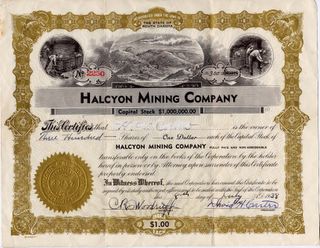
When I got home I remembered I had an old knitting/crochet guide book that had belonged to my Mother, and I thought I'd scan the cover to use with the story I'd planned to do about Lori teaching me to knit (later in the week). In the hunt for the book, which I haven't found, I came across a plastic bag of paper memorabilia I must have brought home after Mother's funeral in 2000. It contained things like a poetry book she'd created in high school, the 1933 Century of Progress guidebook, a dear post card in child script from her brother Clare (died in WWII) from Winona Lake, IN, and two score cards for the Chicago Cubs for 1934, which were probably picked up during my parents' very brief honeymoon. The odd piece of paper was a stock certificate for 300 shares of the Halcyon Mining Company of South Dakota. At $1.00 per share that had set my Dad back $300 ($4,000 in today's money) at a time when they had two toddlers and were in the midst of the Depression.

I called my brother, who is a stockbroker and who ably handled my father's investments in his later years, and asked if he had any recollction of this or why Dad would have taken such risks. He wasn't familiar with event, but speculated it might have been a salesman passing through town with the lure of quick riches. I'm sure the company went belly up, and it doesn't take much imagination to recreate my parents' discussion of the use of their very limited funds (assuming my Mother even knew about it). I think Dad hung on to it as a reminder--because I have a dim memory of his showing it to me many years ago.

Old stock certificates are collectibles even if the stock itself is worthless. This hobby is called "scripophily" and is related to stamp collecting. "Scripophily, the collecting of canceled old stocks and bonds, gained recognition as a hobby around the mid-1970s. The word resulted combining words from English and Greek. The word "scrip" represents an ownership right and the word "philos" means to love. Today there are thousands of collectors worldwide in search of scarce, rare, and popular stocks and bonds. Collectors who come from a variety of businesses enjoy this as a hobby, although there are many who consider scripophily a good investment. In fact, over the past several years, this hobby has exploded. Dot com companies and scandals have been particularly popular." (Wikepedia)

Here's a site that sells gold and silver mining stock certificates, and you can see for yourself how interesting and artistic they are. I did find a Halcyon certificate on the Internet selling for about $45 in one offer. My husband has matted and framed it for me so we'll keep it around as a reminder that things aren't always as good as they seem in the heat of a sales pitch.


Halcyon Mining Company

Saturday, May 14, 2005

1042 Back to my hobby

My friend Bev gave me a new premiere issue, Red, so I've entered it on my hobby page, In the Beginning. Paula, this is called "real life in fabulous shoes" so you must take a look.

>
Diane Lane on the cover of Red

1041 Michigan trounces Ohio

So near and yet so far. Our neighbor to the north has the technology in place for 70.8% of its counties to locate 9-1-1 cell phone callers in distress. Ohio has only 3.4%. If your car is hijacked on a 2 lane road, and you have no idea where you are when you're stuffed in the trunk, you'd better hope you're in Michigan and not Ohio. Story from May 12 WSJ.

Friday, May 13, 2005

1040 Pope Who?

Our friend Ken was attending Mass last Sunday at the church of his son and daughter-in-law. The priest was praying and asked for prayers for Pope Benedict XV. Someone in the congregation piped up and corrected him, "Sixteenth."