Sunday, October 23, 2005


1652 The Purple Finger Victory
Victor Davis Hanson points out something the Iraqis did in their vote last week:"The Western media was relatively quiet about the quite amazing news from the recent trifecta in Iraq: very little violence on election day, Sunni participation, and approval of the constitution. Those who forecasted that either the Sunnis would boycott, or that the constitution would be — and should be — rejected, stayed mum.
But how odd that in the face of threats, a higher percentage of Iraqis in this nascent democracy voted in a referendum than did we Americans during our most recent presidential election — we who have grown so weary of Iraq’s experiment."
Maybe we Americans need a few more threats in order to get us to the polls. I know some people in their 30s who have never voted. Imagine taking freedom so lightly.
Anyway, VDH suggests that in order to get their violence quota, the cable news had to send someone to Toledo, Ohio that week-end.
1651 Spin Sisters by Myrna Blyth
Our November topic at book club will be Spin Sisters; how the women of the media sell unhappiness--and liberalism--to the women of America by Myrna Blyth (St. Martin's Press, 2004). It's not a heavy topic--our first two selections of the year were detailed biographies--and a quick read, because a lot of what the author says you've already thought (if you are a woman).Blyth got a lot of criticism for this book, as I recall, because she was, and admits it, part of the problem. When she blew the whistle on her "sisters," they were understandably defensive. But I also noticed 4 or 5 references to 9/11 in the first 3 chapters, so I think that event had a huge impact on her evaluation of what she did for a living (she may discuss this--I haven't finished the book). Her critics are particularly in denial that the media (TV and women's magazines) lean to the left. I don't have any women's magazines lying around (except in my premiere issue collection), but I've leafed through enough to know that politics isn't limited to the cookie bake-off between the candidates' wives.
However, I want to clear up a misconception that I see when authors are leading up to the current woman's movement (ca. 1970). Blyth included--because she includes some background about what led up to magazines trivializing women's lives. What's her name, The Feminine Mystique lady, seems to have left the impression that women in the 1950s all stayed home and were bored watching kids and baking cookies for homeroom parties.
So, I thought about the adult women I knew growing up in a small town (2800) in Illinois. It was a little different, maybe, because it had a printing/publishing industry. But many younger people don't realize that small towns 50 years ago used to have businesses (before the days of malls), and many of these were owned and managed by husband and wife teams who employed other people and served the community. My own mother did not work outside the home, but here's what I saw (but never gave a second thought to) growing up:
Women in business with their husbands who were present and on the floor every day:
Furniture store
Ben Franklin store
Two drug stores
Hardware store
Appliance store
Dry cleaners
Bakery
Dry goods-shoe store
Dairy
two restaurants
Funeral home
jewelry store
Women who owned business not involving their husbands
two women's dress shops with employees
children's clothing store with employees
beauticians who owned their own shops and employed others
Professional women
teachers
nurses
librarians
Independents
Piano teachers
Avon and other door-to-door saleswomen
Soloists and performers at churches, concerts, weddings, etc.
Writers and reporters for publications
Clerical workers
telephone operators
dental assistants
medical office staff
nursing home staff
retail clerks
secretaries
tellers at the bank and savings and loan
variety of positions at printing plant, publishing house, magazine fulfillment agency
Other
Farmers
Auto mechanic (only one)
Waitresses
Youth workers at churches
No, I didn't know any women doctors, pastors, or bankers, but I didn't know any laundresses or cleaning women either.
1650 A lovely home wedding
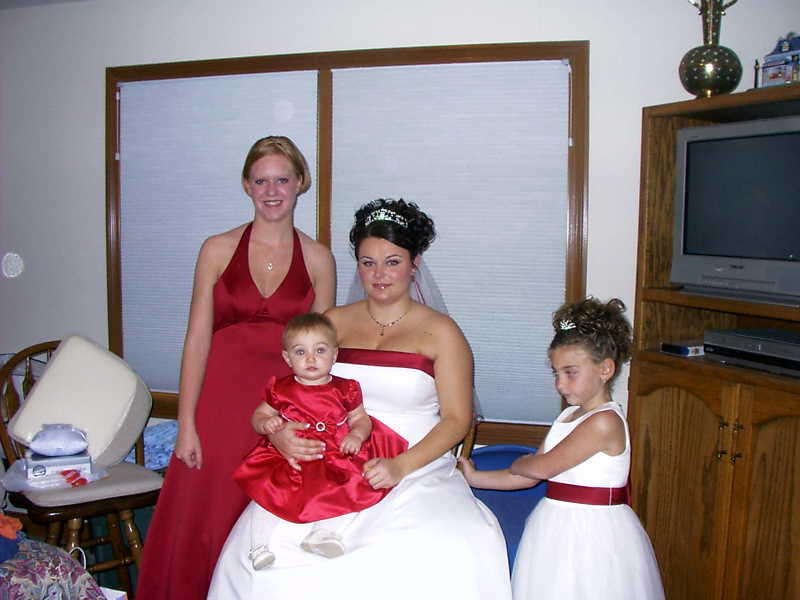
We attended the wedding of a great-niece yesterday in Indianapolis which was held at the home of her aunt. The very first wedding I ever attended was my Aunt Dorothy's which was in our home. I thought she was the most beautiful woman I'd ever seen--black hair, red lipstick and fingernails (which I probably hadn't seen before) and a handsome groom. I was probably about 5 years old and considered old enough to attend, although my brother went to a babysitter's. I was so anxious to try the wedding cake which had little silver balls on it, and so disappointed to find out they tasted like rocks!Dusti's colors were red and white and she looked lovely. The groom had earrings in both ears, but he was pretty cute too. Things are different today. Sigh.

Saturday, October 22, 2005
1649 The needs of men
Marylaine Block who writes Ex-Libris for information junkies has an interesting article on the underserved: MEN. You can find it here. It's not exactly a blog, I think she calls it an e-zine.1647 The NBA dress code
Isn't it silly to try to tell grown men who are millionaires how they should dress? So what if they want to look like junior high wannabees and look like hip-hop drop outs? They are trying to impress the guys in the hood, not you and me, so of course they want to wear side-ways baseball caps, jeans with the crotch at the knees, t-shirts and bling, bling. Dressing preppy never kept these guys from beating up their wives or doing drugs. This is almost as silly as the NCAA telling schools what they can use as mascot names.Friday, October 21, 2005
1646 The negative news media is not news
Although I didn't keep track of the reports of the troops in Iraq and Afghanistan that were negative or positive, I'm not surprised that the Media Research Center found the coverage negative, with even the positive stories under reported. The Executive Summary says the news media presents an inordinately gloomy picture and positive accomplishments are lost in stories of assassinations and military losses (as I reported on the military losses being inserted in the story of the Iraq vote on the constitution, even though 5 of the 7 were from accidents). MRC analysts reviewed all 1,388 Iraq stories broadcast on ABC’s World News Tonight, the CBS Evening News and NBC Nightly News from January 1 through September 30:Network coverage has been overwhelmingly pessimistic.
News about the war has grown increasingly negative.
Terrorist attacks are the centerpiece of TV’s war news.
Even coverage of the Iraqi political process has been negative.
Few stories focused on the heroism or generous actions of American soldiers.
It’s not as if there was no “good news” to report.
In the days leading up to the January elections, most of the positive stories appeared in the last two days, when the networks realized they were going to lose an important story if they didn't jump on the bandwagon of hope: "Out of 343 stories that discussed Iraq’s political process, negative news stories outnumbered positive ones by a four-to-three margin (124 to 92), with another 127 stories providing a mixed or neutral view. More than a third of the stories featuring optimistic or hopeful developments were broadcast over the course of just two days, January 30 and 31, the moment of Iraq’s historic elections.
With all three news anchors in Iraq, the networks gave the elections heavy coverage. While all of the evening news broadcasts had featured gloomy predictions before the vote, the large turnout and relative tranquility of the day provided a pleasant surprise. Of the 40 stories that focused on Iraq’s political process on January 30 and 31, fully 80 percent cast the situation in hopeful and optimistic terms."
Daniel over at LISNews.com (library site overwhelming liberal to radical) asked if I ever read or listen to non-conservative reports. Well, how could you help but know the liberal angle? It is everywhere, and you have to search out the conservative viewpoint. Or even the positive, Christian viewpoint, for that matter.
Full Report, part I.
Full Report, part II.
Right on the Left Beach suggests: "Over time, the policy of President Bush to oust Saddam and incubate democracy in Iraq will be viewed favorably. In five to ten years, you will not be able to find many people in America that will admit to being against Operation Iraqi Freedom. You will still find Bush Haters but even they will consider OIF the right policy instituted for the wrong reasons."
1644 Kennedy on Chappaquiddick
The 100 top speeches ranked by American Rhetoric lists Ted Kennedy's appeal to the people of Massachusetts as one of the top 100 speeches of the 20th century. Then he is listed also for his 1980 DNC speech, Truth and Tolerance speech, and Eulogy for his brother; his brother John, the president, is only list for six! I find it hard to believe that Ted Kennedy is that great a rhetorician--especially that the excuses he made about Chappaquiddick ranks as a great speech--or even believable. Shirley Chisholm and Barbara Jordan, whom I considered two of the most outstanding speakers in my lifetime, only made the list once (Chisholm) and twice (Jordan).1643 Democrats on family values
Now where do you suppose the liberals are going on this one? Hmmmmm? Came in my mail today. They're trying to tell us that Americans have already rejected the traditional one man one woman marriage as a base for the family.“America is changing profoundly. In the 1950s, 80 percent of all Americans lived in a home where the head of household was married. Now, that number stands at 52 percent. The number of young people growing up in single-parent households has jumped from 10 percent in the boomer generation to the current figure of 26 percent.” GQR Research.
So if you see a survey by Greenberg Quinlan Rosner, you know who they work for.
1642 More about the golf course
Two days ago I blogged about the golf course repairs. I was particularly interested in what looked like bandages to me. Today the chief groundskeeper stopped by my table at the coffee shop and told me what is going on. That white mattress looking thing is called a sandtrapper and is made of a fiberglass type material. The sand will be placed on top but it will remain underneath the sand. A new type of sand produced in Chardin, Ohio will be used. The cost of the renovation is $3.5 million he said, but we tax payers aren't footing the bill, he told me. There is an endowment supported by an alumni gift (Phipps) that provides the funding, and the fees from the current players maintains the course. Jack Nicklaus is the designer of the renovation. This press release uses a lower figure, but then it is 1.5 years old.Thursday, October 20, 2005
1641 Big clue they were in deep do-do
“It was also at that time that I realized that the size of the crowd [at the Superdome] was a big concern at the EOC. Terry Ebbert, the city’s Homeland Security Director, made an announcement in the EOC that struck me. He asked the maintenance staff to gather up all of the toilet paper in city hall and any other commodities they could find and immediately take them over to the Superdome. I specifically note this because it told me that supplies at the dome might be a serious issue.” Testimony of Marty J. BahamondeTestimony from today’s Senate Committee on Katrina. This was found at Sabrina Pacifici’s blog--and it looks like an excellent site to bookmark for this kind of legal stuff. Left leaning but useful.
1640 Myths about gun control
John Stossel wanted to know why gun control laws weren't reducing crime, so he asked an expert--a criminal. Interesting stuff. Noticed at Billoblog.1639 Women, do you do this?
Do you expect everyone else to adjust to your schedule so you can work, or do community service or golf and be a mommy too? My husband is on jury duty this week. It's an important case--murder. They could have finished up today. All the evidence has been heard and the jury is in deliberation and the alternates have been dismissed. One morning one of the women was late arriving--problem with the kids--so they had to wait. Today, one of the women announced she'd have to leave at 3:30 because she had to pick up her kids. So the entire jury has to go back tomorrow, when they could've finished up today. This is disrespectful of everyone involved--the victim, the victim's family, the defendant, the State of Ohio and the other jurors. If she does this on jury duty, I'm betting she does this in meetings at work. I was on a jury two years ago, and I thought a couple of the jurors were as dumb as a box of rocks, but no one was disrespectful of the process.And one woman brought along her portable TV so she wouldn't miss her soaps on her lunch hour. Another brought in a huge brief case of work from the office, but of course, was never able to open it. I think it's called a "look at me I'm important" bag.
In the 70s and 80s I cobbled together work schedules so I could be home when my children were, and took the corresponding pay and promotion cuts. My mantra is, you can have it all, but not all at the same time. During all those years I got one call for jury duty and asked to be excused because the kids were more important than my civic duty which if you are a registered voter will come around again. And again. Don't run that poor working mother by me--these women were professionals. If you think this is harsh, you haven't heard me on daddies who leave their families for a new sweetie.
1638 Mouse Dirt
Yuk. When I was a little girl our family moved to Forreston, IL into a house that was on the edge of town near the open farm country. It still had an outhouse, and there was no modern kitchen. This must have been quite a challenge for my mother who had grown up in a home that had all the modern conveniences long before the rest of the country became accustomed to electrified homes and indoor plumbing. There really wasn't a true housing shortage after World War II, despite what you read in the history books. It was government regulations and rent control that caused a shortage by removing less desirable homes from the housing market. After all, we had the same number of people and housing units in 1946 that we had in 1941. If a house should have been off the market, it was ours. Mother rolled up her sleeves and remodeled it and when Dad sold it in 1947, it had a nice kitchen and a bathroom. We drove past that house in 1999--still looks much the same and is well kept.
However, when the weather turned chilly in the fall, the little critters came in the house to get warm, and when you'd open the bottom drawer of the stove or a kitchen cabinet, there were the little trails of mouse droppings, and a furry gray thing would scamper across the floor and we children would all shriek and run out of the room. Except my brother. I don't think he shrieked, because little boys like to chase, grab and poke frightened little animals.
Yesterday my computer mouse was getting really balky. It wouldn't maneuver fine movements, like removing the glare from my glasses in photographs. So I unplugged it and took off the ball cap. With a toothpick I started carefully removing the "mouse dirt" and it was just all over the place. Now it is smooth rolling.
1637 They wouldn't listen to me
It was common knowledge 10 years ago that the professional schools at Ohio State (veterinary medicine, law, pharmacy, medicine) were becoming quite lopsided and feminized. At a veterinary faculty meeting I raised the question why we couldn't start recruiting men for some balance, since being a librarian I knew what happens when a profession becomes dominated by women--salaries and prestige and power go down. No one wanted to address the problem. Sadly, they knew they couldn't and keep their jobs, but after the meeting several male faculty told me they agreed with me.Now today's USAToday has a story on the gender gap in higher education. I hate to say "I told you so," but I told you so.
1636 Adult children living at home
Recently I received an e-mail from Tina, one of my closest childhood friends. Her parents moved when we were 16, but the few times we've been together over the years, it's not hard to catch up. But she mentioned a 25 year old grand daughter. I about fell out of my chair. I remember her daughter (mother of the grand child) as a darling toddler, and she's engraved on my memory that way.Say what you will about people marrying young, but it usually got them out of the house. Yesterday's WSJ had an article about the growing number of adult children returning to live with their parents after college, career mishapes, and marriage failures. I've been hearing that for 20 years, at least, but perhaps it is always a fresh story if you're not aware of "boomerang kids."
I visited my great aunt last week and met for the first time her youngest son (my first cousin once removed). She is a widow and he is single and about 50 years old, so this makes a wonderful housing arrangement for them both. He has a nice home, and she has someone to keep the yard and house in good repair and is able to stay in her own home without fear.
But it sounds like a bad idea for the 25-40 years olds. What do you tell the potential date about who might answer the phone? Or where you live? Do all their friends live this way so they think it is cool?
The author had some suggestions on how to deal with the returning descendants, and I've added my score for reality. 1) Talk about your own struggles as a young person. 4 whoops of laughter. How many kids want to hear about the "old days" when you didn't own a car, had only one black and white TV and a coin operated wringer washer in the basement of the apartment building? 2) Draw up a plan. 3 whoops. Been there done that. No one over 16 wants a parent to devise a plan or budget, no matter how much sense it makes. It always screams, "Here's what you need to do. . ." However, I do this anyway because I write such great plans. 3) Treat them like adults--charge rent, assign cleaning responsibilities, cooking, etc. 2 whoops. If you're charging her rent, she has a right to keep 3 week old pizza scraps and dirty undies all over her room, doesn't she? 4) Financial help-- arrange loans to wean them away from you. This one makes some sense. Pay the deposit on the apartment; make a car payment if necessary, but do something to get them standing on their own two feet and out from under yours.
Our children never returned home as adults--in fact, they left too young (18), in my opinion. But we have helped them financially over the years, with car payments, bills, etc. We've helped them both buy homes, and I think that is a good investment for them and for us. I plan to move in with them some day and leave pizza scraps and dirty laundry around the house.

Wednesday, October 19, 2005
1635 As we watch Wilma
One thing I noticed at the museum today when I read the explanation of the empty frame was that Hurricane Katrina was called "our nation's worst natural disaster." This is not true. Here's the information on the Galveston Hurricane of 1900 from the Sun Sentinel site:"1900 -- More than 6,000 die after storm washes over Galveston
The nation's deadliest natural disaster, the storm struck with little warning late on Sept. 8. Storm tides of 8 to 15 feet inundated Galveston Island and portions of the nearby Texas coast. The tides were largely responsible for the 8,000 deaths, with some estimates ranging as high as 12,000."
Just because it happens within your frame of memory, doesn't mean nothing worse ever happened.
1634 JAMA, JAMA is its name
Ask me again, and I'll tell you the same.
I just go crazy when USAToday and Wall Street Journal spell out Journal of the American Medical Association. It changed its name in 1959 to JAMA.
Anyway, the infamous "today's issue" (there's a phrase that drives librarians crazy) apparently revealed some unsavory information about gastric by-pass surgery for the morbidly obese--patients are dying at a much higher rate than first thought. However, because they are using Medicare figures, and these people were severely disabled by their weight to even qualify for Medicare, they don't have records for people using private insurance for this study. Nor do they have records to show that medical problems requiring non-hospitalization have decreased. Often this surgery needs to be followed by surgery to remove huge skin folds. There's a lot that can go wrong.
Still, does it make sense that one man's family sues Vioxx because he died of an irregular heart rate and that drug which helped millions live with the pain of arthritis is taken off the market; but many people die after by-pass surgery and 48% are readmitted to the hospital within 30 days and the procedure is still used and recommended for unhealthy, obese people who can't lose weight any other way. Somehow, these figures aren't making sense to me. Most public libraries carry JAMA, so go look at it and see what you think.
"Early Mortality Among Medicare Beneficiaries Undergoing Bariatric Surgical Procedures" David R. Flum, MD, MPH; Leon Salem, MD; Jo Ann Broeckel Elrod, PhD; E. Patchen Dellinger, MD; Allen Cheadle, PhD; Leighton Chan, MD, MPH. JAMA. 2005;294:1903-1908. Abstract:
"Results: A total of 16 155 patients underwent bariatric procedures (mean age, 47.7 years [SD, 11.3 years]; 75.8% women). The rates of 30-day, 90-day, and 1-year mortality were 2.0%, 2.8%, and 4.6%, respectively. Men had higher rates of early death than women (3.7% vs 1.5%, 4.8% vs 2.1%, and 7.5% vs 3.7% at 30 days, 90 days, and 1 year, respectively; P<.001). Mortality rates were greater for those aged 65 years or older compared with younger patients (4.8% vs 1.7% at 30 days, 6.9% vs 2.3% at 90 days, and 11.1% vs 3.9% at 1 year; P<.001). After adjustment for sex and comorbidity index, the odds of death within 90 days were 5-fold greater for older Medicare beneficiaries (aged 75 years; n = 136) than for those aged 65 to 74 years (n = 1381; odds ratio, 5.0; 95% confidence interval, 3.1-8.0). The odds of death at 90 days were 1.6 times higher (95% confidence interval, 1.3-2.0) for patients of surgeons with less than the median surgical volume of bariatric procedures (among Medicare beneficiaries during the study period) after adjusting for age, sex, and comorbidity index.
Conclusions: Among Medicare beneficiaries, the risk of early death after bariatric surgery is considerably higher than previously suggested and associated with advancing age, male sex, and lower surgeon volume of bariatric procedures. Patients aged 65 years or older had a substantially higher risk of death within the early postoperative period than younger patients."
1633 An afternoon with Renoir's Women
Five of us met for lunch at the Palette Restaurant in the Columbus Museum of Art this afternoon. Our husbands are all Columbus area watercolorists who meet for lunch and discussion once a month, so occasionally we get together too. Here we are enjoying the food and good company.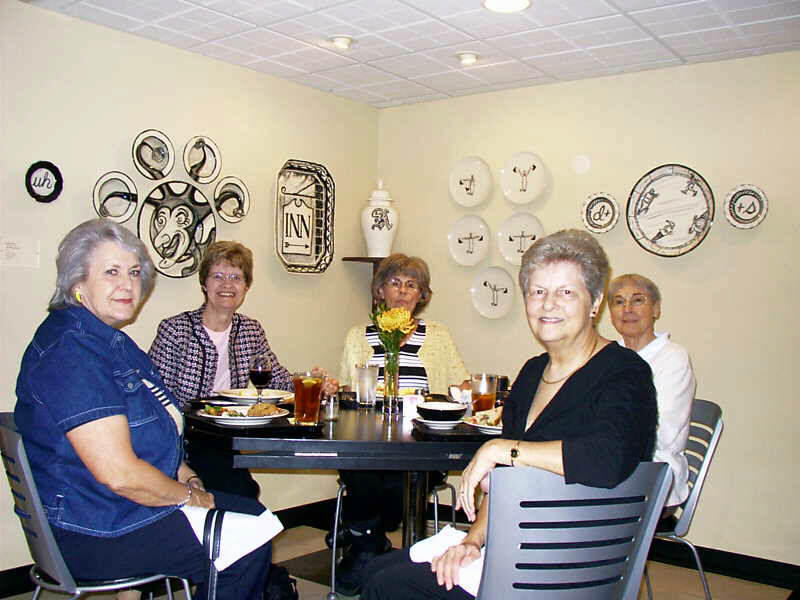
You are not supposed to take photos in a museum, but when the guard stepped out of the room I quickly snapped one of this interesting Renoir, on loan from the New Orleans Museum of Art. Because of Katrina, it didn't make the trip, and I'm not sure they really know what has happened to it. A tiny link in our connectedness. For a view of some of the lovely works on loan, go here.

The site for the show is http://www.renoirswomen.com.
Subscribe to:
Comments (Atom)


 Posts
Posts


