Tuesday, August 01, 2006


FLW tour group, 2006
We were a melting, but hardy group standing on the deck of the Boulter House in Cincinnati. The heat was oppressive, and the sun brutal. Twenty-six and a half folks talking nothing but architecture for three days. Well, the four year old found other things to talk about. I missed one of the group photos because I'd gone back to the bus to sit in the air conditioning. We are third and fourth from the right in the back in this photo.
Frank Lloyd Wright
Boulter House
2708 Site of the day
My stats received a big boost from the University of Waterloo Daily Bulletin, which selected my poem "Last day of July" as its site of the day. Thanks. . .to whomever. . . up there in Ontario.2707 Trip Tale: Reading in the woods
One course of action when you are up early in a log cottage in the pine and birch forest by a pristine lake in South Karelia is to read by the morning sunlight (no electricity) with a freshly brewed cup of coffee (bottled gas). Days without TV, radio, the Internet, or newspaper has a way of returning one to the joys of reading known by earlier generations. The hand woven birch bark baskets and pine shelves of the cottage were full of books--flora and fauna, old novels from the 40s, biographies, guides/tourism for the local events, and some old how-to-manuals. I found only one in English, "Eastern Approaches" by Fitzroy Maclean who was a member of the British Diplomatic corps in the 1930s-40s and wrote of his experiences traveling in the USSR and Balkans during 1937-45.There was one eerie passage that seemed true even 60 years later. [Communists in 1942] all had one thing in common, their terror of responsibility, their reluctance to think for themselves, their blind, unquestioning obedience to the Party line dictated by a higher authority. . . the terrible atmosphere of fear and suspicion that pervaded their lives." This would be a book to read for anyone wishing to do business in Russia today, needing to understand the roots of the culture.
Either Maclean was an outstanding writer or after a week of being deprived of reading, I was like a starving woman at a banquet. In either case, it was a good read, given the years I had spent studying the history and politics of the USSR in the 50s and 60s. The chapter on the purge of the Party in the late 1930s was riveting because of all the old familiar names, particularly Nikolai Ivanovich Bukharin (who was posthumously rehabilitated in 1988).
Maclean sat through the entire trial and with friends tries to sort it all out. He decides that everyone needs a cause to die for--judges, prosecutor, prisoners and NKVD. And for the prisoners, it was the Party. Even in facing death, they were characters in a theatrical production about good and evil. The trial served as a reminder to the people to be suspicious of everyone--to see spies and traitors everywhere, to shun foreigners, to explain the shortages of food and goods not on a failing economic and political system, but on those terrible traitors who were on trial. Certainly the benign and benevolent Stalin couldn't be at fault, but these traitors now being purged from the Party.
When I got home I looked up Maclean and found he was a very popular writer who had written a number of books (some think his life was the inspiration for James Bond) and that Bukharin, one of the more unforgettable characters in this book, had written an autobiographical novel while imprisoned before his death.
Trip Tale: In the beautiful lake
 After dinner Riitta carries the plates and flatware to the lake in baskets, feeds the fish (who love her) the scraps, and washes the dishes in hot water from the sauna and lets them dry in the sun. This may be the first and last time I washed dishes with my feet in water.
 Years ago I took the kids to the community pool every day, but haven't even owned a swim suit in years. I found this full-coverage, retro-version at K-mart. Here Riitta (not dressed for swimming) is encouraging me to just take the plunge, which eventually I did--for about 5 minutes. The lake is quite shallow and warm.
Finland
Karelia Finland
dishwashing
Trip Tale: A visit to a farm museum and artist
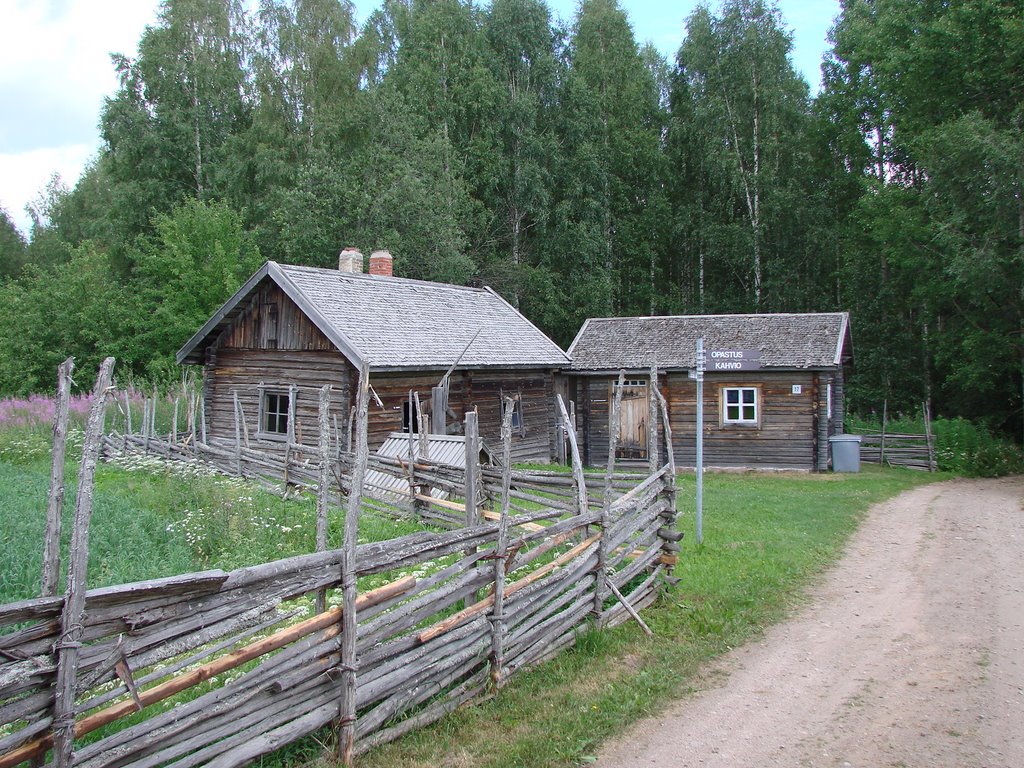 On Friday we visited a living farm museum. "Located in the village of Lyytikkälä at Suomenniemi, near Highway 13, the Lyytikkälä Museum Farm comprises one of South Karelia’s best preserved complete farming estates. A former 18th century “augment” or a farm which paid its land tax to a rustholli estate (a larger farm under obligation to equip a cavalryman), Lyytikkälä Farm was purchased as an independent hereditary estate in 1859. It remained with the same family for well over 250 years." Check site here.
We walked through stables, with walls about 5' thick with fir branches on the floor to drain the urine and manure into a pit and to keep the animals warm. The ovens in the house could bake 17 loaves of rye bread.
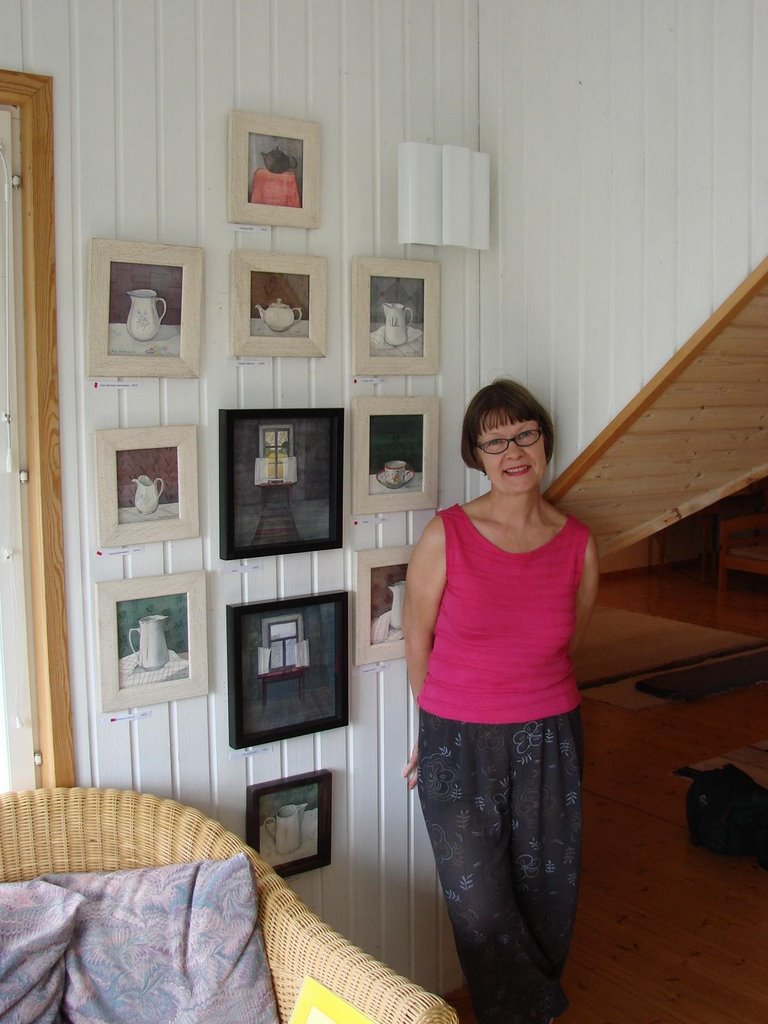 On Saturday morning we ate warm Karelian pies for breakfast, a wheat pastry with rice filling, and then we visited artist Pirjo Lindberg, watercolorist. She and her husband have a small farm/country house. He raises bees and she paints and invites other artists to show with her.
Trip Tale: Driving through Suomenniemi
This is the municipality in which our hosts built their log summer home. At one time it was under the control of Russia, but the Finns secured it in 1917 when they obtained independence. The area was contested again in the 1940s, and Finland lost a lot of territory to the Soviets. Our hosts parents lived in the area which is now part of Russia.On Friday morning we visited a living farm which had been in the same family for generations and was the subject of a film which we previewed at the museum. We also stopped at a library which had been moved from Russia in 1936.
 Kirjasto library was closed that day.
 Lutheran church in Suomenniemi. This has been a Lutheran parish since 1689.
 War memorial at the Lutheran church--the reason the Finns (children of the veterans) don't like the Russians.
Trip Tale: The summer house in the Karelian Forest
Our hosts in Finland have a summer log home which Martti designed and built in the 1980s. He also built the sauna and latrine. The house has no electricity or indoor plumbing, but they have a wonderful system, and the simplicity of it all works.


The view from the porch. Is this perfect, or what?
2702 OCLC to launch Open WorldCat
When we moved to Columbus, OH in 1967 and I was a Slavic cataloguer at Ohio State University Libraries, what was to become OCLC was located in the main library on the third floor, and had 3 or 4 employees. I was new in town and used to lunch with one of the female employees who also didn't know anyone--although I've forgotten her name and she moved on, as did I (to be a stay at home mom).Mr. Kilgour's belief that there must be a better way to manage bibliographic information proved true (he died yesterday at age 92), and the Ohio College Library Consortium, which I think was its name then, grew and grew, moved out of the library building over to Kinnear Road, and then built a huge facility in Dublin, Ohio. In 1983, when my kids were teens, I worked for OhioNet, a vendor for OCLC's services to Ohio libraries. By that time, it was a world wide bibliographic network offering many library services.
Here's the item from Information Today. "In a move designed to reach users outside library environments, OCLC (http://www.oclc.org) is planning to launch a new destination site and downloadable search box for searching the content of libraries participating in WorldCat. Scheduled for a beta release sometime in August 2006, the new WorldCat.org site will continue OCLC’s efforts begun with its Open WorldCat program (http://www.oclc.org/worldcat/open/default.htm)—to make library resources more visible to Web users and to increase awareness of libraries as a primary source of reliable information. The WorldCat.org search box will make visible all 70-plus million records in the WorldCat database—not just the smaller data subsets of 3.4 to 4.4 million currently made available by the Open WorldCat partner sites, such as Google, Yahoo!, and others. And, where Open WorldCat inserts “Find in a Library” results within regular search engine results—where they can get lost—WorldCat.org promises to provide greater visibility and accessibility of library materials."
OCLC
WorldCat
Frederick G. Kilgour
Monday, July 31, 2006
2701 FLW Tour: When you visit Springfield, Ohio
 Be sure to ask for Kevin for your historical walking tour of High Street. The Springfield Preservation Alliance sponsors walking tours of neighborhoods filled with the wealth of 19th century Ohioans who built large homes along High Street, designed in Neoclassical Revival, Italianate, Queen Anne, and Richardsonian Romanesque style. Our Frank Lloyd Wright touring group, on its 16th or 17th summer tour (depends on whom you ask), walked past these lovely homes in various states of repair and renovation to get to the Wescott House. Our tour guide, Kevin Rose, of the Turner Foundation, was outstanding. A booming voice to fight with the traffic, a love of Springfield, and a farm background, makes him ideal for this job of shepherding an architectural tour, or any tour.
The above house is actually not Henry Hobson Richardson designed, but was completed by the same builders who often did his designs. It is on the National Register of Historic Places being completed in 1888 as the personal home for American industrialist and two-term Ohio Governor Asa S. Bushnell. The mansion was designed by architect R. H. Robertson. It is now the Richards, Raff & Dunbar Memorial Home. The staff invited us in, and it is unbelievable inside. Might be worth being buried out of Springfield!
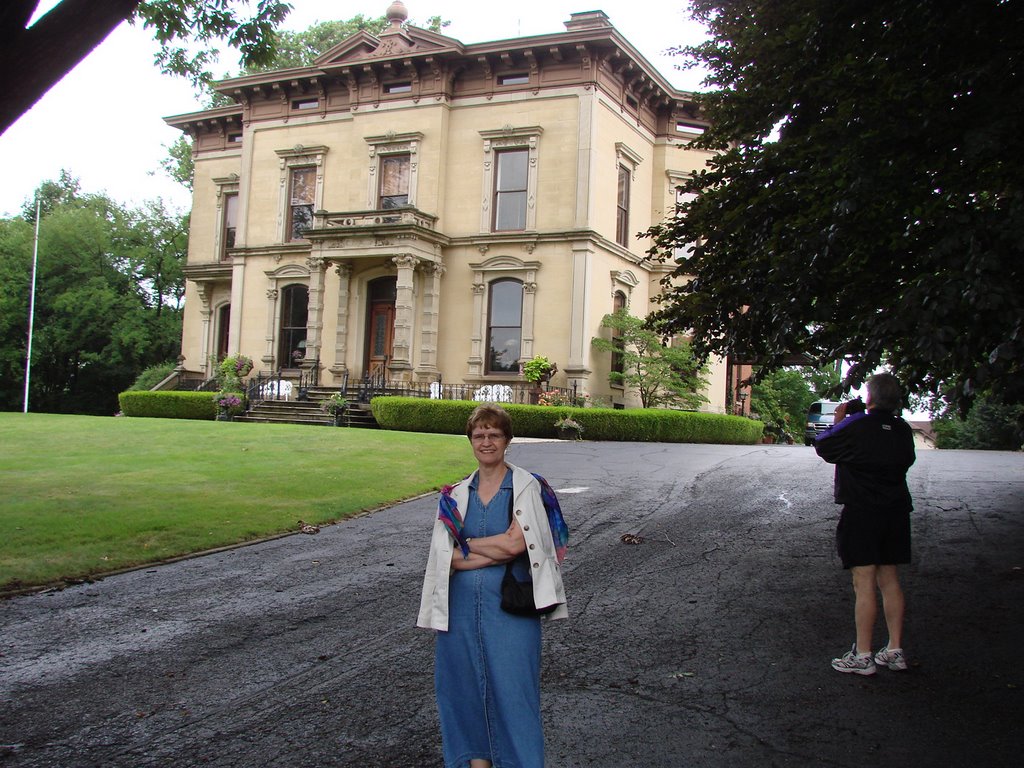
Springfield was a very wealthy town in those heady days, with many farm implement manufacturers located there. In the 20th century it was the home of several automobile factories, including the Wescott, and the Crowell-Collier publishing empire.
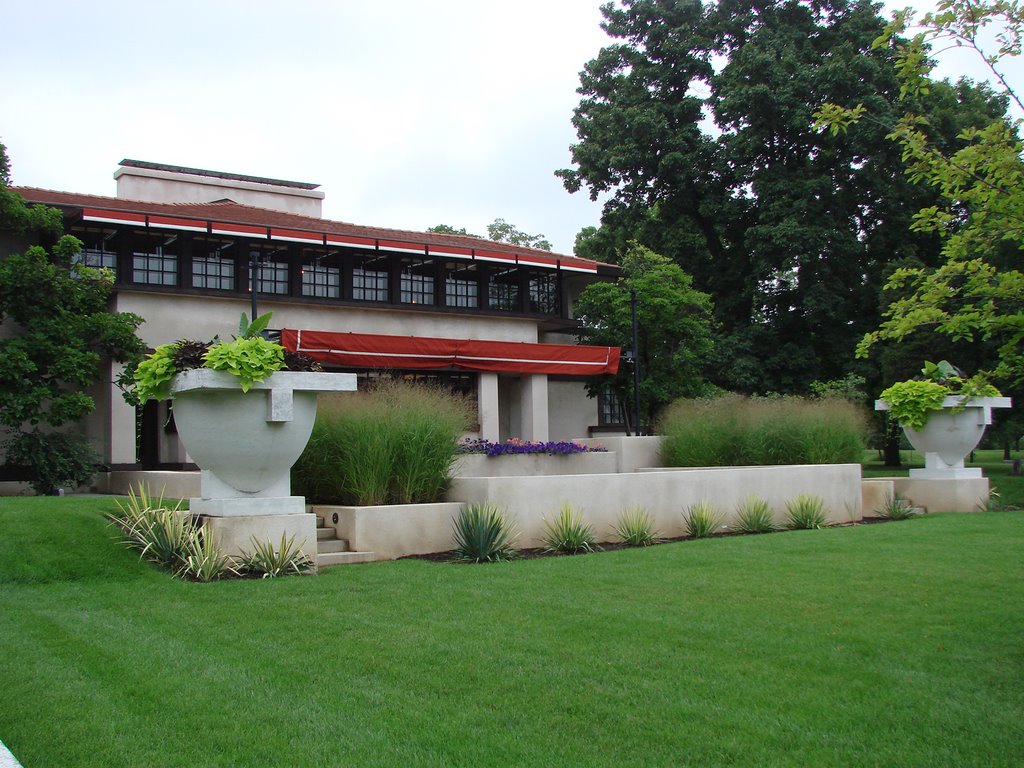 The Wescott House designed by Frank Lloyd Wright is, of course, well worth the trip, but don't miss the rest of Springfield! Make a day of it.
Westcott House
Frank Lloyd Wright
Springfield, Ohio
historic preservation
2700 Home again, sort of
We're home from a fabulous architectural tour that included Springfield, Sidney, and Dayton, Ohio, then Columbus, Indiana (5th best sige for architure in the USA) and Madison, Indiana (133 blocks of restored river town), then on to Cincinnati and Lebanon, Ohio, then home. We've laundered and repacked, and today it is back to the lake for a week. My husband is teaching an art class this week, and the facility has no AC--so I won't be surprised to see dropouts, and dropovers. Hopefully, he'll get some sailing and I'll get to the coffee shop to write some blogs.Friday, July 28, 2006
We're off on another trip
We're touring the architectural sites in Dayton, Cincinnati, and Columbus, IN for several days. I didn't get my Finland stories finished because blogger.com wouldn't cooperate with the photos, but I'll work on that next week. Have a good week-end.Thursday, July 27, 2006
2698 Wedding wear
For his sister's wedding in September in California, my husband's choice is simple--his black tuxedo. He and brother Rick are walking her down the aisle together (second marriage). I'll probably cry. They didn't grow up together, so it is so neat to see them so close now.So where does that leave me? No matter what I wear in California, it always looks like I just stepped off the
So yesterday I tried the summer sales. My top priority is always: price. I don't even fight it anymore. Next is comfort. Then coverage. I actually found three dresses at Talbots summer sale. One black and white bold print looked right out of the 70s in the days we first discovered polyester. I'm positive I must have had one from this pattern, but in a different color. It fit, but because it was long sleeve and snug, I thought it might be too hot if their warm weather continues.
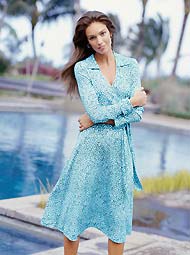 This is the style, but it was black and white. I didn't choose this one.
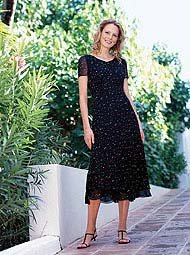 One was sleeveless, and one had a small loose sleeve, so that's the one I went with. It is black silk gorgette with little color dots, and I can wear a light weight jacket in any of the colors, I think. It is a body skimmer with an eased v-neck, so I think it will be comfortable, and has two lengths with small ruffles.
In Russia, we saw many brides--it is the custom to have your photo taken in front of an important monument or government building. So they were everywhere we were. If I can get blogger to cooperate, I'll add some photos. They were the prettiest brides I've ever seen.
Wednesday, July 26, 2006
2697 Great teeth, good fashion
Brains and good looks apparently do go together. Enjoy reading (and looking at) "50 Most Beautiful People on Capitol Hill" in The Hill. I've never seen such beautiful teeth.2696 The real minimum wage
Dick Morris suggests it should have been indexed to the cost of living rather than givin one-shot increases, but figures the real minimum wage as:"Much of the debate over the minimum wage is, of course, obviated by the earned-income tax credit which kicks in for all minimum-wage mothers. The credit, plus Medicaid eligibility, plus food stamps, plus day-care allowances, plus rent subsidies, plus exemption from income taxes, means that those who earn the minimum wage really have a pre-tax income equivalent over $20,000."
Tell that to beginning librarians and school teachers who earned a master's degree to earn about that much.
2695 Trip Tale: Tallinn, Estonia
The five of us went through customs and boarded the hydrofoil for Tallinn, about a two hour trip (it's about 4.5 hours by ferry). The waves were high and it was really bumpy, but with the help of a motion pill and keeping my eyes shut the whole trip, I kept my breakfast. Not so the pretty young Swedish girl next to my husband.Little Estonia (at least its major city) has created a miracle in only 15 years of freedom from the Soviets. We were blown away by the restoration of its "old town," and the vibrancy of its newer areas. I'm sure it's going through some of the growing pains that countries experience as they transform themselves from totalitarian to democratic regimes, but compared to what we were to see in Russia the following week, it is really a transformation.
Riitta had been there under the old regime and she could hardly believe it. Old Town is now colorful gold, pink and blue buildings with red tile roofs and lovingly restored old Catholic, Lutheran and Orthodox churches open for tourists and worshippers. It was like a German city without the hordes of Japanese tourists.
 We docked at a huge decaying concrete "ice palace" built during the Soviet era. This ?? is on top--sort of looks like a Russian bear, but up close seems to be an ethnic-asian person inside a fish or animal skin.
 Although not as crowded as other European cities, driving is a bit dicey because before freedom 15 years ago, no one had automobiles--so it's sort of new to them.
 We skipped lunch in the pricey market place (for tourists) and Tomi led us to a lovely local restaurant with great food and reasonable prices, called H.H. Rüütel.
 Lower left of this photo shows some unrestored and crumbling buildings--what the whole town used to look like.
Tallinn, Estonia
Estonians
USSR
2694 The stem cell veto
There was a cartoon in the international ed. of the NYT last week that showed a distinctly Simian, slumping President Bush vetoing stem cell research with a reference to the flat earth society. If Bush's veto will make no difference in stem cell research (except to those of us with "narrow religious views" who believe it is immoral to create life for the purpose of destroying it to benefit someone else), where's the beef? There is plenty of private money for this, and no one has yet found any cure for any disease using the cell lines created before 2001 which are available. The media are creating yet another victim class--all the people who haven't yet benefitted from research that hasn't yet produced any cures!Also, according to New Atlantis, the U.S. isn't falling behind in stem cell research. "Far from showing the United States lagging behind in the field, they found that American scientists had by far the most publications—46 percent of the total, while the other 54 percent were divided among scientists from 17 other countries. They also found that the number of papers in the field published by Americans has increased each year, with a particularly notable growth spurt beginning in 2002. . . [the study showed] more than 85 percent of all the published embryonic stem cell research in the world has used the lines approved for funding under the Bush policy. Since this is almost twice the number of papers published by Americans, it is clear that a great deal of the work done abroad has also involved these lines, even though most of it could not have been funded by the NIH. The lines are used, in other words, because they are useful, not only because they are eligible for federal support."
The media--NYT, CNN, WaPo and their sibs and blogs--flog this story that the U.S. is falling behind, but like a lot of the other anti-Bush stories published by them, it's a lie.
stem-cell-research
George W. Bush
media bias
Tuesday, July 25, 2006
2692 Trip Tale: Visiting Suomenlinna, the Fortress
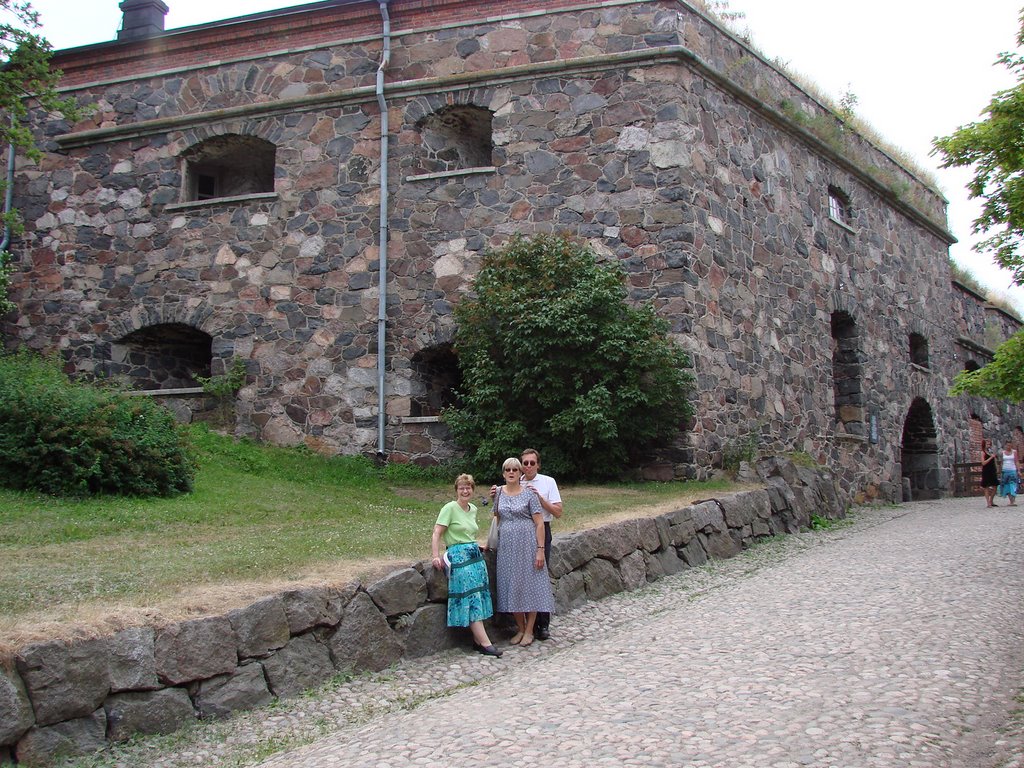
When Peter the Great built St. Petersburg in 1703 so he'd have a port on the Baltic, the Swedes decided to fortify Finland (which it ruled) and built Suomenlinna on the islands. The fortress was lost to the Russians in 1808. It fell into disrepair, but now is a historical preservation site with cobblestone and brick streets, old walls, ramparts, cannons, a working dock for repair of wooden ships, a museum, art shops and a nice little town library. About 800 people live on the islands, but at one time it was quite a bit larger. The ferry there is part of Helsinki's city transportation so it is very accessible and a delightful spot for either tourists or residents.With the long summer days, the island was filled with picnickers and families, sunbathing even as late as 8:30 p.m. We had dinner at a lovely white tablecloth restaurant called Walhalla, Charr with lobster mousse.


2692 The gasoline cost survey
Today I got an e-mail questionnaire from my congresswoman Deborah Pryce asking my opinion on gasoline prices. Although ANWR and more refineries were included as a choice (to solve the problem of high prices), I can't believe our congresspeople never mention the gasoline taxes (20% of the cost). So I reminded her of that option. I don't know why they even run that price gouging question past us! Yesterday in Bucyrus it was $2.85 a gallon. When it gets to $3, which it is around Columbus, and people just stop buying, then the supply increases, and the price goes down. Adjusted for inflation we're about where we were in 1981.In Norway which is an oil rich nation and now very wealthy with the highest standard of living in the world, I see tourists are advised to fix their own food if possible--$14.50 for a chicken breast if you cook it yourself. They put their oil money in a trust fund for the future, so they pay high prices now. Our Finnish friends all drive small, efficient cars, they conserve, they pay huge fees to have a license to drive, and they have an excellent public transportation system. And they are paying well over $5/gal for gasoline, a lot of which is taxes. And they are very unhappy that huge Russian transports are using their highways paid for with their gasoline taxes to haul automobiles from the Finnish port cities of Turku, Hanko and Kotka across the border into Russia.
Gas Prices
2691 Trip Tale: The new veterinary hospital in Helsinki
On Tuesday we toured what is probably the finest veterinary hospital in the world--at least until the next one is built--having opened just this past spring. "The Veterinary Hospital serves the Helsinki region in all small animal or horse medical cases and the whole of Finland as a place of treatment for referred patients. The design of the new hospital building takes into account the needs of the future inmates. Particular attention has been paid to the adaptability of the premises." Annual ReportRiitta was still on call when we arrived on Saturday, and had just completed two major surgeries, and was called in the middle of that night for a third. I don't know if doctors of human medicine spend as much worry and angst over their patients as we observed with Riitta, with frequent calls to the hospital to check on her horses. When we toured the small animal and large animal sections, we not only visited her patients, but saw where the surgery and care takes place.
Riitta is looking for an internal medicine person willing to come for 2-3 years who has a Dip-ACVIM. Because this is a Finnish hospital one of the staff perks includes a lovely sauna.
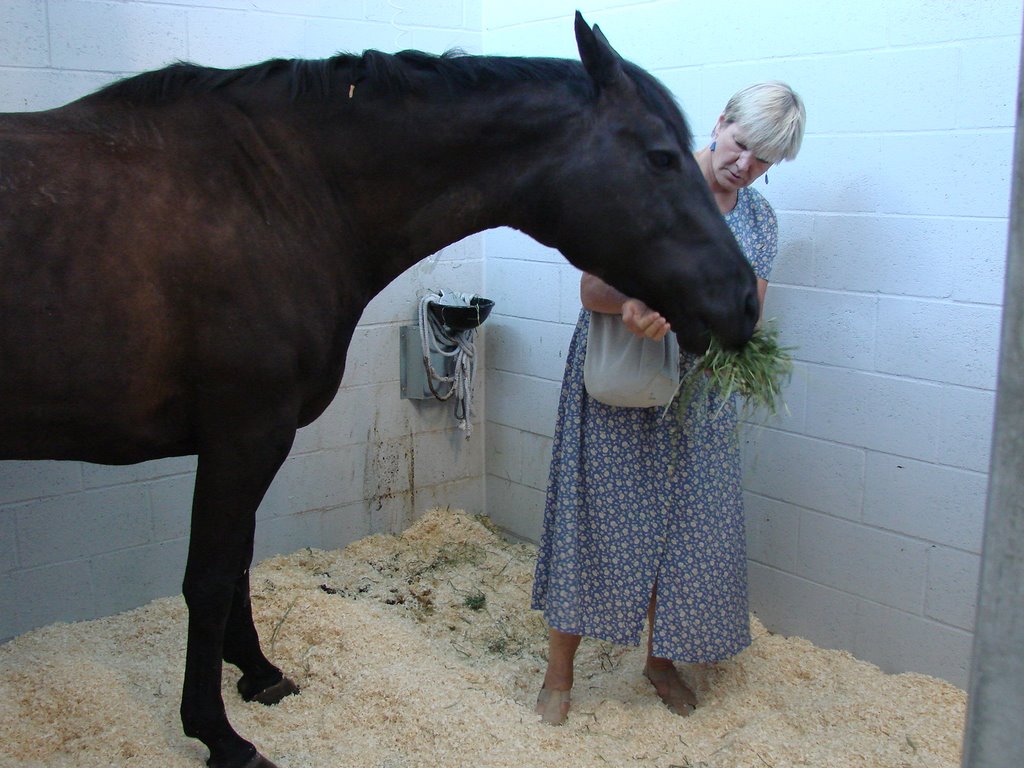 This was an extremely sick animal, but was still alive two weeks later when we left. I won't even describe the surgery or post the photos!
Subscribe to:
Comments (Atom)


 Posts
Posts


