Showing posts with label Camp Emmaus. Show all posts

Friday, April 15, 2022

Down the rabbit hole on Good Friday

Good Friday morning I only read the hymn in my devotional magazine (Magnificat, v. 24, no.2) for Holy Week, for Good Friday. It was "Were you there when they crucified my Lord?" I got no further in the April 15th entry. I remembered the first time I heard it. It was a hot summer day, in midsummer 1953 or 54. I was a teen helper in the kitchen at Camp Emmaus in northern Illinois during an older teen camp week. It was very exciting for me--previous jobs had been baby sitting and corn detasseling. I don't remember why the campers were using this hymn in the summer, but a guy about 5 years older than me sang it to me. I never forgot it. That was the first step into the rabbit hole.
 
Then I had to check out my hymn sources. Another rabbit hole. So I looked at the Brethren Hymnal (c. 1951) and "Were you There" was there. Exact same verse and wording as my magazine (unusual for hymns I've learned). Then I checked my Lutheran hymnals and the hymn was in the 1958 (red), the 1978 (green) and the 1982 (blue) versions. My only Methodist Hymnal (1964) I keep at our Lake house. From the evidence on my shelves I'm suggesting that this hymn began appearing in main line church hymnals around 1950. It's now a standard, but it had been sung for many years in black churches.

I always read the information at the top, bottom and sides of a hymn, about the author, composer, collection, notes for the musician, etc. and of course, there's no information on the author and it's referred to either as a Spiritual or Negro Spiritual.

From there I moved on to my favorite source, "Amazing grace; 366 inspiring hymn stories for daily devotions,," by Kenneth W. Osbeck (1990). He wrote: "The Negro spirituals represent some of the finest of American folk music. These songs are usually a blending of an African heritage, harsh remembrances from former slavery experiences, and a very personal interpretation of biblical stories and truths. They especially employ biblical accounts that give hope for a better life--such as the prospects of heaven. They symbolize so well the attitudes, hopes and religious feeling of the black race in America."

Osbeck suggests: "Imagine yourself standing at the foot of the cross when Christ was tortured and crucified. Then place yourself outside the empty tomb when the angelic announcement "He is not here. . . ". Try to relive the emotional feelings that would have been yours. Allow this song to minister to you as you go through the day---. " For Good Friday, there's no better hymn to put you there.

Note: Although the phrase "down the rabbit hole" is from Alice in Wonderland (1865) over time it's come to mean getting sucked into an endless time search in reading or looking at the internet. I still use books, so it happens a lot.

Thursday, September 22, 2011

LiFE Sports at Ohio State--more than a camp

“Ohio State's College of Social Work and Department of Athletics have teamed up to utilize their expertise in positive youth development and prevention to address issues of school failure, substance use, and juvenile delinquency. The collaboration created the Learning in Fitness & Education through Sports (LiFE Sports) initiative to enhance the quality of youth development, sport and recreational programs through service and outreach, teaching and learning, and research.

A central component of the initiative is its annual four-week summer LiFE Sports camp that serves more than 600 youth ages 10-18 on the Ohio State campus. Unlike most summer programs, however, LiFE Sports is "More than sports. More than camp."
It’s interesting how similar in mission and vision this sounds to the outdoor camping experiences offered by churches and service organizations when I was growing up. Like Camp Emmaus of the Church of the Brethren, or School of Missions camp on Lake Geneva in Wisconsin that I attended, Boy Scout Camp my husband attended, Camp Willson run by the YMCA where my son attended, or Camp Wyandot for the Campfire Girls when my daughter was young.

All except that “research” component, and in parsing that sentence, I can’t quite figure out who is doing the research--the youth, the social workers or the athletes. Maybe our camp counselors were doing research, but I don't think so.

Our camps, too, were more than “sports,” more than camp. They were a place for spiritual growth, for wisdom and understanding, for growing strong in Christ.

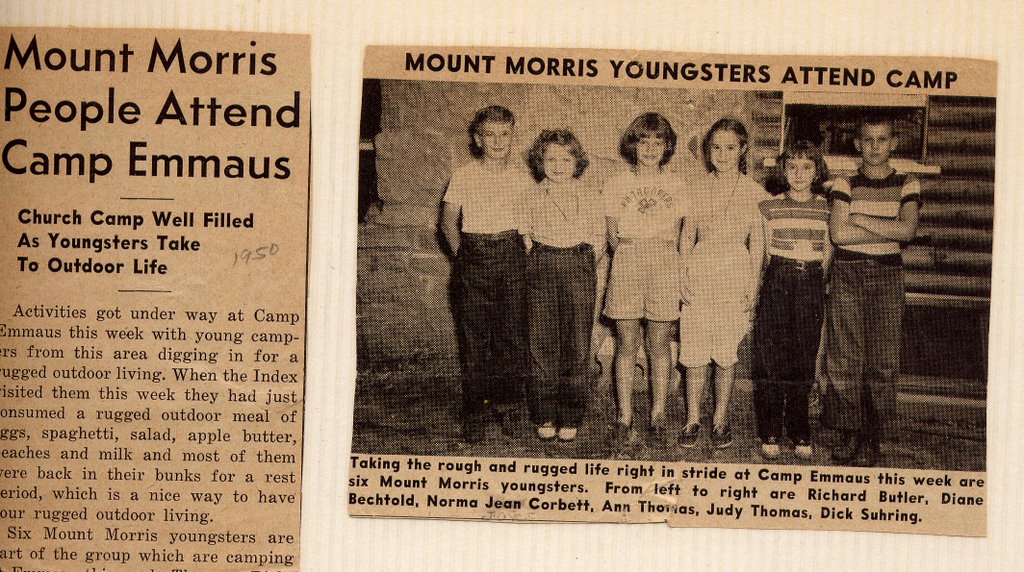
From my scrapbook, 1950, with both my name and town incorrect

Sunday, November 07, 2010

All Saints Day--first Sunday in November

Today is All Saints Sunday, the day Christians remember those called to sainthood (all believers) and espcially particular individuals. My husband and I were communion servers, always a wonderful experience. However, it's also the day the pastor reads from the pulpit the names of the congregation's members who have died since October 31, last year, and the names of loved ones we submit. It's very moving. And Oh! the singing! We get to sing all the verses of "For all the Saints."

Unless I'm morphing some memories (easy to do at my age) I can remember the first time I heard and sang "For all the Saints," and it was interestingly enough, not in church, but at Camp Emmaus near Mt. Morris, Illinois. I wasn't even a camper--I was the cook's assistant, and had come upstairs after clearing tables and washing pots to sit in the back of the lodge main room to observe the campers (older teens). They were learning a "new" hymn, "For all the Saints," being led I believe by a gorgeous young woman from Chicago with a fabulous voice named Carol Hiller. (It's possible that I've morphed her into the hymn, but this is how I recall it.)

The lyrics seem to be much older than the music, having been written by Bishop William W. How in 1864, but the composer Ralph Vaughan Williams died in 1958, so it's possible that in the mid-1950s, we were learning it as a "new" hymn. However it came to my attention, it has always been a favorite, and the older I get, the more departed saints I have to remember and look forward to seeing again at the resurrection.

Monday, May 22, 2006

Monday Memories of summer camp


Have I ever told you about summer camp?

Americans have had a long love affair with the camping experience, both the organized and informal types. My mother told stories of camping as a little girl with her parents in the 1920s. They packed their cooking utensils and tents and strapped the dog's carrier to the running board and headed for Nebraska where they owned property. The family also attended a summer camp in northern Indiana, Winona Lake.

When I was a child, my parents never camped or even took family vacations. However, our little town, Forreston, where we lived until I was in 6th grade, offered "summer recreation" about which I have extremely fond memories. Today it would be called a day camp. The school and grounds (there was only one building for both elementary and high school) were open for crafts, sports and games. We played volley ball and bat mitten in the gym, and soft ball and running games outside. We made those necklaces and bracelets from colorful plastic coated strings, wood burning projects, weaving, and pottery. There were team sports, but summers were pretty hot, so I remember also sitting in a circle under a shade tree for quiet games. I think I only walked 2 blocks to get there, and spent most of the day with my friends. It was all supervised by adults and I don't remember them being at all intrusive or controlling--they just organized things and walked around with clip boards (in my memory). For the 1940s, I think it was a pretty progressive way for the town to look after the children (and we all had mothers in the home since few women were employed, so that wasn't the purpose).

Our house at the star, school at the square

But the absolute best event was rolling our swim suits in a towel, boarding the school bus at the school and driving the 30 miles to Sterling (singing the whole way) which had an outdoor pool. I couldn't swim but I loved splashing around and screaming. Then on the way back, when we were all famished and reeking of chlorine, the driver would stop at a road side ice cream stand and all the wet, bedraggled children would stream out of the bus and get in line for a Sugar Daddy or an ice cream bar. Since I never got these treats at home, I probably thought this was the best part of summer camp!

But we children also went to summer church camp at Camp Emmaus east of Mt. Morris, IL. In 1950, when it had only been open a few years, the costs were about $11 a week and I blogged about it two years ago. My older sisters must have attended as soon as it was opened. We had campfire, singing, vespers, Bible study, crafts, and great food. Not only was I a camper there, but I was also later a junior counselor and a junior cook. The camp looks very much the same today, and is managed by Bill Hare, who was a camper when I was. My brother was the camp manager when he was in his mid-20s.

From my scrapbook, 1950, with both my name and town incorrect

Camp Emmaus 1953, Sara and me (on left)


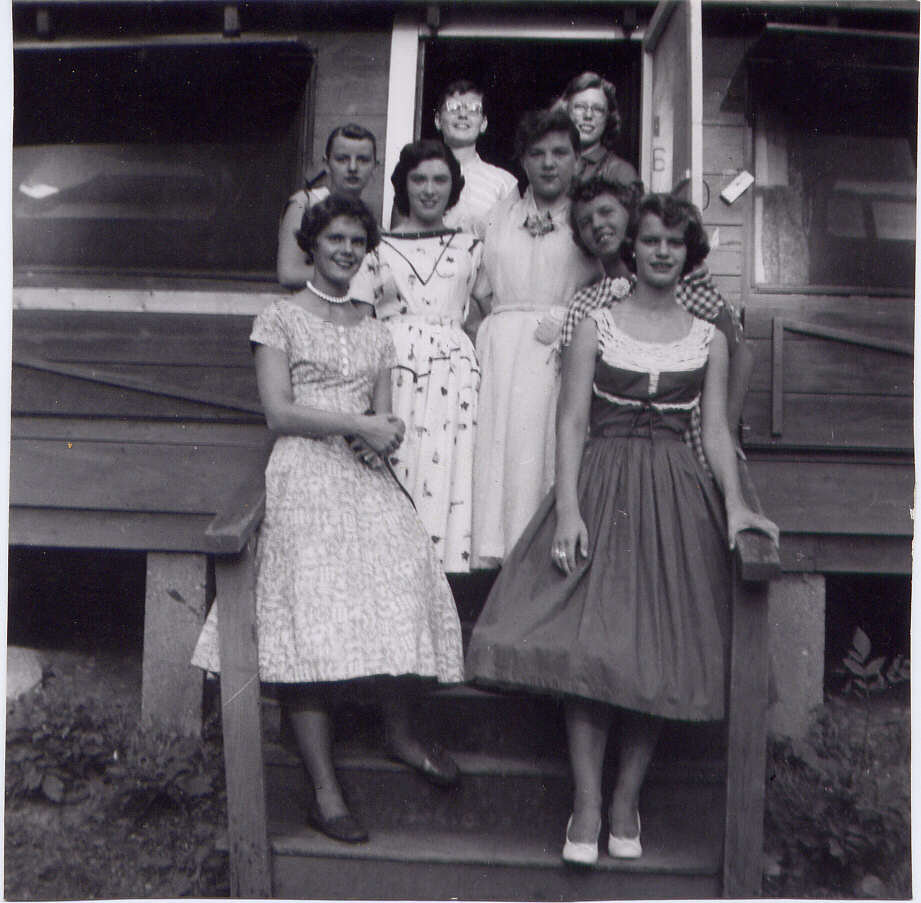
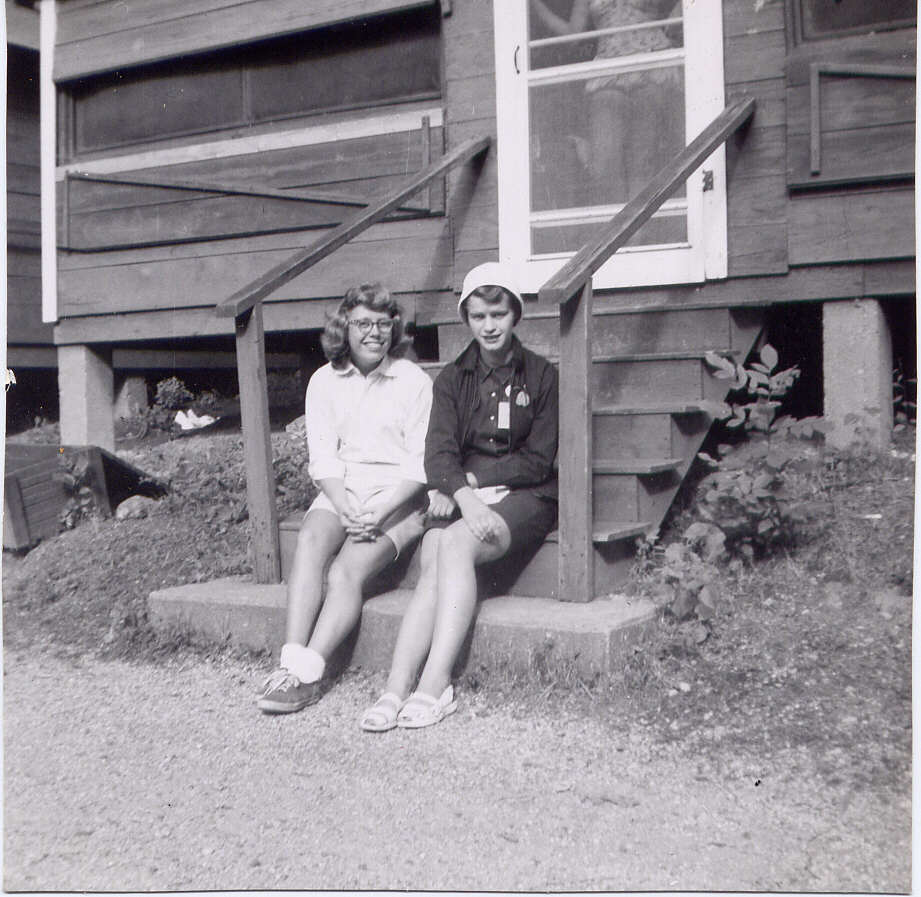
When I was in high school, maybe about 15 years old, I attended a School of Missions camp on Lake Geneva in Wisconsin with a few other girls from my community. It was interdenominational and more study oriented, although there were water sports. In the photo of our cabin I recognize me, my sister Carol (back row left), her friend Dottie (they were 2 years older), and my classmate Priscilla. We apparently brought dresses along to wear for church. That's me in the front with the hoop and white 2" heels (fun to wear on gravel streets). The other photo is Priscilla and me, dressed for typical camping activities.


My husband attended Boy Scout camp for several years when he was in elementary school. He doesn't remember its name (when he was little he thought his mother's name was "Mom" too), but knows it was near Indianapolis. His parents, always a bit ahead of the curve, bought a cabin in Brown County, Indiana, when he was about 14 years old, so from that point, the outdoor camping experience was to help with the Christmas trees and the family cabin.

This is getting a bit long, so I'll have to write about my childrens' camp experiences at another time.

Banner photography by Donald Kinney.

1. Ma2. Renee3. Lazy Daisy4. Lifecruiser
5. The Shrone6. Chelle7. Mrs. Cranky Pants8. Libragirl
9. YellowRose10. Ocean Lady11. novy

Click here for the Monday Memories code

Trackbacks, pings, and comment links are accepted and encouraged!


Saturday, June 05, 2004

349 Summers at Camp Emmaus in Northern Illinois

Today I received the newsletter from the Mt. Morris Church of the Brethren where I was baptized and married, and it included a registration form for Camp Emmaus, the camp for the Northern Illinois and Wisconsin district of that denomination. That really brought back the memories--of homesickness, of being a camper in the cabins, of crafts, singing, campfires, bugs in the food, of working as an assistant cook, of being a junior camp counselor, and of climbing the fence to check on my horse which was boarded at the farm next door. I recall the sights and smells and sounds that only are experienced deep in the woods of northern Illinois--cedar, pine, maple, ash, oak of many varieties, elm, linden, poplar, and walnut dropping piles of decaying leaves and numerous shrubs with sharp points if you get too far off the path.

The mother of one of my best friends, Ada Masterson Thomas, wrote a history of Camp Emmaus in 1979 (1), and the introduction is by Carl E. Myers, the minister who married us, formerly the minister of the Mt. Morris Church of the Brethren. Mrs. Thomas, and her husband Grover, were both wonderful writers who compiled a lot of local history, he for the town newspaper and she for the church and organizations. She reports that the churches of the denomination in the 1940s had rented camp sites for its children, but proposed to find a site it could develop for God’s work with children. First the committee looked at a 160 acre farm 10 miles from Mt. Morris, but the price per acre was too high. Then Robert Fridley, a lay leader in the Mt. Morris church offered 67 acres to which he would retain some pasturing and timber rights within his lifetime. So in 1946 the dream of a camp began 3 miles from Mt. Morris in Ogle County. The Fridley land was part of the original Maryland settlement of northern Illinois of the 1830s.

As I look through Ada’s careful history I see many names that even after 50 years, I recognize--Foster Statler who baptized me, Vernon Hohnadel, a neighbor, Orion Stover whose children went to college where I attended, Earl Buck, a layman from Franklin Grove Church where my grandparents attended, Forest Kinsey who was my junior high Sunday school teacher, Kenny Zellers from my home church, Evan Kinsley, my high school principal and Latin teacher and John Dickson, my uncle.

Twenty seven churches sent 125 members to Mt. Morris to launch a campaign to raise money in 1947. By August 1948, 9,000 man-hours of labor had been donated, and the electricity was turned on and cabins were being built. The first camp of 1948 was lively teen-agers and they all had work assignments which included clearing brush, making paths, painting, and grading a ball field. By 1949 there were 8 cabins and I was attending camp there in 1950, staying in the original small lodge where meals were prepared, and becoming violently ill from extreme homesickness. Fees were $10.50 a week and there was an official list of acceptable clothing which included pedal pushers, slacks, and jeans. Today’s 2004 recommendations are: bedding, Bible, personal items, flashlight, long pants, swim suits, and towels, and fees are still a very reasonable $138.

A new lodge was built in 1951, and one of my earliest memories of it was sitting down for dinner one day in July 1953 and seeing the note on the blackboard, “Give thanks. The Korean War is Over.” The lower level which was the kitchen and dining room was a walk-out with a large fire place at the end. Food seemed to be plentiful with a “runner” assigned to each table to get seconds and extra milk.

A lake was created and later a swimming pool, which opened in 1954. A manager’s home was built near the camp entrance, and I believe my brother and his family lived there for awhile in 1965 when he was the camp manager. The current camp manager, Bill Hare, was one of my camp mates back in the 1950s.

I’m so happy to see that children are still enjoying the opportunity to enjoy the beauty of Camp Emmaus. For photos of the 2003 season, look here.

1. Thomas, Ada Masterson, comp. The founding and development of Camp Emmaus. [Mt. Morris, IL, 1979]. This book contains a list of the original 1948 teen-age campers and their leaders, an appendix of the known plants, and a natural history of the area.