Showing posts with label Magnificat. Show all posts

Thursday, May 23, 2024

Morning meditation on conversion

Morning meditation by Fr. Donald Haggerty:

"It should not be surprising that a desire for a simpler lifestyle is a common impulse after a serious conversion. This is not just the result of new discipline. The shock of finding God in a personal encounter, and of being known to him, is a penetrating light cast upon life itself. Standing before eternity, so to speak, is a jolting experience and awakens a realization that so many gratifications sought in this life are empty, and unworthy. The awareness of time catches hold of our soul with a keen sense of the transiency and impermanence of the things of this life. What a year earlier might have been a coveted object to possess, a desire or ambition to be pursued, seems now unmasked for its paltry insignificance. It is truly as though a light from heaven had shone on the worldly pleasures and gratifications that formerly occupied out life with hardly a thought.

This stripping away of the gloss and sheen covering much of life is a kind of revelation to the soul. The emptiness of the pursuit of self-gratification is soon tasted and often leaves a lasting aversion to indulgent habits in life. It is not surprising, then that we turn to a difference source of satisfaction. The life of prayer begins to attract us more. A kind of disinterest in chasing after chimeras roots itself in the soul. The result in part is the greater simplicity of lifestyle seen after every deeper conversion." Magnificat, May 2024, pp. 355-56

Fr. Donald Haggerty, a priest of the Archdiocese of New York, is currently serving at Saint Patrick’s Cathedral in New York City. He has been a Professor of Moral Theology at St. Joseph’s Seminary in New York and Mount St. Mary’s Seminary in Maryland and has a long association as a spiritual director for Mother Teresa’s Missionaries of Charity. He is the author of many books.

Friday, April 15, 2022

Down the rabbit hole on Good Friday

Good Friday morning I only read the hymn in my devotional magazine (Magnificat, v. 24, no.2) for Holy Week, for Good Friday. It was "Were you there when they crucified my Lord?" I got no further in the April 15th entry. I remembered the first time I heard it. It was a hot summer day, in midsummer 1953 or 54. I was a teen helper in the kitchen at Camp Emmaus in northern Illinois during an older teen camp week. It was very exciting for me--previous jobs had been baby sitting and corn detasseling. I don't remember why the campers were using this hymn in the summer, but a guy about 5 years older than me sang it to me. I never forgot it. That was the first step into the rabbit hole.
 
Then I had to check out my hymn sources. Another rabbit hole. So I looked at the Brethren Hymnal (c. 1951) and "Were you There" was there. Exact same verse and wording as my magazine (unusual for hymns I've learned). Then I checked my Lutheran hymnals and the hymn was in the 1958 (red), the 1978 (green) and the 1982 (blue) versions. My only Methodist Hymnal (1964) I keep at our Lake house. From the evidence on my shelves I'm suggesting that this hymn began appearing in main line church hymnals around 1950. It's now a standard, but it had been sung for many years in black churches.

I always read the information at the top, bottom and sides of a hymn, about the author, composer, collection, notes for the musician, etc. and of course, there's no information on the author and it's referred to either as a Spiritual or Negro Spiritual.

From there I moved on to my favorite source, "Amazing grace; 366 inspiring hymn stories for daily devotions,," by Kenneth W. Osbeck (1990). He wrote: "The Negro spirituals represent some of the finest of American folk music. These songs are usually a blending of an African heritage, harsh remembrances from former slavery experiences, and a very personal interpretation of biblical stories and truths. They especially employ biblical accounts that give hope for a better life--such as the prospects of heaven. They symbolize so well the attitudes, hopes and religious feeling of the black race in America."

Osbeck suggests: "Imagine yourself standing at the foot of the cross when Christ was tortured and crucified. Then place yourself outside the empty tomb when the angelic announcement "He is not here. . . ". Try to relive the emotional feelings that would have been yours. Allow this song to minister to you as you go through the day---. " For Good Friday, there's no better hymn to put you there.

Note: Although the phrase "down the rabbit hole" is from Alice in Wonderland (1865) over time it's come to mean getting sucked into an endless time search in reading or looking at the internet. I still use books, so it happens a lot.

Saturday, February 12, 2022

Daniel Joseph Donahoe, down the rabbit hole

 My book collection has a provenance, a genealogy, a history. So today I write about "Early Christian hymns; translations of the Verses of the most notable Latin writers of the early and middle ages," Daniel Joseph Donahoe, The Grafton Press, 1908. I checked my shelves because I read an article by Anthony Esolen, "The Song of a Crippled Man." 

 Hermann Contractus was born with deformities--he couldn't walk or talk until he was seven or eight years old, but had a sunny disposition and a brilliant mind.  Young men came from all over Europe to study with him.  He was a master of ancient Latin, Hebrew, theology, astronomy and music. His music and poetry is still used to this day in the Catholic church.

Esolen provided a recent translation by John Henry Newman of Alma Redemptoris Mater from the Roman Breviary.

Mother of the Redeemer, who art ever of heaven

The open gate, and the star of the sea, aid a fallen people,

Which is trying to rise again; thou who didst give birth,

While Nature marveled how, to thy Holy Creator,

Virgin both before and after, from Gabriel's mouth

Accepting the All hail, be merciful towards sinners.

So you see I needed to go to the shelves of my own library to see if I had anything for Hermann the Cripple, b. 1013, d. 1054, and I found "Early Christian Hymns," by Daniel Joseph Donahoe. The introductory material on p. 151 states:

HERMANN CONTRACTUS The son of the Swabian Count Wolfrat of Voringen, Hermann was born in 1013, and died in 1054. He was surnamed Contractus, or the Lame, on account of a physical defect. Educated at the monastery of Reichenau, and after-ward admitted as a member of the fraternity, he added greatly to the reputation of that house, which had been noted for its learning from the time of St. Berno. He is famous as a chronicler of his time. He also devoted himself to mathematics and music, and constructed watches and instruments of various kinds. He wrote a number of hymns, besides producing a didactic poem on "The eight chief vices." The "Alma Redemptoris" and the beautiful anthem "Salve Regina," found in the Roman Breviary, are his, although the last words of the latter were added by St. Bernard of Clairvaux. The Vesper hymn, "Ave Regina Coelorum," is probably of a later period. 


 In an on-line source   http://lawlit.net/lp-2001/donahoe.html I found that  Daniel Joseph Donahoe (1853-1930)  was born of Irish parents at Brimfield, Massachusetts, on February 27, 1853. He is well known as a lawyer in Connecticut, and has been a judge at Middletown, Connecticut, since 1883. He was admitted to the bar in 1871.

He [has] written 'The Holy Maid of France,' a sequence of eight idyls, a poetical narrative of the life of Joan of Arc, in the Springfield Sunday Republican, and is a contributor to many Irish-American periodicals, such as the Boston PilotDonahoe's magazine (to whose proprietor he is not related), etc." [Source: D. J. O'Donoghue, The Poets of Ireland: A Biographical and Bibliographical Dictionary of Irish Writers of English Verse 112 (Dublin: Hodges Figgis & Co.; London: Henry Frowde, Oxford University Press, 1912) (Gale Research Co., reprint 1968)] [Daniel Donahoe died at Middletown, Connecticut. See W. Stewart Wallace, A Dictionary of North American Authors 123 (Toronto: The Ryerson Press, 1951)]

Poetry

D.J. Donahoe, Idyls of Israel and Other Poems (New York: John B. Alden, Publisher, 1888)(Middletown, Connecticut: Lucius R. Hazen, Publisher, 2nd ed., 1894) [online text]

___________, A Tent by the Lake, and Other Poems (New York: John B. Alden, Publisher, 1889) [online text]

___________, In Sheltered Ways: Poems (Buffalo [N.Y.]: Charles Wells Moulton, 1895)(1894)

Daniel J. Donahue, The Rescue of the Princess: A Song of the Great Dawn (Middletown, Connecticut: 1907) [online text]

_____________, Songs of the Country-Side (Middletown, Connecticut: The Donahoe Publishing Co., 1914) [online text]

Writings & Translations

Daniel Joseph Donahoe, Early Christian Hymns; Translations of the Verses of the Most Notable Latin Writers of the Early and Middle Ages (New York: The Grafton Press, 1908) [online text(London: T. Werner Laurie, 1908)

__________________, Early Christian Hymns. Series II. Translations of the Verses of the Most Noted Latin Writers of the Early and Middle Ages (Middletown, Connecticut: The Donahoe Pub. Co., 1911).

 How did I get this book I took from my office shelves by Donohue?  

When I was employed by The Ohio State University Libraries I thoroughly enjoyed the annual used book sale sponsored by the Friends of the Libraries.  I should ask some of my retired colleagues about the history of it and when it started, but it hasn't been offered for a long time--maybe two decades. I could almost swoon (it's a librarian thing) even remembering it, because not only did all the librarians contribute gift books to their own campus library, but many non-faculty and non-OSU people contributed, and the proceeds went to the Friends organization to enhance the libraries' collections with special purchases or equipment we couldn't otherwise afford. We were not allowed to sell or give away directly from our libraries to faculty who may have been collectors (in my case, of old veterinary titles), but before I would send boxes of books to the sale, (or to the dumpster in the case of journals) my assistant Sarah Terry would do a brief Author/Title search on each and a list would be prepared so my faculty could go to the sale in the main library basement "armed with information" after checking their own collections.

Thursday, January 13, 2022

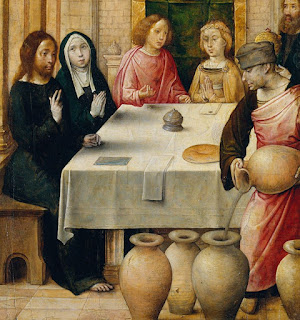
The Wedding at Cana, John 2:1-11


A happy accident. Sometimes that's an unplanned baby who becomes mom's caregiver in her old age; sometimes it's a splash of color on an almost finished painting that becomes an award winner; and sometimes it's something you read right after you read or saw something related that brings it all together.

Our lesson for Sunday is John 2:1-11, Jesus' first miracle at the wedding at Cana. It can be read literally or as theology or as an allegory or a prophecy, but John says Jesus revealed his glory (see Exodus 19:11). Why Cana? Why is Mary in charge of a wedding? Why 6 jars? What is the significance of the first of seven signs. On and on. There are entire sermons and articles on the details. But here's what happened to me.

I use a little journal (5 x 7) "Magnificat" in my morning devotions, and besides several hymns and Bible selections for morning and evening, and the story of a saint, each issue has two articles on Christian art, the cover art and another one which may be connected to other content. It's like taking an art appreciation class. I wait a bit and savor it after a week or two, so I didn't read the essays for January until today. In all the years I've been using this journal, I may have only recognized a few, probably if they were on the little Sunday School bulletins children in the 40s and 50s received. The cover art for January was a small (about 8 x 6) altar piece painted by Juan de Flandes, the official painter of Queen Isabella who with her husband Ferdinand unified Spain and financed Columbus' voyages to the New World. She had commissioned 47 of these paintings illustrating the life of Christ, but only 25 of them are still extant.
 
So, what is the cover story art? The wedding at Cana, and we see Jesus and Mary and the wedding couple (whose names John didn't include, nor do we know what their relationship was to Jesus). Their image in the painting is the likeness of Ferdinand and Isabella's son Prince John of Aragon and his bride Margaret of Austria, who married in 1497. They were 19 and 17 when they married and deeply in love, but sadly John died only 6 months after the wedding. So, he is also memorialized in a painting that lauds the sacredness of marriage.

"The moral of this small, private devotional painting is clear: at the intercession of the Virgin Mary, Christian spouses are invited by Jesus to fill-to the brim--their life of human love that, through the sacrament of Marriage, the love that unites them may be raised to the level of divine love." (Pierre-Marie Dumont on the cover art)

Wednesday, December 22, 2021

Rest during the Flight into Egypt by Francesco Mancini

It's almost the end of December, so this morning in my devotions I read the story behind the cover art on the December issue of Magnificat, vol. 23, no. 10. Pierre-Marie Dumont, the publisher, writes these very interesting and erudite 2 page articles. I can't find out much about him except he is a Catholic layman and has 12 children and is also the president of the website Aleteia.   This article is titled, "The gaze between a Father and His Son." I really like this magazine and have been subscribing for about 3 years.  Although it is keyed to daily readings and holy days with brief essays and writings from 2000 years of Christian history, the old issues are really never out of date, and sometimes you can find them in used book stores. There are usually two articles about art.
"Francesco Mancini († 1758), successor of Carlo Maratta († 1713), enjoyed his moment of glory in Rome at a time when the Baroque was expressing its swansong in the form of the Rococo style. Pope Clement XIV († 1774) purchased this Rest during the Flight into Egypt in 1772 to hang in the paintings gallery of the Vatican museums which he had just founded.

This charming work is inspired by a famous episode, “the miracle of the palm tree,” from the Book of the Birth of the Blessed Virgin Mary and the Childhood of the Savior, known also as the Gospel of Pseudo-Matthew. Drawing on tradition—including the apocryphal Protoevangelium of James dating back to the 2nd century—this ­apocryphal Gospel appeared in the 5th century, and was then ­reworked and enriched until the 12th century. It should be noted that the miracle of the palm tree is also mentioned in the Quran, Surah XIX, Mary, v. 23. Here then is the story according to the apocryphal Gospel: On the third day of the flight into Egypt, Mary was suffering from the scorching heat of the sun. Seeing a palm tree in the distance, she asked Joseph to take her there. As the Holy Family rested under the generous shade of this providential tree, Mary expressed the wish to eat of its fruit. Joseph replied that the high-hanging fruit was out of reach and, moreover, before gathering fruit, he must go in search of water, for their gourds had run dangerously dry. With that, the little child Jesus said to the palm tree, “Bow down and feed my mother with your fruit.” And the palm tree bowed down until Joseph was able to gather its fruit and offer it to Mary and Jesus. Then Jesus said to the tree, “Stand up again, and make the spring that bathes your roots rise up and flow forth.” And immediately, a spring of clear fresh water appeared.

To this basic story, later versions and the theological ­imagination of artists added other wondrous elements. For example, the palm tree didn’t simply offer dates, but fruit suitable to this earthly ­trinity that wished to eat of it. Thus, GĂ©rard David painted a luscious bunch of grapes with clear Eucharistic symbolism. Here, as in the famous painting by Barocci on the same theme, it is cherries that Joseph has gathered in the wicker basket lying at Mary’s feet. For heart-shaped red cherries symbolize the Passion of Christ, his blood shed for many, and his pierced heart. Taking another artistic liberty with the apocryphal narrative, Saint Joseph is not depicted as an indifferent old man, but as an attractive young husband fully assuming his role as head of the family.

Let us then enter more deeply in contemplation of this work. In the background, we find an obelisk and a temple whose presence suggests that this episode takes place at the gates of Egypt. The characteristic trunk of the palm tree forms a diagonal around which the scene is constructed. While an archangel holds the crown of the immaculate conception above Mary’s head, two angel-musicians play a celestial hymn: this is clearly the Holy Family. In her hand, Mary holds a cup brimming with water from the miraculous spring. On her lap, the infant Jesus takes a cherry from his father’s hand. The unfathomable depth of the gaze he shares with his father attests to their mutual awareness of the symbolism of this gesture: it is no less than his Passion for the glory of God and the salvation of the world that Jesus grasps and will consummate. And there is the hand of Mary reaching out, as though to prevent her child from doing something foolish. But this isn’t a reflex of maternal instinct who wants to protect her child from all harm. It is the image of the consecration of the Mother of God who will accompany her child’s every act… right to the foot of the cross and the entombment.

The Rest during the Flight into Egypt, Francesco Mancini (1679–1758), Pinacoteca, Vatican, Italy. © 2021, Photo Scala, Florence.


Note on Magnificat by Dumont Magnificat Foundation - Home