Showing posts with label St. Paul. Show all posts

Friday, May 10, 2024

Who wrote Ephesians?

Recently I heard a Bible teaching on Ephesians. When speaking of who is the author of the letter to the Ephesians, she suggested that Paul wasn't the actual author, that instead it may have been a disciple or someone closely working with him, and then she went on. . . without mentioning the option that it is not "settled" science and there are just as many arguments and scholars for Pauline authorship. When I got home I looked at what books I might have to explain that. Unfortunately, although I knew that line of thinking comes from "higher criticism," I no longer have any of those volumes. Here's what I do have, and also my own conclusions.

I have an IVP New Bible Commentary; Revised by Guthrie. He explains the higher criticism view of Ephesians, but completely debunks it point by point (p. 1106)

I have an NIV Archeological Bible, and its article "The Authorship of Ephesians" under subsection "The Reliability of the Bible," points out "some scholars" question Paul's authorship and then supports Paul's authorship with 8 bullet points with citations.

I have an NRSV Catholic edition which confirms that speaker, "It is unlikely that the Letter to the Ephesians was actually written by Paul. It is generally thought to be pseudonymous written after his death. The vocabulary, style and general content of the Letter do not resonate with the same expression and viewpoint articulated in the seven unquestionably Pauline letters." In other words, what most seminaries are teaching their new pastors and church workers. That's from the "Introduction to the Books of the Bible" ( p. lxxi), and it's difficult to say if the same wording is in the Protestant editions (this one contains the Deuterocanonical books removed in the 16th c.) It also provides the higher criticism view of 3 Isaiahs, and casts doubt on the authorship of other NT epistles.

So then I turned to my most scholarly title, the Encyclopaedia Britannica, 11th ed. 1910 which I inherited from my grandfather Weybright. It really laid out in detail the 16th, 17th, 18th, and 19th centuries research primarily by German Protestants beginning with the OT and working through most of the NT, until the rationalist, anti-supernatural, post-Christian theories had infected all the seminaries, and because of the date, did not include the rise of the fundamentalists and the major splits in Protestantism. Yet it would not fly the white flag and roundly defended Paul's authorship. Perhaps the most clever and witty paragraph was: "The view which denies the Pauline authorship of Ephesians has to suppose the existence of a great literary artist and profound theologian, able to write an epistle worthy of Paul at his best, who, without betraying any recognizable motive, presented to the world in the name of Paul an imitation of Colossians, incredibly laborious and yet superior to the original in literary workmanship and power of thought, and bearing every appearance of earnest sincerity. It must further be supposed that the name and the very existence of this genius were totally forgotten in Christian circles fifty years after he wrote. The balance of evidence seems to lie on the side of the genuineness of the Epistle.

From my point of view, I looked through some of the homilies of the early church fathers. They were much closer to the "real" author than German scholars who weren't even Christians. They did not doubt the authorship of Paul.

Saturday, September 16, 2023

Who wrote the letter to the Ephesians

 Recently I heard a Bible discussion where the speaker remarked that "scholars believe Paul wasn't the author of Ephesians, that it was someone, a disciple perhaps, who worked closely with him."  She didn't suggest an alternative but just went on with the examination of author, audience, culture and context. Although it's not an unusual theory (it's even in the preface of my NRSV that way), I suspect "higher criticism."  I no longer keep any of those books on my shelves, but I still have my grandfather's Encyclopaedia Britannica, 11th ed (1910), and since it's primarily an 18th and 19th century scholarly exercise, I decided to take a look.  Sure enough, there it was, however the author pretty much debunked it.  In a nutshell, higher criticism denies the supernatural nature of scripture, particularly the Old Testament, and develops theories for anything it can't understand. It's hard to believe that any of these "scholar" were believers. There were hints of this in the 17th century, but the Germans really ran with it in the 19th century, and pretty much split seminaries and denominations.  The article I found was very long, but here's the essence.  I underlined the most simple and easy to understand.  It's sort of like the theory that someone else wrote Shakespeare, but he sure was good at it.

"Objections to the genuineness of Ephesians have been urged since the early part of the 19th century. The influence of Schleiermacher, whose pupil Leonhard Usteri in his Entwickelung der paulinischen Lehrbegriffs (1824) expressed strong doubts as to Ephesians, carried weight. He held that Tychicus was the author. De Wette first (1826) doubted, then (1843) denied that the epistle was by Paul. The chief attack came, however, from Baur (1845) and his colleagues of the Tübingen school. Against the genuineness have appeared Ewald, Renan, Hausrath, Hilgenfeld, Ritschl, Pfleiderer, Weizsäcker, Holtzmann, von Soden, Schmiedel, von Dobschütz and many others. On the other hand, the epistle has been defended by Bleek, Neander, Reuss, B. Weiss, Meyer, Sabatier, Lightfoot, Hort, Sanday, Bacon, Jülicher, Harnack, Zahn and many others. In recent years a tendency has been apparent among critics to accept Ephesians as a genuine work of Paul. This has followed the somewhat stronger reaction in favour of Colossians.

Before speaking of the more fundamental grounds urged for the rejection of Ephesians, we may look at various points of detail which are of less significance.

(1) The style has unquestionably a slow and lumbering movement, in marked contrast with the quick effectiveness of Romans and Galatians. The sentences are much longer and less vivacious, as any one can see by a superficial examination. But nevertheless there are parts of the earlier epistles where the same tendency appears (e.g. Rom. iii. 23-26), and on the whole the style shows Paul’s familiar traits. (2) The vocabulary is said to be peculiar. But it can be shown to be no more so than that of Galatians (Zahn, Einleitung, i. pp. 365 ff.). On the other hand, some words characteristic of Paul’s use appear (notably διό, five times), and the most recent and careful investigation of Paul’s vocabulary (Nägeli, Wortschatz der paulinischen Briefe, 1905) concludes that the evidence speaks for Pauline authorship. (3) Certain phrases have aroused suspicion, for instance, “the devil” (vi. 11, instead of Paul’s usual term “Satan”); “his holy apostles and prophets” (iii. 5, as smacking of later fulsomeness); “I Paul” (iii. 1); “unto me, who am less than the least of all the saints” (iii. 8, as exaggerated). But these cases, when properly understood and calmly viewed, do not carry conviction against the epistle. (4) The relation of Ephesians to Colossians would be a serious difficulty only if Colossians were held to be not by Paul. Those who hold to the genuineness of Colossians find it easier to explain the resemblances as the product of the free working of the same mind, than as due to a deliberate imitator. Holtzmann’s elaborate and very ingenious theory (1872) that Colossians has been expanded, on the basis of a shorter letter of Paul, by the same later hand which had previously written the whole of Ephesians, has not met with favour from recent scholars.

But the more serious difficulties which to many minds still stand in the way of the acceptance of the epistle have come from the developed phase of Pauline theology which it shows, and from the general background and atmosphere of the underlying system of thought, in which the absence of the well-known earlier controversies is remarkable, while some things suggest the thought of John and a later age. Among the most important points in which the ideas and implications of Ephesians suggest an authorship and a period other than that of Paul are the following:

(a) The union of Gentiles and Jews in one body is already accomplished. (b) The Christology is more advanced, uses Alexandrian terms, and suggests the ideas of the Gospel of John. (c) The conception of the Church as the body of Christ is new. (d) There is said to be a general softening of Pauline thought in the direction of the Christianity of the 2nd century, while very many characteristic ideas of the earlier epistles are absent.

With regard to the changed state of affairs in the Church, it must be said that this can be a conclusive argument only to one who holds the view of the Tübingen scholars, that the Apostolic Age was all of a piece and was dominated solely by one controversy. The change in the situation is surely not greater than can be imagined within the lifetime of Paul. That the epistle implies as already existent a developed system of Gnostic thought such as only came into being in the 2nd century is not true, and such a date is excluded by the external evidence. As to the other points, the question is, whether the admittedly new phase of Paul’s theological thought is so different from his earlier system as to be incompatible with it. In answering this question different minds will differ. But it must remain possible that contact with new scenes and persons, and especially such controversial necessities as are exemplified in Colossians, stimulated Paul to work out more fully, under the influence of Alexandrian categories, lines of thought of which the germs and origins must be admitted to have been present in earlier epistles. It cannot be maintained that the ideas of Ephesians directly contradict either in formulation or in tendency the thought of the earlier epistles. Moreover, if Colossians be accepted as Pauline (and among other strong reasons the unquestionable genuineness of the epistle to Philemon renders it extremely difficult not to accept it), the chief matters of this more advanced Christian thought are fully legitimated for Paul.

On the other hand, the characteristics of the thought in Ephesians give some strong evidence confirmatory of the epistle’s own claim to be by Paul. (a) The writer of Eph. ii. 11-22 was a Jew, not less proud of his race than was the writer of Rom. ix.-xi. or of Phil. iii. 4 ff. (b) The centre in all the theology of the epistle is the idea of redemption. The use of Alexandrian categories is wholly governed by this interest. (c) The epistle shows the same panoramic, pictorial, dramatic conception of Christian truth which is everywhere characteristic of Paul. (d) The most fundamental elements in the system of thought do not differ from those of the earlier epistles.

The view which denies the Pauline authorship of Ephesians has to suppose the existence of a great literary artist and profound theologian, able to write an epistle worthy of Paul at his best, who, without betraying any recognizable motive, presented to the world in the name of Paul an imitation of Colossians, incredibly laborious and yet superior to the original in literary workmanship and power of thought, and bearing every appearance of earnest sincerity. It must further be supposed that the name and the very existence of this genius were totally forgotten in Christian circles fifty years after he wrote. The balance of evidence seems to lie on the side of the genuineness of the Epistle.

If Ephesians was written by Paul, it was during the period of his imprisonment, either at Caesarea or at Rome (iii. 1, iv. 1, vi. 20). At very nearly the same time he must have written Colossians and Philemon; all three were sent by Tychicus. There is no strong reason for holding that the three were written from Caesarea. For Rome speaks the greater probability of the metropolis as the place in which a fugitive slave would try to hide himself, the impression given in Colossians of possible opportunity for active mission work (Col. iv. 3, 4; cf. Acts xxviii. 30, 31), the fact that Philippians, which in a measure belongs to the same group, was pretty certainly written from Rome. As to the Christians addressed, they are evidently converts from heathenism (ii. 1, 11-13, 17 f., iii. 1, iv. 17); but they are not merely Gentile Christians at large, for Tychicus carries the letter to them, Paul has some knowledge of their special circumstances (i. 15), and they are explicitly distinguished from “all the saints” (iii. 18, vi. 18). We may most naturally think of them as the members of the churches of Asia. The letter is very likely referred to in Col. iv. 16, although this theory is not wholly free from difficulties."


Tuesday, October 06, 2020

What Saint Paul said

Most Americans are familiar with the idiom, “Damascus road experience” even if they haven’t read about Saint Paul’s conversion in the Acts of the Apostles in the New Testament. But I had completely missed his retelling of that in the first chapter of Galatians. Perhaps it is the translation.

“But when he [God] who FROM MY MOTHER’S WOMB* HAD SET ME APART and called me through his grace, was pleased to reveal his Son to me . . . “ Do you really think “from” excludes “inside?”

In evaluating the policies and philosophies of the candidates, I put life issues first, as does one of our founding documents, “life, liberty and the pursuit of happiness.” Just a few years ago there was only one U.S. politician who would go on record as against the born-alive infant protection act—Barack Obama (as Illinois state senator) and he was left of NARAL, which is hard to do. Now his entire party of sheeples has followed his lead.

Joe Biden, who may have once been pro-life, has gone against his church, his savior, the founding documents, and his own conscience.  And Donald Trump, like Saint Paul, who may once have been pro-choice (with no vote in Congress) but is now pro-life, is the one chosen by God from the womb to save babies.

Late term abortions are indeed rare, as my pro-choice friends remind me—maybe 1.3% of all abortions.  “Only” 5,000-10,000 a year. In Ohio that’s 106 and in New York that’s 1590.**  How many are the proper number for you?

*NIV translated the passage as “from birth,” with “from my mother’s womb” another translation.

**https://lozierinstitute.org/late-term-abortion-stats/ June 2020

Thursday, October 24, 2019

On Thanksgiving and suffering

I was on my way to reading something else in 2 Corinthians, but stopped at Paul's "thanksgiving" which follows his greeting, "grace to you and peace from God our Father and the Lord Jesus Christ." We hear that greeting so often, we sometimes don't even notice it. Christian pastors often begin their sermons with that.

I was writing in my gratitude journal; the words grace and gratitude are derived from the Latin gratis/gratus/gratia which means thankful. Eucharist derives from the Greek εὐχαριστία (eucharistia), meaning "thanksgiving," and root for "charity" is right in the middle.

Interestingly, in Paul's "thanksgiving" which I often skip to get on to the juicy stuff of resolving conflicts, and raising money, he uses the Jewish blessing "God of all encouragement" (consolation, paraklesis) ten times! And when does he encourage us? In every affliction. He mentions suffering or affliction seven times in this word of thanksgiving.

"Our hope for you is firm, for we know that as you share in the sufferings, you also share in the encouragement."

Although I never got to the verses I had planned to read, today I'm thankful for God's encouragement in a time of suffering.

https://www.wordsense.eu/grace/

I shared the above thought about thanksgiving and gratitude on my Facebook page, which allows others to respond immediately, not like a blog which has to be approved first.  A young Lutheran pastor from Texas, Phil Daniels, who a few years ago was a seminary student serving at our church, responded.  I don’t know when I friended him on FB, or how he happened to notice my little essay.

Philip Daniels: That is very insightful. I have noticed, as I have been working on sermons, how often I overlook those introductions in order to go onto the more meaty stuff ... and I'm a pastor! That has been something God has been teaching me both in my personal study and public proclamation: don't overlook those introductions. And I do love the word "Paraklesis" which has overtones of the word often used to describe the Holy Spirit. In the Septuagint we see Isaiah most famously use it in Isaiah 40:1: Comfort, comfort my people, says your God. The Hebrew in that sense is "Nacham." As far as I can understand, the word is tied to both breath and resuscitation. In Arabic, the word means "to breath pantingly." While, this misses the mark, it does give us a little insight as words of comfort are often felt like gasps of living breath to those worn out by fatigue in the world. Yet the earliest parts of the Bible seem to use it in the comforting after a death (i.e. Genesis 24:67b, "So Isaac was comforted after his mother’s death.")

Nacham therefore is best understood as a revivification after the loss of someone or some ideal dear. And, oddly, one wonders if one has to experience this death in order to have this new breath breathed into one.

This is probably overanalyzing Paul in this context. On the other hand, I am also sure Paul would not be averse to such thinking. These are people who can offer comfort because a new breath has been put inside them. A Comforter has been called beside them. They can now breathe new life into the lives of those around them since they have been "comforted" indeed we could say they have experienced "nacham." If we forget that we have been revived, that we too have looked upon the cross and the body placed in the tomb; we can also declare that Someone has revived us and bids us to GO! and share the good news that we have.

In any case, keep reading and don't be afraid of the New Life found each New Day in the easy glanced-over parts of this Book of Life.

Sunday, February 07, 2016

Marching orders from Paul's letter to the church at Rome

Romans 12 has an extensive list of how Christians behave who have received grace. We studied this chapter in class this morning. Some statements are clarifications of those that came before, some are in the negative.
Present your bodies as a living sacrifice that is holy and pleasing to God

Don’t be conformed to the patterns of this world,

Be transformed by the renewing of your minds

Don’t think of yourself more highly than you ought to think

If your gift is . . .[list of gifts] prophesy, service, teaching, encouragement, giving, leadership, mercy. . .do it!

Love should be shown without pretending

Hate evil

Hold on to what is good

Love each other like the members of your family

Be the best at showing honor to each other

Don’t hesitate to be enthusiastic

Be on fire in the Spirit as you serve the Lord

Be happy in your hope

Stand your ground when you’re in trouble

Devote yourselves to prayer

Contribute to the needs of God’s people

Welcome strangers into your home

Bless people who harass you--don't curse them

Be happy with those who are happy

Cry with those who are crying

Consider everyone as equal

Associate with people who have no status

Don’t think that you’re so smart

Don’t pay back anyone for their evil actions with evil actions

Show respect for what everyone else believes is good.

Live at peace with all people

Leave room for God's wrath

Don’t be defeated by evil, but defeat evil with good.
Romans 12:1-12 CEB


Monday, December 21, 2015

The earliest Christian creed

There was no Bible to direct Paul on his missionary journeys or to guide his letters to the converts.  He had to tell them what he had been told in the period of time between his Damascus Road experience (about 4-5 years after the resurrection) and the beginning of his ministry.  This was a time when the disciples of Jesus were able to school him in the truths of the gospel until he was ready to go out on his own. They gave him this creed. Also, Paul’s letters were circulating before the four Gospels. He teaches using a form of a creed--a statement of belief--which had been taught to him.

“For what I received I passed on to you as of first importance:

That Christ died for our sins
According to the Scriptures
That he was buried
That he was raised on the third day
According to the Scriptures
And that he appeared to Peter
And then to the Twelve.”

1 Corinthians 15: 3-5

He preceded that statement of faith by reminding them that this is the gospel that saved them, otherwise their belief is in vain.  And also ours.

https://carm.org/questions/about-jesus/1-cor-153-4-demonstrates-creed-too-early-legend-corrupt

 http://winteryknight.com/2009/04/03/gary-habermas-explains-the-earliest-source-of-resurrection-facts/

 http://www.evidenceunseen.com/bible-difficulties-2/nt-difficulties/romans-2/1-cor-153b-5-was-this-an-early-christian-statement-of-faith/


Sunday, October 25, 2015

Adult Sunday School, October 2015, UALC

Our Sunday school class is studying Romans, and for two weeks had an outstanding, articulate retired Lutheran pastor, Douglas McBride formerly of San Antonio, as our teacher. Class members are taking us through Romans after his excellent overview and first three chapters. I hope he can come back.

Paul wrote a letter to the Roman church, a mixed group of Jews and Gentiles, from  Corinth, while he was on his third missionary journey between 56 and 58 A.D. He was on his way to Spain.**  At the time he was gathering an offering from the Gentile Christians for the church in Jerusalem (15:25; Acts 24:17). Over half of the people he specifically mentions in the letter have Greek or Roman names, and he calls the Jews, “my brothers.” The church may have been started by his converts, but no one knows for certain. Since he first mentions Phoebe it appears that she brought the letter to Rome, so she must have been a trusted convert and helper. He greets a number of households indicating the church was made up of numerous groups, and he addresses in the letter a number of situations, many of which sound similar to our churches today. Struggles among themselves; how to deal with the government, etc.

He encourages unity and accepting one another, just as Christ accepted them. Yet it seems the church has never been more divided and scattered than today.

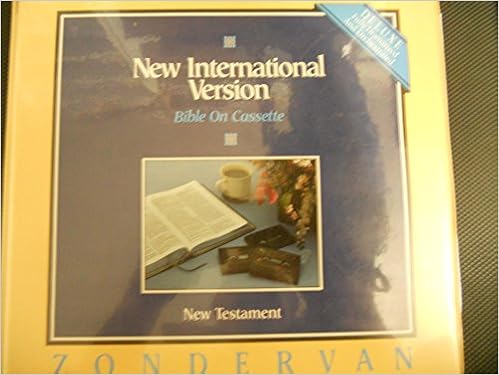
In the free box at church I found the New International Version of the Bible (Zondervan) on cassette.  I may be one of the few people who still have a hand held cassette player, so I’ve been listening to Romans while using my exercycle. Usually, I don’t enjoy audio of the Bible--speakers/voice actors go too fast or it’s too monotonous, but this one is really excellent.  There are music and sound effects, and when the writers reflect on OT passages of Jesus’ messages, there is a slight echo or reverberation.

* * “We know little about the early years of Christianity in the Iberian Peninsula. According to legend the apostle James --at Christ’s urging--carried the gospel to the country in 40 AD, but the early church writers have nothing to say about it. We know that St Paul intended to visit in Spain (Epistle to the Romans, XV, 24 and 28), which would suggest that there were organised groups for him to preach to. But there is no evidence that he made the trip, nor does any church in Spain popularly claim to have been founded by Paul.

By the second century, however, some Christian communities were probably established in the peninsula. We know that St Irenaeus, bishop of Lyons (France), writing around 180 AD, alludes to Christian churches amongst the Celts and Iberians.  We also know from a letter by St Cyprian of Carthage (?-258?) that by 254 AD there were Christian communities in Astorga, Mérida, León and Zaragoza.”  Source.

Monday, September 23, 2013

Taking out the trash

Sharon Jaynes writes at her website:

“Once I had a door-to-door vacuum salesman come to my house. To my detriment, I let him in. Before I could convince him I did not need a new vacuum cleaner, he had his demonstration trash sprinkled all over my foyer floor. Almost two hours later, I finally got him to leave.

What was my first mistake? You know it! My first mistake was to let him cross the threshold of my doorway and enter my house. Once he was in, it was difficult to get him out. It is the same way with our thoughts. Once we entertain a thought, once we allow the “salesman” to scatter his “trash” in our minds, it is hard to dismiss it or push it back out again. The place of easiest victory is at the threshold; don’t even let the trash in the door. It has been said, “Every spiritual battle is won or lost at the threshold of the mind.” I think victory is possible once the thought has passed over the threshold, but it sure will save us a lot of heartache and pain if we begin to recognize Satan’s lies and reject them from the start.”

I came across this looking for the exact citation for, “Hold every thought captive for Christ.” (Paul)  The complete wording and citation is, For though we live in the world, we do not wage war as the world does. The weapons we fight with are not the weapons of the world. On the contrary, they have divine power to demolish strongholds. We demolish arguments and every pretension that sets itself up against the knowledge of God, and we take captive every thought to make it obedient to Christ. (2 Corinthians 10:5)

At this age, I wouldn’t make the mistake of letting in a salesman of anything unless I had invited him or called for an appointment, but my goodness, the dust and dirt still creeps in and I find ways to avoid cleaning it up (often checking FB or my blog instead). Better to have a good seal and filter so there isn’t so much to clean up later.

photo

Monday, February 28, 2011

Hope and Change--it's not just a political slogan

Hope and Change is the message of the New Testament, and it was stolen by the Obama campaign because the clever marketing firm that ran the campaign knew the familiarity and the challenge of it have a comfortable, familiar ring, even if the candidate was preaching political concepts unacceptable to most Americans--concepts that have failed in every country they've been tried. "Hope and change" (the slogan) is also an underlying desire of youth--in my generation it was the 18-23 year old's mantra, but since adolescence has been lengthened since the mid-60s, so has young adulthood, and now it's the 20-30 year olds who yearn to make changes in the world and believe they are the generation to do it. Constant, unremitting change (they are fuzzy on this but it includes risk taking, hedonism/slackerism, entertainment and sports) is in fact their hope as they postpone marriage, family and career.

Paul lists seven questions in Romans 8.31-39
    31 What, then, shall we say in response to these things? If God is for us, who can be against us? 32 He who did not spare his own Son, but gave him up for us all—how will he not also, along with him, graciously give us all things? 33 Who will bring any charge against those whom God has chosen? It is God who justifies. 34 Who then is the one who condemns? No one. Christ Jesus who died—more than that, who was raised to life—is at the right hand of God and is also interceding for us. 35 Who shall separate us from the love of Christ? Shall trouble or hardship or persecution or famine or nakedness or danger or sword? 36 As it is written: “For your sake we face death all day long; we are considered as sheep to be slaughtered.” 37 No, in all these things we are more than conquerors through him who loved us. 38 For I am convinced that neither death nor life, neither angels nor demons,[k] neither the present nor the future, nor any powers, 39 neither height nor depth, nor anything else in all creation, will be able to separate us from the love of God that is in Christ Jesus our Lord.
We have our only HOPE in Jesus Christ, and yes, because our lives will CHANGE, we CHANGE the world.

Do be fooled or misled by political slogans. Jesus didn't come to change political systems, or to be a humanist mystery called "peace and justice." He's not a member of any nation or political party. He's Lord and Savior of the universe, The Word of God, the Alpha and Omega, and he's Hope and Change.

In yesterday's sermon John Stolzenbach said he uses this passage from Romans at every funeral. Yes, it's truly amazing in listing changes and hope. "For I am convinced that neither death nor life, neither angels nor demons, neither the present nor the future, nor any powers, neither height nor depth, nor anything else in all creation, will be able to separate us from the love of God that is in Christ Jesus our Lord."

Life here is full of changes--don't leave home without hope.

Tuesday, March 17, 2009

The Acropolis, Mars Hill, and the Parthenon

Where Paul preached the good news about Jesus and the resurrection. "The God who made the world and everything in it is the Lord of heaven and earth and does not live in temples built by hands. . ." (Acts 17)


Below the Acropolis is a theater built in 161 AD and still used today for concerts, from classical to rock


Carytid Porch of the Erechtheion. One was removed and is at the British Museum. What we see here are exact replicas of the originals


The Parthenon, the most famous surviving building of ancient Greece, probably 2500 years old


The happy architect who never dreamed he would see the Parthenon!


Explanation of the restoration