Showing posts with label New Testament. Show all posts

Friday, May 10, 2024

Who wrote Ephesians?

Recently I heard a Bible teaching on Ephesians. When speaking of who is the author of the letter to the Ephesians, she suggested that Paul wasn't the actual author, that instead it may have been a disciple or someone closely working with him, and then she went on. . . without mentioning the option that it is not "settled" science and there are just as many arguments and scholars for Pauline authorship. When I got home I looked at what books I might have to explain that. Unfortunately, although I knew that line of thinking comes from "higher criticism," I no longer have any of those volumes. Here's what I do have, and also my own conclusions.

I have an IVP New Bible Commentary; Revised by Guthrie. He explains the higher criticism view of Ephesians, but completely debunks it point by point (p. 1106)

I have an NIV Archeological Bible, and its article "The Authorship of Ephesians" under subsection "The Reliability of the Bible," points out "some scholars" question Paul's authorship and then supports Paul's authorship with 8 bullet points with citations.

I have an NRSV Catholic edition which confirms that speaker, "It is unlikely that the Letter to the Ephesians was actually written by Paul. It is generally thought to be pseudonymous written after his death. The vocabulary, style and general content of the Letter do not resonate with the same expression and viewpoint articulated in the seven unquestionably Pauline letters." In other words, what most seminaries are teaching their new pastors and church workers. That's from the "Introduction to the Books of the Bible" ( p. lxxi), and it's difficult to say if the same wording is in the Protestant editions (this one contains the Deuterocanonical books removed in the 16th c.) It also provides the higher criticism view of 3 Isaiahs, and casts doubt on the authorship of other NT epistles.

So then I turned to my most scholarly title, the Encyclopaedia Britannica, 11th ed. 1910 which I inherited from my grandfather Weybright. It really laid out in detail the 16th, 17th, 18th, and 19th centuries research primarily by German Protestants beginning with the OT and working through most of the NT, until the rationalist, anti-supernatural, post-Christian theories had infected all the seminaries, and because of the date, did not include the rise of the fundamentalists and the major splits in Protestantism. Yet it would not fly the white flag and roundly defended Paul's authorship. Perhaps the most clever and witty paragraph was: "The view which denies the Pauline authorship of Ephesians has to suppose the existence of a great literary artist and profound theologian, able to write an epistle worthy of Paul at his best, who, without betraying any recognizable motive, presented to the world in the name of Paul an imitation of Colossians, incredibly laborious and yet superior to the original in literary workmanship and power of thought, and bearing every appearance of earnest sincerity. It must further be supposed that the name and the very existence of this genius were totally forgotten in Christian circles fifty years after he wrote. The balance of evidence seems to lie on the side of the genuineness of the Epistle.

From my point of view, I looked through some of the homilies of the early church fathers. They were much closer to the "real" author than German scholars who weren't even Christians. They did not doubt the authorship of Paul.

Tuesday, November 01, 2022

2022 is the 500th anniversary of Luther's New Testament, 1522-2022

"German translations of the Bible have been around since the Middle Ages. After Gutenberg printed a Latin Bible in Germany around 1465, vernacular Bibles in German quickly followed. A Bible in High German was issued by Johannes Mentelin in Strasbourg in 1466. Low German vernacular Bibles were issued in Cologne in 1478 and 1479. In all, before Martin Luther issued his famous translation of the New Testament in 1522 (Luther’s full translation of the Bible was published in 1534), there were at least 18 editions printed of the complete Bible in German and several dozen editions of portions of the Bible, such as Gospel books and Psalters." https://scblog.lib.byu.edu/2013/04/24/german-bibles/

So, I suppose you could say this is a Brigham Young University Library (Mormon) source, but that's not the only source that reports on the many Bibles available in German before Luther's famous translation. Here's another one:

"By the time of Luther's birth in 1483, no fewer than nine such editions of the complete Bible in High German and two in Low German had appeared, with further ones still to come before the publication of the Reformer's "September Testament" in 1522. In fact, by the latter date, the total had increased to fourteen High-German and four Low-German editions of the entire Bible, to say nothing of editions of portions of Scripture and manuscript copies." https://digitalcommons.andrews.edu/books/86/

Excerpt from the book, "German Bibles Before Luther, The Story of 14 High-German Editions," by Kenneth Strand, 1966. So why do I open a magazine from Fall 2022 (Lutheran Bible Translators Messenger) and read:

"Five hundred years ago, the German people lived in darkness. They needed relief and deliverance of the Gospel message. The church used a Latin translation, something only the educated understood. Some translations were available in other languages, but they were not very good."

Here's my take (and I'm a Lutheran in NALC, one of the newer synods):

1. To the victor belong the archives (this is a librarian axiom). All the easily available church history books are published by Protestant scholars and publishers, each of which has its own bias on the Bible and history,
 
2. Misinformation and disinformation is not a feature of just the 21st century. What we read, hear and "know" is cumulative, paraphrased, folded in on itself and sometimes just gossip. I read a few paragraphs in the Strand book (you can download it), and it would seem that before the early 20th century, no one even looked for older German translations.

3. Technology was changing lives and creating revolutions in the 15th century also, and Gutenberg did more for our learning and making information available quickly than Zuckerburg.

Just my thoughts.

Thursday, April 28, 2022

What happened to the disciples?


"Go and make disciples of all nations, baptizing them in the name of the Father and of the Son and of the Holy Spirit." (Matthew 28:19)

Tuesday, May 19, 2020

A good word for today

1 Peter 5:6-11

Humble yourselves, therefore, under God’s mighty hand, that he may lift you up in due time. Cast all your anxiety on him because he cares for you.

Be alert and of sober mind. Your enemy the devil prowls around like a roaring lion looking for someone to devour. Resist him, standing firm in the faith, because you know that the family of believers throughout the world is undergoing the same kind of sufferings.

And the God of all grace, who called you to his eternal glory in Christ, after you have suffered a little while, will himself restore you and make you strong, firm and steadfast. To him be the power for ever and ever. Amen. 

Thursday, November 14, 2019

The Kingdom of God is among you

"The Kingdom of God is Among You [within you]." How often I've heard that, or read it, and found the explanation (mine or theirs) unsatisfactory--especially the quibbling over the translation. As a protestant, particularly a Lutheran, I always get to be the Pope, the theology professor, the preacher of the day, the one who knows best, and most of the time, that's daunting. The words were heard in Jesus' spoken language, recorded in Greek, translated to Latin, and retranslated into hundreds of languages in multiple versions written and edited and published by people with beliefs and biases. But I like what Pope Benedict XVI wrote in "Jesus of Nazareth," Ignatius Press, 2007. He's has a great mind, and a fabulous translator.

"The new proximity of the Kingdom of which Jesus speaks--the distinguishing feature of his message--is to be found in Jesus himself. Through Jesus' presence and action, God has here and now entered actively into history in a wholly new way. The reason why now is the fullness of time (Mark 1:15), why NOW is in a unique sense the time of conversion and penance, as well as the time of joy, is that in Jesus it is God who draws near to us. In Jesus, God is now the one who acts and who rules as Lord--rules in a divine way, without worldly power, rules through the love that reaches to the end (John 13:1) to the cross . . .

In this context we understand Jesus' statements about the lowliness and hiddenness of the Kingdom; in this context we understand the fundamental image of the seed. . . in this context we also understand his invitation to follow him courageously, leaving everything else behind. He himself is the treasure; communion with him is the pearl of great price."

The book (in Latin) was developed before he became Pope, and his preface is worth looking at.

https://www.catholiceducation.org/en/culture/catholic-contributions/preface-from-jesus-of-nazareth.html?

Friday, October 18, 2019

Saint Luke

Today is October 18 and the day the Catholics, Orthodox and many Protestant denominations honor St. Luke, author of 2 volumes in the New Testament, Luke and Acts. Luke was most likely a Syrian (something to remember, too) and didn't know Jesus or his disciples, but thought it was critical to do the research of what was already written down and being preached in the churches. He did know Paul, and I'm sure those discussions were magnificent. He gives us fascinating insight into our Lord's life and heart, and particularly has a tender heart for the poor and not so powerful. He also provides a lot of focus on women. No one but Mary could have provided the details of the Infancy Narratives. Thank you Lord for the words of Luke.

Luke is the patron saint of artists; bachelors; bookbinders; brewers; butchers; glassworkers; goldsmiths; lace makers; notaries; painters; physicians; sculptors; stained glass workers; surgeons.

And so St. Luke, take care of my sweet, darlin' bachelor and the surgeons and physicians who are helping him. (Had brain surgery Oct. 8)

https://www.liturgytools.net/2018/07/hymns-feast-of-st-luke-evangelist-doctor-physician-artist-18-october.html

"As Luke with courage went
to heal, restore and teach,
obedient to his Lord
in spirit, action, speech,
give doctors, nurses, clergy too
the healing power that comes from you."

http://jocelynmarshall.org/texts/hymn_for_st_luke.html

Sunday, March 03, 2019

Jesus at the “bedside” of the aborted child

Imagine if you can. . .it may not be a bed, or a table—might be a medical waste can. The baby might be alive and struggling.  There’s never a medical reason for a 3rd term abortion.  “. . . but the disciples rebuked them.”  Tragically, Jesus has disciples, church members of many denominations and groups from Catholic to Baptist, from Orthodox to Methodist, who are rebuking these children.

“People were bringing children to Jesus that he might touch them,
but the disciples rebuked them.
When Jesus saw this he became indignant and said to them,
"Let the children come to me; do not prevent them,
for the Kingdom of God belongs to such as these.
Amen, I say to you,
whoever does not accept the Kingdom of God like a child
will not enter it."
Then he embraced the children and blessed them,
placing his hands on them.”

Mark 10:13-16

Friday, September 14, 2018

The Pope is still part of the problem, according to many Catholics

"There are three takeaways from the announcement that came from the Vatican on Wednesday, of a gathering of the presidents of the world’s bishops’ conferences (in February 2019) to discuss “the protection of minors”:

1) the pope is closing the barn door after the horse got out;
2) the C9 cardinals had to twist the pope’s arm to close the door;
3) when it comes to the moral rot in the clergy, high and low, the pope is still part of the problem.
Christopher Altieri, The Catholic Thing, https://www.thecatholicthing.org/2018/09/14/two-on-the-crisis/

Before 21st century Christians, particularly the non-Catholics, get their feathers fluffed and fur standing on end so they can look bigger, let's just remember that all the reprimands Paul wrote to the churches in the first century concerned all these sins--pornography, pederasty, false gods, impiety, every wickedness known to man, mutual degradation, worship of a creature, insolence, scandals in the church, gossip, murder, and so forth. Or, look at the revelation Jesus gave John with descriptions of the church--again first century--the favorite apostle was still alive and the Christians were already stumbling! People were claiming to be apostles who weren't! Members of the assembly of Satan! Kneeling at Satan's throne! Holding to the teachings of Balaam! Listened to a fake prophetess! Harlots! Incomplete works and a dead church.

To each of the 7 churches, Jesus says, "I know your works."

Friday, April 15, 2016

Quite amazing these internet resources

Why buy a book or commentary on scripture written last year by a flash in the pan when you can have one written by Thomas Aquinas? Free.

Commentary on the Epistle to the Hebrews by
Saint Thomas Aquinas

Latin and English here. 

And, The Golden Chain is also quite spectacular.  In this Thomas Aquinas pulls together all the early church fathers' commentaries on the four gospels.

Sunday, October 25, 2015

Adult Sunday School, October 2015, UALC

Our Sunday school class is studying Romans, and for two weeks had an outstanding, articulate retired Lutheran pastor, Douglas McBride formerly of San Antonio, as our teacher. Class members are taking us through Romans after his excellent overview and first three chapters. I hope he can come back.

Paul wrote a letter to the Roman church, a mixed group of Jews and Gentiles, from  Corinth, while he was on his third missionary journey between 56 and 58 A.D. He was on his way to Spain.**  At the time he was gathering an offering from the Gentile Christians for the church in Jerusalem (15:25; Acts 24:17). Over half of the people he specifically mentions in the letter have Greek or Roman names, and he calls the Jews, “my brothers.” The church may have been started by his converts, but no one knows for certain. Since he first mentions Phoebe it appears that she brought the letter to Rome, so she must have been a trusted convert and helper. He greets a number of households indicating the church was made up of numerous groups, and he addresses in the letter a number of situations, many of which sound similar to our churches today. Struggles among themselves; how to deal with the government, etc.

He encourages unity and accepting one another, just as Christ accepted them. Yet it seems the church has never been more divided and scattered than today.

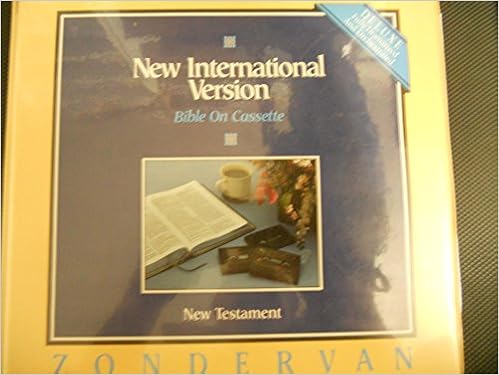
In the free box at church I found the New International Version of the Bible (Zondervan) on cassette.  I may be one of the few people who still have a hand held cassette player, so I’ve been listening to Romans while using my exercycle. Usually, I don’t enjoy audio of the Bible--speakers/voice actors go too fast or it’s too monotonous, but this one is really excellent.  There are music and sound effects, and when the writers reflect on OT passages of Jesus’ messages, there is a slight echo or reverberation.

* * “We know little about the early years of Christianity in the Iberian Peninsula. According to legend the apostle James --at Christ’s urging--carried the gospel to the country in 40 AD, but the early church writers have nothing to say about it. We know that St Paul intended to visit in Spain (Epistle to the Romans, XV, 24 and 28), which would suggest that there were organised groups for him to preach to. But there is no evidence that he made the trip, nor does any church in Spain popularly claim to have been founded by Paul.

By the second century, however, some Christian communities were probably established in the peninsula. We know that St Irenaeus, bishop of Lyons (France), writing around 180 AD, alludes to Christian churches amongst the Celts and Iberians.  We also know from a letter by St Cyprian of Carthage (?-258?) that by 254 AD there were Christian communities in Astorga, Mérida, León and Zaragoza.”  Source.

Monday, February 28, 2011

Hope and Change--it's not just a political slogan

Hope and Change is the message of the New Testament, and it was stolen by the Obama campaign because the clever marketing firm that ran the campaign knew the familiarity and the challenge of it have a comfortable, familiar ring, even if the candidate was preaching political concepts unacceptable to most Americans--concepts that have failed in every country they've been tried. "Hope and change" (the slogan) is also an underlying desire of youth--in my generation it was the 18-23 year old's mantra, but since adolescence has been lengthened since the mid-60s, so has young adulthood, and now it's the 20-30 year olds who yearn to make changes in the world and believe they are the generation to do it. Constant, unremitting change (they are fuzzy on this but it includes risk taking, hedonism/slackerism, entertainment and sports) is in fact their hope as they postpone marriage, family and career.

Paul lists seven questions in Romans 8.31-39
    31 What, then, shall we say in response to these things? If God is for us, who can be against us? 32 He who did not spare his own Son, but gave him up for us all—how will he not also, along with him, graciously give us all things? 33 Who will bring any charge against those whom God has chosen? It is God who justifies. 34 Who then is the one who condemns? No one. Christ Jesus who died—more than that, who was raised to life—is at the right hand of God and is also interceding for us. 35 Who shall separate us from the love of Christ? Shall trouble or hardship or persecution or famine or nakedness or danger or sword? 36 As it is written: “For your sake we face death all day long; we are considered as sheep to be slaughtered.” 37 No, in all these things we are more than conquerors through him who loved us. 38 For I am convinced that neither death nor life, neither angels nor demons,[k] neither the present nor the future, nor any powers, 39 neither height nor depth, nor anything else in all creation, will be able to separate us from the love of God that is in Christ Jesus our Lord.
We have our only HOPE in Jesus Christ, and yes, because our lives will CHANGE, we CHANGE the world.

Do be fooled or misled by political slogans. Jesus didn't come to change political systems, or to be a humanist mystery called "peace and justice." He's not a member of any nation or political party. He's Lord and Savior of the universe, The Word of God, the Alpha and Omega, and he's Hope and Change.

In yesterday's sermon John Stolzenbach said he uses this passage from Romans at every funeral. Yes, it's truly amazing in listing changes and hope. "For I am convinced that neither death nor life, neither angels nor demons, neither the present nor the future, nor any powers, neither height nor depth, nor anything else in all creation, will be able to separate us from the love of God that is in Christ Jesus our Lord."

Life here is full of changes--don't leave home without hope.

Saturday, May 09, 2009

Clouds without rain, trees without fruit--twice dead

That's the message of Jude to the 2009 U.S. Congress, attempting to foist all manner of evil on the citizens of this country. He wrote a letter 2000 years ago warning the church not to be fooled by people who reject common decency and morality--the big word would be antinomians. They perverted the Gospel of Jesus Christ and filled their own minds and bodies with perversion, particularly sexual, basing their "truth" on their own personal experiences and beliefs. The real problem was the Christians were allowing these lawless folks who thought they were beyond criticism and the law to take over. Sounds like reading today's beltway news, doesn't it? Jude, very short and right to the point:


Dear friends, although I was very eager to write to you about the salvation we share, I felt I had to write and urge you to contend for the faith that was once for all entrusted to the saints. For certain men whose condemnation was written about long ago have secretly slipped in among you. They are godless men, who change the grace of our God into a license for immorality and deny Jesus Christ our only Sovereign and Lord.

Though you already know all this, I want to remind you that the Lord delivered his people out of Egypt, but later destroyed those who did not believe. And the angels who did not keep their positions of authority but abandoned their own home—these he has kept in darkness, bound with everlasting chains for judgment on the great Day. In a similar way, Sodom and Gomorrah and the surrounding towns gave themselves up to sexual immorality and perversion. They serve as an example of those who suffer the punishment of eternal fire.

In the very same way, these dreamers pollute their own bodies, reject authority and slander celestial beings. But even the archangel Michael, when he was disputing with the devil about the body of Moses, did not dare to bring a slanderous accusation against him, but said, "The Lord rebuke you!" Yet these men speak abusively against whatever they do not understand; and what things they do understand by instinct, like unreasoning animals—these are the very things that destroy them.

Woe to them! They have taken the way of Cain; they have rushed for profit into Balaam's error; they have been destroyed in Korah's rebellion.

. . . They are clouds without rain, blown along by the wind; autumn trees, without fruit and uprooted--twice dead. They are wild waves of the sea, foaming up their shame; wandering stars, for whom blackest darkness has been reserved forever. Jude 3-12 NIV

Jude's letter uses a lot of Old Testament images--and even if you're not a church goer, you've probably seen some movies or read a novel or two with themes of rebellion, licentiousness, or greed. Cain, of course, committed the first murder; Balaam was an ancient pagan sorcerer who was greedy, and Korah led a rebellion against Moses.

Congress is again attempting to foist "hate crime" legislation under the guise of protection for special interest groups, although we are loaded with laws that prohibit murder, assault, libel, etc. The FBI statistics show that in a nation of 300 million people, there were only 242 "violent" crimes against homosexuals, bisexuals or drag queens in 2007. This is hardly an epidemic worthy of liberals' attention--but it is really a cover-up and an attempt to silence any criticism (not prevent violence) from the press, from the churches, from private discussion, from bloggers, or even playground teasing of sexual perversions. Most crimes against ethnic groups, minorities, gays, wiccans, polygamists, etc. are committed by their own kind--black on black crime, gay men against gay men, etc. Women are not protected in the bill proposed by Kennedy unless they are lesbians, yet assaults on women continue despite all manner of laws, protection orders, self-defense classes, and light the night programs. Based on percentages of assaults on a special group, maybe Ted could introduce legislation to protect women with the name of Peterson.

Wake up folks--especially liberal and moderate Roman Catholics and main line Protestants. This is not what you think it is. It is an assault on the First Amendment masquerading as something warm and fuzzy--like mold in your basement eating the foundation, causing a stench. An assault onn freedom of religion, freedom of speech, freedom to choose your associations, and your right to redress grievances.

"Congress shall make no law respecting an establishment of religion, or prohibiting the free exercise thereof; or abridging the freedom of speech, or of the press; or the right of the people peaceably to assemble, and to petition the government for a redress of grievances."
    "A bill that would provide federal money to train law enforcement officers to identify and criminally prosecute speech and thought offensive to homosexuals has been introduced into the U.S. Senate, matching a House-approved bill that critics fear will be used to crack down on biblical teachings.

    The proposal, from Democratic Sens. Edward Kennedy and Patrick Leahy, aligns with H.R. 1913, which was approved in the U.S. House yesterday.

    It denies protections to classes of citizens such as pastors, Christians, missionaries, veterans and the elderly that would be granted to homosexuals and those with gender issues." Link

Sunday, December 21, 2008

You also can't trust those Christmas carols

Some years ago I was told--probably during a sermon--that there weren't three wise men--there were three types of gifts to honor the new born king. So a 19th century minister came up with "We three kings of Orient are/ bearing gifts we traverse afar. . ." Then during Advent our senior pastor preached on the meaning of the carols, and I discovered the Bible doesn't say the angels sang. Nope. They said. Kind of takes the fun out of it, doesn't it? We think we're singing right along with the angels, and they weren't even humming! Also, the Bible doesn't say Mary travelled on a donkey either. Wow, that ruins a lot of Christmas cards and pagents, doesn't it?

Then this week I was listening to Father Mitch Pacwa, S.J. preach about St. Paul. It's apparently the 2000 anniversary of his birth--although they don't know exactly--and there was a special series on the sacraments. I listened to the one on baptism, and learned all sorts of things. Did you know Paul's letters in the New Testament are arranged by size? I didn't. The longest is first, so to look at what he said chronologically about baptism he cited 1 Cor 6:9-11, 12:12-13, Gal. 3:23-27, Romans 6:3, then Col. 2. Also he said St. Paul never spoke about Hell, never condemned anyone to go there, but Jesus spoke a lot about it. I guess I'd never thought about it before, and to think Paul gets all the bad press for being cranky. Along the way he mentioned that 8,000,000 Muslims in Africa convert to Christianity each year, and there's been a large increase among the Kurds. The sermon is about 48 minutes, and quite interesting, although I'm not sure why. He must have quite a following because he has his own web site and program on EWTN.

Given in the Cathedral of Saint Paul in Birmingham, AL on September 4, 2008. Part I: Baptism in Saint Paul's Writings

Sunday, October 28, 2007

4276

St. Paul to Richard Dawkins

Yesterday when clicking through the channels I saw Richard Dawkins for about 10 seconds--probably a C-SPAN rerun. Nothing new here--someone or other has been saying the same stuff for 2,000 years. Including Paul, the author of most of the New Testament. He too was an educated man persecuting Christians, probably saying the same things as Dawkins, although he didn't have the benefit of C-SPAN to spread his views, or the internet for people to down load it.

Here's Paul writing to Titus, which just happens to be the Oct. 28 selection in my One Year Bible (NIV), but he could just as well be writing to Dawkins (all Christians could be praying that Dawkins have a Damascus Road experience). He would be a terrific Paul Jr.:
    At one time we too were foolish, disobedient, deceived and enslaved by all kinds of passions and peasures. We lived in malice and envy, being hated and hating one another. But when the kindness and love of God our Savior appeared, he saved us, not because of righteous things we had done, but because of his mercy. He saved us through the washing of rebirth and renewal by the Holy Spirit, whom he poured out on us generously through Jesus Christ our Savior, so that, having been justified by his grace, we might become heirs having the hope of eternal life."