Present your bodies as a living sacrifice that is holy and pleasing to GodRomans 12:1-12 CEB
Don’t be conformed to the patterns of this world,
Be transformed by the renewing of your minds
Don’t think of yourself more highly than you ought to think
If your gift is . . .[list of gifts] prophesy, service, teaching, encouragement, giving, leadership, mercy. . .do it!
Love should be shown without pretending
Hate evil
Hold on to what is good
Love each other like the members of your family
Be the best at showing honor to each other
Don’t hesitate to be enthusiastic
Be on fire in the Spirit as you serve the Lord
Be happy in your hope
Stand your ground when you’re in trouble
Devote yourselves to prayer
Contribute to the needs of God’s people
Welcome strangers into your home
Bless people who harass you--don't curse them
Be happy with those who are happy
Cry with those who are crying
Consider everyone as equal
Associate with people who have no status
Don’t think that you’re so smart
Don’t pay back anyone for their evil actions with evil actions
Show respect for what everyone else believes is good.
Live at peace with all people
Leave room for God's wrath
Don’t be defeated by evil, but defeat evil with good.
Showing posts with label Romans. Show all posts
Showing posts with label Romans. Show all posts
Sunday, February 07, 2016
Marching orders from Paul's letter to the church at Rome
Romans 12 has an extensive list of how Christians behave who have received grace. We studied this chapter in class this morning. Some statements are clarifications of those that came before, some are in the negative.


Sunday, October 25, 2015
Adult Sunday School, October 2015, UALC
Our Sunday school class is studying Romans, and for two weeks had an outstanding, articulate retired Lutheran pastor, Douglas McBride formerly of San Antonio, as our teacher. Class members are taking us through Romans after his excellent overview and first three chapters. I hope he can come back.
Paul wrote a letter to the Roman church, a mixed group of Jews and Gentiles, from Corinth, while he was on his third missionary journey between 56 and 58 A.D. He was on his way to Spain.** At the time he was gathering an offering from the Gentile Christians for the church in Jerusalem (15:25; Acts 24:17). Over half of the people he specifically mentions in the letter have Greek or Roman names, and he calls the Jews, “my brothers.” The church may have been started by his converts, but no one knows for certain. Since he first mentions Phoebe it appears that she brought the letter to Rome, so she must have been a trusted convert and helper. He greets a number of households indicating the church was made up of numerous groups, and he addresses in the letter a number of situations, many of which sound similar to our churches today. Struggles among themselves; how to deal with the government, etc.
He encourages unity and accepting one another, just as Christ accepted them. Yet it seems the church has never been more divided and scattered than today.
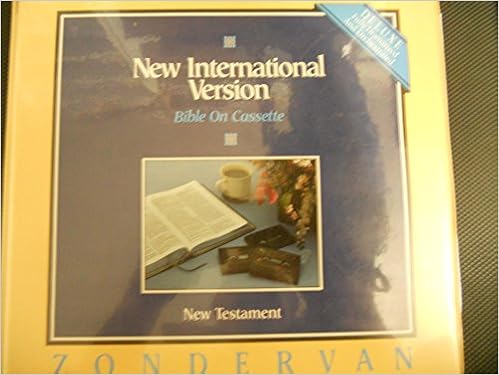
In the free box at church I found the New International Version of the Bible (Zondervan) on cassette. I may be one of the few people who still have a hand held cassette player, so I’ve been listening to Romans while using my exercycle. Usually, I don’t enjoy audio of the Bible--speakers/voice actors go too fast or it’s too monotonous, but this one is really excellent. There are music and sound effects, and when the writers reflect on OT passages of Jesus’ messages, there is a slight echo or reverberation.
* * “We know little about the early years of Christianity in the Iberian Peninsula. According to legend the apostle James --at Christ’s urging--carried the gospel to the country in 40 AD, but the early church writers have nothing to say about it. We know that St Paul intended to visit in Spain (Epistle to the Romans, XV, 24 and 28), which would suggest that there were organised groups for him to preach to. But there is no evidence that he made the trip, nor does any church in Spain popularly claim to have been founded by Paul.
By the second century, however, some Christian communities were probably established in the peninsula. We know that St Irenaeus, bishop of Lyons (France), writing around 180 AD, alludes to Christian churches amongst the Celts and Iberians. We also know from a letter by St Cyprian of Carthage (?-258?) that by 254 AD there were Christian communities in Astorga, Mérida, León and Zaragoza.” Source.
Saturday, October 17, 2015
When we point a finger, three are pointing back at us
"The family is under attack from internal forces, such as divorce, cohabitation, decline in marriage, promiscuity, abuse and violence, addictions, pornography – and the list goes on and on. The family is also under attack from outside forces, such as cultural coarsening, anti-family entertainment and rhetoric, sex trafficking and sexual exploitation, and extremists who want to shut down religious freedom and redefine marriage and family." Janice Shaw Crouse
Last Sunday our class was looking at the first three chapters of Romans. Her quote taken from an interview reminds me of Paul's letter to the Romans. He was writing to a Christian congregation in Rome made up of pagans and Jews--all saved by grace. Pagans accepted pedophilia, abortion and homosexuality, Jews didn't. Paul calls those practices degrading, unnatural, indecent, exchanging the truth of God for a lie, and perversion, and it needed to stop. But Jews had the advantage of the law and the prophets which addressed many other sins and which were also being violated. Paul had harsh words for them for being stubborn, self-righteous, self-seeking and blind to the light. Adultery, stealing, blaspheming, gossip, arrogance, etc. The family is under attack, but we Christians weakened it to the point of collapse and now point fingers at those who violate natural law.
God doesn’t grade on a curve.
Wednesday, September 24, 2008
Martin Luther's Definition of Faith
Luther was the most amazing writer. I wish I had a set of his works--as it is, I only have vols. 27 and 54, probably picked up at book sales, and his Small Catechism, plus a smattering of excerpts, like prayer books. Our church library set is now on the reference shelf; I used to be able to check out individual volumes, and of course, the local public library doesn't have them. Some of his works is available on-line, some in ascii and some in html (if you print for easier reading, the number of pages is about the same). However, if you want to understand modern western history, you really need to understand Luther.In 1520 among the hundreds of other things he published were 4 titles which laid out reform of the medieval church as he understood it. I've printed out for the coffee shop today, "Concerning Christian Liberty," a quote from which heads the blog today (Sept. 24), although maybe not the day after tomorrow, since I change that often. In that document Luther writes that Christian freedom is genuine discipleship as the faithful way of following Christ. Essentially, in those 4 titles he called for the common priesthood of all believers, the rejection of the sacramental system, and removing ethics from a meritorious obligation to free love of neighbor in need--all points of which were clearly stated in Scripture, which is why he promoted translation into the vernacular (German, in his case). Here's his definition of faith:
An excerpt from
"An Introduction to St. Paul's Letter to the Romans,"
Luther's German Bible of 1522
by Martin Luther, 1483-1546
Translated by Rev. Robert E. Smith
from DR. MARTIN LUTHER'S VERMISCHTE DEUTSCHE SCHRIFTEN.
Johann K. Irmischer, ed. Vol. 63
(Erlangen: Heyder and Zimmer, 1854), pp.124-125. [EA 63:124-125]
August 1994
Faith is not what some people think it is. Their human dream is a delusion. Because they observe that faith is not followed by good works or a better life, they fall into error, even though they speak and hear much about faith. "Faith is not enough," they say, "You must do good works, you must be pious to be saved." They think that, when you hear the gospel, you start working, creating by your own strength a thankful heart which says, "I believe." That is what they think true faith is. But, because this is a human idea, a dream, the heart never learns anything from it, so it does nothing and reform doesn't come from this "faith," either.
Instead, faith is God's work in us, that changes us and gives new birth from God. (John 1:13). It kills the Old Adam and makes us completely different people. It changes our hearts, our spirits, our thoughts and all our powers. It brings the Holy Spirit with it. Yes, it is a living, creative, active and powerful thing, his faith. Faith cannot help doing good works constantly. It doesn't stop to ask if good works ought to be done, but before anyone asks, it already has done them and continues to do them without ceasing. Anyone who does not do good works in this manner is an unbeliever. He stumbles around and looks for faith and good works, even though he does not know what faith or good works are. Yet he gossips and chatters about faith and good works with many words.
Faith is a living, bold trust in God's grace, so certain of God's favor that it would risk death a thousand times trusting in it. Such confidence and knowledge of God's grace makes you happy, joyful and bold in your relationship to God and all creatures. The Holy Spirit makes this happen through faith. Because of it, you freely, willingly and joyfully do good to everyone, serve everyone, suffer all kinds of things, love and praise the God who has shown you such grace. Thus, it is just as impossible to separate faith and works as it is to separate heat and light from fire! Therefore, watch out for your own false ideas and guard against good-for-nothing gossips, who think they're smart enough to define faith and works, but really are the greatest of fools. Ask God to work faith in you, or you will remain forever without faith, no matter what you wish, say or can do.
_________________________________________
This text was translated for Project Wittenberg by Rev. Robert E. Smith and is in the public domain. You may freely distribute, copy or print this text. Please direct any comments or suggestions to:
Rev. Robert E. Smith
Walther Library
Concordia Theological Seminary
E-mail: smithre@mail.ctsfw.edu
Surface Mail: 6600 N. Clinton St., Ft. Wayne, IN 46825 USA
Phone: (260) 481-2123 Fax: (260) 481-2126
Note: It's nice to see this modern English translation by Rev. Smith. Much of what Luther wrote was in Latin, then translated into German, then into 19th or early 20th century English, so it gets a bit tough to slug through all that. It makes me conscious of all the parenthetical phrases and unnecessary asides I use in my writing. Also, it makes me appreciate the beauty of having the Bible in modern English, or any vernacular. After all, there are over 10 million Lutherans in Africa (more than North America), and many Lutheran missionaries have worked for years to carry Luther's dream of Scripture in the mother language to spread the gospel to the common man.**
In case you want to hop in and criticize me for not acknowledging Luther's flaws (he had many), or other denominational missionaries translating (there are thousands), you are free to write your own blog or web page. I can't do all of it!
-------------
** “Since Luther was a prolific writer it came about that he began to standardize the rather loose orthography and syntax within his Mittel Hoch Deutsch expression. Second, that product was not addressed solely to the nobility nor to a cloistered religious readership, but purposefully and directly to the common people. Inasmuch as the capacity of the printing presses at that time reached a broad public, the effect of Luther's standardization led eventually to a changed form of the German language which has been termed "ein frühes hoch Deutsch." “
Martin Luther’s German Writings
Thursday, January 31, 2008

Thursday Thirteen--13 discussion starters
In the margins of my Serendipity Bible for Groups (4th ed. NIV) there are "warm up" questions of a personal nature to get members of a small group talking. Most are non-threatening and deal with childhood, the thinking being I suppose that the members stay off the topic of co-workers or current relationships. I'm not fond of "ice-breakers," but I've enjoyed looking through these and thinking about them. Here are 13 from the margins of Romans in the New Testament. Can you pick one to answer?1) When you write a letter are you more likely to write until you run out of paper, or keep it short and to the point? They got me on this one. I definitely use up the paper, even if I have to add an afterthought. Then I'll write in the margins to keep from using another sheet, because I'd have to fill it!
2) When you were growing up, what chores were you expected to do around the house? Dishes--rotated with my two sisters, and lawn mowing--and my brother was in on that rotation.
3) What is the biggest scam or junk mail offer you have fallen for? It was either the life-time free ink cartridges or the 15 sex crazed 3-legged mountain climbers. Just kidding.
4) In your family, who tried to keep the peace? Mom or Dad? Mom.
5) Who do you take after in your temperament, your mother or your father? Father.
6) What about abilities, like music or art? Most likely my mother, but for those we'd probably go back to grandma.
7) What is the closest you have come to losing your life? I almost drowned as a child, and another girl who really didn't swim well saved me.
8) In your first real job, was your boss easy to work for or a slave driver? Not easy, but then who would be with a bunch of teens? I see it differently today.
9) What New Year's resolution have you made only to have it fizzle? Could I just list the one or two I've ever kept?
10) What signs of aging or weathering are you starting to feel in your bones? Ah, let me count. How much time do you have?
11) What was one thing about which your folks used to say, "Wait 'til you're older, you'll understand then?" I can't remember this specific phrase, but it undergirded every lecture from my mom I heard (and ignored). The woman had advice on absolutely everything--the apple didn't fall far from the tree.
12) When you were a child, what did you do to earn your allowance? At least when I was little, my allowance wasn't tied to anything. Family chores were not connected to money, just expectations and maturity level. As a teen-ager, the allowance was supposed to cover my clothes (except shoes and coats).
13) Describe briefly your first best friend. Are you still in touch? Smart and sort of goofy, but deep thinker, even then. Yes, we're still in touch.
Subscribe to:
Posts (Atom)


 Posts
Posts


