Faber came up in my morning devotions. He authored the well-known hymns "Faith of our Fathers" and "There is a wideness in God's mercy."
Showing posts with label archives. Show all posts
Showing posts with label archives. Show all posts
Tuesday, March 05, 2024
Forgotten books--like strolling through the stacks
This morning I was looking on-line for a title about the hymn writer Frederick W. Faber and came across a reprint series. "Forgotten Books is a London-based book publisher specializing in the restoration of old books, both fiction and non-fiction. Today we have 1,294,132 books available to read online, download as ebooks, or purchase in print." I found what I was looking for plus many more written by Faber. But truly the oddest collection of titles with nothing in common except they are "forgotten." https://www.forgottenbooks.com/en Everything from "Canned Poultry," October 1950 to "The Lives of the Popes in the Early Middle Ages" to "The Book of Costume, or Annals of Fashion From the Earliest Period to the Present Time" to "The Blind in the United States, 1920, by U. S. Bureau of the Census." Cost is about $9 a month to read as a member, or $9.50 for a paper copy.


Wednesday, November 16, 2022
Words, words, words.
Words have always been political. No language has more words than English/American. But with today's deconstruction and destabilization of the 19th century Marxist thinkers, you particularly have to be careful about words. Take no words home to meet your parents until you know what they mean to your grandchildren (my proverb I just made up).
"Gender affirming care" is actually legalized child abuse which includes toxic hormones for children, and amputation of body parts. Pay no attention to those "medical" associations that approve it. There are virtually zero/zip clinical or long term studies, only hunches and hopes, what these zombized lab specimens will be when they are 80.
"Respect for marriage act" is exactly the opposite. It intends to enshrine same sex or any sex or any number of genders or any species into formal, cultural recognition of a relationship which will criminalize you if you don't agree. The most primitive of societies in the most far reaching regions and religions always had a way to formalize a marriage between men and women. They weren't confused. They knew concubines, mistresses, male temple prostitutes and adolescent boys who were sex toys of older men were not marriage partners. They were sex objects. Marriage was for the creation of a family, for procreation, even if that culture had no knowledge of Christ, Moses or Mohammed or a named Hindu God or gods. There are some things pre-history people knew that we're trying to legislate away today in order to destabilize society.
"Inflation Reduction Act" is exactly the opposite. Only governments create inflation, and only governments increase inflation by expanding the supply of money. Both the Trump and Biden administrations threw unreasonable amounts of money at the pandemic on the advice of people who claimed to know how to stop a virus. They then burdened the people who make the money and give it to the government in taxes with lockdowns. Even churches took money to stay closed--the very people we trusted with our souls and our first amendment.
"Climate change" is one of those, of course it does, phrases. But the political meaning is very different than the words. It actually means there is a huge cloud of power hungry bureaucrats who have enlisted science, entertainment, information giants and massive corporations to convince you the tax payer to believe puny, insignificant people, can control the universe. These are the same people who can't define a woman or properly fund the police or can use an attack on Paul Pelosi while police were in house to accuse Trump supporters.
So that's my word story for today. Now a few words from a career librarian: to the victor belong the archives. If you have to go to the victor (Biden administration, Bush, Obama, Clinton, JFK, LBJ, FDR, etc.) to get your information (data, knowledge, news reports, archives), you better have your eye on a deeper understanding of TRUTH before you start your journey.
"Gender affirming care" is probably the biggest lie, biggest inversion of language I can imagine. It's as fake as the penis that is inverted to create a vulva and then call the male victim an actual girl. You don't need a class or lecture in medical ethics to know that the doctors, nurses, and "counselors" are creating, not treating, Frankensteins. To call this abuse "bottom surgery" is absurd. If they actually told the truth of what they are doing, eyes would pop. And if you say "follow the money" and it enriches a huge chain of medical and support staff and leads back to the pharmaceutical companies who will then have a patient--or thousands of patients--for life with bad bones, bad kidneys, bad hearts from hormone blockers--the perps will pull out all those obfuscating terms for compassion and kindness and accuse you of being hateful, of being "transphobic." Would a ethical doctor amputate a leg if a patient demanded it? Why are they amputating breasts of young, under age girls?
And btw, why do lesbians and homosexuals want these goons and abusers in their camp? Haven't they spent decades claiming they are not pedophiles, and now they take the T and the Q into their acronym?
"Gender affirming care" is actually legalized child abuse which includes toxic hormones for children, and amputation of body parts. Pay no attention to those "medical" associations that approve it. There are virtually zero/zip clinical or long term studies, only hunches and hopes, what these zombized lab specimens will be when they are 80.
"Respect for marriage act" is exactly the opposite. It intends to enshrine same sex or any sex or any number of genders or any species into formal, cultural recognition of a relationship which will criminalize you if you don't agree. The most primitive of societies in the most far reaching regions and religions always had a way to formalize a marriage between men and women. They weren't confused. They knew concubines, mistresses, male temple prostitutes and adolescent boys who were sex toys of older men were not marriage partners. They were sex objects. Marriage was for the creation of a family, for procreation, even if that culture had no knowledge of Christ, Moses or Mohammed or a named Hindu God or gods. There are some things pre-history people knew that we're trying to legislate away today in order to destabilize society.
"Inflation Reduction Act" is exactly the opposite. Only governments create inflation, and only governments increase inflation by expanding the supply of money. Both the Trump and Biden administrations threw unreasonable amounts of money at the pandemic on the advice of people who claimed to know how to stop a virus. They then burdened the people who make the money and give it to the government in taxes with lockdowns. Even churches took money to stay closed--the very people we trusted with our souls and our first amendment.
"Climate change" is one of those, of course it does, phrases. But the political meaning is very different than the words. It actually means there is a huge cloud of power hungry bureaucrats who have enlisted science, entertainment, information giants and massive corporations to convince you the tax payer to believe puny, insignificant people, can control the universe. These are the same people who can't define a woman or properly fund the police or can use an attack on Paul Pelosi while police were in house to accuse Trump supporters.
So that's my word story for today. Now a few words from a career librarian: to the victor belong the archives. If you have to go to the victor (Biden administration, Bush, Obama, Clinton, JFK, LBJ, FDR, etc.) to get your information (data, knowledge, news reports, archives), you better have your eye on a deeper understanding of TRUTH before you start your journey.
-------------comment
And btw, why do lesbians and homosexuals want these goons and abusers in their camp? Haven't they spent decades claiming they are not pedophiles, and now they take the T and the Q into their acronym?
Saturday, November 21, 2015
Annual Conference of the Church of the Brethren, Winona Lake, Indiana: Panoramic Photograph, 1913
I don’t have a scan of the photo, but I would be able to see it if I went to Manchester University (formerly Manchester College) in North Manchester, Indiana at the Funderberg Library college archives. I only note this because I think the archivist was very clever in finding a method to preserve it—a hot humid day.
“Many panoramic and oversized photographs were rolled up and stacked on a metal shelf in the photograph section of the Archives. These pictures had become dry and were impossible to unroll. The Archivist took the photographs outside on an extremely humid and hot summer day. In about 30 minutes the photographs had relaxed enough to unroll and were brought back into the Library and pressed under books, using archival photo file folders as blotters between pictures.”
I think I remember my mother telling me about attending Annual Conference at Winona Lake, and at one time I had a post card of the facility. I may have even scanned it for the blog since it had been addressed to my mother, but after 13 years of blogging, and many tagging systems, I doubt I can find it [after checking I found a mention in a 2006 blog, and noted in 2005 that the Winona Lake post card was from her brother Clare].
There must be dozens of rolled up panoramic photos in attics and store rooms—perhaps they could be left in the bathroom with the hot shower left on.
I have a panoramic photo of the Tennessee Reunion, but I don’t believe it was rolled. Very difficult to store or frame.
Sunday, April 19, 2015
Arthur Godfrey and FDR
I'm not an FDR fan, but I'm surprised I didn't see/hear more on the 70th anniversary of his death/funeral this past week. Was I napping? Was the TV off? The recording of the funeral has now been added to the Library of Congress under the National Preservation Act of 2000.
"Following President Franklin D. Roosevelt’s death on Thursday, April 12, 1945, the national radio networks suspended regular programming until after his interment on Sunday, April 15. In its place, they ...aired a round-the-clock stream of reactions from home and abroad, including formal tributes, memorial services, and live coverage of the journey of the funeral train bearing the president’s body to Washington, D.C. On Saturday, April 14, a solemn funeral cortege made its way through the streets of the nation’s capital from Union Station to the lawn of the White House, with relays of radio announcers describing its progress.
Arthur Godfrey, a local broadcast personality with many years of experience covering public events in the area, was added to the CBS national broadcast team. As the last announcer on the route before the White House, he gave beautifully detailed and dramatic descriptions from atop a bank building at the corner of Pennsylvania Avenue for nearly half an hour, with his tone changing from solemn and journalistic to personal and emotional. When the caisson bearing the president’s body came into his view, Godfrey was dumbstruck, finally murmuring "God help me to do this" and choking out a few more sentences before breaking down on the air, forcing CBS to return to the studio briefly before resuming coverage on the White House lawn. Godfrey, a veteran of 15 years in radio, was deeply embarrassed by this incident, but soon became one of the country’s most popular broadcasters when he started his national morning show on CBS. His emotional coverage of this event now helps to illuminate the depth of the nation’s grief over Roosevelt’s death."
Thursday, June 09, 2011
Why university libraries are becoming closets
When I returned to work in the late 1970s at Ohio State University Libraries, one niggling problem was "closet libraries," which had been set up by various specialties and faculties to serve their specific needs. I guess they thought the library system was not flexible enough or knowledgeable enough to handle them.
A few disappeared. There is no longer an Agricultural Economics reading room, an Arnold Credit library, the one that served plant pathologists, or the journal collection for the veterinary medical faculty on the third floor of Sisson Hall, or other special collections (I'm more familiar with the ones west of the river). But they just popped up somewhere else. Increasingly, these collections are digital, and although they may meet in Thompson Library (recently renovated), they long ago by-passed the library.
Six digital media collections containing over 850,000 media assets that will reach over 20,000 students in 105 course sections annually.
History Multimedia Database (Humanities)
Arts & Sciences Media Manager (Humanities)
Charles Csuri Archive (Arts)
History of Art Visual Resources Library (Arts)
Huntington Archive (Arts)
Knowlton School of Architecture Digital Library (Engineering)
Related project: Praise Poetry Video Database (Humanities)
And this is just the group that has a defined mission statement (committed to cutting through the red tape, sharing resources and making things work on a grassroots level--I think they mean library) and collegial arrangements for staff, faculty and course credit. There are others.
Now it's the main library (Thompson) that has become the closet for books in special collections.
A few disappeared. There is no longer an Agricultural Economics reading room, an Arnold Credit library, the one that served plant pathologists, or the journal collection for the veterinary medical faculty on the third floor of Sisson Hall, or other special collections (I'm more familiar with the ones west of the river). But they just popped up somewhere else. Increasingly, these collections are digital, and although they may meet in Thompson Library (recently renovated), they long ago by-passed the library.
Six digital media collections containing over 850,000 media assets that will reach over 20,000 students in 105 course sections annually.
History Multimedia Database (Humanities)
Arts & Sciences Media Manager (Humanities)
Charles Csuri Archive (Arts)
History of Art Visual Resources Library (Arts)
Huntington Archive (Arts)
Knowlton School of Architecture Digital Library (Engineering)
Related project: Praise Poetry Video Database (Humanities)
And this is just the group that has a defined mission statement (committed to cutting through the red tape, sharing resources and making things work on a grassroots level--I think they mean library) and collegial arrangements for staff, faculty and course credit. There are others.
Now it's the main library (Thompson) that has become the closet for books in special collections.
Monday, April 26, 2010
Digital Preservation: An Unsolved Problem
Recently I purchased three paperback books. "A Patriot's History of the United States" by Larry Schweikart and Michael Allen ($25); "The reason for God" by Timothy Keller ($16); and "The Lutherans in North America" (2d ed., used $10). It takes my breath away to pay that much for a pb, but I think these books will last longer than anything on my computer, or access to their scanned versions on some future computer. They still don't know how to save a book on bits.
"For digital preservationists, a prime concern is that data might be kept perfectly secure and complete, but still be unreadable by machines and programs in the future. A New Yorker cover depicting an alien, come to post-apocalyptic Earth, sitting amid the detritus of modern civilization—discarded CDs, tapes, and computers—illustrates the point: the alien is reading a book, the only thing that still “works.” "
And to think some agency is trying to archive Twitter and Facebook! Who will do the upgrade that will be able to read all those expletives and English reduced to text message skrinkage 4 U. K?
Digital Preservation: An Unsolved Problem | Harvard Magazine May-Jun 2010
"For digital preservationists, a prime concern is that data might be kept perfectly secure and complete, but still be unreadable by machines and programs in the future. A New Yorker cover depicting an alien, come to post-apocalyptic Earth, sitting amid the detritus of modern civilization—discarded CDs, tapes, and computers—illustrates the point: the alien is reading a book, the only thing that still “works.” "
And to think some agency is trying to archive Twitter and Facebook! Who will do the upgrade that will be able to read all those expletives and English reduced to text message skrinkage 4 U. K?
Digital Preservation: An Unsolved Problem | Harvard Magazine May-Jun 2010
Wednesday, January 28, 2009
From my archives
Today I'm waiting to see what happens with the weather. The rain has turned to sleet, has turned to ice, and now a layer of snow. So I was playing around with the google site search command for my various blogs. Since I often change the quote at the top, I see that a 2009 quote may be attached to a 2003 blog entry. That must really mess up people doing keywood searches and the quote pulled them in. Oh well. It was fun to browse. For your reading enjoyment, but mostly for mine.From October, 2003
- "Why do cats love to watch people in the bathroom? Not just the obvious stuff, but want to hang around even when the hair dryer is running and that's got to hurt little feline ears. Want to be with you, want to touch your arm when you're applying mascara. Why, when you close the door, do they slip their little paws under it? Do dogs do that? Or do they just whine and bark and chew up the rug until you come out?"
- "Today it was reported in WSJ that Harvard University researchers found a 55% greater risk of heart disease among grandmothers who care for their grandchildren than those who don’t. 36.3% of U.S. grandparents provide intermediate or extensive care for their grandchildren. One theory about the stress is that there are other events in the lives of their adult children, such as divorce or substance abuse, that causes the parents to have to help out, thus causing a lot of stress. And those of us with no grandchildren have a 47.95% greater risk of a broken heart. (I made that up.)"
- "When there is a practice or law so clearly working against the average, tax paying, law abiding citizen, I always say the trite and true: FOLLOW THE MONEY. Who benefits when undocumented workers buy homes? [Now we know it was Barney Frank and ACORN and the supporters of our future president.]
MurrayT has a home in Florida and the recent tornado wiped out some of those homes. He says FEMA is trying to find the home owners to give them aid--but they have fled fearing arrest for being in the country illegally and are afraid of the INS. Property owners paying taxes in that county and paying high insurance premiums and the rest of the nation (me) who donate to the very inefficient Homeland Security Department are paying."
- "I've learned a few things in retirement that I wish I'd known earlier. a) Always use a non-stick spray when cooking--sauce pans included. Sure makes clean up easy (I use a soybean oil spray). b) Trader Joe's sunblock makes a wonderful hand lotion--has zinc oxide, and their c) shaving cream works wonderfully for washing your face. Leaves your skin soft and smelling yummy. d) I can buy a B width shoe if it has laces or elastic inserts. e) Since I buy 1/2 decaf with 1/2 regular for my morning coffee, it just tastes a lot better if I start with 1/2 cup of regular and leave out the decaf until I'm ready to go (about an hour later). It also stays hot longer if you start with 1/2 cup. f) In the last few months I've learned there is life after peanut butter."
- "As much as I hate to see horse slaughter for human consumption, I would hate to see the laws become so restrictive, that disposing of an animal became difficult, and therefore would lead to abuse such as poor health care, food, or being sold to bad people just to get if off your hands. Also, if species-specific legislation outlawing slaughter for human consumption works with horses, you can bet pigs, cattle and chicken supporters will be watching very closely." [with a link to an extension article on how to compost your horse]
- "Shoe [a librarian] doesn't really mean it, but she'd like to announce it [“unattended children will be sold“]. She writes about unattended children in libraries. That wasn't a significant problem in an academic library where I worked from 1986-2000--although I did keep coloring books and crayons in my office for children of the occasional negligent parent who would lose herself in the stacks reading about nematodes or cryptorchidism."
- "I'd forgotten how effective that do not call list really is. Since we arrived around noon on Saturday [at our summer home] the phone has rung about every two hours--and since we have no answering machine, we don't know what is happening when we're out for dinner, or walking along the lake front, or attending a program. I've been offered a subscription to the Toledo Blade, a summer resort vacation package, several new phone plans, a lower mortgage rate, and possibly waterproofing something, but I hung up too quickly. We never added this phone to the list--indeed, we may get rid of the land line altogether and just use the cell phone, as many do here [we did that]. We're probably getting a huge share of the calls, since so many people's numbers are not accessible."
- "We're finally in Lakeside, rolling in about 11:15. And the cat didn't poop or puke. Good trip! The gates are down, the lines are long, and it is hot, hot, hot--about 94 I think. One more hour and our flowers would have been dead. We've watered twice, and they are starting to perk up. Dehydration is a painful way to die." (obviously a slam at you who thought Terri Schaivo was not human enough to feel pain)
- "Usually I don't see my doctor at the coffee shop, but today I didn't get there until about 3 p.m., and he said they'd cancelled all appointments at his office. It takes a level 2 to keep me from my 6 a.m. trek to the coffee shop, but we were socked in here with first rain, then 6" snow, then sleet, then rain, and then back to snow. Just south of us, it is a level 3, and you get a ticket if you're on the roads looking for a cup of coffee. But by 3 p.m., I was a bit stir crazy, and our roads locally were in good shape. By 5 p.m. about 400,000 people were without power and the temperature was dropping. We called a friend to see what was happening in Lakeside, Ohio, and he said they'd had 18 inches, but no ice. Streets were clear."
Thursday, April 26, 2007
3752
"Just outside Princeton, the building housing the David Sarnoff Library took nearly two feet of water in its basement, a level the staff had never expected. The water damaged a collection of laboratory notebooks, technical reports, manuals and manuscripts from the early days of radio, television and electronics.
The library rushed to hire a document-repair company to try to dry them out and save them.
"We saved these files in the first place because of their importance in documenting the birth of modern communications, from broadcast microphones to color TV picture tubes, from satellite communications to the microchips that surround us in cars, computers, and cell phones," library director Alexander Magoun wrote in an e-mail seeking donations to offset the cost of the emergency repair work."
I probably ought to check my own basement. For 34 years we lived in a house without a basement, but it's really easy to slip back into old habits.
David Sarnoff Library damaged
When I read a lengthy description of the damage to the valuable archives caused by the storm in the northeast about 10 days ago, (at the listserv of archivists) the first thing I asked myself was why any library anywhere with a valuable historic collection would store items in the basement. Especially since the companies that do this kind of rescue work from mopping up to freezing paper items to stop the rot will be stretched to the max because everyone in the area probably has damage. True, a tornado can take the top floors, but even a sewer backup can take your basement storage. Story in Philadelphia Inquirer"Just outside Princeton, the building housing the David Sarnoff Library took nearly two feet of water in its basement, a level the staff had never expected. The water damaged a collection of laboratory notebooks, technical reports, manuals and manuscripts from the early days of radio, television and electronics.
The library rushed to hire a document-repair company to try to dry them out and save them.
"We saved these files in the first place because of their importance in documenting the birth of modern communications, from broadcast microphones to color TV picture tubes, from satellite communications to the microchips that surround us in cars, computers, and cell phones," library director Alexander Magoun wrote in an e-mail seeking donations to offset the cost of the emergency repair work."
I probably ought to check my own basement. For 34 years we lived in a house without a basement, but it's really easy to slip back into old habits.
Thursday, April 19, 2007
Poetry Thursday

"Think of places that most need to see a poem. Think of people who most need to read a poem. Go to those places, to those people and leave your words for them to find." The assignment calls this Guerrilla Poetry. Not my term, but I did pass this one out to a few people and post it on a bulletin board at the coffee shop. Actually, my blog is where I do this. I don't really like the idea of cluttering up public places. It seems a bit pushy.
I wrote this poem while reading about the difficulty of preserving archives, how memory changes over the years, varies from person to person, and is valued depending on who the victors are. The archives themselves can be biased and/or violated, as we learned in the Sandy Berger theft of 9-11 materials from our National Archives, or even by what is selected to be released, printed, digitized and stored within our various levels of government.
Interview with a western journalist
by Norma Bruce
The problem is not
that I know nothing,
but that I know everything.
Now that I've disappeared
into the general population,
it's with the locals I survive.
So when you speak to me of
identity, ethnicity and faction,
who would you have me be?
Unless you've seen your mother raped,
don't talk to me of the evils of
genocide, vengeance or escalation.
Correct your own country's history,
douse your own archives with gasoline,
then we'll talk.
For my past, present and future
I shall burn in Hell,
but at least I'll burn for Croatia.*
*Quote about Croatia from "Archives, documentation and institutions of social memory, essays from the Sawyer Seminar."
Thursday, August 03, 2006
2722 Lakeside Week 6, 2006
Not much to say about the programming--it has been so hot I've been staying inside the house, or slipping off to the coffee shop early. But we had a thunderstorm this morning and the temperature has dropped a bit. So I decided to go for a walk. Then the rain began again, so I just took a few photos. I ducked into the Lakeside Archives and found Jan, the archivist, helping my neighbors Ed and Karen research their house. Shortly after we bought our cottage, we cleaned out the crawl space. The former (and only other) owner had been a house painter, so in addition to old paint and turpentine cans and garden tools, we found his parents' 19th century marriage license and his baptismal certificate in fancy frames. We donated them to the archives.
Jan had put several panoramic photos on display from the 20s, 30s and 40s. Observation: people in the "old days" were thinner and they wore more clothes. Most of the women were wearing hats and the men suits. Must have been dressed for Sunday services. Didn't see many children or teens, who may have all been sleeping in or swimming--assuming it was allowed on Sunday.
 These ladies are all from our church in Columbus, here enjoying a respite at Lakeside, and admiring my husband's paintings at the Patio Restaurant.
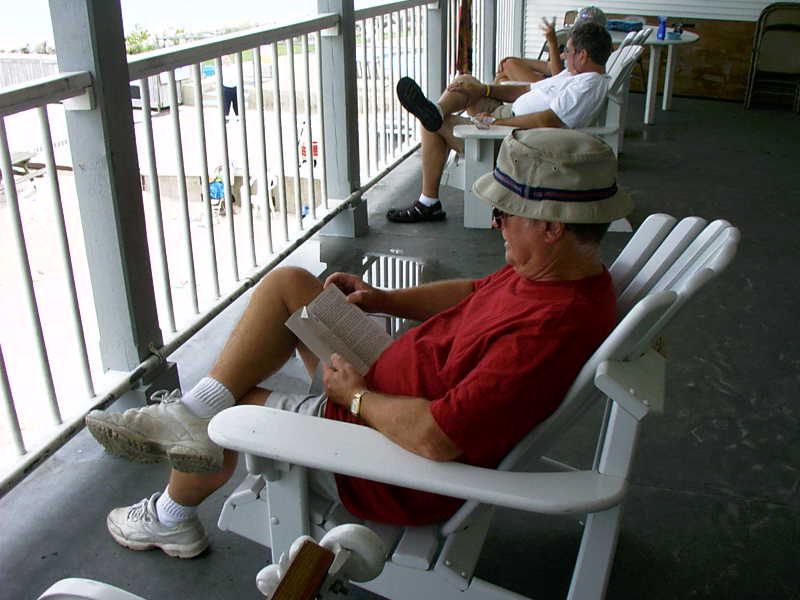 Our friend Wes is enjoying a novel in the Pavilion by the lakefront. Notice the puddle to his right from the morning storm.
Lakeside, Ohio
Subscribe to:
Posts (Atom)


 Posts
Posts


