Thursday, January 25, 2007

3405 Sandy Berger, keep out

There has been a library at Queen's College, Oxford, ever since its foundation in 1341 by Robert Eglesfield, Chaplain to Queen Philippa, consort of Edward III. The current building was built at the end of the 16th century, and has about 50,000 volumes in the lending library, and 100,000 in rare books, printed before 900 and over 500 manuscripts, of which 50 are mediaeval.

The latest newsletter reminded "members" who have entry cards of the security procedures:

Security
Please remember:


· Do not let anyone 'tailgate' you into
the Library.

· Do not hold the door open for anyone
entering when you are leaving.

· Do not offer to swipe your card so
that someone else can get in,
whatever they say.

Bags
All bags other than the smallest handbag
must be left on the shelves to the right of the
front door. No bag capable of holding a book
must be brought into the Library.

No mention of pants, socks or undershorts as receptacles for anything other than the usual body parts. But I'm guessing with medieval manuscripts, they are a bit more vigilant than our National Archives staff was about document stuffing.

List of rules from the library's website.

3404 What I didn't and did find at the library

Your kid got a paper due next week? It isn't just the journals and books that lack balance, perspective and diversity. You might want to browse the digitized sources, especially if you are homeschooling. The titles may not be what you remember from your school days. Publishing firms are bought and sold; editorial boards change direction; standards of reliability must meet market demands. Someone had to compile and write them, too--someone with a point of view, someone your children will be citing as an authoritative source. Recently I took a quick spin through "Annals of American History which is produced by Encyclopedia Britannica."

I can log on at home, but I was at the library. By clicking to Religion, I found the first paragraph set the tone:

"America was first colonized by religious exiles, who found in the New World their first opportunity for religious liberty. The United States, as a result, became the first country in the Western world to make an effective separation between church and state, as well as the first to write into its basic law the principle of religious toleration. This enormous diversity of religion is one of the hallmarks of the country."

So that's the framework. What will be the focus? Essays, articles and documents that don't meet the standard of tolerance and separation of church and state. How Indians were mistreated by missionaries. Brief (skimpy) one page articles on major Protestant denominations like the Presbyterians and Methodists bringing their history all the way up to--about 1800 in this source--and huge coverage of very minor organizations and movements of the 20th century I've never heard of (toleration and diversity, right?)

Original documents? That's what Annals does. It's just extremely selective. And if a kid is writing a paper, it's much easier to use this source than pull paper sources. (Although if there are recent compilations in paper, they too will be sifted and filtered to be politically acceptable to the left.) There's an eight page article in Annals by Clarence Darrow about what to expect from different religious groups if you seat their members on a jury; some court cases that reflect poorly on Christians; and a selection of "scholarly" articles, mostly negative about people of faith.

By using the timeline, I was able to pull up the 2003 gay Bishop document of the Anglican Church. I'm not well informed about the Anglicans, but I'm guessing there have been a few other achievements in the last decade. The timeline stops with 2003, although the copyright of the database is 2007. Has nothing much has happened in the last three years? I was a bit surprised to find that the Thomas Jefferson/Sally Hemings paternity debate was deemed worthy of inclusion (actually not surprised at all), and that "Fast Food Nation" was a historical treasure--and not even exerpts from the book, but pieces of an on-line interview. The USS Cole story didn't make the cut that I could find.

So I turned to the reference shelves and looked through some of the handsome, hard bound multiple volume sources. The three volume, 50's in America by Salem Press (2005), had no entry for Christianity at all, but Stan Freeberg got in. No denomination, not even Roman Catholics, had an entry. I took a peek at Modern America 1914-1945 by Facts on File (c1995, but purchased by the library in 2005). In the Table of Contents I found a section on Religion. The first topic of 4 subdivisions? Women and the Church.

3403 Great cat photos

Crazy Aunt Purl writes longer entries than I do. Her husband left her and the cats (she's gorgeous, funny and knits), but she hangs in there entertaining the blog troops and creating fabulous knitzy things.

"Being rejected sucks. Being abandoned sucks. Being alone and almost-divorced sucks. Of course, not having to clean up after anyone ever again ... is PRICELESS." Crazy Aunt Purl

Wednesday, January 24, 2007

3402 Do what it takes

to get the homeless off the streets. USA Today has a good article today (1-24-07) on what programs are working for the homeless in large metropolitan areas. Last week (1-18-07) the Wall St. Journal had an article about successful programs like "Ready, Willing and Able," which has saved NY a lot of money by getting the homeless into permanent housing and jobs. Getting the hard core 10% off the streets into safe housing units, not temporary shelters, without the carrot to reform their lives first, is working and is cheaper than other programs. It also helps restore businesses in the neighborhood, or at least gives them a chance. I know this irritates both the left and the right. Some on the right want the homeless to "earn it," and on the left, the do-gooders think we should expect nothing from them.

From a Christian point of view, Matthew 25 never says you do this (offering shelter, clothing, food) in order to reform someone. It might; it could; but probably won't. Homelessness at its root really isn't about being without homes, but being confused, sick, brain damaged from alcohol and drugs, mentally ill, mentally retarded and a prison system that dumps ex-cons on society with nothing to do. No six month government grant run by a 25 year old social worker is going to "fix" weird uncle Harry. We're reaping the harvest of misguided social ideas of the 60s and 70s which closed institutions and put people on the streets.

Some think if you make decent housing available without demanding the homeless change their lifestyle first, their numbers will increase. How many alcoholics do you know personally who stop drinking because someone tells them to? Do you know what we're getting with the present system? Public libraries with people who smell so bad they drive away anyone else who would use the newspaper or computer. Urine filled stairwells in the city. Hostile people begging. Cardboard shelters under by-passes. No accessible restrooms for the rest of us because stores or buildings don't want the homeless creating filth. Enclaves of mentally deranged people sleeping on heat grates. "How's that working for you?"

Permanent housing and assistance grants work better than shelters (which many homeless are afraid of because of violence). It will continue to work until it decreases the number of homeless so much that their advocates and the bureaucrats start losing government funding; then they'll find something else to ask for with their favorite phrase, "Yes, but. . . "

3401 Caring Service from Staples

Mr. Cloud wrote this past week about several incidences which indicated the little guy wasn't getting very good service from businesses and governments. I agreed with most of his points.

However, we had an odd thing happen yesterday that has restored my faith in the chain store, even though the clerk had made a mistake thinking we'd made a mistake.

My husband is going to Haiti on a mission trip in February, and in addition to helping with building and maintenance, he will be teaching a perspective drawing course for students studying English (although a very poor country, most of the children learn four languages). He doesn't know how many will be taking this optional unit, but he's preparing 60 packets of handouts, so I suggested he take the originals to Staples [office supply store] which has always done an excellent job on my blogs (yes, I have my blogs bound). He added a title page with the name of the school "Institution Univers" There were TWO messages left on our answering machine from the staff asking if we had misspelled Univers, and they wouldn't print until they heard back from us.

I smiled, but was touched to get that kind of service.

Are liberals ruining Wal-Mart?

And in another, unrelated item, I'll just mention my favorite giant American success store--Wal-Mart. I love Wal-Marts, and although I don't like the super stores as much as the older "just huge" stores, and nothing around here matches what you find in Arkansas, I visited the grand opening of one on Friday near here. I think Wal-Mart has been so pressured by bad publicity from the left, that they are losing their touch. Either that, or Columbus' unemployment rate is so low, it is hard to staff stores.

I actually had an African cashier who couldn't speak English. I only bought a bunch of bananas and thought it had rung up incorrectly and asked her to recheck the per pound price. She was obviously confused, so I repeated my question. She looked up, pointed at the ceiling. I again asked her to check the price. She smiled, took the label off and pressed some keys. She smiled and nodded. I smiled and nodded (didn't do well in math so had no idea if it was correct). I took the sales slip and the bananas to the customer service. The slip clearly said, TWO ITEMS, and I only had one bunch of bananas. That much math I know. I got my refund and left the store.

Then yesterday we stopped there again looking for various items on the Haiti list. Knee pads. Didn't have them. 12' measuring tape. Didn't have it. Carpenter apron. None. Bug repellent. Check in grocery. One young man we asked had a speech impediment and such poor English (but he was one of our own) that we could hardly understand him. I spoke to four or five staff people, and all were on loan from other stores in the Columbus metro area, one was from Delaware (north of Columbus).

3400 Best selling books for youth

How often is a best seller for young people actually written by someone under 18 or even 21? The USA Today Best-selling books for 2006 list for young people has Christopher Paolini's Eragon as number one and his Eldest: Inheritance Book II was fourth. I'm not sure I read books for youth even when I was a teen and I claim total ignorance on this genre and mysteries and fantasies.

What I find fascinating is Paolini's background. Farm raised, and home schooled, he finished high school by age 15. He'd also had a few failed attempts (by age 15) at novel writing. In this interview for other teens interested in writing, he mentions, sort of off hand as though everyone does this, the depth of reading he'd done (before age 15) in Teutonic and Old Norse history in order to have the background for his characters, language and country.

He says when he was little he didn't want to learn to read--didn't think it was important, but that his mother was persistent and patient (a former teacher).

"Then she took me to the library. It's easy to write those words now, but they cannot convey how that single event changed my life. In the library, hidden in the children's section, was a series of short mystery novels. Attracted by their covers, I took one home and read it eagerly. I discovered another world, peopled with interesting characters facing compelling situations." Can you imagine how busy he must have kept the Interlibrary or Regional Loan department at his public library?

When he had his first book self-published after years of drafts and editing, the family marketed it themselves--beginning with talks at libraries. These parents obviously had a lot of faith in their boy! I think I heard an interview on the radio where he said they'd mortgaged their home to do this. But don't quote me.

"The Paolini family spent the next year promoting the book themselves. Beginning with talks at the local library and high school, they then traveled across the U.S. Christopher gave over 135 presentations at libraries, bookstores, and schools in 2002 and early 2003." His webpage

Someone who bought it brought the title to the attention of a publisher, who signed him, and by mid-2004 Eragon had sold over 1 million copies.

3399 The Mexican model

More Albanians reside beyond Albania's present borders than within them. Remind you of anyone around here?
see "The Chicago Connection," by Allison Stanger, The American Scholar, Autumn 2006.

3398 Silly word choices

An article on full body scans for skin cancer for female veterans I noticed this odd phrasing, "We found that 16% of subjects would refuse the examination if the primary care provider were of the opposite sex, whereas 38% would not refuse but be less willing to be examined. "

Seems that whole sentence could be tightened up a bit by using the term, "male doctor."

And who knew our brave women soldiers were so squeamish around men?

Archives of Dermatology. 2006;142:312-316.

Tuesday, January 23, 2007

3397 Cooking the blog

No one cares what you had for lunch is a book for bloggers, the premise being that bloggers run out of things to write about when all they can think of is what they ate for lunch. This has never happened to me--having nothing to write about--although I have on occasion written about my lunch. Here's our dinner menu today.


Sweet sour meatballs (fully leaded)
Tender crisp fresh asparagus
Baked butternut squash with drizzled maple syrup (sugar free)
Chocolate peanut butter pie (low fat, low sugar)

To make the meatballs you first have to leave the computer--probably when Blogger.com is acting up. Go to the kitchen and mix in a sauce pan one 15 oz can of sauerkraut, one 12 oz. jar of chili sauce, and one 16 oz can of whole cranberry sauce (sizes make no difference). Remove half of it from the pan and put it in the freezer for another day. Makes a wonderful topping for a boneless pork roast. While the mix is warming up, check the computer to see if Blogger is working, and if so, download that picture before it quits.

Go back to the kitchen and tear and crumble in a bowl at least two pieces of stale bread and let it dry a little while you go back and finish your blog entry. Oh, turn off stove and remove the sauce because you might forget and it will scorch.

If you forgot to remove the Cool Whip from the freezer earlier (for the pie), do it now! Put cream cheese on the counter to soften. Later, add 2 eggs to the bread crumbs and 1/2 package of dry onion soup. It will have all the seasoning these meatballs will need. You now have a really disgusting looking yellow mess in the bowl and something yummy smelling on the stove. Return to computer for awhile.

Next, add one and a half pounds of ground chuck to the bread crumbs and thoroughly mix. Shape into 10 nice sized meatballs, and lightly brown for a few minutes. Spray a casserole dish with a non-stick (I use olive oil), and arrange the meatballs. Pour the sauce over the meatballs, completely covering them. Put in the oven at 375 for at least 45 minutes. Check your e-mail.

Return to the kitchen to make the pie. Cream together one cup of creamy, natural peanut butter with one cup of Splenda and one teaspoon vanilla. Add half an 8 oz carton of sugar free Cool Whip. Mixture is a bit stiff especially if blogging has impaired your muscle tone. Pour mixture into a purchased chocolate graham cracker 9" crust. You can make your own if you don't blog. Put it in the frig to firm, 'cause you're running late now.

Go back to computer and check for errors. Now it is time to get the veggies ready. Put some water to boil in tea kettle. Peel and cut the butternut squash into small pieces, put in small casserole sprayed with non-stick, dab a bit of butter and drizzle some sugar-free maple syrup over it and put in oven with meatballs. (About 15 minutes, with the last 5 or so at 400 after you take out the meatballs.) Wash and cut the asparagus and put in small pan. About 5 minutes before serving, add the hot water to the asparagus and return to a brisk boil; turn off heat and cover. Remove pie from frig, warm a tablespoon of sugar-free hot fudge in microwave and drizzle it over the peanut butter filling; return to frig. Take meatballs out of the oven and reset at 400 to finish the squash for 5 minutes. Set table, feed cat, call husband to table.

Makes about 10 meatballs. Freezes well, or makes great sandwiches the next day.

3396 Who knew?

WASP is shorthand for White Anglo-Saxon Protestant. It's a very useful acronym and I think sounds a whole lot better than SWAP, if you rearrange the word order*. I know it has been misused in a snarky way for certain rich northeastern presidential candidates, but as one whose ancestors were Scots-Irish, English and German and married to a Scot, it works well. So I was a bit taken aback to find out that WASP is used in the medical literature to mean "Wait and See Prescription," used with antimicrobial therapy.

That was definitely the medical treatment I had as a kid.

*Or, White Aging Saggy People.

3395 Are you living in the fast lane?

Karen Quinn wants to talk. She's got a contest and you can reach her by video, essay or e-mail, or just send one line, but you've got to get it in by February 16. I've looked through the list of prizes, and I'm here to tell ya, this is one fabulous contest. This is Karen's way to market her new book, Wife in the Fast Lane. Pretty clever.

Here's a sample of a one-liner:

"I was coloring my hair, sending a file to the office, answering a students question on the phone that “just can’t wait”, and helping a 2 year old heifer have her first calf."

If you're from the city you probably didn't know "heifer" is the word for a cow that hasn't been a mommy yet. Or that there are 55 different words in English for sheep. I guess cattle get to claim that word "heifer" right up to the time the little guy pops out. Sounds like the way some people use virgin, doesn't it?

I've never lived in the fast lane--don't even know where it is or how to get there. Anyone got a map? Keep it. I've spent my life carefully arranging my schedule, saying NO to things I really didn't want to do, and avoiding high maintenance people who would chew up my free time. As it says in my bio, somewhere, "My motto is you can have it all, just not all at the same time."

Monday, January 22, 2007

3394 Respect your brain

The library notified me that there was a book waiting for me that I had requested (placed a hold several weeks ago when someone else had it checked out). I had no recollection of the book, and didn't remember when or why I requested it. The title? Making a good brain great, by Daniel G. Amen, MD. Hmmm. Looks like I needed it, doesn't it?

I leafed through it and noticed the chapter on brain injury. In 1989 my daughter was in an automobile accident--hit by a drunk driver while waiting at a stop sign. I think I blogged about it some time back. Since you aren't told much on the phone at 3 a.m. except to come to the hospital, I was fully expecting to claim a body when we got there. Even as I type this, my heart rate has soared from the stress of remembering that awful night. She was in ER with a concussion, but was sent home after a few hours. She had years of trouble resulting from that "mild concussion" and a huge hassle getting the other driver's insurance company (Nationwide) to pay up. She started stammering, was depressed, tested very low on IQ tests (done for the court), and developed debilitating migraines. She told me the other day that she had a few sessions with a neuropsychologist (also court ordered) who taught her some cognitive skills to work around the injured area. Even today, she will occasionally use what he taught her if she feels a migraine coming on, and her speech cleared up and she's her old self at problem solving and intelligence.

So I was interested to read in Dr. Amen's book that many people have had brain injuries and don't know it--particularly from falls and sports like biking, snowboarding, sledding and skating. He writes:

"A concussion or mild "traumatic brain injury" (TBI) is far more than just a bump on the head. According to the American Academy of Neurology, "There is no such thing as a minor concussion." A study from UCLA found that "the level of brain glucose use in people who suffered mild concussions was similar to that in comatose, severely brain-injured patients. . . Even mild head injuries result in major changes to the brain's metabolism and could make victims susceptible to more serious damage from a repeated blow."

Dr. Amen advises parents to never let their child knock the soccer ball with his head--heading drills, in which a child's head is knocked repeatedly, are of greater concern to pediatricians than is the occasional head-punt in a game. A study of adult soccer players found 81% had impairment of attention, concentration, memory, and judgment when compared to non-players of similar age and circumstances. He says football players are struck in the head 30-50 times per game and regularly endure blows similar to those experienced in car crashes.

Dr. Amen, who has seen over 30,000 brain scans, says: "I would not let my children hit a soccer ball with their heads, play tackle football, or snowboard without a helmet. I encourage my own kids to play tennis, golf, table tennis, and track. Your brain matters. Respect and protect it."

Monday Memories--Remembering Mother

January 24 will be the seventh anniversary of my mother's death. I remember getting the call at my office in the library at OSU and the overwhelming feeling of desolation and abandonment. But also I felt relief. She had died as she lived--with peace and dignity. Here's what I wrote about her in 2004 when her second cousin Marianne who lived in Iowa (their grandparents were siblings) returned a batch of her letters to me.

"I didn’t wait until Mother's death to canonize her as some have done with their parents. I've always known I had an exceptional mother (well, not counting those awful teenage years when I knew everything and she knew nothing!). And I've never known anyone who thought otherwise. She was, however, a rather private person, kept her own counsel, I think is the phrase. Didn't dabble in controversy. Didn't gossip. Didn't argue. So her letters from 1975 to 1998 are less than forthcoming. Weather report. Crop report. Grandchildren report. Health report (as they aged).

Each year Mother wrote Marianne promises or near-promises to travel to Iowa so they could see each other in person, but as far as I can tell from the letters, this only happened for Thanksgiving in 1988, although the Iowans did visit in Illinois in the late 70s.

Since Marianne was her cousin and also Brethren, she did share some thoughts on their common heritage on Christmas: "[at a 1978 retreat] no one of Brethren background could recall Christmas trees except at our country school programs. Most of us hung up stockings as children. Christmas dinners with relatives and programs at church and school seemed bigger than our present celebrations. Gifts were mostly homemade. We had lots of fun and excitement as we remembered."

She fretted a little on Memorial Day 1975 that she and her sister were the only ones left to place flowers at the grave sites of parents and brother, grandparents, aunts, uncles and cousins, something their mother had always done. In 1987 she recalls visiting in Iowa her great Aunt Annie as a young child--"the comb honey served at meals and the fat feather mattress we slept on reached with a little foot stool. I wish I might have known them at a later age when memories wouldn’t be so dim and one could appreciate more."

Finally, in 1998, Mother writes Marianne that "I try to tell Amy (granddaughter, early 30s) stories about the family [learned from Marianne's mother] so someone remembers how the George family spread out and came west."


Remember to pass along those family stories to your children and grandchildren. Monday Memories is very useful for that.


My visitors and those I'll visit this week are:
Anna, Becki, Chelle, Chelle Y., Cozy Reader, Debbie, Friday's Child, Gracey, Irish Church Lady, Janene, Janene in Ohio, Jen, Katia, Lady Bug, Lazy Daisy, Ma, Mrs. Lifecruiser, Melli, Michelle, Paul, Susan, Viamarie.

3392 A spanking law proposed

Democratic assembly woman of California, Sally Lieber, wants an anti-spanking law. As near as I can tell, she has no children, but is a "guardian" of a cat which is very smart. What do you want to bet she believes in "a woman's right to choose" and all sorts of animal rights. OK to kill the little duffers if it's inconvenient for them to be born, but not swat their bottoms if they're smacking another kid in the head with a shovel on the playground. I just love the consistency of liberals, don't you? Spanking bill

Sunday, January 21, 2007

15 questions to ask if you want to marry

These questions appeared in the New York Times. Maybe we were too young, but I don't think we asked any of them--we sort of went on faith that the other was a good person--and being a woman I just figured I change what I didn't like. We talked about short term stuff--what was his draft number, should we rent a furnished or unfurnished apartment, which one of us would use the car and which would take the bus. Was there enough money for the first month's rent. However, we married young. If you are 35 or 40, there's a lot of water under the bridge and mountains out of molehills to cross, so you'd better ask some questions. I've rearranged them for my priorities based on over 40 years experience, and added my comments in brackets. All these questions are asked only if you believe you truly love the person, of course.

December 17, 2006 New York Times
Questions Couples Should Ask (Or Wish They Had) Before Marrying

Relationship experts report that too many couples fail to ask each other critical questions before marrying. Here are a few key ones that couples should consider asking:

9) Have we reached a clear understanding of each other’s spiritual beliefs and needs, and have we discussed when and how our children will be exposed to religious/moral education? [Is she/he a committed Christian? Does she/he commune on the golf course or with a congregation and clergy?]

6) Can we comfortably and openly discuss our sexual needs, preferences and fears? [Does she/he expect a cohabitation probationary period before marriage--a sure route to divorce? If she/he has been unfaithful, will it change?]

2) Do we have a clear idea of each other’s financial obligations and goals, and do our ideas about spending and saving mesh? [How much debt does she/he have? Is she a shopaholic who needs to spend for mental health? Does he/she gamble? Has she/he been looking to the future or just likes to spend as you go?]

1) Have we discussed whether or not to have children, and if the answer is yes, who is going to be the primary care giver? [Does she/he already have children; what kind of parent is she/he; will you be expected to be a parent or just a stand-by babysitter with no say; what are the custody arrangements?]

11) Do we value and respect each other's parents, and is either of us concerned about whether the parents will interfere with the relationship? [Is he/she in a family business? Do her/his parents live close? Are her/his parents married to each other? Are there siblings?]

3) Have we discussed our expectations for how the household will be maintained, and are we in agreement on who will manage the chores? [Whose standards will determine "fair," or "clean," or "on time."]

4) Have we fully disclosed our health histories, both physical and mental? [Does she/he have health insurance? Unpaid medical bills? Preexisting conditions for which you'll be responsible? How much time spent with a shrink?]

5) Is my partner affectionate to the degree that I expect?

8) Do we truly listen to each other and fairly consider one another's ideas and complaints? [Don’t forget the non-verbal communication--sulking, slamming doors, driving like a maniac, flirting, procrastinating, etc.]

10) Do we like and respect each other's friends? [Does she/he even have friends or are you it?]

12) What does my family do that annoys you? [Get over it.]

13) Are there some things that neither are prepared to give up in the marriage? [Does he/she hate your hobbies and leisure activities? What about your pets?]

14) If one of us were to be offered a career opportunity in a location far from the other’s family, are we prepared to move? [Are your job skills and training readily transferable to another geographic area? Mountain guide in Iowa; scuba diver in Nebraska, for instance.]

15) Does each of us feel fully confident in the other's commitment to the marriage and believe that the bond can survive whatever challenges we may face? [How many times has she/he been married and what's your limit?]

7) Will there be a television in the bedroom? [Huh? Is this a which way to roll the toilet paper question or a sex question?]

3390 One more thing I have to remember

Folic Acid.

"A randomized, placebo-controlled trial has shown daily folic acid significantly improves cognitive performance in older adults — specifically as it relates to memory and information processing.

The study, which included 818 subjects aged 50 to 70 years who were folate deficient, showed that those who took 800 µg daily of oral folic acid for 3 years had significantly better memory and information processing speed than subjects in the placebo group.

Furthermore, serum folate concentrations increased by 576% and plasma total homocysteine concentrations decreased by 26% in participants taking folic acid compared with those taking placebo." Medscape story here. “Effect of 3-year folic acid supplementation on cognitive function in older adults in the FACIT trial: a randomized, double blind, controlled trial” Lancet 2007; 369: 208-216.

Three years of treatment with folic acid conferred on individuals resulted in the performance of someone 4.7 years younger for memory, 1.7 years younger for sensorimotor speed, 2.1 years younger for information processing speed, and 1.5 years younger for global cognitive function.

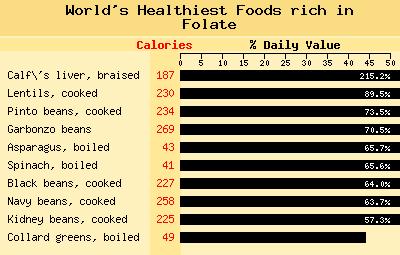
World's Healthiest Foods chart

World's Healthiest Foods site has an article on the important of Folate. Calves liver is right at the top. Yuck. I don't kill or eat babies.

My vitamin supplement has 400 mcg, but that's obviously not doing the trick, since I can't remember what mcg stands for. Let's try some of my lunch mixtures, of which I would mix maybe 1/4-1/2 cup of each: corn: 76 mcg per cup; greens (either collard or turnip) 177 or 170 mcg per cup; bell peppers 20 mcg per cup; tomatoes 27 mcg per cup; black beans 256 mcg per cup; onions 30 mcg per cup; brown rice zero. Looks like black beans are the winner if I avoid the liver.

I'm guessing that senior vitamins will increase the folate content (currently at 400) if this research continues to be so positive. It's obviously very difficult to get 800 mcg just through eating.


3389 What they were saying 70 years ago

"The farm family [previous paragraph was on divorce rate being much lower in rural areas] remains also the cradle of the nation, whereas the urban family is its grave. Births have declined so rapidly in the cities that urban populations are no longer reproducing themselves. Without the migration of rural youth into the cities to make up the deficit of necessary births, cities would find their population depleted by two-thirds within a century, assuming that the rate of decrease will remain what it now is; and as a matter of fact the trend is to a greater and greater decline." . . .

"Among social institutions that touch upon the material well-being of people, postulate high moral qualities, and produce rich social by-products, few, if any, are the equal of private property. Basic to peace, order, and progress is the security of private property. On this account, Pope Leo XIII, almost fifty years ago, in his celebrated encyclical, Rerum Novarum — On the Condition of Workingmen, developed at length arguments in behalf of private property. 'The law, therefore, should favor ownership,' he wrote, 'and its policy should be to induce as many people as possible to become owners.' "

Aloisius Muench, Bishop of Fargo, North Dakota, Catholic Rural Life Objectives, St. Paul, 1937, pp. 16–19. Annals of American History, accessed Jan 21, 2007.

3388 Common sense consumption, pt. 1

We'd better develop a taste for it, because the lefties, greenies and tree huggers are hooking up with socialized medicine and Democrats for more regulations and laws about food.

If only solvent white people were obese, we'd be safe from the food police. But unfortunately for all of us, non-white and poor individuals are more obese than wealthier and Euro-gened folks. I'm a retired WASP (Irish-German-English 9th generation American) with a decent pension, two homes and investments. No one cares if I'm fat (and I'm not).

Even Asians, who can skew our academic and educational achievement graphs and statistics, pack on the pounds by the second or third generation of living in the USA. It's world wide, and it is primarily economic, but because Europe is about a decade behind us in weight gain, and there are fewer fast food restaurants and less marketing to children there, we're told these are the reasons. (We've been in Germany, Austria, Finland, Estonia and Russia in the last two years, and I can assure you they are gaining on us even without a McDonald's on every corner.) I'll tell you what I think the reasons for USA obesity are in pt. 2.

Just keep this in mind. Lawyers are salivating. Sociologists and anthropologists are rubbing their hands with glee waiting for the grant money. Foundation CEOs, people with zero regulation and accountability, see a steady income stream--if only they can get on the obesity bandwagon. And the medical community--looking at 20 million of us with diabetes--to say nothing of stroke and heart problems--well, you're giving them a very nice lifestyle. And Congress is gearing up. Hear the distant parade music? Folks, all we have to do to stop the biggest invasion of our wallets and privacy in the history of this country, is eat less and move more--shed those pounds you wrote about in your New Year's resolutions. Don't let the government take your French fries and Twinkies. Be pro-active!!!! Dump them on your own.

Source of irritation: JAMA 297:1:87 (January 3, 2007)

3387 Finally, some snow!

Our neighbor across the creek and ravine (we can wave at each other when there are no leaves on the trees) told me today that after they moved here from New Orleans after the hurricane, they agreed with one of their neighbors to outfit a riding mower with a snow plow for their shared use on their huge drive-ways. It was ready three weeks before Christmas--and the huge investment sat in the garage with nary a snow flake in sight. Finally today it is snowing. We should have a total accumulation of 3". They are ecstatic!

Before the big three

there was still hatred in the region. Backstory. My New Year's resolution, made because of a man I met New Year's Day at a coffee shop, is to read The One Year Bible (NIV). It's January 21 and so far, I haven't missed a day, which makes this a more successful resolution than most. So, I'm still in Genesis, the book with all the great stories. These stories are some of my earliest memories. As I read, I can hear the scrape of wooden chairs on the basement floors of the two Illinois churches (Mt. Morris Church of the Brethren and Faith Lutheran in Forreston) I attended as a child and see my faithful Sunday School and VBS teachers in my mind's eye. Even so, every time I read them I see something new.

In today's passage (Gen 42:;18-43:34), Joseph is welcoming back to Egypt his brothers who had sold him many years back (they don't recognize him, but he knows who they are). This is their second trip to get grain for their families and father Jacob (renamed Israel) only this time they had to bring along Benjamin, Joseph's full brother. Joseph, who is very well placed in the government, prepared a banquet for the brothers, who are terrified, because they have no idea what is going on. Joseph had to momentarily leave and collect his wits because he was so emotionally overwhelmed at seeing Benjamin. OK. That's the setting.

"After he had washed his face, he came out, controlling himself, said, "Serve the food."

They served him by himself, the brothers by themselves, and the Egyptians who ate with him by themselves, because Egyptians could not eat with Hebrews, for that is detestable to Egyptians."

God had not yet chosen the Jews (he had, but they hadn't been told); Jesus was in the plan but not yet revealed; and Mohammed who would investigate both Judaism and Christianity for a replacement of the pagan gods of the region, was many centuries away. And still there was hatred.

Happy birthday, First Baptist.