Can you think of other similarities?
Thursday, October 03, 2024
Remarkable similarities in the four candidates
Can you think of other similarities?
Friday, August 16, 2024
Children and exercise--the gym or outdoors?
No one wants to hear that we knew better in the "old days" but here it is. I hated school PE classes, I admit it. I did avoid all organized summer sports although the town had community leagues. But I certainly had a lot of exercise. Watching a little kid on one of those machines today I recalled:
- climbing trees
- riding horses
- biking on no-speed, manual brake bicycles
- playing hop-scotch
- raking leaves in the fall
- mowing the lawn in the summer
- pulling weeds in the garden in the summer
- digging dandelions in the yard in the spring
- running during recess
- swinging on the monkey bars in the school yard
- roller skating with strap on skates on the sidewalks
- catching tadpoles and frogs in creeks
- playing softball in the street with neighborhood kids
- delivering newspapers on a morning route
- running just because
- and we walked because our mean mothers wouldn't drive us everywhere we wanted to go!
Tuesday, February 08, 2022
This time next year we'll be laughing; a memoir by Jacqueline Winspear
Our book club met yesterday (via Zoom) to discuss Jacqueline Winspear's memoir. She is the author of the Maisie Dobbs series, that my husband loves and has read every title on the list. I've only read a few of them. Because it was on our 2021-2022 list and he loves her, I bought the book for him as a Christmas gift so I could read it! https://jacquelinewinspear.com/books/this-time-next-year-well-be-laughing/
I didn't find the memoir all that compelling, but what I enjoyed were those memories with which I could identify although I am 15 years older and grew up "across the pond." She is British (now lives in California) and grew up with WWII stories told by her parents and I lived in northern Illinois hearing my parents' stories of the Great Depression.
Two chapters (the book is not linear and each seems to stand alone as if she had written them for a class, and maybe she did) resonated for me--horses and neighbors. Young Jackie loved horses and wrote about her first encounter in her long relationship, even to this day, with horses. Sort of like mine. I remember the day (although not the date) I fell in love with horses. I think it's memorable because when our family was living on highway 64 in little Mt. Morris I probably never saw a horse except in the movies or in a parade. My grandparents lived on a farm between Franklin Grove and Ashton, but there were no horses. When we moved to Forreston in 1946 to a small farm house on the west edge of town there was a fenced 10 acre field right at our back yard that had several horses. I was fascinated; I fell in love. From that day forward I wanted a horse, I dreamed about owning a horse, I drew pictures of horses, I began reading all the horse series like Black Stallion and Marguerite Henry. When I finally got a 2 wheeler bike, it became a horse, at recess during play time I WAS a horse, and when in 1947 we moved to a better home, I became acquainted with the Ranz men, Charlie and Raymond, father and son horse and cattle dealers who had a barn--with horses! When I was old enough to earn my own money, it was saved quarter by dime in my "Marathon" bank (my dad delivered fuel oil for Marathon). How much money can an 8 or 9 year old earn to save for a horse? By delivering the Rockford Morning Star through the snow and rain, and by babysitting by age 10, apparently a lot. We moved back to Mt. Morris in March 1951, and that summer I babysat for $5/week (a magnificent sum for an 11 year old). Like Jackie's parents, mine had made a promise--I could have a horse if I had enough money. By the time I was in seventh grade I had saved $100.00--about $1,000 in today's value. I counted several times a week. One day I came home from my babysitting job and there on the railing of our house on Hannah Avenue was a leather, western saddle (not sure about the bridle). My dad got my old friend Raymond Ranz to look at a horse I wanted--a lovely roan mare my friend Mary Ann owned. He declared her "unsound"-- she had a hip problem which is probably why Mary Ann was selling her. Then dad found a chestnut and white pinto gelding owned by the Orr family who lived a few miles away on the road to Dixon. I had never seen the horse, but he was bought sight unseen by me, and my dad rode him to our house on Hannah (how he went back for his car I don't know). And my happy story ends there, because if you ever want to fall out of love with horses, just own one and try to support their upkeep on what a 12 year old can earn!
One of the other stories in her memoir was about her neighbors at the Terrace, one of the places the Winspears lived. There were the Martins and Jenners who took her to Sunday School (may be the only mention of church in her memoir), Elsie who took care of her own mother, two nosy sisters, the interesting Polly who apparently was a prostitute, Auntie Marion and Uncle Bryn, and Pat and Ken, teachers who had no children of their own. So I immediately wandered back to my old neighborhood on Rt. 64, with the Aufderbecks on one side and the Crowells, Ruth and Earl, on the other. Further down the street were the Ballards, my great grandparents, and the Potters. Behind us were the Rittenhouses, the Zickhurs, the Balluffs, and the Leopolds, plus some others whose names I've forgotten. Mike and Tommy and I would ride our tricycles up and down Hitt St. and around the corner to Mike's house. But I seemed to wander in and out of the houses of the neighbors--don't remember anyone telling me I couldn't.
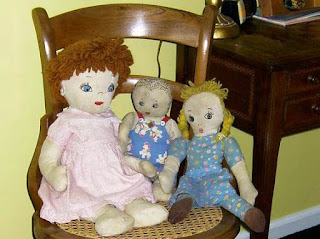
Ruth and Earl had a box of toys that were charming--much more desirable than those I had to share with my siblings. Ruth made two cloth dolls for me, Blue Doll and White Doll, and I still have White Doll. Earl would actually play with us in the back yard--casting his fishing line for us to catch, although no one could. One of our neighbors was a chicken hatchery, and we were free to walk in and look at the baby peeps, who were just about eye level for a five year old. The Burkes lived across the street and also owned a filling station and auto repair shop. So I knew women could have careers because Minnie ran the station and repaired cars. Although I didn't know this until she died and I read her obituary, Minnie's brother was married to my Great Aunt. So we were sort of shirt tail relatives. When Tommy's dad (they lived next to my great grandparents) went hunting or trapping, I'd go down and inspect the skins nailed to boards in the garage. Tommy's dad had been a famous baseball player, Nelson Potter, so everyone in town knew him. When we grew up Tom was the valedictorian of our class and I was the salutatorian, so we sort of remained friends until his death a few years ago. He became a professor of philosophy at the University of Nebraska in Lincoln. https://en.wikipedia.org/wiki/Nelson_Thomas_Potter_Jr. He may have been the smartest man to ever leave our little town. Ruth died in 1950 when she was about 49 from heart problems--I was devastated, and remember to this day that phone call. Earl died in 1965 and I remember waving to him as I walked past the campus where he sat every day with the other old men when I was in high school. In 1949, my great grandfather died, and we came from Forreston to attend the funeral. I met people I'd never seen before--all members of my grandmother's family.
Sunday, October 27, 2019
Believing children’s fantasies
When I was a child I was horse crazy. Not only did I pretend my blue bike was a horse named "Red" (my best friend JoElla's bike/horse was named "Rusty" and oh the adventures we had), but at school recess I imagined I was a horse--could outrun all the boys in my class, too. My mother gave me wallpaper rolls so I could draw horses--all the time. At home I would gallop around the house on all fours, neighing and jumping around (imagine coming home from a 10 hour day on the fuel truck to that--poor daddy).
Fortunately, no teacher or doctor or parent took me seriously and knew I'd outgrow my fantasies. How did our society get snarled into these children's delusions and come to believe boys should be on girls' track teams using their bathrooms and pronouns? That it's OK to give children hormone blockers or destroy their body parts with surgery or chemicals. Why particularly are social workers, psychiatrists and surgeons falling for this tragedy called transgenderism? There are children born without kidneys, fingers, toes, arms, even brains. We don't say that is normal and everyone now has to play "let's pretend."
We know money is involved--that's always the first place to look. When same sex marriage was passed so easily, the agenda groups were left with bagsful of money and large staffs with no soliciting method. So an affliction of less than 1% became a cause and T was added to their acronym, although they really have nothing in common with homosexuals.
But there has to be more than just money. You can't even blame the Soviets, Maoists, or Che. Communists were always quite repressive about sex. It has to be the demand in our society to discount everything about a creator God who has a plan for us. Of course, Christians bought into it early on. Churches have caved to the contracept movement since the 1930s violating the first command to be fruitful and multiply. Then the demand for abortion in the 1970s became a mantra, a hymn for feminists, a "right" to destroy our future and our own children. And now we have a birthrate below replacement. The country can't survive and feed the hungry government programs without importing more workers, workers who will be willing to have babies, at least for one more generation.
Crazy how it all links together.
Friday, July 19, 2019
Investments in early childhood nutrition
Recently it's been reported that use of a nutritional supplement in children (pre-natal through 2 years) has had a remarkable affect on their adulthood--intelligence, physical stature, etc.
"The Institute of Nutrition of Central America and Panama developed a protein-energy supplement (Atole) and a protein-free control supplement (Fresco), which were offered to pregnant women and young children in four villages; two matched villages each. The investigators followed up 1139 (69%) of 1661 traceable participants from an original cohort of 2392 children enrolled in 1969–77."
This isn't the first or last time we'll see women and children in 3rd world and developing countries used as lab specimens. Many studies are never reported because of negative outcomes or poor designs. Birth control pills were developed and tested this way, and God only knows what long term effects that had on African women and later women on welfare who were the original guinea pigs back in the 1960s. Vitamin supplementation and vaccines were other products tested by pharmaceutical companies in developing countries before being marketed to the west.
However, although most moms are not dieticians or scientists, I think we could have figured out in 1969 (when my children were little) that providing one child with protein while depriving the other, one might see a difference in brain, muscle, skeletal, and intelligence development.
I have great respect for the author of this article, but strongly disagree with the casual way the study was done on which the costs are based.
Here is an earlier description from 2018. https://www.thelancet.com/journals/langlo/article/PIIS2214-109X(18)30308-5/fulltext
Saturday, December 12, 2015
A writing prompt from Tweetspeak Newsletter--Home
Memories of Home
Norma J. Bruce
December 12, 2015
Home. Where is that located?
Is it Kenbrook where memories
Are daily, brief and quiet.
Where we moved in January
And I was then hospitalized?
Home. What would it look like?
Is it Abington with memories
Of babies, birthdays and weddings?
What will the current owners risk
And remodel beyond recognition?
Home. When a horse was pastured?
Is it Hannah where memories
Push a porch swing with Polka-dot,
When boyfriends stopped by for dates,
And we went to movies and dances.
Home. Why not a whole village?
Is it Forreston whose memories
Of friends hold to this day
Why when some have moved or died,
And we are always children.
Home. Would it be war time?
Is it Alameda’s bay area memories
With trips to the zoo and playground.
Would I hear White Christmas in fog
And walk to kindergarten?
Friday, February 06, 2015
I remember this book from second grade, Miss Flora, Forreston Elementary School
“Horton Hatches the Egg is a children's book written and illustrated by Theodor Geisel under the pen name Dr. Seuss and published in 1940 by Random House. The book tells the story of Horton the Elephant, who is tricked into sitting on a bird's egg while its mother, Mayzie, takes a permanent vacation to Palm Beach. Horton endures a number of hardships but persists, often stating, "I meant what I said, and I said what I meant. An elephant's faithful, one hundred per cent!" Ultimately, the egg hatches, revealing an elephant-bird, a creature with a blend of Mayzie's and Horton's features.”
I’ve never forgotten it, and think it influenced me to be an adoptive mom.
Although I read Dr. Seuss books to my children (they seemed to love Green Eggs and Ham, the fourth best-selling English-language children's book of all time), I don’t recall reading any others when I was a child.
Friday, December 26, 2014
The unvaccinated

With the exception of meningitis, I had these plus scarlet fever. Trust me, it’s not pleasant.
Monday, June 16, 2014
Monday Memories--strap on roller skates
Yes, I went around the block a few times on skates similar to these. Cracks in the sidewalks, bumps, skinned knees, and most painful, sometimes the toe lock would loosen, and slip off your shoe, leaving the leather thong still fastened at the ankle. The key to the lock was usually kept around the neck of the skater.
Monday, January 27, 2014
Monday Memories—childhood before modern vaccines
If you're anti-vaccine, please check out this interactive map about outbreaks of easily preventable diseases. Most vaccines weren't available when I was a child (except for small pox) and I had measles, mumps, whooping cough, chicken pox and scarlet fever; my sister and many friends and relatives had polio; in the early 60s I had a baby born with multiple defects from my having been exposed to measles—he died. My children only had chicken pox which now has a vaccine. As an adult I got tetanus vaccine and boosters. My grandmother’s brother died from stepping on a nail in the barn and got lockjaw and left a widow and 3 children. Her other brother died of diphtheria when he was 17. Both diseases are now preventable with vaccines. My cousin Jimmy died of polio in 1949 and the affects of polio followed my sister all her life, and probably shortened it. I never miss my flu shot--it's a killer of the elderly. As an adult I got a shingles vaccine after seeing the horrible pain it causes. I personally know two people who didn't get the shingles vaccine and got it in their eyes (it can affect any part of the body). Vaccines are so successful that today parents don't realize the damage, death and disability infectious diseases can cause by jumping on the anti-vaccine bandwagon. They've never seen a child blinded by measles, made deaf from mumps, and if they've seen an iron lung it's in a medical museum.
http://www.iflscience.com/health-and-medicine/one-map-sums-damage-caused-anti-vaccination-movement

Shingles: While the rash itself usually lasts two to three weeks, people often go on to have permanent pain in the area of the rash. This is known as neuralgia and is debilitating and very difficult to treat as it doesn’t respond to normal painkillers. Approximately one in 1,000 people over 70 will die from shingles
Tetanus:. Of 99 tetanus patients with complete information reported to CDC during 1987 and 1988, 68% were greater than or equal to 50 years of age, while only six were less than 20 years of age.
Whooping cough: The CDC recommends that all adolescents and adults from age 11 and up receive a single booster dose of Tdap. In adolescents, Tdap should replace the usual tetanus booster shot that’s due around the same time. In adults, Tdap can be given at any time, although it may be better to wait a few years if a tetanus booster was recently given.
Influenza: Influenza is much more likely to result in hospitalization and death in the elderly than in young persons. As many as 35,000 excess geriatric deaths due to pneumonia and influenza occur during influenza epidemics each year. Medicare expenditures for excess hospitalizations due to influenza are estimated to exceed $1 billion each year.
Sunday, January 18, 2009
Today's new word is TRAJECTORY
At least it is new to me the way it is used in Archives of General Psychiatry 2008;65(10) 1185-1192. My sense of the word was that it had something to do with a bullet or something flying through space in some sort of predictable line and going splat. Not so in the social sciences, apparently.- Peer-victimization trajectories
pre-school trajectories
developmental trajectories
What I got out of the article, other than a vision of seeing little kids hurtling through the air from pre-school into a gang of bullies in high school, is that the parents’ behavior and the child’s behavior cause something in the dynamics that invites bullying by other children. I’ve read it through several times and don’t see any other conclusion. The children are aggressive or hyperactive from a very early age, and the parents have poor skills and react harshly. When these children are around other kids, they are doing something that causes the other children to react mean or negative. Also, the same predictors for poverty (teen mother, single parent, low education) seem to be in the bullying scenario.
- Conclusion: Early childhood preventive interventions should target parenting skills and child behaviors, particularly within families with insufficient income.
Wednesday, November 19, 2008
Guys and dolls--paper that is

Collecting paper dolls is not something I do, but because I have scanned a few, my site meter shows that sometimes people interested in paper dolls do show up here at Collecting My Thoughts. I have a few of my childhood paper dolls squished into photo albums, and some that belonged to my mother which were cut from women's magazines. Paper doll collectors specialize just like other collectors of Ohio pottery, old quilts, or retro clothing (I seem to have a few of those, too--Hull, grandma's and mine).
Here's a bulletin board for collectors--very interesting to read even you aren't a collector. It's maintained by Joan, who has written a book on magazine paper dolls.
You can always tell when childhood memorabilia wasn't loved or played with--it's still in good condition! The dollies that survived my little girl loving were given to me when I was moving out of that stage, which is also why I have children's glass play dishes. The older ones were all broken or given away to younger children. So it is with these young men. My Mary Martin and Betty Grable and Gene Tierney paper dolls are headless, knee capped, folded and wrinkled. These guys are in near perfect condition (considering their age) and the tabs haven't even been folded on the little boy's clothing. Written on the back are Greg (2), Eddie, and Jerry, but I don't recognize the handwriting. We often renamed the paper dolls, even the movie stars, so those probably aren't the names they came with. From the clothing they came in, I'd guess they are ca. 1943-1946. What do you think?
Thursday, January 31, 2008

Thursday Thirteen--13 discussion starters
In the margins of my Serendipity Bible for Groups (4th ed. NIV) there are "warm up" questions of a personal nature to get members of a small group talking. Most are non-threatening and deal with childhood, the thinking being I suppose that the members stay off the topic of co-workers or current relationships. I'm not fond of "ice-breakers," but I've enjoyed looking through these and thinking about them. Here are 13 from the margins of Romans in the New Testament. Can you pick one to answer?1) When you write a letter are you more likely to write until you run out of paper, or keep it short and to the point? They got me on this one. I definitely use up the paper, even if I have to add an afterthought. Then I'll write in the margins to keep from using another sheet, because I'd have to fill it!
2) When you were growing up, what chores were you expected to do around the house? Dishes--rotated with my two sisters, and lawn mowing--and my brother was in on that rotation.
3) What is the biggest scam or junk mail offer you have fallen for? It was either the life-time free ink cartridges or the 15 sex crazed 3-legged mountain climbers. Just kidding.
4) In your family, who tried to keep the peace? Mom or Dad? Mom.
5) Who do you take after in your temperament, your mother or your father? Father.
6) What about abilities, like music or art? Most likely my mother, but for those we'd probably go back to grandma.
7) What is the closest you have come to losing your life? I almost drowned as a child, and another girl who really didn't swim well saved me.
8) In your first real job, was your boss easy to work for or a slave driver? Not easy, but then who would be with a bunch of teens? I see it differently today.
9) What New Year's resolution have you made only to have it fizzle? Could I just list the one or two I've ever kept?
10) What signs of aging or weathering are you starting to feel in your bones? Ah, let me count. How much time do you have?
11) What was one thing about which your folks used to say, "Wait 'til you're older, you'll understand then?" I can't remember this specific phrase, but it undergirded every lecture from my mom I heard (and ignored). The woman had advice on absolutely everything--the apple didn't fall far from the tree.
12) When you were a child, what did you do to earn your allowance? At least when I was little, my allowance wasn't tied to anything. Family chores were not connected to money, just expectations and maturity level. As a teen-ager, the allowance was supposed to cover my clothes (except shoes and coats).
13) Describe briefly your first best friend. Are you still in touch? Smart and sort of goofy, but deep thinker, even then. Yes, we're still in touch.
Wednesday, October 24, 2007
Totally Optional Prompt
Today's prompt is a poem by Ted Kooser about the horse, "its hide a hot shudder of satin/ head stony and willful. . ." For this I pull out an old one, written on the occasion of Lou Ferrigno's 50th birthday in 2002. He is the actor who played "The Hulk." The photo is me with my horse at a trail ride. The poem is about noticing the changes as I went from being a straight and skinny child to a more adult figured young woman.Happy Birthday, Lou Ferrigno
Today it was announced
with little surprise
That the Hulk had turned 50;
so did my thighs.
Yes, back in ‘52
I fell from a horse,
Noticed my body shifting--
southward, of course.
Legs that outran all the boys
in school races,
Now slowed down and waited
for a few paces.
The limbs that scrambled up and
were scraped on trees
Became pudgy, dimpled
soft above the knees.
The body so straight and slim
looked like a rack,
Now grew fat and fleshy
I knew for a fact.
So it’s with mixed emotion
and a few sighs
Eat cake and ice cream,
“Happy Birthday, dear thighs!”
Thursday, August 30, 2007
Polygamy might be better than nannygamy
Polygamy will be the next change in marriage law. After the gays push through same sex legal unions, there will be no reason to limit it to two consenting adults, or three or even adults. They already have a political action group to decriminalize it.Polygamy has some benefits, according to an ABC program I watched the other night about a community of polygamists in Arizona. Legally, the man (a school teacher) has only one wife, however, their community and church recognize both women equally. The younger one is hoping he'll take a third wife, because she needs some help. There are seven children, five by wife #1 and two by wife #2. The women are close friends and help each other; the older one helped the younger with a difficult birth. The older wife goes to work in an an office, while the younger one stays home to care for the children. She's pooped.
I saw an ad for a nanny in our local paper. Truly, it sounds like this family needs polygamy, a wife #2, not a nanny. Here's what "young professional couple" wants
- nanny to work 2-3 days full time, with possible full time
- prior experience with newborn (the "delightful" girl is 3 months old)
- pediatric CPR training
- First aid certificate
- college degree
- interest in child development
- car
- driver's license
- references
- must pass background check
- caring, experienced and energetic personality
- willing to do housekeeping
- be able to cook
- do the laundry
- run errands
Friday, May 18, 2007
Friday Family Photo
Yesterday the WSJ ran a parenting article about overscheduling children in their summer activities. In my mind's eye I replayed the dozen or so summers I remember when I was a child--they seemed to run forever--hot, hazy and relaxed with hours of finding shapes in the clouds and bugs in the grass and bubbles in the tarred streets for bare toes.
At first I couldn't imagine my mother managing my summers for me, but looking back I realize she was quietly (she was always quietly doing something) planning my schedule. In Forreston I attended summer recreation program at the community school for games, swimming and sports. From age 11-16 I attended summer camp at Camp Emmaus. In elementary school I had babysitting jobs; in high school I detasseled corn, worked at the drug store, at a feed company and the town library. I had a horse, or my friends did, and we rode them down hot, dusty roads. After age 14 I was dating and going on picnics at the Pines, to the roller rink, to movies out of town and locally. My church CBYF had weekly Sunday evening meetings; my girl friends and I had slumber parties; the town had summer band concerts (still does) where you bought bags of popcorn and hoped to see someone special even if you didn't hear a note; and there were 4-H projects to get ready for the county fair. And the projects Mom would invent to keep us busy! Gardening, canning, cleaning, cooking, sewing, laundry. Oh my! That could cut into a sleepy summer day's reading.
Obviously, this is not a summer photo, but my mother's camera broke around 1945 and we don't have many pictures of my childhood. There was no extra money to get it fixed, she once told me. I thought hanging upside down was just about the most fabulous trick, and it was performed on our back yard slide on Hitt Street in Mt. Morris. The two board and batten barns you see in the background were actually garages, but in those days, many barns from an earlier era had been converted. We had a "real" garage, one side for us and one side for our neighbors, the Crowells. The barn nearest in the photo was behind Mike Balluff's and Dick Zickuhr's homes, and the one further away I think was behind Doug Avey's house or possibly the Aufterbecks. At the left edge I think I can see a chicken coup. There were no horses in town, but a lot of people still had a few chickens for fresh eggs.
There are no leaves on the trees, and I'm wearing a coat, head scarf, and slacks which must mean it was cold. Little girls only wore slacks if it was really cold--the rest of the time we were in dresses. The coat was probably a hand-me down from one of my sisters. I think it was navy blue, double breasted with large white buttons, most likely made by my mother.
So maybe childhood schedules aren't so different. What do you think?
Monday, April 24, 2006
Monday Memories

My 11th birthday was in the fall of 1950. During the summer of 1950 the curtain was slowly coming down on my childhood, but I didn't know it until much later. In fact, I was reminded of it last week when our writing group prompt was the comic strip Agnes who is supposed to be about 11 years old, lives with her grandmother and is always pondering life's difficult questions.
It was my last summer to ride a bike with my brother on the country roads and catch tadpoles to take home; the last summer to swing from vines in the dense woods on the road west of town; the last summer to visit our friends who had moved to Baileyville where you could still get a nickel ice cream cone; it was the summer I rode in the livestock truck with Charlie and Raymond; it was the last summer I would walk to the town baseball field in the evenings, sit up on the score board and run around being silly; it was the last fall I would build leaf castles in our front yard with my friends JoElla and Nancy; the last time I would play with dolls.
I started 6th grade in Miss Michael's fifth/sixth grade class in Forreston, IL in September in a building with grades one through twelve. On Sundays we worshipped at a small Lutheran Church in Forreston, although we weren't members, and my sisters attended their confirmation classes. We all sang in the choirs and my oldest sister took organ lessons there. On Sunday afternoons we would all get in the 1950 Chevrolet sedan and drive either to Mt. Morris to see my father's parents, or to a farm near Franklin Grove to visit my mother's parents. My parents would visit with my aunts and uncles and grandparents while we cousins would either walk to the Lamb Theater in Mt. Morris to see a B cowboy movie, or down the country lane into Franklin Grove.
In March 1951 my family moved back to Mt. Morris from which we had moved in 1946, and I finished 6th grade in a different school with a new teacher, new friends and a different church (where I had been baptized). I learned new slang, how to cope with cliques, and discovered the girls were gossiping about things I’d never heard of.
I'm in the front row right in this sixth grade class photo. I have a rather grown-up hair style and two piece dress and was probably close to my adult height and weight. There would still be time for child-like activities, but those times would be less and less Looking back, I think childhood was over during my 12th year, and like Agnes, I did start seeing things differently.

If you have enjoyed my Monday Memory, please lease a comment and I'll link back to you.
Renee, Jen, Emma, Barbara, Libra, Amy, Bec, Joan, Purple Kangaroo,
Trackbacks, pings, and comment links are accepted and encouraged!
Mount Morris, Illinois
Forreston, Illinois
childhood
Monday, March 13, 2006
Monday Memories
Have I ever told you I was horse crazy when I was a little girl?
During 1949 and 1950, when I wasn’t hanging out at the livestock barn owned by father and son, Charlie and Raymond, in our little town, Forreston, IL, I was heading out to a farm of a girl friend to ride her horses. At Charlie’s barn I had to be sort of sober and grown up because there were only adults there and it was a place of business. I could watch them muck the stalls, shoe the horses, and listen as they explained the parts of a saddle and tack. I was allowed to sit on the horses and wash or curry them; and I could ask questions which seemed to cause the men a lot of mirth and red faces, such as, “How do you tell a steer from a bull?”
None of my friends were as interested in horses as I was, so after school I’d go to the barn by myself, within walking distance of our home but outside the town limits. I knew how to open the latches to the doors, so I’d let myself in. When my eyes adjusted to the dim light, I'd climb up on the stall dividers, scoot over and slide onto the horses. If I did take a friend with me, I would show off by walking under the horse. I shudder now to think of the danger I was in. There wasn’t an adult within a half mile. Usually, Charlie and Raymond bought nice, well-trained horses, but they were in the resale business and never kept an animal very long, so who knows what behavior problems they could have had? I probably weighed less than 100 lbs., and the average horse can be over a 1,000 lbs., and really, they aren't very bright.
Charlie and Raymond would take me with them in their stock truck on their buying trips--I remember going with them up to Wisconsin and over to Iowa. Again, I can’t imagine I would have allowed my children to do this, but it was a different time, and my parents knew them, or at least Dad did. I was a reasonably well behaved child, but I do remember wandering around stock barns and county fairs by myself as the men attended to their buying. I can remember being too embarrassed to ask about a rest room or for something to eat. So I wasn't as brave as it might sound. Then the cattle or horses would be loaded into the truck and we’d start for home.
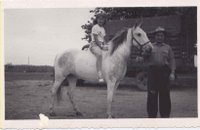
I don’t remember how I met Marlene and Carol and their large family. At least one was my age, so possibly we met at summer Bible School. They didn’t go to elementary school in our town, but attended a one room rural school. However, for Bible School, the country kids came to town, which was always exciting because it meant some new faces--important in a town of 1,000 or less. Their mother was a jolly farm woman who made beef tongue sandwiches for our lunch (which made me gag and decline her hospitality) and all the children in the family could play the accordion.
For my first visit to their farm, which was on Route 72 between Forreston and Leaf River, my mother probably dropped me off, but after that, I was on my own. So I rode my standard bicycle along a busy highway, with a gravel and dirt berm before the days of helmets and safety concerns. It was years later working in an agriculture library that I learned about the high injury and death rate among farm children because of dangerous machinery, but their townie friends, like 10 year old Norma riding her bike out to see them, were probably at risk too. (We'd also take rides on the tractor driven by a 14 year old, but that's another story.)
This family had two riding horses, one a handsome, fast sorrel mare, and the other a blind, overweight “Indian” pony, named Pinky. Pinky’s eyes were blank and glassy, but one was blue. He was white and his pink skin showed through, which is probably how he got his name. If he wasn’t an albino (who often are blind), he was close to it. The sorrel I would gallop around a pasture where she would attempt to rub me off against the fence while spinning so she could make a break for the barn.
Pinky was a step down in prestige, but was easier to catch. If you’ve never ridden an overweight equine, let me explain. When he galloped, or attempted to, his breath expelled with very loud heaving noises, especially when the three children on his back came down out of the air to make contact in sequence. Because Pinky was so fat, the saddle girth wouldn’t fit, so we rode him bareback. Away we'd go, along busy Route 72, always with two or three children atop, with cars whizzing by, many honking their horns to see if they could startle the horse. As Pinky would hesitate and balk, confused by the noise, the gravel, and holes in the dirt, we kids would slip-slide back and forth on his sweaty back, our thigh muscles burning, hanging on to his mane, the reins, and each other for dear life.
Mother would have had nightmares had she known. It’s a mystery to me that I don’t.
Renee,13. Libragirl 14. FrogLegs 15. Jen
(If you participate, leave your link in the comments and I'll post it here)
Trackbacks, pings, and comment links are accepted and encouraged!
Post in the comments if you want to be on the MM blogroll!