Showing posts with label genetics. Show all posts

Wednesday, July 02, 2014

Genetic diversity in Mexico

A very interesting story about the genetic diversity among Mexico's indigenous and mestizo populations, especially for medical importance. But isn't it interesting that in the U.S. when minorities respond differently to medical treatments, it's because of poverty, discrimination and biased research. In Mexico, apparently it's because of different gene pools. Who knew? http://news.sciencemag.org/biology/2014/06/people-mexico-show-stunning-amount-genetic-diversity

When the team analyzed the genomes of 511 indigenous individuals from all over Mexico, they found a striking amount of genetic diversity. The most divergent indigenous groups in Mexico are as different from each other as Europeans are from East Asians, they report online today in Science. This diversity maps onto the geography of Mexico itself. The farther away ethnic groups live from each other, the more different their genomes turn out to be.

Wednesday, January 28, 2009

What would we do without twins?

The media were all abuzz this week with the revelation from a pre-print e-article in the Proceedings of the National Academy of Sciences (PNAS 2009 : 0806746106v1-pnas.0806746106) that analyzed 1,110 adolescent twins from 142 schools and discovered "your genetic background may help determine not only how many people count you as a friend, but also how many of your friends are friends among themselves." This apparently explains why on Facebook some people have hundreds of "friends," many of whom count each other as friends, and other people only have a few. But you wait, no one really cares why you have 120 cyberfriends, and I have three. Eventually they'll find a way to tie this into 1) poverty, and 2) global climate control. I read a lot of medical articles, and this is where they go--follow the (grant) money. Already one of the researchers is planning for this direction--otherwise, where would his funding come from?
    "Given that social networks play important roles in determining a wide variety of things ranging from employment and wages to the spread of disease, it is important to understand why networks exhibit the patterns that they do," Matthew Jackson, a Stanford University economist, wrote in a commentary accompanying the study.
All quotes are from the WSJ summary, because I didn't want to wade through the original. Similar reports appeared in Boston Globe, Columbus Dispatch, etc. Whether the writers actually read the pre-print, I don't know.

When I read the article I immediately thought of my friend Von. I hadn't thought of her in many years as she died about 20 years ago. She had the most amazing circle of friends--it was vast. I think we met at a neighborhood Bible study--and there was just something about her--the voice, the smile, her flashing black eyes, her attention to you that made you think you were the only person in the crowded room. At first I was a little puffed up to be one of Von's friends--basking in the reflection of her popularity. Then I discovered that if I wanted any quality time with her and we pulled out our pocket calenders, she had no time free for months! I'm a "can we meet tomorrow for coffee" type of woman, and if my friend has to schedule me in for November when we run into each other at the supermarket in July, I start to scan the horizon for someone with fewer friends. But she really was a fabulous woman. When we saw each other one autumn at a community event, I noticed she was gaining weight, but only through the middle. I didn't say anything, but within a few months I learned through mutual friends she had a massive tumor. And it was malignant. Her friend network didn't fail her. Most of us knew each other. There were management friends and line friends--she had many people to sit with her in the hospital and hold her head when she vomited; many to bring meals into her large family; many to call and send notes. Many to call each other and consult and grieve together. Eventually, her deteriorating health caused her to be selective because she needed to save her energy resources just to stay alive and hold her husband and children close.

This morning I saw something out of place on top of a bookshelf--a retail bookmark I'd never seen. My office may be messy, but the living room is rarely a place for clutter. I picked it up--the illustration was either a sunset or sunrise over an ocean. I turned it over, and there was a note from Von to my husband, written in 1977 for his *Cursillo week-end, November 10-13, 1977, Men's 52nd, Columbus. So Von's friendship is still here to bring a smile and thank-you.

-------------
*A three-day experience of Christian renewal which originated in the Roman Catholic Church. The Cursillo program has been duplicated in some Protestant denominations, Walk to Emmaus, Vía De Cristo, Tres Días, with changes made to reflect the doctrines and culture of different denominations. In Columbus it is now called Cum Cristo, and is mixed Catholic and Protestant event.

Tuesday, January 29, 2008

Poverty and crime

We used to visit prisoners in the honor dorm of the Ohio State Penitentiary as part of a church program. Somewhere we have this album--we were probably there the night it was recorded. In fact, one career criminal with whom we developed a relationship we visited in 3 or 4 different facilities. I remember a charming, handsome young man in his mid-20s--Jack, I think--who told me he was there on his first offense. Before I could shake my head at the cruelty of the system (because O.P. was indeed an awful place with a reputation of terror and abuse), he chuckled and assured me it was just his first conviction. He had been leading a financially successful life of crime since before his teen years, and when business was bad, he pimped for his wife. She didn't visit, so he was always happy to see the "church ladies."

There's a very disturbing article in today's (Jan. 29) USAToday about the pattern of crime and incarceration that runs in some families. At least I hope it is disturbing to journalists, social workers, and politicians who seem to track all of society's problems to poverty and not sin. The article leads with a pathetic story of three brothers, all in jail, all abused by their violent father and abandoned by their mother. But the final disturbing truth is buried at the end. There was a study done in Boston in a crime plagued neighborhood of 19,000 that showed 457 of the residents were responsible for 12,000 "law enforcement contacts" (i.e., crime). Some crime families were 5 generations deep. If poverty were the cause or major contributing agent, what miracle happened to the other 18,500 residents who don't commit crimes? Indeed, I often think the media regularly insult poor people by predicting horrendous outcomes based on their financial condition, when in fact, the crimes of upper classes are the ones most likely linked to their financial sins--greed, avarice, risk, gambling, and envy.

Update: Maybe I should go look for that album. I think we probably sold it in a yard sale or gave it away.
Update 2: Found it. Still shrink wrapped. Autographed by all the band members. I started to check a few names. At least one still in the system in 2001. Think I'll have my son put it on e-bay; if I haven't listened to it in 36 years, I probably won't start now. I think it was pressed in 1972, at least that's when I bought it.

Tuesday, October 17, 2006

2972 On parenting

Are you a good parent? I noticed this at The Corner--can't vouch for the statistics--don't know the author:

"Your life outcomes are determined 45-50 percent by genetics, 45-50 percent by outside-the-home socialization (which is affected by parental decisions about housing, schooling, etc.), 0-10 percent by in-home socialization (=parenting). That's what the evidence tells us, as I read it. Parenting has been WAY over-sold. And Freudianism (in-home socialization determines 100 percent of life outcome) is dog poop." The Corner, July 26, 2006

I agree--although I'd put genetics (personality, intelligence, physical attributes, talents) a bit higher, and parenting (values, discipline, religion) I'd put at about 1-2%. You've pretty much got the game plan when the baby pops out of the womb. If your daughter is 5'8" and a size 10, she just will never work for Abercrombie & Fitch no matter what you do. You can chose a good school, or have a good health plan to help things along, but the kid will grow up to be the one God gave you at the beginning. If you're a parent, it would be smart (and gracious) to not take the credit and never take the blame.

Parenting comes at you in stages. What works at 2 definitely doesn't fly at 12. I was a fabulous parent for the early years--not so great for teens. The kids are 38 and 39 (or is that 39 and 40?); just ask 'em. Had the proverbial eyes in the back of my head, I did. Although most of the time they were growing up, my hair was too long to peek through. Now, we socialize occasionally and help each other out--my husband's helping our son paint his house and our daughter has been taking care of our cat during all our travels lately. I do try to mind my own business, and only nag occasionally--usually about health--but it's tough considering I was very over protective. Afterall, I want them to take care of me in my old age!

As children they never missed church; never even asked. As adults they attend on Christmas Eve. I think my husband and I said prayers with them every night practically until they left home--or at least until they were bigger than we were. As the saying goes, God has no grandchildren. My husband still prays for them every day!

I was room mother, choir mother, Campfire leader, and VBS teacher. I took them to art shows and libraries. Heck, I taught them to read before kindergarten, and supervised all the homework. I used to storm into the school and demand that the teacher keep my kid after school until the work was completed! (They were sooo happy to have my kids graduate!) I gave up all sorts of perks I probably didn't need and ate macaroni at the end of the month just so we could live in the best school district in Columbus. I made sure they always had holidays with the relatives so they knew what an extended family was (we have no relatives here).

I taught them to cook, clean and sew (don't bother with the sewing--Wal-Mart is cheaper). We took them to restaurants for family time, but also they learned how to behave in public. They ate better than most of their peers and we always ate meals as a family, so they learned good table manners. Fast food or pop? They didn't get it in our home. I remember the shocked look when they were adults and found pop in our refrigerator and learned we occasionally went to McDonald's.

They took piano lessons and one even had 2 clarinet lessons! Our daughter took voice lessons for awhile. I hired a really neat guy to teach my son to play the guitar by ear; and 25 years later he still plays and once had long stringy hair and played in bars with other guys who thought they'd be famous some day.

My kids were in every imaginable sport activity when they were young, and one is a natural athlete. But I was on the job and didn't let them join up until at least 3rd or 4th grade because I thought I was smarter than the other mommies and that kids needed time to be kids. Of course, that meant no one else was around to play with--so you're fighting a losing battle there. Swimming, tennis, and ice skating lessons. Neither one of us plays golf, but we talked a golfer friend into teaching our son a few basics as a teen, and I think he still goes to the course and throws his back out from time to time.

I said "No," a lot. Much more than was necessary. "No, 6 weeks in France in 5th grade will not benefit your education." "No, you can't go to Florida on Spring break with your friends." "No, you can't leave the house until you write Grandma a thank-you note." "No, that outfit is too expensive." "No, you're not leaving the house looking like that." Playing with matches with friends? I called the fire chief and arranged a little chat while the other mommies said their little sweeties would never do such a thing.

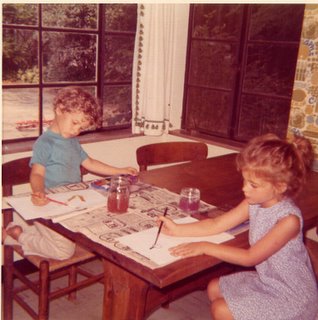
We laughed and played a lot--went on picnics down by the river, bike rides around the neighborhood, put on records and danced, played dress ups and made forts, had overnights with friends, family camp, birthday parties, made a zillion crafts at the kitchen table, dressed the cat in doll clothes, went to Tullers for fresh cider and donuts on Saturday mornings, ice skating, movies--the same kind of stuff I did when I was young. In fact, except for the TV and the community sports, I was surprised by how similar the activities were.

Oh sure, I made mistakes. They could probably tell more than I know about. The teen years I would never want to do over. But if I could have a "do over," I'd never sign a permit for my teen-ager to work. This wasn't the 50s or 60s; it was the 80s. Fast food and retail jobs don't build character, work ethic, or good values, etc., it just puts them under the influence of 22 year old assistant managers, and in close association with school drop outs and kids you'd never let through your front door. Let's see, what else. I'd never put a child in a special class unless the regular work was totally out of reach--and even then I'd tighten the belt and go for tutoring. If the school says your daughter doesn't pronouce a consonant correctly, just lisp at the teacher and tell her that's how it's done in your family. No one wants to be your pet project--children don't like to feel like they need to be fixed, and they hate being different.

Another mistake I admit to--I'd never let a minor living under my roof own an automobile, not even with their own money. Because of insurance laws, you actually have this decision in your hands. A 17 year old that can afford a car, probably can't afford the insurance. You might think it will help transportation problems, but trust me, mommies and daddies, you want to keep them driving 4 door sedans as long as possible. Some things need to be done or not done just to help the parents!

But we hope it all pays off. Parents try to raise up adults, not children. They grow up, come home to visit, invite us for dinner, visit when we're sick, call just to chat and make us proud. The Bible says, "Train up a child in the way he should go, even when he is old he will not depart from it." Scripture is a bit vague about just when "Old" takes place, however.

, , , ,