Showing posts with label low-income. Show all posts

Monday, May 23, 2022

How Biden's American Families Plan hurts the low income

I disagree with the premise of the headline of this article.  I think Progressives know exactly what they are doing and how their programs keep the low income at the bottom.  It keeps them dependent on the government and thus keeps the progressives in office.  I wrote a blog about this years ago using a fictional character and how she couldn't get ahead because her benefits would be cut if she accepted a promotion or a better job.    https://www.econlib.org/library/columns/y2021/richardsonmckenzieprogressives.html

 Progressives' Desires to Help the Poor Will End Up Hurting Them Instead

"How do no-income and low-income Americans pay “taxes” when they are welfare beneficiaries? Very simply. Public assistance programs are “means tested,” structured to target households below certain income thresholds. The level of benefits a beneficiary receives under a given program falls at some rate as earned income rises, eventually reaching zero dollars in benefits.

Consider a household that receives benefits from only two welfare programs, with one tapering off at 20 cents for each added dollar earned and another tapering off at 40 cents for each added dollar earned. Those cuts create an implicit tax rate of 60 percent, which means the worker has only 40 cents in additional spendable income for each added dollar earned. This implicit tax rate can be expected to affect work incentives in much the same way that a federal income tax rate does.

To further illustrate, consider a real-life, low-income single mother of two children in Forsyth County, North Carolina earning $10 an hour in a full-time job, which means she has a monthly earned income of $1,600 (or $19,200 annually). Suppose the single mother receives monthly benefits from five welfare programs: $425 in food stamps, $1,471 in subsidized childcare, $370 in housing subsidies, $180 in WIC benefits, and $493 in an earned income tax credit (EITC). Her monthly welfare benefits will total $2,939 (or $35,271 a year).

Now, suppose the single mother takes a new job paying $15 an hour, a 50 percent increase. Her monthly earned income will rise by $800 to $2,400 (with her annual income rising to $28,800 a year, an annual earnings increase of $9,600). However, she will face decreases in four out of her five monthly benefit streams, with each benefit reduction based on the same $800-increase in earnings (a problem known among welfare researchers as the “cumulative stacked effect”). The single mother will lose $231 in food stamps, $80 in childcare benefits, $216 in housing benefits, and $166 in EITC. Her total decrease in monthly benefits will reach $694 (which means her annual benefit total will drop by $8,328).4 Her implicit tax rate on her added monthly earnings of $800 is 87 percent—more than two times the highest explicit marginal tax rate proposed for the rich. (The details of our calculations are in a table we have appended to the end of this article.)

In addition, the single mother will be required to pay an added $185 a month in federal and state income taxes on her added earned monthly income of $800, which is an explicit tax rate of 23 percent. Adding the 87 percent implicit tax rate to the 23 percent explicit tax rate leads to an overall tax rate of 110 percent. Her raise has left her $79 per month poorer in lost wages and benefits—surely a strong disincentive for her to take the higher paying job.5

But the total (implicit plus explicit) marginal tax rate on poor and low-income workers can be worse, and actually spikes to 1,400 percent at an earned income of around $43,000 (which is known as the “welfare cliff”).6 However, studies in different areas of the country show that the total marginal tax rate on poor and low-income workers within an annual earned-income range of $15,000 to $80,000 moves between 28 and 53 percent for full-time workers earning up to an annual earnings of $24,000 (or $12.50 an hour). The implicit tax rate for workers earning between $24,000 and $40,000 jumps to 90 percent.7"


Wednesday, August 15, 2018

50 + Years of Upward Bound—Is it working?

Today I received an article about Upward Bound summer institute at Ohio State University, https://odi.osu.edu/upward-bound/ . Launched in 1965, Upward Bound (UB) is one of the flagship federal college access programs targeted to low-income or potential first-generation college students.  So it’s now 50+ years old. The article included several photographs, and I noticed there were no white students, even though whites outnumber blacks and Hispanics in the low-income and disadvantaged statistics, which the program is supposed to address.
Then I began the tedious search for outcomes—the program is part of the War On Poverty and is 50+ years old.  I found a lot of on-line help in applying for a grant if I were an educational institution (that’s where the money goes,over 4,450 per student).  I found an annual report for 2015-16 published in 2018, but that was all about the tutoring programs, counseling, help with applications—numbers of students—all looked like things I thought schools were already doing.
The FY 2017 budget from the federal government was $312,052,710, with 70,000 participants, at $4,458 per participant. https://www2.ed.gov/programs/trioupbound/funding.html 
Finally I found an assessment for the 2004-05 school year “POLICY AND PROGRAM STUDIES SERVICE, REPORT HIGHLIGHTS, The Impacts of Regular Upward Bound on Postsecondary Outcomes, 7-9 years after scheduled High School Graduation, final report. (2009)
Scanning that, I came to these depressing conclusions.
“For students offered the opportunity to participate in the Upward Bound program, the study found that:
  • Upward Bound had no detectable effect on the rate of overall postsecondary enrollment, or the type or selectivity of postsecondary institution attended. About four-fifths of both treatment and control group members attended some type of postsecondary institution.
  • Upward Bound had no detectable effect on the likelihood of apply for financial aid or receiving a Pell grant.
  • Upward Bound increased the likelihood of earning a postsecondary certificate or license from a vocational school but had no detectable effect on the likelihood of earning a bachelor’s or associate’s degree. Estimated impacts on receiving any postsecondary credential and receiving a bachelor’s degree are 2 and 0 percentage points, respectively, and are not statistically significant.
Upward Bound increased postsecondary enrollment or completion rates for some subgroups of students. For the subgroup of students with lower educational expectations at baseline—that is, the students who did not expect to complete a bachelor’s degree—Upward Bound increased the rate of postsecondary enrollment by 6 percentage points and postsecondary completion by 12 percentage points. Because targeting on the basis of lower educational expectations could create an incentive for applicants to understate their expectations, further analyses were conducted to examine the effects of Upward
  • Bound on subgroups that could be more readily targeted. These exploratory analyses suggest that UB increased enrollment for students who were in tenth grade or above at the time of application, students who took a mathematics course below algebra in ninth grade, and students with a ninth grade GPA above 2.5.
  • Longer participation in Upward Bound was associated with higher rates of postsecondary enrollment and completion.”
It would be political suicide to ever cut this program even though there is no detectable effect on the billions spent.

Thursday, February 23, 2017

An apple a day, unless it's organic

I don’t specifically buy organic because it is so commercialized (even has special support from USDA). Organic farming uses pesticides, and more of it.  It's just a different kind. What Americans of lower income level really need is better access to food so they can eat healthier. There’s no lack of calories! I would just love to see churches supplying vans to drive people to supermarkets so their money would go further. Food pantries are great and we have many, but even walking to or taking the bus they are a long trip for many elderly and disabled who can’t work here in Columbus. Mt. Morris, IL where I grew up has a wonderful little food pantry Loaves and Fish in the basement of the Brethren church. Volunteers work very hard to keep it going. I think gardeners also donate fresh produce in the summer. Both my brother in law and my high school friend Lynne volunteer there.

Friday, February 10, 2017

Obama's plan to help poor children (there wasn't one)

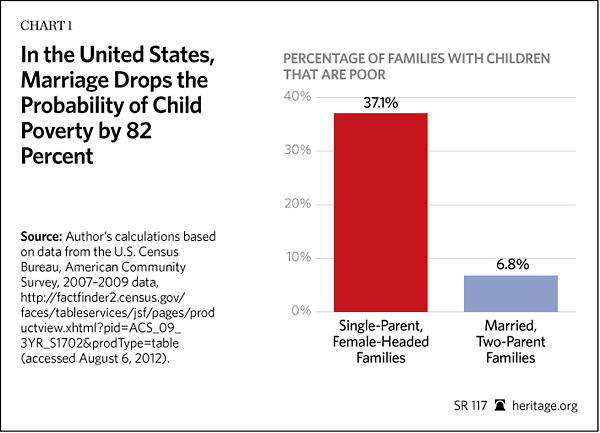
“Among all children under 18 years in the U.S., 43 percent live in low-income families and 21 percent—approximately one in five—lives in a poor family." How did Obama let this happen? I thought everything was great! He said so! Our pension investments did fine most of his 8 years--and I know the wealthy did extremely well. How many articles did you see the last 8 years on a gap?  Do you suppose this could be why President Trump won and the rent-a-mobs now rage? And did you know that being raised in a married family reduced a child’s probability of living in poverty by about 82 percent? Nothing like a job to get Dad out of poverty. We have 123 income transfer programs to help the poor; it seems it does help--them stay poor.

Basic facts about low income children    Jiang, Y., Granja, M.R., & Koball, H. (2017). Basic Facts about Low-Income Children: Children under 3 Years, 2015. New York: National Center for Children in Poverty, Columbia University Mailman School of Public Health

Marriage Drops the Probability of Child Poverty by 82 percent  
 Obama's economic, social and foreign policies not only lost the Democrats control of the federal government, but he pretty much destroyed their chances in the state governments--Republicans are now in control of a record 67 (68 percent) of the 98 partisan state legislative chambers in the nation, more than twice the number (31) in which Democrats have a majority, according to the bipartisan National Conference of State Legislatures (NCSL). Instead of doing some soul searching, kicking a few has-beens to the curb and reorganizing, Democrats continue to rage about Trump's tweets and hire rent a mobs, like trying to stop Betsy DeVos from visiting schools today.

Tuesday, June 07, 2016

He claims capitalism hasn't helped the poor, we need socialism

Why do you think capitalism has so poorly served the lower income and poor? Have you ever seen a list of the consumer goods that even low income people can afford in the U.S.? The typical poor household (in 2011), as defined by the government, has a car and air conditioning, two color televisions, cable or satellite TV, a DVD player, and a VCR. If there are children, especially boys, the family has a game system, such as an Xbox or PlayStation. The household has a refrigerator, an oven and stove, and a microwave, also a clothes washer, clothes dryer, ceiling fans, a cordless phone, and a coffee maker. Do you know any low income people who don’t have a smart phone? (We don’t.)
 
I don’t know about you, but in 1960 when we set up our first apartment, we had a 10 year old car, b&w TV (gift from my in-laws), a refrigerator and stove (bought used) from this list, and we didn’t think we were poor, just newlyweds. Now we’re retired on pensions, and we have everything on this list, except the gaming systems.  We bought our first color TV in 1967, at $375, which would be about $2700 today’s money, and you can buy an HDTV set for $200 today. Same with computers and printers. I now have a desk top computer, a wireless printer, a laptop, an i-pad, a nook and an i-pod for less than my first computer in the 1990s.

The poor in U.S. also have larger houses than socialist countries and even before Obamacare, the poor reported not having a problem with healthcare, since we already had 5 systems to take care of them, plus ERs in hospitals were required to take them.
 
The poor have less than the top 20%, true, no trips to China or Mongolia, no celebrity parties like the Obamas go to, no BMWs or Lexus in the drive-way, instead they probably go to Disney or 6 Flags or Cedar Point, but compared to poor or even socialist countries, U.S. people living at the poverty level (government standard) have a lot, and it's because of competition and capitalism, and that is increasingly being done overseas because of the enormous number of regulations and hostile business environment in the U.S., and the hostility of our government toward our golden goose—capitalism.We've become consumers instead of workers who consume. 
 
During the Obama years, only the top 20% have made any gains in wealth, everyone else has been flat, so those socialist and regulatory burdens are working well for the wealthy, and not so good for the rest of us.

Friday, October 19, 2007

4236

Subprime late payments

A chart in today's WSJ showed the number of people keeping up with mortgage payments on subprime loans is improving. During the last quarter about 7.6% were late and that's dropped to 7.2% (this compares to .8% and .6% in prime). Missed payments were high in mid-1999, then dropping way down to under 2% in mid-2003. Obviously, the reasons for this have yet to be sorted out. But it must not be the economy, or how much was loaned to poor people vs how much to speculators. Subprime loans went to low income people who were poor credit risks and to high income people with high debt in relation to their income. The rest of us went the standard route--10 or 20% down and fixed rates.

But here's what's interesting. After 9/11 there was a drastic drop in late payments for both types of loans. As the economy soared, so did late payments. Seems to be psychological, not financial.