Friday, January 06, 2006

1989 Phoebe Philo Phalls Phrom Phashion

Phoebe Philo, 31, has resigned as creative director of Chloe, a women's wear brand and star performer last year in luxury goods.

She took a materinity leave a year ago and now wants to have time to raise her child, apparently. She's credited with having turned Chloe into a powerhouse, and joined the fashion company in 1997.

So I'm figuring in 1997 she was 22, right? Maybe she just needed a break from being an over-achiever and great success at such a young age.

1988 Secrets

These aren't really secrets--we all know them--at least intuitively. These are Investor's Business Daily "Ten secrets for success" which they developed after analyzing leaders.

Investor’s Business Daily’s Top 10 Secrets to Success

1. HOW YOU THINK, IS EVERYTHING:
Always be positive. Think success, not failure. Beware of a negative environment.

2. DECIDE UPON YOUR TRUE DREAMS AND GOALS:
Write down your specific goals and develop a plan to reach them.

3. TAKE ACTION:
Goals are nothing without action. Don’t be afraid to get started now. Just do it.

4. NEVER STOP LEARNING:
Go back to school or read books. Get training and acquire skills.

5. BE PERSISTENT AND WORK HARD:
Success is a marathon, not a sprint. Never give up.

6. LEARN TO ANALYZE DETAILS:
Get all the facts, all the input. Learn from your mistakes.

7. FOCUS YOUR TIME AND MONEY:
Don’t let other people or things distract you.

8. DON’T BE AFRAID TO INNOVATE; BE DIFFERENT:
Following the herd is a sure way to mediocrity.

9. DEAL AND COMMUNICATE WITH PEOPLE EFFECTIVELY:
No person is an island. Learn to understand and motivate others.

10. BE HONEST AND DEPENDABLE; TAKE RESPONSIBILITY:
Otherwise, Numbers 1-9 won’t matter.

I would have some problems with a few of these based on my experience and personality. First of all, I hate to set goals. I'm a problem solver. Don't give me pie-in-the-sky talk about 5 goals to accomplish before the next annual report. And don't we all know successful people who aren't particularly positive, are horrible communicators, and act before they have all the facts? They were certainly in my career field, and I even reported to a few. In general, I'd have to say I knew very few librarians or staff who were positive and upbeat about the future or their careers. There were always budget cuts and staff shortages to deal with. The sky was always falling. Negativism is pervasive in academe, except for the football coach when interviewed on TV.

And then too, I knew fabulous communicators with stunning personalities, super empathetic and warm, who couldn't work their way out of a paper bag. This was particularly true when I worked in the state government. But in general, the tenth one is essential in everything you do. Honesty is always its own reward. I'm also a big fan of #3 through #7. All in all, not a bad list--I saw it at the library today.

1987 Write a letter today

The postage will increase on the 8th. How about thanking people who gave you gifts for Christmas? (I wrote my children today.) Or helped you with an event? Or performed so beautifully in that choir concert you enjoyed over the holidays? Or who have recently had surgery? Or, why not surprise your radio or TV favorite with an actual fan letter. What about that elderly uncle who lives alone but likes to walk to the mailbox at the end of the drive-way. Wouldn't he be thrilled to find something other than "dear occupant?" Go for it. You have a few days to save a few pennies and make someone happy.

1986 Duct tape offer

I'd planned to send my roll of duct tape that we just uncovered in last week's reorganization to Pat Robertson's caretakers, but Right Wing Nut House has taken care of that. Even if you believe God sends a stroke as punishment, you don't have to blurt it out to the media and look like a patsy for the Palestinians. Pat also is developing jowls, wrinkles and a paunch. Is that God's punishment for going over the hill?

1985 Postdenominational coffee shop

The title of the article I'm taking to the coffee shop this morning is a mouthful: "Postdenominational Christianity in the twenty-first century," by Donald E. Miller, Annals, American Academy of Political and Social Science, 558, July 1998. If I'm lucky, the Wall Street Journal will get there before I'm out of other things to read, because I'm sort of afraid this is going to be one of those "new paradigm," "seeker sensitive," "new reformation" dirges that are announcing in the death knell of liturgy, hymnal singing, and music that doesn't grow tumors in your ears.

Actually, I'm always surprised at the number of religious gatherings I find at the coffee shop. My husband meets with his Cursillo group at Bob Evans--although they move around a bit. I've met two different women named Brenda at Panera's, one is a chaplain and the other has recently moved here and reads her Bible and listens to music several times a week a few tables from me. I've invited her to our Saturday women's group because she is new in town and doesn't know anyone. At Caribou there's a very intense group of young business men who do Bible study before heading for work. This morning I'll see a group of 4 or 5 retired guys who meet to discuss their faith and response to the culture--I think they are Church of the Nazarene and Baptist. Then there is a black pastor and his assistant whom I see on occasion; they pastor a church north of here that meets in a shopping mall. In fact, I can't recall a time I've been in a coffee shop (as a semi-regular) that I haven't seen someone with a Bible.

Sometimes I want to look at my watch and say, "Let's have a word of prayer before we start this meeting," but I just go back to my reading.

Update: The WSJ didn't arrive until after I finished the article, which was really quite readable and well paced. It is based on the author's observations of Calvary Chapel, Vineyard Christian Fellowship, and Hope Chapel. Our church, UALC (Upper Arlington Lutheran Church), fits his description of the seeker-friendly, postdenominational church to a T, with the exception that we have seminary trained clergy, and many of these churches don't.

Thursday, January 05, 2006


Thirteen Things about NORMA in the last 5 days


1. Served communion on Sunday.

2. Entertained house guests for the New Year celebration.

3. Played with my new grandpuppy, a Chihuahua named Abbie.

4. Read "Beyond the River" by Ann Hagedorn.

5. Wrote 23 blog entries, including this one.

6. Cleaned out 2 drawers and one file box.

7. Sorted through all the bills and invoices for 2005.

8. Wrote 6 notes (real handwritten notes with stamps) to friends and relatives.

9. Delivered magazines to a library sale.

10. Attended book club.

11. Met a friend for breakfast.

12. Took a walk on a mild day.

13. Did some financial research.

Links to other Thursday Thirteens!
1. Jane
2. I heart Peanut Butter
3. Straddling the line
4. Colleen
5. Grumpy
6. Busy Mom
7. Dariana
8. Jane, Cozy Reader


Get the Thursday Thirteen code here!

The purpose of the meme is to get to know everyone who participates a little bit better every Thursday. Visiting fellow Thirteeners is encouraged! If you participate, leave the link to your Thirteen in others comments. It’s easy, and fun! Be sure to update your Thirteen with links that are left for you, as well! I will link to everyone who participates and leaves a link to their 13 things. Trackbacks, pings, comment links accepted!

1983 The press has done it again

The West Virginia mine bad reporting incident reminded me of the press fiasco of Katrina, but Achoress has said it better than I could:

"So, yes, one could could excuse the press their mistake, and forgive the torturous turnabout which came after, if only they had not - just a few months ago - done precisely the same thing while covering Hurricane Katrina. Recall that back in New Orleans - just as last night - unknown people ran about, shouting unverifiable “news” and the journalists, particularly the always-voracious cable news outlets, latched on to the “news” and emotionally redelivered it, without checking it out, without doing the basic job of journalism which is: if your parents say you’re not adopted, and you look just like your brother, confirm, confirm, confirm."

1982 Maureen Dowd vs. Ann Coulter

Both of these women journalists are vitriolic, sarcastic, bombastic and often angry. The difference is Coulter's columns actually contain information and facts. I tried, I really did, to read Maureen Dowd's column today about Abramoff, but it wasn't about him. His crime didn't appear until paragraph five where she gets to "the Abramoff plea bargain." On the way there she manages to smear only Republicans, as though there are no Democrats involved. Then she moves on to bashing Bush, then Cheney, then she's on to quoting the WaPo that Bush has used something (legal) 108 times. Then moves on to smearing Bush for a joke he cracked at a medical center, completing her tirade about Abramoff (I think) with Nixon. That's a lot of column inches to point out that Abramoff has a plea bargain.

She might spend a bit more time on the whole smelly process of tribal casinos. Today's WSJ reports "Indian gaming is a $19 billion industry involving 228 tribes operating 405 gambling operations in 30 states." "Lobbyists, legislators and inside-the-beltway lawyers are the real stakeholders in Indian gambling," according to Alexis Johnson, Arizona lawyer, and Abramoff is the tip of the ice berg.

I think Dowd knows that, and her column is smoke and mirrors. She'll want to check into some of the Democrats' favorite causes when she's finished bashing Bush and Cheney (yeah, that'll happen) because these tribes getting wealthy on gambling are exempt from local taxes, state labor laws, municipal ordinances, zoning restrictions and environmental reviews.

For well-paced, factual vitriol, here's Ann Coulter. You can find Maureen Dowd on your own.

1981 Nibbled to death

by fees, taxes, surcharges and related components. I've been going over the year's expenses. My, isn't it a treat to look closely at the phone bill, electric bill and gas bill? Where do they get this stuff? If they divy it up into enough small pots do they think we won't notice? Well, we don't, for the most part. Were the taxes for WWII ever removed? This is just the phone company (SBC) and Verizon has a different set.

  • federal access charge
  • federal universal service fee
  • federal tax 3%
  • federal long distance tax
  • federal universal service fund
  • regulatory surcharge
  • 911 system fee
  • sales tax 6.75%
  • state tax
  • municipal tax

Our electric bill from Ohio Edison (Lakeside) is just as confusing. First they alerted us that there will be a 3% increase in a "transmission related component" approved by the Federal Energy Regulatory Commission, or about $1.50. I'm left to ponder how transmission differs from delivery. That new charge is not to be confused with the
  • transition charge
  • generation related component or the
  • delivery charge

Our electric company in Columbus is AEP, and it has transmission charges, distribution surcharges, customer charges and transition charges, that don't look anything like the Ohio Edison hen scratches. If we're getting a 3% increase approved by the FERC, I missed the ferkin announcement.

Wednesday, January 04, 2006

1980 National Education Association supports left causes and candidates

with members dues. About a third of the members' dues goes for political lobbying, gifts and grants. Unions now have to disclose how they use their members dues, and it isn't pretty, according to this editorial in yesterday's WSJ. The Union gave away $65 million last year to Jesse Jackson's Rainbow PUSH Coalition, the Gay and Lesbian Alliance Against Defamation, Amnesty International, AIDS Walk Washington and dozens of other such advocacy groups. I'm not sure how that helps teachers (certainly doesn't help children, but that isn't what the organization is about).

"Reg Weaver, the union's president, makes $439,000 a year. The NEA has a $58 million payroll for just over 600 employees, more than half of whom draw six-figure salaries. Last year the average teacher made only $48,000."

". . .last year the NEA gave $45,000 to the Economic Policy Institute, which regularly issues reports that claim education is underfunded and teachers are underpaid. The partisans at People for the American Way got a $51,000 NEA contribution; PFAW happens to be vehemently anti-voucher. . . Protect Our Public Schools, an anti-charter-school group backed by the NEA's Washington state affiliate, received $500,000 toward its efforts to block school choice for underprivileged children. . . the Floridians for All Committee, which focuses on "the construction of a permanent progressive infrastructure that will help redirect Florida politics in a more progressive, Democratic direction," received a $249,000 donation from NEA headquarters."

This one really surprised me. The Fund to Protect Social Security got $400,000, presumably to defeat personal investment accounts. I have a teacher's pension (STRS, university faculty) and we're not eligible for Social Security--not our own and not our spouse's--so just what is NEA protecting? Are they afraid that if their members also had personal accounts when they did work under SS, they'd be less dependent on the union?

Librarians don't have a union; they have the American Library Association, ALA. It looks out for libraries, not librarians, with campaigns against censorship, the Patriot Act, and the Bush administration. I guess that's a good thing to keep their eye off the ball after seeing what NEA does to schools. The NEA may be an arm of the DNC, but ALA is far too liberal to be anybody's patsy.

Public disclosure page.


1979 The Index of Economic Freedom

For 12 years the Heritage Foundation and the Wall Street Journal have cooperated on the Index of Economic Freedom, and today's article in the WSJ compared the freedom outcomes of two small countries, Estonia, which has moved quickly with reforms and Chile which has moved slowly. Estonia is 7th and Chile is 14th.

"The Index measures 161 countries against a list of 50 independent variables divided into 10 broad factors of economic freedom. Low scores are more desirable; the higher the score on a factor, the greater the level of government interference in the economy, and the less economic freedom a country enjoys. . . A systematic analysis of these factors continues to demonstrate that countries with the highest levels of economic freedom also have the highest living standards."

The nice thing about using the website is that you can select the variables and see how different countries compare within their regions. Canada and the U.S. are almost always neck and neck whether it is wages, or trade policies; except for fiscal burden, and there Canadians have us beat (lower score is better). Here's the executive summary--note particularly what is happening in Latin America where Chile is the poster child for economic freedom and all the rest are marginal or repressed. Three countries in Latin America made the 10 most worsened list.

1978 Mom! I'm famished. What's to eat?

There's a lot of media coverage of overweight children. Given the success of the anti-smoking campaigns (which I support), I'm guessing we'll see the lawyers and do-gooders checking our lunch boxes and dinner tables before too long--after they get the pop and snack contracts with the food companies out of the schools (which I support).

So here's a tag for you and the rules: you can only tag a blogger over 50 and you copy the question and let the person know he or she's been tagged.

What snack items did your mother allow in your home and put out for you when you were growing up--either home made or store bought? And what item was absolutely not allowed? Here's mine:

1. Buttered slice of bread with sugar-cinnamon sprinkles.
2. Egg nog--milk, egg, sugar and vanilla.
3. Raw potato slices.
4. Kool-aid if it was really a hot day (made with sugar).
5. Peanut butter toast or sandwich.

We NEVER had soda pop in our house.

I'm tagging Mr. Cloud, Octogenarian, Bonita, Jane, and Cuppa.

BTW, Mr. Cloud and Cuppa are married, and both have fabulous winter photos on their sites--check it out.

1977 Blooger burps

What else would you call it when your blogger template goes all crazy? The writing window for "create" was all messed up this morning, but I know a little code and remember life from a kinder, gentler software, so I kept going. It was a little like driving at night in the rain with no headlights. Then when I posted my last entry about Canada, Blogger.com somehow scooped up the NLM page from the previous entry, and used its bold green heading style to morph into my title and face! It was scary, I tell ya. So I quickly exited before it tried to become part of my blog family (I have six, you know). Leaving it alone in the closet for awhile, I came back, and everything was just peachy.

1976 Building boom in Canada for the Arts

Although there's more to be done, Canadians will be happy about this:

"The arts are experiencing a construction boom in Canada unlike any other in modern memory, as museums and galleries scramble to open the biggest, best, and most recognizable buildings they can afford."

Story here.

Tuesday, January 03, 2006

1975 Sorry, no more room for tools!

PubMed has a new tool bar to install, but now that I've got the lower level of the condo clean and neat and all our tools in a nice arrangement, I don't think I'll clutter up my computer screen with one more tool bar. I love my Google tool bar, though.

Check out the NLM Technical Bulletin for details.

1974 Journalist gives up job to become a Marine

A 32 year old Wall Street Journal reporter in poor physical condition decided to go for it and become a Marine officer after living in China for 7 years and reporting on the tsunami last December. He'd been disgusted and sicked by the murder of a colleague and the beheading of Americans. He wanted to become part of something bigger than himself and so he trained and disciplined himself until he could pass the requirements. What made him give up what some would see as a wonderful career? On December 15 he wrote his story in the WSJ:


"It's a cliché that you appreciate your own country more when you live abroad, but it happens to be true. Living in China for the last seven years, I've seen that country take a giant leap from a struggling Third World country into a true world power. For many people it still comes as a surprise to learn that China is chasing Japan as the second-largest economy on the globe and could soon own a trillion dollars of American debt.

But living in China also shows you what a nondemocratic country can do to its citizens. I've seen protesters tackled and beaten by plainclothes police in Tiananmen Square, and I've been videotaped by government agents while I was talking to a source. I've been arrested and forced to flush my notes down a toilet to keep the police from getting them, and I've been punched in the face in a Beijing Starbucks by a government goon who was trying to keep me from investigating a Chinese company's sale of nuclear fuel to other countries."


HT to our Blue Star Mom, Beth.

1973 When Bess Myerson became Miss America

You'll enjoy this story of how Bess Myerson made the day for a young Jewish soldier stationed in India, a long way from home--the Bronx. He's a very experienced writer and editor, but a little new to blogging.

1972 And that's no bull

Speaking of the New Year, maybe it's time for a new screen saver? How about something really cute, like some Angus art work by a famous animal artist, Frank C. Murphy. You can get left leaning bull, or right leaning bull, it's entirely up to you. Aren't these heifers just too cute?

Check here for more Angus clip art

1971 Tag for the New Year

The Soul Sings has tagged me, and here are the rules.

Rules: “The first player of this game starts with the topic “five weird habits of yourself,” and people who get tagged need to write an entry about their five weird habits as well as state this rule clearly. In the end, you need to choose the next five people to be tagged and link to their web journals. Don’t forget to leave a comment in their blog or journal that says “You are tagged” (assuming they take comments) and tell them to read yours.”

1. I add up the purchases in my head (rounding to the nearest dollar) as I place items on the conveyor belt at the grocery store. I'm almost always within 50 cents of the correct total, but I've never been able to balance my check book.

2. I collect first issues of journals and write about them, but mostly I look at them in a pile under the small couch in my office, and do nothing with them.

3. I leave my home very early in the morning to buy a cup of coffee. I'm not on my way anywhere except the coffee shop, and I've done this for the last 50 years or so. Wasn't so bad when coffee was a quarter. Now it probably amounts to a mortgage payment in a year's time. I write about what I see and hear at coffee shops.

4. I analyze library databases as I use them, and usually e-mail the contact person about the screwed up mess in the numbering of series or complain about the terrible printing options. I was just looking at Annals of the American Academy of Political and Social Science at OSUL and OhioLINK and almost had a meltdown. Sometimes I write about that too.

5. I have 5 or 6 places for loose change, but have forgotten where most of them are. It's like found money (actually it IS found money) when I come across the receptacle. Most recently I cleaned out a pink mitten that had no mate, but did have $3.00. Although it's not exactly a New Year's resolution, I'm planning to do some drawer cleaning to go along with our big December clean out, so I expect to claim some lost funds.

And now I'll tag Pat in NC, who is pretty in pink, and Beth, a proud military mom, and Cathy, who is incredibly crafty, and Joan, who is Beth's sister, and Eric, who needs a little encouragement (he took my blogging class).

If I had 6 habits, I'd mention that I shamelessly promote my blogs.

Monday, January 02, 2006

1970 Don’t ask don’t tell--Christians in U.S. history.

This is a paragraph from an Ohio history teachers’ website. I was looking through it after reading about John Bennington Mahan whose story is told in our January book club choice, “Beyond the River” by Ann Hagedorn. Virtually all the abolitionists were devout Christians, and often they were battling Christian slave holders. The abolitionists' homes and businesses were destroyed, their lives and families were threatened, they were whipped, imprisoned and "egged." Both sides used the Bible to defend their own morality. The slaveholders were motivated by economics, but why leave out what motivated the abolitionists? They believed in the common humanity of blacks and whites; that Jesus had died also for the black slave, that they were their brothers and sisters, and that slavery was an abomination in the eyes of the Lord, a insult to a holy God. Their commitment and beliefs are reduced to “conscious choice to break the law” in this passage--sort of a "values clarification" exercise. Mahan died a few years later, probably as a result of his imprisonment.

“Rev. John Mahan, Rev. John Rankin, and others in Brown County, Ohio were not just making a choice to help slaves to freedom; they were making a conscious choice to break the law. The case of abolitionist John Mahan illustrates the fine line between —doing the right thing“ (his conscience) and —breaking the law,“ his capture, arrest, trial, and the results that followed. People involved with the Underground Railroad broke the law every time they helped a runaway. This not only put them in danger of going to jail but also their family (some were left destitute).” Case histories, Underground Railroad


1969 What's private is also political

How many times have we heard or read that abortion should be private and not political? That's because the unborn in the minds of many are either property of the mother (but not the father), or a parasite living off the good graces of another.

Liberals are outraged by Alito's ruling that it was not an undue burden for a married woman to notify her husband that she was having an abortion. Now that notification didn't save the child's life, did it?

So the story of the antislavery saints of Ohio, "Beyond the River," reminds me a lot of the current "private vs. political" struggle.

"Their response was to tighten restraints, to raise the walls of confinement higher, to argue for laws to protect their human property, and eventually blame anti-slavery crusaders for fomenting revolt."

Anti-abortionists are painted as the personification of evil woman haters by the pro-abortionist camp--and nothing Alito has done or stands for will ever be more important in their minds than abortion--not civil liberties, or the death penalty, or the 2nd amendment, or the 10 commandments in schools or Christmas trees in the public square. Just as in the early 19th century when slavery threatened the union, it has come down to one issue again in the early 21st century. And Christians are complicit now as then.

"Even though members of the church agreed with him [John Rankin, a Presbyterian minister] that the Bible was opposed to slavery, to say it publicly was a radical move, . . .never [to be] discussed from the pulpit." p. 31

Sunday, January 01, 2006

Advent Carol Service

Although Advent season is over, I'm listening to the Advent Carol Service from the Chapel of St John's College, Cambridge on the BBC radio player which was originally broadcast November 27. I can't give you a link or I'll lose my station. It is really quite lovely, and may perhaps be more welcome now than before. I think I started here, after reading Tom Roper's site.

Nine Ten Planets

This story of the discovery of the 10th planet in our solar system is not new, but was one of the top stories of 2005. There's just a lot I learned in school or from my doctors or in graduate school or from politicians that just isn't true or factual, but we used to believe it. Wonder what's next? Evolution?

1966 Parting company

We accidentally received a copy of YouthWorker Journal yesterday and I blogged about that at Church of the Acronym.

Saturday, December 31, 2005

Wishing you a safe and happy New Year

Our friends Tom and Pat are coming over from Indianapolis. The guys have been friends since their teen years, and Tom was the best man in our wedding. Our children are about the same age, and some day I hope to see their son Mike's name on the title page of a novel. Their daughter Rachel teaches in an urban school in Indianapolis.

We'll either go to a movie or a jazz concert--it's their call, then either to Old Bag of Nails or Rusty Bucket--our call--for something to eat, and then downtown to look at the lights, which so far, we've managed to miss. I think there is a Ferris wheel at Skate on State something set up to draw people downtown during the holidays. Hope we aren't too late.

I hope you have a wonderful, healthy, prosperous 2006.

May your investments do well,
your medical visits few,
May your friends be many
and love always surround you.

At least, that's what matters when you're my age!

1964 Why AmVet's won't take TV and microwaves

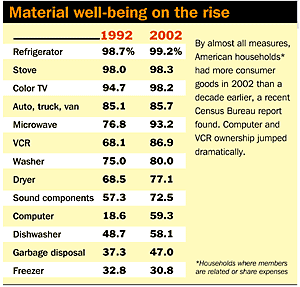
Am Vets picked up just about everything we put out yesterday--nothing was broken, and everything was in good condition and resaleable at their shop. But they will not take a TV or microwave. Too many poor people already have them. They didn't say that, but take a look at this.


HT Randy who found it at the Christian Science Monitor.

"The Census report also compares, from 1992 through 1998, people's perceptions of whether basic needs were being met. More than 92 percent of Americans below the poverty line said they had enough food, as of 1998. Some 86 percent said they had no unmet need for a doctor, 89 percent had no roof leaks, and 87 percent said they had no unpaid rent or mortgage."

Gee whiz. I know middle class folks who have unpaid rent and mortgages!

1963 Thorncrown Chapel receives AIA award

We had a wonderful trip to visit Frank Lloyd Wright and E. Fay Jones buildings last summer, about which I blogged here. The American Institute of Architects has awarded the Thorncrown Chapel in Eureka Springs, Arkansas, which we visited, the 2006 Twenty-Five Year Award for architectural design that has stood the test of time for 25 years.

"The small but soaring glass and cross-braced pine chapel, designed by the late E. Fay Jones, the 1990 AIA Gold Medalist, nestles into an 8 acre woodland setting on a sloping hillside in the Ozark Mountains. It stands 48 ft. with 24 ft. wide by 60 ft long dimensions for a total of 1,440 sq. ft. Its 425 windows, make of 6,000 sq. ft of glass, filter woodland light across its upward diamond-shaped pine trusses to form ever-changing patterns of light and shadow throughout the day and night." AIA Columbus, Dec. 29, 2005.

Approximately 5,000,000 people have visited Thorncrown which is the built dream of Jim Reed, who purchased the land in 1971. When raising money for the chapel, the banks told him that tourists wouldn't come to a glass chapel in his back yard in Arkansas. The Reeds son Doug Reed is currently one of the three pastors at the chapel which is supported by donations. Jim Reed died in 1985 and Jones died in 2004.

Jones's other chapel in the Ozarks, the Mildred B. Cooper Chapel, is also a delight, and one of my blogger links, Hokulea recently visited there for a Christmas service that sounded really special,

"Today the church pianist had a small gathering in her place of employment. She is the manager of the Mildred B. Cooper Memorial Chapel check out the website and catch a glimpse of the gem of our lovely village. The place seats about 100 and was fills with people, most involved with the choirs of their churches. We sang for two hours watching the glorious winter sunset throught the barren trees. It was a delight."


1962 Why New Orleans failed long before Katrina

New Orleans used to have a thriving African American community, according to this article by Joel Kotkin which compares the paths to growth between Houston and New Orleans. It probably answers my general question in my blog about the robust U.S. economy about why so many cities with entrenched poverty also elect Democrats year after year and keep slipping backward.

“But during the 1960s, the push for economic growth that created an upwardly mobile working class was replaced—in New Orleans as well as most other cities —by a new paradigm that emphasized politics. Political agitations promoted various forms of racial redress, and the rights of people to receive government welfare payments. By the late 1970s, African Americans in many American cities had gained more titular power than they’d ever dreamed of, including the mayoralty of New Orleans.

The new political gains of black Americans were widely regarded as a major step toward an improved social status. This coincided with the rise of a new form of urban boosterism—which showcased downtown renewal districts and insisted that the dramatic decline of city quality of life during the 1960s and 1970s had been reversed in the 1980s and 1990s. Urban elites, including in New Orleans, burbled about the vigor of their cities. Right through last year’s Gallup poll, leaders and residents of the Crescent City had (along with San Francisco) one of the highest levels of municipal self-esteem in the country. That now appears sadly delusional.

The truth is that, rather than improving conditions for average residents of their cities, many urban politicians and interest groups have promoted policies that actually exacerbated a metastasizing underclass. Urban liberals tend to blame a shrivelling of Great Society programs for problems in cities. Observers such as former Houston mayor Bob Lanier have suggested, however, that the Great Society impulse itself is what most damaged many cities—by stressing welfare payments and income redistribution, ethnic grievance, and lax policies on issues like crime and homelessness, instead of the creation of a stronger economy.”

Sadly, the needed tax and business and local government reforms will be ignored and instead:

". . .our urban leaders and their enablers—from rich developers to social agitators—will insist their old strategies are working. The media will likely echo their press releases. This will work only until our cities crumble under pressure, as in New Orleans, explode from within, like Paris, or simply become irrelevant anachronisms at the margins of modern society."


Read the whole article in either html or a pdf file complete with pictures.


Friday, December 30, 2005

1961 Remember stories and theater on radio?

Today I followed a link at Jay Kegley’s blog to a free radio site, LibriVox, which provides totally free audiobooks from the public domain. Volunteers record chapters of books in the public domain, and then LibriVox releases the audio files back onto the net (podcast and catalog). Their objective is to make all books in the public domain available, for free, in audio format on the internet.

From that site I clicked through several other free audio sites, including old radio theater. "Bookworm" showcases writers of fiction and poetry. Podiobooks.com will feature your book if you are an author--a good way for you to get an audience. FreeAudio.org was featuring The Law by Frederic Bastiat. “The Law is one of the most important books ever written on the uses and abuses of law. While short, The Law has proven itself time and time again to be life changing to those who read it.” I’d never heard of it, but am finding it very interesting. This site seems to feature titles important to liberty and freedom, and includes Frederick Douglass’ autobiography.

You can spend hours mining these sites for novels, short stories, poetry and essays.

1960 Before and After the Clean-up

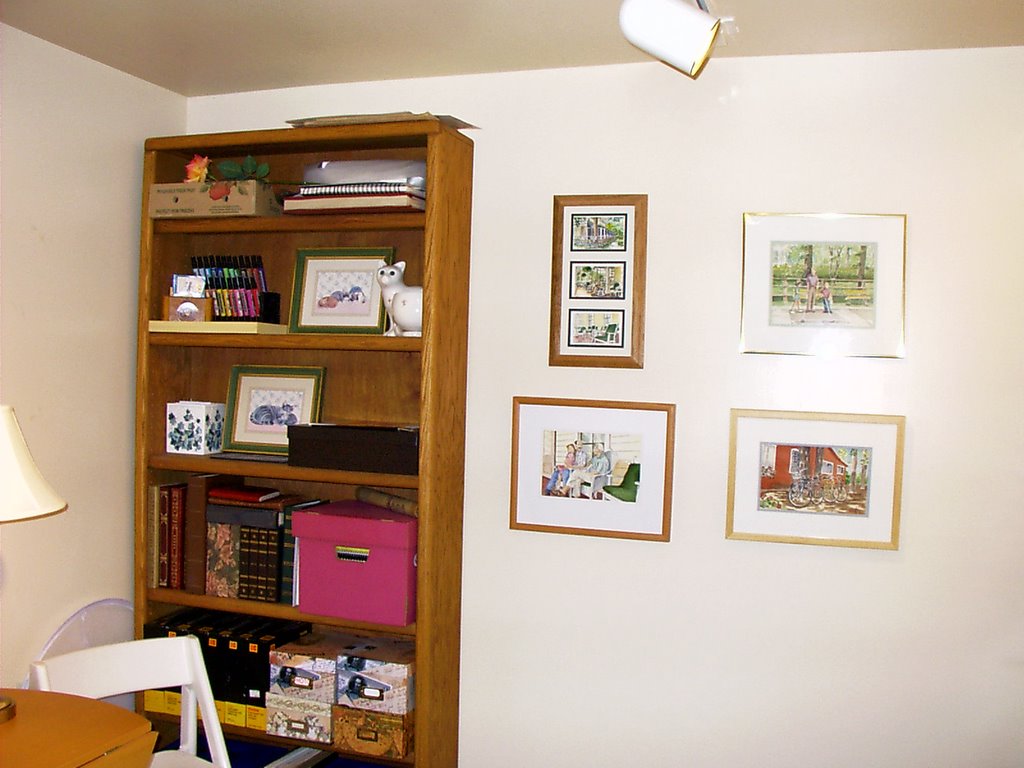
It may be difficult for you to see the difference in these photos, but let me assure you, except for one small tray (filled with rolled pennies, WWJD bracelet, buttons from shirts no longer worn, a high school ID photo, and pens that don't work) which my husband wouldn't give up, these shelves are now functionally organized.

Before the great clean out


After the reorganization


See the mat board in plastic peeking from behind the shelf? It is now resting comfortably in a flat file, which took days to purge. All the books from the bottom shelf (if we could learn to paint by reading books, we'd be making a fortune, but have instead spent one on books) have been moved into the art studio to shelves that were liberated of old notebooks stuffed with specs that were out of date. Then 15 years of American Artist were moved and are neatly shelved by year and month instead of jabber jibber. See all those cameras? They used to be all over the place, sometimes in a case, sometimes not. Now they have friends to keep themselves company. See those little plastic film containers building pyramids like cheerleaders? In the trash--we had about 50. See the box on top of the shelf. It contained slides which have all joined their slide friends in another cabinet behind those louver doors (the kitty litter is also behind those doors and that artificial floral arrangement is to pretend you can't smell it).

Now on the other side of the room is the larger 36" shelf we swapped with our son, and a few items, like those photo boxes were moved there. This shelving unit contains a lot of reference material--magazine photos, Christmas cards, sketches, etc. Also, loaded carousels for painting reference--probably every barn in northern Illinois is in there. The paintings on the wall are mine--all of Lakeside, OH. A mirror would have been nice, but after getting rid of so much stuff, I didn't want to start buying again.


Well, what do you think?


1959 Year-end assessments of the economy

Those of us concerned about the poor will be delighted to read all the year end assessments of the economy. If you were Kedwards people who believed all the sour economic news floated by the DNC during the election of 2004 please know nothing helps the poor more than a good economy--although it does hurt Democrats if they aren‘t in charge because then people aren't beholden to them.

Now that we’re retired on pensions and moving to the bottom quintile again, where we were in our early 20’s, I’m very happy with the thriving economy and am puzzled that liberals who claim to care so much are so unhappy. And it is a mystery to me why the cities with the highest poverty rates keep returning local Democrats to office to run things. You can fool some of the people all of the time, I suppose.

“Remember the 2004 debate over the "jobless recovery" and "outsourcing"? Here's the reality: The great American jobs machine has averaged a net increase of nearly 200,000 new jobs a month this year. Some 4.5 million more Americans are working today than in May of 2003, before the Bush investment tax cuts. The employment expansion in financial services, software design, medical technology and many other growth industries dwarfs the smaller job losses in the domestic auto industry.

Critics of the U.S economic model charge that income gains for workers still have not caught up with the losses from the 2000-2001 high-tech collapse. Now they have. The Treasury Department reported last week that "real hourly wages are up 1.1% versus the previous business cycle peak in early 2001." Workers are now earning more per hour in real terms than they did at the height of the 1990s expansion.” Rodney Dangerfield Revisited in today’s WSJ

Kiplinger’s Personal Finance, Jan. 2006 reports a very positive picture: "As we begin the 50th month of economic growth this new year, not too much has changed. You can expect 3% growth in 2006 to follow the 3.6% of 2005 -- an excellent showing considering the massive hurricanes, record oil prices and relentless Federal Reserve Board interest-rate hikes. . . The U.S. will create two million new jobs in 2006, on top of 1.8 million in 2005, enough to hold the unemployment rate to 5%. With jobs plentiful, employers will add nearly 4% to paychecks. . . Corporate America's balance sheets and profit margins are the strongest they've been since the 1960s, with only a few industries, such as airlines and U.S. automakers, in trouble."


1958 Mere Magazines

In today's Wall Street Journal Dr. Thomas P. Stossel of Harvard Medical School takes on the hypocrisy of some of the top medical and science journals. Recently, some high profile U.S. journals like JAMA, NEJM, and Science have been caught with their data down, publishing articles from India, China and Korea ranging from cloning to stem cell research to nutrition after heart attacks that would never meet FDA scrutiny in the USA because of the limited clinical trials and bad data. His gripe with these journals' editors is that they quick to criticize the pharmaceuticals (i.e. big business that took the risks) but seem to be blind to the power trail in academe or their own flubs.

"Many [academics] would run over their grandmothers to claim priority for a discovery, impose their pet theory on the field, obtain a research grant, win an award or garner a promotion. . . We exercise our ambitions by publishing research papers in journals."

And he concludes: "If reporters understood that journals are magazines, not Holy Scripture. . ." Oh I love that.

I can't find a free link to Dr. Stossel's article, but here's one he wrote for Forbes with similar information and different details called "Free the Scienctists."


1957 Book Club selection for January

This coming month's selection is "Beyond the River" by Ann Hagedorn. The subtitle: the untold story of the heroes of the underground railroad. The action takes place in Ripley, Ohio, across the river from Kentucky--a free state and a slave state. I'm not far into the book, but the writing is good and draws the reader into the story immediately with setting the scene and building the characters. However, when I read about this era, which according to Hagedorn begins in the 18th century with people who were against slavery and believed they were born to change the world, I can't help think of our current battle between the pro-life and pro-choice forces. What is a life and what is its value. There are many paragraphs that with a few word changes could describe our politics today, where every court nominee depends on what was said about abortion 20 years ago in some clerking memo.

"As news of the Missouri Compromise reached Carlisle, Kentucky, where [John] Rankin lived, and nearby Concord, where he preached, Rankin felt the pulse of his community quicken. He sensed the anger in the hearts of slave owners and the frustration among antislavery advocates when he stood at the pulpit seeking to prove that slavery was as great a crime against the laws of God as murder, and arguing that every slaveholder must free his slaves to adhere to the teachings of the Scriptures..."

Also, I'll need to check my Family Tree database. John Rankin was born in East Tennessee in 1793, and that's where my family's ancestors settled after service in the Revolution (Scots-Irish who hated the British), and I think I remember some Rankins in the family.

Thursday, December 29, 2005

1956 Bush book critics

Over the holidays, the President is reading "When Trumpets Call, Theodore Roosevelt After The White House," by Patricia O'Toole, and "Imperial Grunt, The American Military On The Ground," by Robert Kaplan. A talk show hostess like Oprah can recommend anything and the MSM falls all over her. But every time it is reported in the news that the President is reading a particular title, some literary snob jumps in and makes snide remarks about his choices, his ability to read, his grades in college, or his conclusions.

The president enjoys reading biography, history, military science and economics, and Literary Saloon reacts predictably--doesn't think he can read two books, and doesn't believe he is an avid reader. She/He probably believed Kerry's opinion about the worst economy since the Depression. If you hate Bush, you'll believe--or not believe--anything. This summer when he was reading "The Great Influenza: The Epic Story of the Deadliest Plague in History," "Salt: A World History" and "Alexander II: The Last Great Tsar" journalists and critics were "reading" all sorts of strange things into his choices. Oh yes, and they criticize him for not watching their newscasts. Reads and doesn't watch TV. Sounds smart to me.

But at least "Saloon," the blog of Complete Review, knows what it is: "The Complete Review makes no claims whatsoever to any form of objectivity in its reviews and opinions. We acknowledge that the biases and personal views of the editors colour all aspects of this site." That's refreshing, isn't it?

1955 A wonderful love story

between a brother and sister that will have you laughing and crying at the same time. Read Jake's story about the mysterious Christmas puzzles.

1954 Podcast is Word of the Year

Nathan Bierma who writes "On language" for Chicago Tribune reports:

"The editors of the New Oxford American Dictionary have validated the sudden spread of podcasting by naming "podcast" the Word of the Year for 2005.

"Podcast," defined as "a digital recording of a radio broadcast or similar program, made available on the Internet for downloading to a personal audio player," will be added to the next edition of the New Oxford American Dictionary.

The word originated as a play on the word "broadcast" using the name of Apple's popular handheld digital music player, the iPod."

He goes on to say that the word "pod" isn't from the Greek, as in "podiatrist," but rather, "The word "pod" began as "cod" in Old English, meaning "the husk or outer covering of any fruit or seed." The 'pod' spelling isn't recorded until 1688, according to the Oxford English Dictionary." No one seems to know why the P replaced the C, but apparently numerous English words meaning swollen or protruding start with the letter P, but let's not go there.

1952 The Travesty of Daniel

Insulting, demeaning programming about Christians wouldn't be so bad if there were anything to balance it. Like a show about an actual Christian who wasn't a ghost or an angel. The new NBC show, Book of Daniel, about a dysfunctional Episcopal priest is supposed to "edgy," "challenging" and "courageous." Yea, and I'm Madonna in a reality show about Detroit. The series is written by Jack Kenny, a non-Christian who describes himself as being "in Catholic recovery," and is interested in Buddhist teachings about reincarnation and isn't sure exactly how he defines God and/or Jesus. "I don't necessarily know that all the myth surrounding him (Jesus) is true," he said.

All you can do is turn it off--not just the show, but the whole channel--or write to the advertisers and let them know you will vote for this show with your non-dollars. Complaining to NBC will probably just give it more publicity. You know how the liberals love to whine about censorship.

1951 Just about packed up

We decided to rearrange and repack and give-away, and I've written about that ordeal here and here. AmVets are supposed to come tomorrow to pick it all up, and we've taken everything to the garage, hoping we don't have to move that car today. And I use the royal "we" here because everything was too heavy for me to carry.

I think there is over $10,000 of drapes in the pile--however, used drapes have no value especially if they've been created for specific windows. And there are size 37 sport coats and suits, an almost new pair of black loafers that hurt my feet, bright fuschia Capri pants size 8 with an even wilder top (what was I thinking?), winter sweaters, Hawaiian shirts, a 20 cup coffee maker, about 50 8-track tapes, pictures in frames, a double bedspread with matching pillow shams, twin bed skirts, two director's chairs, b & w TV, microwave, books, toys, a number of cookie tins nesting, notebooks and paper and pencils, portable typewriter, a tall chair for a drawing table, and other stuff I've already forgotten. Three 40 gallon trash bags of shredded documents went out with the trash pick-up this morning.
Some things were rescued and redistributed--like jewelry from the 70s and 80s to a niece who can reuse the beads in her art, and itty bitty figurines and toys for a friend who makes dioramas. We pulled out a framed photo of the Columbus skyline at the last minute deciding we could reuse the frame.

This is going to feel good when my muscles stop hurting.


1950 Hostile aggressive drivers

are also hostile and aggressive in other areas of their lives and are also more likely to drink and drive, according to a report I heard this morning on drivers from 18-45. I guess we knew that intuitively, didn't we? So when you hear the squealing tires, the horn blaring, and you get the finger, just imagine what his wife and kids are putting up with.

1949 Love cats, and the occasional dog

This is a thought from the writer Anne Lamott, in "Mothers who think," July 22, 1999, www.salon.com.

"If you hang around sober alcoholics long enough, you will hear at least a few of them pronounce that God's will for them is to be happy, joyous and free. I personally believe that this is a bit of a stretch, or at any rate, a very American conviction. My priest friend Tom Weston says that God's will for each of us is to have a life. "And it is up to us to go and get one. Find some work, some love, some play. Taste things. Be of service. Feed the hungry and clean the beaches and clothe the naked and work for justice. Love God, love your neighbor. Help build a world where it is safe to be a child, and where it is safe to grow old. And love cats, and the occasional dog." I think this pretty much says it."

Wednesday, December 28, 2005

1948 Are there two of you under one roof?

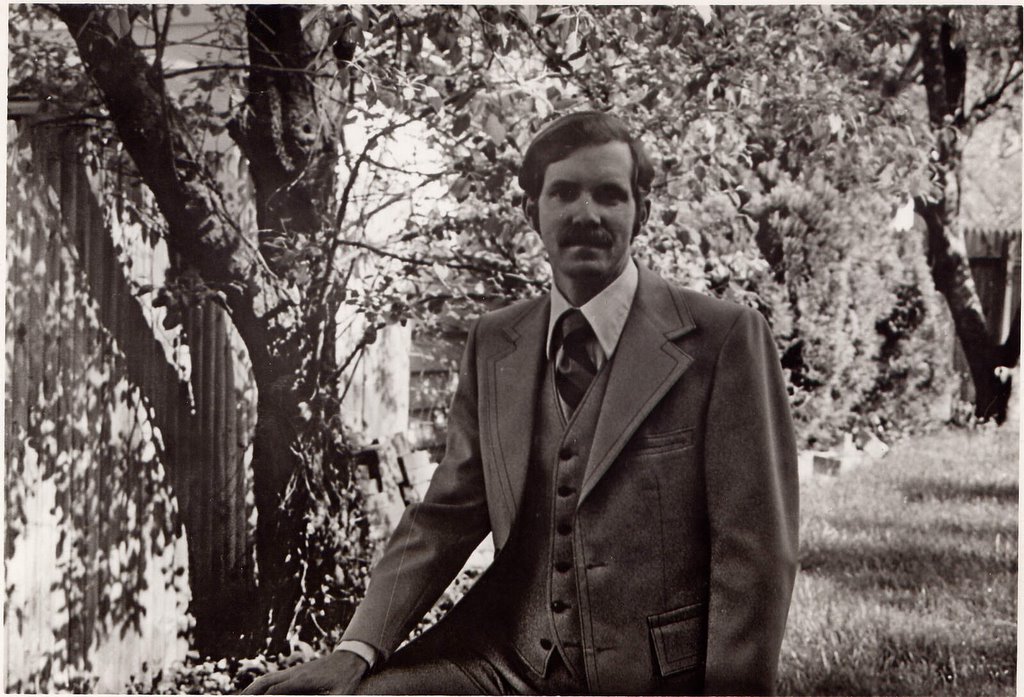
For over a week, we have been discarding, rearranging and repacking our files, books, art work, church records and memorabilia. All so I can move my drawing table and art space into the family room/husband's office which has nice north light. If you have two musicians, or two artists, or two doctors in your house, you will understand the problem. We are two organizers trying to share space. My husband is more tidy, but I'm the better organizer. I can think alphabetically, chronologically or by keyword. But all three mushed together drives me crazy. After he was hitting the home stretch yesterday (I'm not even close), I took a peek. I looked inside a box labeled, "Hawaii and stuff." I found some papers from church workshops of 30 years ago, never looked at after the event; some black and white photos of my husband when he had hair and polyester suits; a 1994 NCARB memo; a 17 year old letter; and some items from our 1985 trip to Hawaii.

When I looked at the boxes and boxes of old financial records, I discovered not only did we have all the cancelled checks, but all the invoices, bills, and statements too. He was too discouraged by my displeasure to even think about another reorganization, so I went to Staples and bought a small paper shredder, and am going through about 15 years worth of bills, etc. I have no idea where the first 30 years are--but apparently I've done this before. I decided to shred them because of all the account numbers. They don't mean anything to me, but with the ever growing number of databases on the internet tracking us, I just didn't want them floating around the garbage dump, or where ever these will finally be buried or incinerated.

Earlier in the month I'd planned to hire my friend Bev to reorganize us, but now see the folly of that idea. We got ourselves into this, and no professional organizer (or marriage counselor) will get us out. But Bev, there is still the garage! It is very tidy, but I can't find anything in it because he organized it.

Here's the polyester suit. I also found the bill for the removal of the two apple trees that show in this photo which happened about 20 years later.

Tuesday, December 27, 2005

1947 Women can’t take this anymore!

NOW and the Feminist Majority have launched Enraged and Engaged as part of Freedom Winter '06 to stop the confirmation of “extremist” Samuel Alito to the U.S. Supreme Court. So watch out for some funny stuff because I’ve read through their news items with all the alarmist words, but can find not one single specific thing they can point to--just the usual “call your Senator, send e-mails, send us money, lots of money” rant, rave and hoop-la.


1946 The Road to Kelo is paved with wheat

"Beginning with its 1938 term, the Court actively promoted broad national authority over economic and social affairs, at the expense of state power. The justices relied on novel and expansive interpretations of the spending and taxing power, the general welfare clause, and, above all, congressional power over interstate commerce. The high point (or low, depending on your perspective) occurred in Wickard v. Filburn (1942), where the Court decided that even wheat grown by a farmer for his own consumption was nevertheless in interstate commerce and therefore subject to federal control. After Wickard, it was hard to see how any activity, no matter how small or remote from national interest, could escape potential federal regulation. The idea that the federal government was a government of limited powers gradually disappeared, with the approbation of the federal judiciary."

As we move toward the Alito hearings, this is an interesting summary of the 2005 Supreme Court and how we got here. "John Roberts will be an improvement, but one vote is still only one vote—which is why the battle over the next vacancy will be so bloody."

Monday, December 26, 2005

1945 A mother's poem for her sons at war

One of the boxes I pushed around today was genealogy, and I found a poem written by my grandmother in 1945. The hand writing was my aunt Marian's because my grandmother was blind. She had three sons in the service during WWII. I've been seeing a lot of service people sending holiday greetings, so here's to all of you who wait for them to come home. You're not alone.

As I sit alone,
thinking back over time,
I recall pleasant memories
that once were mine.

When I rocked two little boys,
One in each arm,
and tucked them in bed
without fear of harm.

A few years later
the third son was there
to occupy his place
in the old rocking chair.

Little did I think then
that the day would come when
they would all be scattered afar
to serve in this awful war.

Poor John fights desperately
to see Germany collapse,
while Howard guards our shores
from those terrible Japs.

Joe Russell will fight on
Till the battle is won,
and the last Japanese
is brought to his knees.

To myself, and all mothers I say,
be patient, and brave,
and never cease to pray
until the boys come home to stay.

1944 A visit from the puppy

Our cat hissed and ran up to the landing. Meanwhile, the little 4 month old Chihuahua carefully stepped out of her carrier, sniffed and barked. She's adorable. Lots of personality.

1943 Student story is a hoax

A U Mass student reported that agents from the Department of Homeland Security had visited him at home simply because he had tried to borrow Mao Tse-Tung's "Little Red Book" for a history seminar on totalitarian goverments.

"The story, first reported in last Saturday's New Bedford Standard-Times, was picked up by other news organizations, prompted diatribes on left-wing and right-wing blogs, and even turned up in an op-ed piece written by Senator Edward M. Kennedy in the Globe.

But yesterday, the student confessed that he had made it up after being confronted by the professor who had repeated the story to a Standard-Times reporter."

Story here. HT Conservator

Even Ted Kennedy was taken in and commented on it in his column blaming the Bush administration's intrusion on civil liberties. Laura Capps, a Kennedy spokeswoman, said even if the student's story was a lie, it did not detract from Kennedy's broader point that the Bush administration has gone too far in engaging in surveillance. My, that has a familiar ring to it doesn't it--sort of like the forged documents and Dan Rather. The truth doesn't matter--only the assertion that it could be true.

1942 Digging deep, piling high

Repacking boxes is just no fun. My back hurts and I think I pulled a muscle. I'll sit and write for a few moments--a blogrest. I keep finding things I'd forgotten about, but once I find them, I think I should reread them--especially if I wrote it. With lunch today I read an article by Utley (Francis Lee): "The one hundred and three names of Noah’s wife," Speculum 16, 1941, pp. 426–52. I'd printed it out from JSTOR in 1999, read it, filed it with unrelated stuff, and found it today.

Then I came across 8 pages (there was more but can't find it) I wrote in 1990 after attending a program on libraries and literacy. It was in preparation for the 1991 White House Conference on libraries and literacy. In 1990 I was still a left of center liberal and a Democrat, but I was obviously puzzled that librarians, with all they had to do, were taking on the responsibility for literacy, which clearly is a job that has been assigned to the schools. Reading through it, I see not much has changed--except computers and internet access. Now librarians teach the public computer literacy.

"Librarians have created every imaginable network, coalition, association, and service organization to lure people into their libraries, but they haven't been able to keep libraries in the schools, not even with all the dues we pay. We can't even get a librarian appointed as the Librarian of Congress."


"On October 1 (1990) the Wall Street Journal reported on the drop in literacy among school age children--even those whose mothers had spent hours reading to them as pre-schoolers. Children are too busy to read because of all their outside activities, no one converses with them, and they have developed two minute attention spans through TV and videos, concluded the article. So what is my public library offering this week? Four different programs using movies, three for pre-schoolers and one for elementary age, and three different craft programs for Halloween. Librarians didn't know how to lick the competition for children's time and attention, so they joined the opposition."


"One of my concerns as an academic librarian is not that my students are illiterate, in the sense they can't read, but they don't seem to be book literate. I use our Closed Reserve material heavily for answering reference questions. For example, I pull off a book on feline medicine to answer a question on anesthesia and hand it to the student. She eagerly begins leafing through it. I gently stop her. "Here, let me show you how to use this. Here is the index; look up the surgical technique or the name of the anesthetic. Here is the table of contents; it will show you how the book is arranged. See these little numbers? They will refer you to more things you can read at the end of every chapter." And I am surprised each and every time I hear myself explaining to a college graduate how a book is put together."


". . .libraries will be killed off too if they don't put the brakes on seeing themselves as the social change agent for the nation, believing: they can correct what the churches did wrong; they can teach what the schools didn't; they can prevent what the social workers missed; and stop what the government couldn't. . . Librarians will do more good in the long run if they leave Mapplethorp to the cultural arts commissions and instead see to it that a child can check out material on photography to become the best photographer she can be."


I was leaving the fold and didn't even know it!


1991 White House Conference on Library and Information Services

1941 Mrs. Felker's Sunday Coffee Cake

Friday night we went out to eat with Joyce and Bill and then we stopped here for dessert. Joyce presented us with a lovely wrapped loaf coffee cake which was nice. However, when I opened it Christmas morning and had a taste, I was pretty sure I recognized Mrs. Felker's coffee cake from the drug store in Mt. Morris, IL. Both the Felker's and Zickuhr's Drug Stores had lunch counters managed by the wives of the pharmacists. They were the after school hangouts for the high school kids and the Monday morning quarterbacks. They were wonderful pieces of Americana, now gone. I worked at Zickuhr's in high school and during college breaks, and I think one of my sisters worked at Felker's.

I put together a family cookbook in 1993 for a family reunion ten years after the death of my grandparents who had been married 71 years when they died in 1983. Each member of the family was asked to submit a recipe with a brief comment. Some contributed more than one, some not at all, but my sister-in-law submitted "Mrs. Felker's Sunday Coffee Cake" because she had worked there at one time in the 1960s and knew how popular it was. I've only made it once, for a wedding breakfast, and it truly is the most delicious coffee cakes east of the Mississippi. I'll ask Joyce the next time I see her, but I'm pretty sure this is it.

Sift together:
2 cups sifted cake flour
1/4 tsp. salt
1 1/2 tsp. baking powder
Cream well:
1 1/2 cup sugar
1 1/2 sticks of butter
Add, beating well:
2 eggs
1 tsp. vanilla
Mix in by hand:
1 small carton of sour cream
Set aside:
1/2 cup chopped pecans
Topping mix:
6 Tbsp. sugar
1 tsp. cinnamon
1/2 tsp. unsweetened cocoa
2 1/2 tsp. butter

Add the dry ingredients to the creamed mixture. Grease and flour an angel food pan. Spoon in half of the batter. Sprinkle with 1/2 of the topping mix plus 1/4 cup of chopped pecans. Spoon on remaining of batter and the rest of the topping mix, plus 1/4 cup of pecans. Bake at 350 degrees for 55-60 minutes.

This coffee cake was a regular feature at the lunch counter on Sunday mornings at Felker's Pharmacy in Mt. Morris, IL before it was removed.

Sunday, December 25, 2005

1940 Face Recognition needs some tweaking--I hope

MyHeritage.com has a face recognition site where you can be matched with celebrity photos. It thought my husband looked like Hilary Clinton (when he was in high school, had red curly hair and weighed 120 lbs.) and that in 2003 I looked like the young Britney Spears when I had medium blonde hair. But in a 2004 photo when I had longer brown hair, my celebrity face was Yasser Arafat! If it is measuring face maps for genealogical purposes, it is quite a distance from Arafat to Spears! So I tried a third photo and got Kim Jong Il.

I Googled Mr. Kim and found this out: "Say what you like about Kim Jong Il's appearance -- at least it's distinctive. Absolutely no one in North Korea ever has to ask "Who's that squat little man in the glasses and khaki windbreaker?" Also, there's his signature hairstyle. The dictator artfully conceals his diminutive stature by wearing platform shoes and whipping his hair into stiff peaks. So what if the autocrat feels a little self-conscious about his height? That's understandable -- he's only 5'2". Napoleon was four inches taller. . ."

I tried a fourth photo and got Harry Belafonte. So I sent them some feedback. Four different ethnicities?

HT Daddy's Roses.

1939 A glorious Christmas morning

We were communion servers this morning and that is always such a privilege. There was only one service instead of four (there were probably 10 or 12 last night), and it was quite full. It is so wonderful to hand the bread and wine to a person who comes to the rail looking like he is at death's door (and aren't we all?), and see his face light up with peace when I say, "The body of Christ given for you," and my husband then says, "The blood of Christ shed for you." Particularly the elderly seem to really understand the gift--many can't kneel so they just stand and smile. Perhaps you need a lifetime of thinking about this.

When we were putting on our robes in the back room, the lector, who had to read the OT lesson (Isaiah 52:7-10), the NT lesson (Hebrews 1:1-9) and the Gospel (John 1:1-14), said, "I've been doing this since 1963 and I still get stage fright (although he used a much more colorful expression dealing with bodily functions).

And Tony Gonzaga sang "O Holy Night," and that's worth the trip in the rain and cold right there. Our choir loft is in the back of the church, but he could have been three blocks away and we would've heard him. And we got to sing out of the hymnals which only happens about once a year (screens have words but no music), and say the Nicene Creed, and hear the liturgy. Yes, a lovely Christmas morning.

1938 We think she's the one


After a year of grieving the loss of her beloved Chihuahua (who lived about 17 years), our daughter and son-in-law visited a 4 month old at the breeder's home, and decided she's the one. They were not getting their hopes up--were waiting to see her and interact. Here she is. They'll pick her up tomorrow.

1937 Is Detroit differently abled?

Detroit's handicapped stickers, placards and hanging tags are on the increase causing a serious problem for handicapped finding parking places, according to this article in the Detroit News.

"The number of drivers with disability license plates, placards or free-parking decals jumped 17 percent from 2000 to 2004, while the state's population grew only 1.8 percent, according to the U.S. Census. Today, more than 10 percent of Michigan's 7.2 million drivers have a disability designation. The Secretary of State runs the program."

Disability advocates say the causes include growing over-65 age group which grew 10 percent from 1990 to 2000. . . African-Americans and Hispanics nationwide have higher rates of disability and 82% of Detroit residents are black and the city's Hispanic population is growing. . . 33 percent of residents live in poverty and nearly 30 percent of Detroit's workers are employed in the manufacturing, construction and transportation/warehousing industries which tend to have higher rates of injuries.

I might add, if you build them (handicap accessible parking spots) they will come. I don't know how it's done in Michigan, but I know relatives and friends of disabled or elderly people who have the tag and sticker because they supply the transportation. Many disabled people don't drive at all because they can't see or use their arms, legs or hands well enough to drive. However, their drivers don't use the service just when the relative or friend is with them, but all the time just for the convenience of getting a parking place close to a restaurant or shop.

HT to Perry Peterson, another retiree blogger.

Saturday, December 24, 2005

1936 Outsourcing education

While I was Christmas shopping this week I noticed that all the labels on sheets, blankets, and towels at Macy's were from India and Pakistan. Global competition isn't new, but it did make me remember what a healthy textile industry we used to have in the United States. It isn't my intention to research this topic right now because I'd be in way over my head trying to sort out NAFTA, improved technology, role of unions and environmental regulations, and trade agreements, but here's a site for North Carolina that does present some positives and negatives in the textile industry.

What I did sit up and take notice of was an article in Kiplinger's about outsourcing math and science tutoring to India. Growing Stars is a California based on-line tutoring service which uses Indian tutors with American English accents. They charge $20 an hour, which is about half the rate you'd pay if you used a homegrown math genius for Susie. Smarthinking in Washington DC also uses foreign tutors from Chile, India and the Philippines who were educated in the United States.

1935 Vince Morris returns to Columbus

Didn't know he left--didn't know he existed, but now he's back and playing at the Funny Bone at Easton Town Center (I also didn't know that our comedy club had moved--I'm so behind).

Anyway, it is reported that he will have material on everything from ignorance and self-respect to hip hop, and he's thought provoking, but not preachy.

Big deal. So's my blog. Well, maybe I'm just a leeeetle bit preachy and I'm hip-hop-lite, but I'm all that other stuff and no one will pay $15 to see me blog.

1934 Does your chewing gum lose its flavor on the bedpost overnight?

That sad old hillbilly song may have to be updated.


It is reported that Kenny Chesney told Life in October that the break up of his marriage to Renee Zellweger was "like opening the door of your house and having someone come in and take your big-screen TV off the wall during the big game, and there's nothing you can do about it."

My toe is tapping along with the keys, but I haven't quite got the tune.

1933 Dear Donna Sapolin

Actually, I may address this letter to Laura Dye Lang. Ms. Sapolin is the Editor-in-Chief of Home and Ms. Dye Lang is the Executive Editor. Magazines have the most bloated titles you've ever read, but that's another blog. This one isn't about that, but is about a suggestion made in the January/February 2006 issue, a suggestion I'm seeing more frequently as print magazines have tie-ins with their websites. So here's my draft:


I see you tell your readers to go to their local library to use the internet to set up a free e-mail account and then visit your website to get into a contest for free giveaways.

As you at Hachette Filipacchi Media well know, these giveaways aren't "free" for your company. Neither are libraries. The library staff will have to assist anyone who doesn't understand simple computer functions (using a mouse, pressing the enter key, finding a login and password that works, to say nothing of going through the advice they'll need to even find a free e-mail website, etc.) This could take 15-30 minutes of staff time depending on the level of comprehension or computer savvy of the client. And if they don't have a computer and are relying on the library, that ability may be fairly limited.

Don't get me wrong, the library staff are willing to help, but perhaps if libraries are helping you, you could help them by reminding your readers to support their local libraries when bond issues or levies roll around. You could maybe work in some decorating themes or ideas for homey furniture groupings in libraries."


Well, it needs a little work, but that's what I've got so far. It is in response to this item on p. 18 with instructions for entering a "giveaway" sponsored by the magazine where the details and rules were only posted on-line. "If you don't have internet access, inquire at your local library about how to set up a free e-mail account, and then visit our website. No purchase necessary to enter or win."

1932 A change of menu plans

Did I tell you what happened to my wonderful $26 standing rib roast (it was on special so I bought it about a month ago). When I took it out of the garage refrigerator/freezer Thursday it was soft! I nearly died. Also about $12 worth of chicken. Had to dump it all because I didn't know when it happened. The turkey was rock solid in November--took about 5 days to thaw in the frig and even then had some ice crystals in that bag of gunk I always toss. So I don't know when the freezer died. So it will be a boneless pork roast with cranberry topping for our Christma Eve dinner tonight, which is too bad because my daughter's serving that Sunday (in Cleveland) when they visit her in-laws. Then I'm also having the festive Christmas salad (cauliflower, broccoli, cherry tomatoes, and hard cooked eggs), spiced honey carrots, apple/onion dressing, something-potatoes (haven't decided) and pumpkin pie. I think the nice bread I had frozen will probably be too stale, so I'll have to do a bit of shopping this morning.

I love to get out the china and crystal and silver(plate), and say hello to all the visiting memories of Mom, grandma, my husband's grandmother, my sisters, all of whom either passed down or gifted some lovely pieces, rarely used but always appreciated.

Friday, December 23, 2005

1931 Wouldn't this add to the cost of your couch?

Home Magazine's latest issue suggests buying a $600, 4 megapixel digital camera to take with you when shopping for furniture, then you can send the photo to a friend for instant suggestions or confirmation on your choice. p. 33. If you're that insecure, spend the $600 on an interior designer.

Thursday, December 22, 2005

1930 Pieces of string and bad photographs

Years ago I heard a story (maybe on Paul Harvey) about a frugal lady who died. In cleaning out her home her children found a ball of string labeled, "Pieces of string too short to use." We are in the midst of a huge housecleaning and room shift, which involves all our art materials, paper scraps, old references from yellowed newspapers, dried up watercolor tubes, maskoid and gesso that's looking doubtful, old supply catalogs and rusty paper clips. I found a large file box full of photos and negatives that we'd forgotten about because we stored it so well. So I'm trying to sort and pitch. I found one envelop labeled, "Bad photos of paintings." Obviously, my frugal husband's work.

We also traded a small 24" bookshelf for a larger 36" one with our son. Originally, the whole set was ours, but one unit was too big, we thought, and let him use it when we moved here. Now after rearranging, we have room for the larger one, but not the smaller unit. So my husband drove there today and made the trade. After some struggle and maneuvering, we got it past light fixtures and down a turning staircase and set up where we wanted it. As it warmed up from the cold, the entire lower level of our house began to smell like cigarette smoke. If wood absorbs this much smoke in 4 years and has to gas out, imagine what's happening to his lungs, liver, kidneys, skin, hair, tongue, etc. which have been enduring this torture for over 20 years. Sigh. And I took such good care of him as he was growing up.

Disclaimer: he reads my blog.

1929 Instructions for writing to Santa Claus

The Post Office will help here.

If first mistyped this, "Stanta." Which reminds me, I almost got a letter from Stan last week. He wrote a note on an envelop in which he'd placed something and inserted it in the Christmas card. I'm going to save it and put it with the one he wrote me in 1967.

HT Michael, the Library Despot.

Wednesday, December 21, 2005

1928 The Crunk Awards

This website "Regret the errors" lists corrections in the news--like writing "Jew Jersey" instead of New Jersey, "socialist" instead of socialite and "beef panties" instead of beef patties. The typos get corrected--the media myths that I listed earlier, are just left dangling out there to continue confusing the public.

HT to ACRLog.

1927 A second look at the public library collection

Yesterday I mentioned that there was only one evangelical Christian magazine subscription at our public library, quite lopsided when compared to what might loosely be called the "popular arts" serials. Today I went back and looked at books. There were two titles, both from the early 60s on Lutheranism. Maybe three on Methodists and Baptists, several shelves of Catholicism, and 5-10 each on Amish and Shakers. Except for the Amish books, all looked pretty old just viewing the shelves. I'm not sure what is out there on the history of Lutherans in the United States, but I'm sure something's been published since the early 60s--there have been numerous mergers of synods, if nothing else. Lutherans were pretty clanish and ethnic, so I don't think they had as strong an influence as Methodists (the great awakenings, abolition of slavery, temperance movement, woman's movement) on the American culture. However, this community has one of the larger Lutheran churches in the country and there is a Lutheran college and seminary in Columbus.

Then I stepped into the huge video/DVD section to look at those journals (they are separate from the general content journals) and here's what I found:

Absolute sound
Air Fare (WOSU)
Animation
Box Office
Camcorder
Camcorder and computer video
Cineaste
C.F.Q.
Cinefex
Electronic gaming
Emmy
Entertainment
Film Comment
Film Quarterly
Film Maker
Films of the Golden Age
Gramophone
Guitar Player
Guitar World
Jazz times
Keyboard
Mojo
Hollywood life
Perfect Vision
Premiere
Rolling Stone
Sight and Sound
Sound and Vision
Stereophile
Take One
Widescreen Review

In the other journal section of the reference room there are two Mac and four PC journals, that I noticed. I don't think I'm comparing apples and oranges here. I'm looking at the total serial budget (something the librarians apparently haven't done) and am asking does this breakout reflect the activities and interests of the community, or a few people on the staff? There are two golf titles and three boating titles--and even those seem a bit stunted compared to the popular culture/entertainment titles.

When I was the vet librarian at Ohio State, if I'd purchased one title on dogs and 31 on llamas just because I liked or raised llamas, I think I would have been fired. (Actually, there aren't 31 health or breed journals on llamas--or there wasn't in the 1990s--so this is just hyperbole to make a point, just in case you are a librarian who's a stickler for detail.)

1926 Is there a doctor in the house?

Your house? The December 7 JAMA has a review of "Seventy five books from the Osler Library" edited by Faith Wallis and Pamela Miller, $40, ISBN 07717-0625-1. It's probably too late for Christmas, but perhaps an IOU? The Library is at McGill University in Montreal. The reviewer, Elizabeth Fee, is from the History of Medicine Division of NIH and comments:

"gorgeous book"
"polished little miniatures of scholarly erudition"
"well designed"
"fine quality paper"
"some surprises"
"exquisitely decorated manuscript"
"delightfully illustrated"
"sprinkling of curiosities"
"elegant little essays"

The reviewer suggests that doctors buy it for their waiting rooms as an engaging alternative to People, Time and Fortune.

1925 December 21st, a poem

I posted this two years ago, and here it is, December 21 again.

Christmas will be here in only four days.
House is festive--we found the artificial poinsettia
in the attic with other mementoes of holidays past.
A big roll of wrapping paper--blue with snowmen--and scissors
wait on the dining room table for those final exchange gifts
we’ll take to Indiana, socks for a guy, gloves for a girl.
The decorative shopping bag waits for its next assignment.

Christmas will be here in only three days.
It’s always been a pagan holiday, but now it’s more so.
The cranky ACLU is just spinning its wheels in snow
because not even Christians can make it religious these days.
Mistletoe, holly, evergreen trees, candles, and Santa Claus,
feasting, caroling, office parties, gift giving and shopping.
It’s all worldly or completely secular, therefore legal.

Christmas will be here in only two days.
The early Christians scooped up local winter festivities
in a giant snowball, soft and white, and pronounced it holy.
The godly let the Angles, Saxons and Romans keep their ways.
People do not care who they worship if they have a good time.
Our Puritan forefathers tried to stamp out the revelry.
They were the nay sayers of yesterday, spoiling the party.

Christmas will be here in only one day.
Yes, there really is a new born babe, and a sweet young mother,
and angels announcing to shepherds in the fields, Peace on Earth.
But Rachel is weeping because Herod is killing her sons.
One baby lives on only to die on a cross for my sin,
including celebrating his coming rather than going,
his birth, not his death and resurrection.


Tuesday, December 20, 2005

1924 Need a score card

Today I got the e-newsletter from the Graduate School of Library and Information Sciences at the University of Illinois (GSLIS). Before they ask alumni for money, they always tell you about new stuff. I think I'll need a score card to keep the degree programs straight, and I don't think I know what social entrepreneurship, community informatics, or bioinformatics mean. But if you were thinking about what we used to call librarianship (we got a Christmas card today from someone who said she was), here's what's new[from the newsletter]

Chicago-Based MS Track in Community Informatics
In fall 2006, incoming Chicago-based students will be the first to participate in a new MS track in Community Informatics (CI). The program was first conceived of through ongoing collaborations between the Puerto Rican Cultural Center (PRCC) in Chicago's Humboldt Park and the GSLIS Community Informatics Initiative. . . The CI track will emphasize social entrepreneurship and community library and information service, and provide opportunities for both Chicago-based and on-campus students to create innovative information services, implemented within and across a range of community-based and public interest organizations. For more information, visit: http://www.prairienet.org/cii/public_engagement.htm

Master of Science in Bioinformatics
As a professional school specializing in information management and systems, GSLIS is a natural fit to offer a concentration within the campus-wide M.S. in Bioinformatics. In the GSLIS Concentration in Bioinformatics (GCB), students may take courses in several departments across the University of Illinois campus. This breadth of training provides students with the multidisciplinary skills that are required for a career developing and managing information systems for the biological community. The program provides training from faculty who are international experts in many areas of information management, including bioinformatics, biology, chemistry, statistics, and computer science. The GCB is an entirely separate program from the existing GSLIS M.S. degree, and the new concentration is not accredited by the American Library Association. Final approval of the program is expected in early 2006. For more information, visit http://www.lis.uiuc.edu later this spring.

Certificate of Advanced Study in Digital Libraries
In fall of 2005, GSLIS welcomed the first cohort of students into the Certificate of Advanced Study in Digital Libraries program. These students have come to us with advanced degrees in a wide range of disciplines including LIS, CS, Physics, English, History and Mathematics. For more information, visit: http://www.lis.uiuc.edu/programs/cas-dl.html