Sunday, March 05, 2006

2241 You've probably met Mr. Pyle

Whether you're a teacher, or a librarian, or a store manager, or a supervisor of a brake shop, you've got one of these guys to deal with. They make going to work generate thoughts of changing jobs. This one happens to be a special ed teacher. He's always expecting someone else to be doing his job.

"The guy is a poster child for what is wrong with a minority of teachers, specifically in special education. Teaching is hard work, no doubt about it. Most of us roll up our sleeves and go to work doing many thankless tasks. But there are some who will whine and complain about every single thing and then wonder why they don’t get paid more. It’s for the kids. We serve them and their parents, not the other way around."

However, The life that chose me will certainly give you a new appreciation for special ed teachers. To see what his "typical day" is like scroll to the bottom of this page.

Saturday, March 04, 2006

2240 My navel and my jaw

Looking through vocal sites on the internet, I came across The Vocalist.org site with all sorts of drop down windows and some instructions on breathing, and listening, and exercising. I think I know how to think about my jaw, but I've never had to imagine my navel, except maybe when pregnant when it was moving on ahead of the rest of my body. Therefore, I'm having some difficulty figuring out just where this pipe organ is.

"The two places to think about are:

Lower abdomen
Jaw

All the support should come from the lower abdomen. That's where it should all be "happening". Think about anything above the navel as a huge flexible organ pipe. You shouldn't be doing anything conscious with muscles above the navel until you get to the jaw. Everything in between should work on its own without your intervention if you get the lower abdomen working (this is an oversimplification - but let's stick with it at the moment - basically, what you're going to do above the navel and below the jaw has more to do with POSTURE and allowing things to do what they do naturally by NOT trying to interfere than with actively trying to control anything - INCLUDING the diaphragm).

The jaw needs to work like a well-oiled hinge. This means no rigidity, no tension, no clamping shut nor forcing too far open. The tension you feel in your throat, I am willing to bet, is due in large part to tension in the jaw and the back of the tongue ("throat" tension usually means back of tongue tension, which is directly influenced by jaw tension). Secondarily, if your chest is "collapsed" rather than lifted (not forced up muscularly, but *lifted* - a sense that you're gently lifting the breastbone off the top ribs - if you think of your rib cage as an accordion, think about keeping it stretched apart, rather than squeezed together - but the feeling should be, as I said, one of LIFT, rather than anything involving really stretching, which implies tension).

If the chest is up and the support is active below the navel, you'll find that mysteriously the jaw doesn't want to work as hard to articulate vowels and consonants."

The Vocalist

2239 Encounter at the coffee shop

The Roast Mistress is chatting again at the coffee shop--about a book. Go figure! And Rosabelle has a message for the government about her pantry.

2238 Her Daddy

"My daddy had one true love in his life. He fell in love when he was 12 years old, and now, at 67, he still loves with all his heart and soul, this one passion that has been by his side ever since. Her name is alcohol. She is beer. She is brandy. She is very little else, but that is enough. It encompasses enough to satiate his need for her. He never cheats on her or abandons her. He holds her in the highest esteem and protects her with all his ability. He will do anything to ensure her safety, her presence, and her love for him. He left his wife for her. He left his children for her. Oh how he loves her! And he thinks she loves him." Read her whole post here.

How sad to have wasted his whole life and disappointed all who knew him.

2237 Yes, we've been here before

A reader at Victor Davis Hanson's site asks if there has ever been such a pathology as today where the intelligence services leak information to the opposition via the media, and he replies:

"I think at times in the Civil War the Copperheads in 1864 engaged in activity and disclosed information that was designed to harm the Union cause and force a stalemate that might bring them into power. In addition, there were a number of Confederate sympathizers in the government and military that were hardly careful in handling classified material. And their opposition to Lincoln also was grounded in a hatred of abolitionists and equity between the races. At times in WWII the Press hounded Patton to such an extent after Sicily that America lost its most gifted commander just when we needed him most in Italy in early 1944. And of course you remember Vietnam, when there was not merely leaks from intelligence agencies, but prominent Americans who ventured to Hanoi, lied about the terrible conditions faced by American P.O.W.s, gave propaganda lectures for the enemy, and did all they could to lose the war. My first memory as an incoming freshman at UC Santa Cruz in 1971 was walking into the dorm and seeing two Viet-Cong flags with Uncle Ho posters at the end of the hallway. So, yes, we've been here before."

2236 The voice of experience: why we don't hear from moderate Muslims

Minh-Duc is a Buddhist, but says he knows why we don't hear from the moderate Muslims about the Danish cartoon follies.

"Those who claim, that because there is no uproar of opposition against fundamentalism from Muslim, that there is no moderate Muslim, have never lived in an oppressed tyranny. This is the equivalence of the argument from the Left (made during the Cold War) that because there is no protest against Communism behind the Iron Curtain, the Worker Paradise is truly a paradise.

The reason moderate Muslims are so quiet is the same reason we victims of Communism were so quiet – fear. For 15 years, I lived under the tyranny of communism; and for those 15 years, I said nothing. My father said nothing, my neighbors said nothing, and my (then) countrymen said nothing. In fact, if a Western journalist asked me a question about the government, I would have nothing but glorious praise for the Communist government. Of course, I would not believe what I said. We had food shortage; our lives were miserable and oppressive. But miserable as we were, we preferred living in misery to death and imprisonment. My family and I were terrified, and being terrified is a forgivable sin.

The majority of Muslims are afraid – and they have every reason to be fearful." Read the entire piece.

Minh-Duc, State-of-Flux is newly linked here.

Friday, March 03, 2006

2235 I used to think I was the only one with a Sad Story. I was wrong.

That's one of the things Tom McMahon has learned in the 15 years since his 8 year old son Ryan had a brain injury leaving him unable to walk or talk or feed himself. Most of the things he's had to learn are pretty wrenching. Like how slow time can go, or how all Ryan's classmates have gone on, or how the friends he thought would be there for him weren't. ". . . don't you remember somebody you need to send a card to? Or make a phone call to? Or visit? You don't need to be brilliant, or wonderful, you just have to be there. You can do this. Off you go now!"

A very thought provoking piece.

Business Crude

Americans have never been known for their manners and etiquette, but apparently electronic communication has made this worse. I remember when we were taught in high school how to write polite business letters. Anyone remember, 1) date, 2) inside address, 3) greeting/salutation, 4) paragraph or two of information, 5) closing, 6) signature? Badaunt gives examples of trying to help friends doing business overseas (she's from New Zealand and lives in Japan):

"The U.S. is the worst in terms of simple business etiquette, and I can't blame email for this. On one memorable occasion before we had email, a response to a fax I sent was my own fax sent back with a scrawled, difficult-to-read note in the margin and an arrow pointing to the question it was answering. The question was answered, but showing it to our client was embarrassing, it was so unprofessional. This was an extreme example, but unbusinesslike responses are not unusual. The tone is not professional, questions are not answered fully, and most of the time if there is more than one question they are not answered at all.

The same goes for companies in the U.K.. People apparently do not read emails to the end, and nor do they read them properly. Responses from the U.K. tend to be more professional in tone, but the content is no better."

She gives some suggestions:

1. PLEASE LEARN TO READ AND WRITE. Alternatively, hire somebody who can. A person who can compose professional, businesslike letters addressing your clients concerns in full will do wonders for your company's image in the international business world.

2. PLEASE DO NOT PUT UP A WEBSITE WITH A SPECIAL FORM FOR ENQUIRIES IF YOU HAVE NO INTENTION OF RESPONDING TO THE ENQUIRIES YOU ARE SENT.

2233 ACLU screening at the Columbus Metropolitan Library

The local paper notes that the Columbus Chapter of the ACLU of Ohio will screen their religious liberty files TV series at the Columbus Metropolitan Library featuring well-known actors, comedians and activists who share their beliefs. Yawn. Bleh. Sigh.

But here's some interesting information on Christians and the courts at the Volokh Conspiracy. Prof. Greg Sisk, who teaches law and religion, guest blogged a 3 part series called, "Explaining Why Traditionalist Christians are at a Disadvantage in Making Religious Liberty Claims in Court" which in turn relies on his law review article, "How Traditional and Minority Religions Fare in the Courts." His thesis of his article:

" . . when compared with other religious claimants, when examined within the particular venue of the federal courts, when evaluated in the context of other potentially influential variables, and when evaluated through data drawn from recent litigation controversies, the hypothesis that minority religious adherents are more likely to lose and that the Christian faithful are more likely to win religious liberty claims is of doubtful continuing validity. Accordingly, as the new century unfolds, the more interesting inquiry may be why those whose religious practices and values fit most comfortably within the mainstream Christian tradition find themselves with a higher hill to climb than people of unconventional beliefs when seeking judicial exemption from secular regulation or judicial recognition of expression and equality rights. Is our nation's concept of religious liberty sufficient robust to encompass those whose claims of conscience may directly challenge the cherished orthodoxies of modern secular liberalism?"

His guest blog appears in several parts with a conclusion commenting on the comments, between February 27 and March 3, 2006 here with 72 comments, here with 88 comments, here with 59 comments, here with 87 comments, and here with 14 comments, 2 hours after it was posted.

Of his critics, he writes: "Most critics parted ways with me on how to characterize the finding that Catholics and Baptists were less likely to succeed in court. I suggest typical claims by Catholics and Baptists—seeking exemption from anti-discrimination rules, licensing and regulatory requirements, etc.—were a shot right across the bow of the liberal ship of state. Critics retort that these anti-discrimination or regulatory provisions advance compelling public interests that admit to no exception. I respond that they are conflating the merits—and thus the scope of religious liberty—with ideological or cultural preferences. And ‘round we go."

So, if you've got a free afternoon, it will be interesting reading. Probably more valuable than watching an ACLU screening.


2232 Thinking ahead

Be sure to stop by next week for Monday Memories and Thursday Thirteen. I'm thinking ahead. At this time, I've decided to write about why my grandparents in the 1920s were better prepared for a disaster than I am in the 21st century (hint: lack of technology). In 1993 I interviewed my father about his growing up years, and learned things I'd never heard before--like he grew up on a farm. Sure, I knew where he lived--I'd been past it once on a drive in the country, but I had no idea they were actually farmers. I'd only known my grandparents when they lived in town while my grandfather worked at a printing company or was retired. I wrote it up (about 7 pages single spaced)and distributed the story to various family members at a reunion that year. Then after 2001 I looked at it again and realized there were many advantages to living low-tech, and so I'm looking at it yet again for Monday Memories.

Then for Thursday Thirteen I think I'll write about 13 reasons I like a new activity I'm in. So far, I've just taken a few notes but it seems to be humming along, and I'm having such a good time it shouldn't be hard to come up with 13.

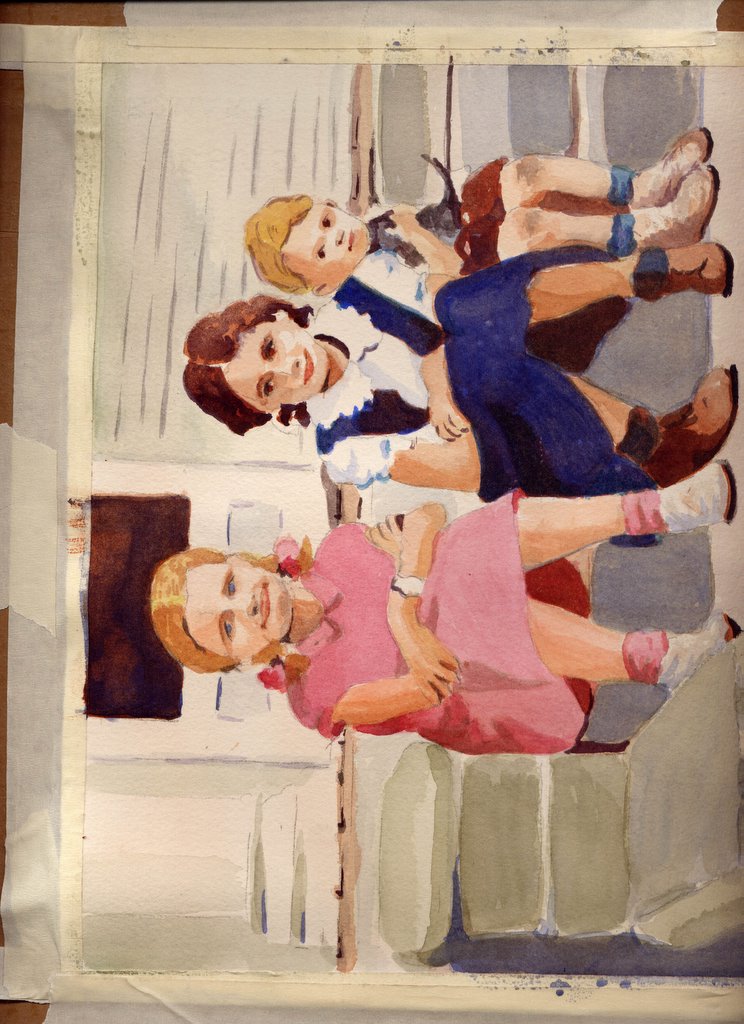
Here's the painting I'm working on in art class--obviously not finished yet, so don't twist your neck too far. But it's been a lot of fun chatting via e-mail with Sylvia (who is not in the painting but is in the photo it is based on) and JoElla. Each of us saw something different. I immediately noticed I was wearing a bracelet, a gift from my Sunday School teacher Mrs. Green "back home." I was the new kid in town, so I think it was my way to say, "I'm not from these parts." The reason I can remember it is that it was probably my only one. I'd forgotten that my mother always had an array of ribbons for our braids to match our dresses. In the photo, there is no cat, but JoElla had a cat that is probably the ancestor of most cats in Forreston, Illinois, so I added in "Butch." I need to put some dots on Jo's dress and work on the skin tones So unless I ruin it between now and next week, you should see the finished piece soon.


Thursday, March 02, 2006

Thursday Thirteen


13 things NORMA will tell you about this Thursday

I've been reading scary news stories about new infectious diseases the antibiotics can't fight anymore. I wondered if I had 13 illnesses and injuries I could recall--and it was a reminder of how things have changed since I was a kid. Here are 13 diseases/conditions I've had in my life time, most before antibiotics and vaccines.

The first seven items on the list didn't require a trip to the doctor in the 1940s and 1950s, because in those days, the doctor came to our house. With four little children, Mom certainly considered that a blessing. Also, "well-baby" check-ups hadn't been invented yet (no one had health insurance), and mothers weighed their babies at home. Medical care was pay-as-you-go except for catastrophic illnesses--and my dad bought polio insurance a few weeks before my sister came down with it.

1. Tonsillitis. Before the age of 5 when my tonsils were removed, I was constantly sick with infected tonsils, burning up with fever with painful sore throats. I was miserable. You don't hear a lot about this today, but surgery sure did the trick for me and it was a new lease on life and probably made life a lot easier for my mother.

2. Whooping cough. This is called pertussis today and children receive vaccinations for it with diphtheria and tetanus vaccines. It is a bacterial disease, and if one child got it, usually everyone did. It is more dangerous for girls than for boys. Although children used to die from this, I don't recall being aware of its seriousness. Still, once you've heard that cough, it is hard to forget it--like coughing through a tuba.

3. Chicken pox. Although it could have serious side effects, this disease was usually just allowed to run its course through the family. Kids just stayed home until the scabs fell off. Even if you've had chicken pox, the virus can stay in your body and reappear as shingles and is extremely painful.

4. Mumps. I remember having this in kindergarten. Painful ear ache. By the time my children came along, there was the MMR vaccine.

5. Measles. It wasn't unusual to get this more than once. Probably 90% of people my age had this; now because of MMR immunization, almost no one gets measles.Ruebella is the serious form especially for pregnant women.

6. Scarlet fever. Right after third grade let out in May, I got this. I became sick at a friend's house and her mother called my Mom to come and get me. What a way to start summer vacation! This is a strep infection.

7. Pneumonia. I think this was 7th grade, and antibiotics weren't common, but house calls still were because I remember opening an eye and seeing the doctor in my bedroom.

8. Asian Flu. Freshman in college. This was a pandemic starting in China, killing about 2 million, and although there was a vaccine, I didn't seem to know about it. There wasn't much they could do since most of the campus had it, so we just stayed in our dorm rooms and sipped 7-Up. It disappeared and then evolved into the Hong Kong flu in 1968.

9. Infectious mononucleosis. Sophomore in college. Because it is communicable (known as the kissing disease since so many teens get it), I was put in the student hospital for a week. This is very common and most people have had a mild case by the time they reach adulthood, but sometimes you get really sick.

10. Appendicitis. I was about 33 years old, and they weren't really sure what I had until they got in there and looked. I healed pretty fast, but it took months for my son to get over it--I think he was in first grade and he would run after the car sobbing when I dropped him off at school.

11. Aches and pains. My horse fell on me when I was 12 years old starting a long history of back trouble, but for real pain you need a pulled neck muscle. Sounds silly but one day I turned around in the car to back out of our very long drive-way and pulled something. I discovered that every part of your body seems to be connected to your neck, even your fingernails. Worse than any back trouble I'd ever experienced.

12. Atrial fibrillation. Although this wasn't diagnosed until 1996, I was apparently born with an extra circuit in my heart, which caused the electrical charges to misfire with rapid and irregular heart beats. Because I'd always had it, I didn't know anything was wrong (I thought the room went black for everyone from time to time when standing up or walking up stairs quickly) and it never happened during a medical exam. It could have killed me or caused a serious stroke. It was ablated in 2002 and now seems to be OK even without meds.

13. Rotator cuff. When I was in rehab for this in 2000 I got to meet a lot of huge athletes and dainty dancers, but the best I can figure (I'm not athletic at all) is it was years and years of lifting heavy journals in the library and then smacking my weakened shoulder on the side mirror of a car.

Readers and thirteeners who have stopped by: 1. Joan, 2. Carol, 3. Eric, 4. Elle, 5. Tanya, 6. Denise, 7. Jane, 8. Melli, 9. Frog Legs, 10. Better Safe, 11. Lingerie Lady, 12. Lazy Daisy, 13. Nancy, 14. Heather,, 15. Courtney, 16. Ann, 17. D. Challener Roe, 18. Wystful1, 19. Lindsey, 20. Chickadee, 21. Yellow Rose, 22. Reverberate58, 23. Ocean Lady, 24. Suz, 25. Tunia

(TT banner courtesy of Novelist in Training)


Get the Thursday Thirteen code here!


The purpose of the meme is to get to know everyone who participates a little bit better every Thursday. Visiting fellow Thirteeners is encouraged! If you participate, leave the link to your Thirteen in others comments. It’s easy, and fun! Be sure to update your Thirteen with links that are left for you, as well! I will link to everyone who participates and leaves a link to their 13 things.

Trackbacks, pings, comment links accepted!


Wednesday, March 01, 2006

Ash Wednesday

The choir sang "Wondrous Love" (arr. Alice Parker & Robert Shaw) and then had rehearsal after the service, which was lovely. Although things are a bit cramped in the choir loft, I love sitting so close to the piano and organ (probably 3 ft.). There was a clarinet solo during the offering (Adagio by Tomaso Albinoni) and I was close enough to read her music. Just delightful. But I'm definitely going to move to the alto section.

From the bulletin: "Ash Wednesday is the beginning of the season of Lent--a time of renewal and coming back to God. It comes as an intrusion as we face the reality that we are going to die. "Remember, you are dust, and to dust you shall return." These words echo the service at the grave--"dust to dust." This forceful reminder of our sinfulness and human frailty. It is a time of dying to ourselves and being crucified with Christ. And as surely as we have died with Him, so we will be raised with Him to the glord of God."

2229 Would the internet lie?

I took a cybertest for a personality DNA (I think it is a reworded Myers-Briggs) and was quite surprised to see I was a "genuine architect." I suppose they don't have enough personality types for librarians to have it show in the database, or I've been retired too long.

It made for interesting dinner conversation last night with my architect husband who thinks of me as disorganized and indecisive. That's how a true architect sees things. I told him it was probably his influence of 45 years. Also he reads more and is better informed about politics and religion than he used to be, so maybe I'm rubbing off on him too. A few more years and we'll have this relationship stuff all worked out. The test gives suggestions for changes, which I will ignore, given my personality type. Goals? You've got to be kidding!!!

personalDNA
Genuine Architect

Your preference for concrete, visually pleasing things, combined with your confidence and your respect for order make you an ARCHITECT.

You are logical and detail-oriented, which allows you to get things done efficiently.

You are quite sure of yourself, so that you tend to know the best ways of doing things.

Your eye for aesthetic beauty and style indicates that you know a lot about design.

Having a routine and sticking to it is important to you; you find comfort in tradition and familiarity.

Self-reliance is something in which you take great pride—you are confident and down to earth.

You have a basic faith in yourself in many areas of your life, allowing you to be self-assured when facing challenges.

You do your own thing when it comes to clothing, guided more by practical concerns than by other people's notions of style.

Generally, you believe that you control your life, and that external forces only play a limited role in determining what happens to you.


Your outgoing personality, your preference for order, and your cautious appreciation of others makes you GENUINE.

You aren't afraid to be the center of attention. Actually, it is quite the opposite: You are comfortable and confident in social situations.

As a charismatic kind of person, you tend to be energized by other people and enjoy their company.

When other people are upset, you are able to think about the situation rationally, without getting too caught up in their feelings.

At times you find it difficult to understand where other people are coming from, and wish they could just see things the way you do.

You are a strongly principled person who believes in right and wrong. This helps you make decisions easily when it comes to moral issues – you don't have to waste time hedging on important values.

In your experience, people tend to get what they deserve. So, you work hard and try to follow your principles in your day-to-day life, knowing that you will be rewarded for your efforts.

2228 Chocolate Peanut Butter Cream Cheese Tart with Caramelized Bananas

A mouthful in more ways than one. We watched Spencer Budros, a Certified Pastry Chef/Owner of Pistachio in Columbus' short north area make this yesterday afternoon at the Columbus Home and Garden Show at the Fairgrounds. It was the 50th anniversary of this show, so the theme was "The 50s." The peanut butter and banana dish was to honor Elvis Presley who liked peanut butter and banana sandwiches. We also saw a 1949 Chevie with plants growing out of its headlights and dashboard, tastefully planted in an abstract garden.

I must say, this was a fabulous dessert--we all got a generous helping after the demo. We missed a lot of the "how-to" although we were very attentive. Some of the mixing was done off camera, and sometimes all we could see was the back of Mr. Budros' head as he leaned over the stove (camera was positioned above him). I think it probably takes a lot of practice to be a TV chef and not step in front of the main event. Also, we couldn't see the 1950s style kitchen that was behind him--and I sure don't remember any red refrigerators.

We also got a free cook book, "Gourmet Galaxy Cafe Cookbook" put together I think by Doral Chenoweth (at least he wrote the bios), who used to write "The Grumpy Gourmet" column for the Columbus Dispatch. Mr. Budros' pastry shoppe is for the busy family or business who likes to buy desserts when throwing a party--at any time you can find 50 fancy items in his case. However, if you're all done cleaning the toilets and setting the table, you can whip this little number up. But set aside generous amounts of time for the chocolate shortbread dough chilling and flame throwing for the bananas.

Update: I requested and received permission from Pistachio to post the recipe:

Yield: 10 individual 3 1/2" tartlettes

Chocolate Shortbread:
1 3/4 cups all-purpose flour
1 1/3 cups confectioners sugar
1/4 cup cocoa powder
pinch of salt
1 teaspoon baking powder
3/4 cup (1 1/2 sticks) unsalted butter, room temperature
2 eggs
1/2 teaspoon vanilla extract

Combine flour, sugar, cocoa powder, and salt in electric mixer bowl. Add better and mix on low speed with paddle attachment until mealy. Add eggs and vanilla. Mix on low speed until just combined--do not overmix! Remove dough from bowl. Lightly flour and wrap in plastic. Refrigerate for one hour. Roll dough to approximately 1/3 inch thick; cut or stamp 5 inches round. Form dough into 10 individual 3 1/2 inch tartlette rings. Bake with pie weights for 10 minutes. Remove pie weights. Bake for an additional 5 minutes or until set. Cool and store at room temerature.

Semisweet Chocolate Ganache:
1/2 cup heavy cream
6 oz. semisweet chocolate, finely grated (1 cup)

Finely grate approximately 6 ounces of semisweet chocolate; place in medium-size mixing bowl. Bring 1/2 cup heavy cream to a boil. Pour boiling cream over grated chocolate. Mix until smooth. Cool at room temperature.

Peanut Butter Cream Cheese Filling:
1 package (8 oz) cream cheese
1 cup granulated sugar
1 cup Krema unsalted creamy peanut butter (this is a local, natural brand)
1 teaspoon vanilla extract
1 teaspoon salt
1 cup heavy cream

Blend cream cheese and granulated sugar using paddle attachment in electric mixer until smooth. Add peanut better, salt and vanilla extract. Mix until smooth. Transfer mixture to a small bowl. In a mixer bowl, whip heavy cream to a soft peak. Add peanut butter cream cheese mixture to the whipped cream and mix on medium speed until smooth.

To Assemble:
10 chocolate shortbread tartlette shells, prepared (see above)
semisweet chocolate ganache, prepared (see above)
1 cup Spanish peanuts
peanut butter cream cheese filling, prepared
5 bananas, sliced (diagonal or oval shape)
1 stick unsalted butter, melted
1 cup sugar

Remove prepared, cooled chocolate tart shells from rings. Place onto sheet pan or work surface. Spoon one tablespoon of chocolate ganache into the bottom of each tart shell. Smooth with spatula to cover bottom of tart shell. Divide one cup Spanish peanuts equally among ten tarts--sprinkle over ganache. Spoon or pipe peanut butter cream cheese filling to fill tart shell. Cover filling with sliced bananas. Brush bananas with melted unsalted butter. Refrigerate until time to serve.

To serve:
Remove tarts from refrigerator. Sprinkle granulated sugar on top of bananas to cover. Use torch to caramelize. Serve immediately.

Norma's notes: He said that brushing the bananas with butter would keep them from discoloring and add a nice flavor. He used a high quality cocoa and semi sweet chocolate but I don't remember the brand--I just remember him stressing that. He also told us how to make our own pie weights out of beans, but best not to trust me on that one. I have no idea where you get the torch--he said something about going to the garage to get it, but I think that was a joke. It's not among my kitchen tools, nor are 5" tart rings. Just know this is a fabulous dessert--one I'll never make--considering how long it took to type it--but would buy.


Tuesday, February 28, 2006

2227 The daughter-in-law--taking applications

You've seen the reality show about the bachelor choosing a wife. Why couldn't there be a show called "The daughter-in-law?" I've thought of throwing a big party and inviting all the single women I know to meet my son--he'd be the only guy at the party (unfortunately, most are in their 50s and 60s, and one in her 80s). He has excellent manners and I'm sure would make them all feel special, but would probably not speak to me for awhile.

My idea of the perfect daughter-in-law is probably different than my son's idea of a perfect wife. Actually, in marriage there is no perfection, so let's just toss that word out, OK? Marriage is mostly enjoying the good qualities and accepting the flaws, your spouse's and your own. Marriage is smoothing out your own rough edges so you aren't always poking at each other. He says next time he'd like to be the boss; he wants to be only 50% to blame when there is a problem. Personally, I don't think that's the best attitude if he wants it to last longer than a week or two.

I would like her (my new daughter-in-law) to be a little bit like my friend Mitzi, who used to use her week-ends to help care for her husband's father. Not so unusual, you say? Well, she lived in Illinois and her father-in-law lived in Arizona. So I'd say she was one fabulous daughter-in-law. My father-in-law's other daughter-in-law, Kate, is another one who willingly stepped in to provide care when needed, but they lived in the same house.

I would also like her to be a little bit like my son-in-law, who is cuddly, funny, and available when we need help--like tomorrow he's coming over to move furniture so we can have carpeting installed on Thursday. He also cleans the house and does the laundry (at his house) and has a good job. She wouldn't have to be strong enough to move furniture, but it would be nice for my son if she liked to clean and do laundry (don't laugh, some women do) and was also the CEO of a Fortune 500 company.

I would also like her to be a bit like my former daughter-in-law who was a fabulous cook and hostess. We aren't party people, so having her around was always a blast, and being invited for dinner was marvelous. Once when I was in the hospital she brought in a great meal and also gave me a manicure! I would also like her to be smart like my niece-in-law, Leigh, who is brainy, but very easy to talk to. I would like my daughter-in-law to be active in her church like my niece-in-law Joan, who seems to have a wonderful group of supportive friends and helps with the youth group. My son is a Christian and has learned the meaning of being unequally yoked.

I also think it would be nice if she were as good to her own parents as our daughter is to us. God save us from a woman who "has issues" she's always working on. I just don't think we have enough time left on this earth for her to find herself. She should like living in the mid-west and not be pining for mountains or oceans all the time. Sharing holidays--would that be too much to ask for?

I'm sorry this list is getting a bit long and doesn't look very romantic, but my son, of course, is going to be looking for what men always look for, so I thought that department was covered and I'd just throw out some ideas.

Oh yes, and he likes to fish, plays the guitar, and has a dog and a cat. So we want someone outdoorsy with no allergies.

2226 The Meathead Economics

That's what the WSJ is calling the universal preschool tax which would cost Californians $23 billion over the next 10 years, if Rob Reiner's Proposition 82 passes. Rob Reiner, for those of you too young to remember, was the flaming liberal son-in-law of Archie Bunker in the TV series, All in the Family. He left Gloria and she raised their son alone (in another short lived series). Now he's just another limousine liberal from Hollywood, making money off poor schmucks who buy movie tickets.

First of all, there is no evidence whatsoever that sending poor kids to preschool puts them ahead in elementary or high school. It doesn't get them into college and good jobs. Billions of dollars spent on Head Start over 40 years have not shown any permanent gains, because when the lights have been turned out and the doors of the school locked at night, these kids go home to the old environment and the parent (usually just one, ala Gloria Bunker). When California preschools are universal, you can bet your bippy that Hollywood moms will be sending their little darlings to a private school or jet setting them around the world with nannies and tutors in tow. The middle class and the working poor will be footing the bill, not the rich.

Second, California already has confiscatory taxes, and long time permanent (and wealthy) citizens are moving out of state. They love their sunshine, but they love their wealth more. According to one pundit, you can buy a home in Nevada just with the the tax savings by moving out of California. When the rich leave a state, who is going to pay the bulk of the taxes? Well, the middle-class, of course, since the poor don't pay anything.

Third, Reiner is using tobacco tax money (intended for children) to promote his latest Meathead scheme, and it has been funneled into the pockets of the public relations firms who got those contracts to sell his scheme.

"Beware of liberals promising to tax someone else to help children" they really mean you.

November story from Orange Co. Register on the Meathead tax

Wall Street Journal article

2225 This calls for a bag of Fritos

Some of you munch chocolates when under stress; I scarf down Fritos.


I just finished looking over our income tax forms before they are mailed--federal, state, RITA (our suburb), and Columbus. Even with all the eyes we've had looking this over, we've had the wrong address for our business for four years! No one seemed to care.

I have a pension and my husband has Social Security but is finishing up a few jobs for long time clients. His income is negative, so that offsets our interest income; even with a negative income he still owes taxes on his Soc. Sec.; the auto expenses for business still have to be claimed, but the record doesn’t have to be submitted; medical expenses were well over $10,000 (more than half my income) because of insurance and Medicare costs and we had no illnesses--it‘s been one of our healthiest years; we have a small house on the east side (considered a rental for us) which on paper shows up at $420,000 for depreciation (!) and the reasons are just flat out bizarre, but I assume it is so you never get to zero like we did back in the 60s when we owned a duplex. Must be very beneficial to people who own acres of apartments. But this is little house.

Here's a rerun from what I wrote on Feb. 8, but nothing has changed.

In 1995 the total pages of federal tax rules were 40,500; in 2004, 60,044.

In 2000 the number of IRS tax forms were 475; in 2004 they were 529.

In 1994 there were 16 loopholes for education and training; in 2004 that had risen to 28.

In 1995, 50% of taxpayers used paid tax preparers; in 2003, 62%.

In 1995 Americans spent 5.3 billion hours filling out tax forms; in 2004, 6.5 billion.

In 1995 there were 84 pages in the 1040 instruction book; in 2003 there were 131.

To complete the 1040, A,B, and D schedules in 1995, it required 21.2 hours; in 2003 it took 28.5. [figures from CATO Handbook on Policy, p. 120]

Monday, February 27, 2006


Monday Memories: Did I ever tell you about:
When my letters turned into a memoir?

When my children left home about 20 years ago, I was suffering from empty nest syndrome big time. I decided to gather up the letters I’d written to my mother and sisters and the ones they’d written me and excerpt the “crazy” time in our year--from about Halloween through January so I would have a written record of our family life. Both children have November birthdays, so that’s about the time things really heated up at our house.

After looking through the letters (which my mother had saved), I pushed the time line back another 10 years and started with my years in college until I had about 30 years worth of letters. And I added in letters from girl friends, cousins, and in-laws. (I never throw away a letter). It was hours of typing (at the office after work since I didn’t have a computer then) and careful editing out really personal stuff. My husband designed an artistic cover, and I had the little book reproduced and bound at Kinko's.

Although the collection recorded all the cute and interesting things about my children’s growing up years, it also inadvertently became a story about a group of women--with a few men around the fringes--who were keeping things going by following a few familiar holiday traditions. At the beginning, I'm a college student and my mother is 47 years old with three children in college, a married daughter and two little grandchildren. My niece and nephew are 3 and 2 in the first letter and then are parents of their own children at the end, and repeating many of the same traditions, questions, and yearnings we letter writers had. Some people who didn’t write letters are in the collection anyway--their health and well-being and activities reported by the women who tell the stories year after year.

These letters recorded the ordinary events of our lives to the faint drumbeat of the cold war, the civil rights movement, space flight, the VietNam war, political campaigns, Watergate, economic growth and slowdown cycles, the rise of feminism, employment crises, career changes and family reconfigurations. On and on we wrote, from the conservatism of the Eisenhower years, on through the upheaval of the 60's, the stagnation of the 70's, then into the conservatism of Reagan/Bush in the 80s. National and international events are rarely discussed in these letters as though we were pulling the family close into the nest for a respite from the world's woes. If you were to read the letters, you might miss that we were even aware of world events. Or maybe because, as one of my sisters noted in a letter, when you're struggling on the home front sometimes there isn't much left to give to others.

The edited letters became the rhythm of women's lives--nursing a dying parent, holding a sick child, putting up the tree, playing the old records, going to the post office, baking favorite Christmas cookies, helping with school work, going to holiday programs, creating crafts with the children, shopping for gifts, checking the sky for some sunshine, wallpapering the hall, folding the laundry, looking for that just right job.

E-mail and blogging will have an effect on family memoirs--it will be interesting to review this phenomenon in 30 years. Digital is much less permanent than paper. Print out what is worth keeping--your children will be grown and gone the next time you turn around. And when they ask you why you printed them out for safe keeping, tell them, "Because Norma said so."

Links to Other Monday Memories
1. Kimmy, 2. AnvilCloud 3. Katherine, 4. Courtney, 5. Frog Legs, 6. Shelli, 7. Libragirl, 8. Melanie, 9. Beckie,


(If you participate, leave your link in the comments and I'll post it here)

Click here for the Monday Memories code

Click here for Shelli's blog

Trackbacks, pings, and comment links are accepted and encouraged!


Post in the comments if you want to be on the MM blogroll!


2223 Rising college costs

As tuition goes up and more students take on the burden of loans, perhaps it's time to ask some questions about the courses, and how they will help a young person's career? The Young America's Foundation identified 12 courses on college campuses that make the people pushing for the 10 commandments or creationism in the classroom look like sound, sensible thinkers worthy of our support just for some balance.

1. Princeton: "The cultural production of early modern women" which examines prostitutes, cross-dressing and same sex eroticim in 16th and 17th century England, France, Italy and Spain.

2. Occidental College, California: "The unbearable whiteness of Barbie: race and popular culture in the United State."

3. Johns Hopkins University: "Sex, drugs and rock n roll in ancient Egypt."

The whole list here, but you can probably find more examples at the college of your choice by going on-line and searching "bulletin" or "courses."

I just quickly glanced through some women's studies course descriptions at Ohio State, but they are sanitized so as to reveal nothing, but I did find it odd that in women's studies, teaching middle school students is called "peer education." So the fact of biology makes the teacher and student peers? Or have I misunderstood this jargon and it means teaching students to teach their peers about sexuality?

2222 What would we do without committees?

Although I love being retired, I'm ecstatic about not being on committees to earn a paycheck. They truly made potholes in the road to a wonderful life and career. And things have always been so, I think. The committee gets a charge, works hard, battles for every concept and sentence in the report, brings it to the larger body (none of whom have done an ounce of research on the problem), only to get a bazillion "what ifs" and "why didn't you do" comments. Librarians can spend 15 minutes placing a comma. I used to envy the guy who sat in the back and slept.

Yesterday I checked out a black Lutheran hymnal published in 1930 from the church library. I wanted to examine it to determine if it was the edition used in the 1940s-50s at little Faith Lutheran Church in Forreston, IL when my family attended. We weren't Lutherans, but this little community of believers took us in and treated us like we were one of them (we were Church of the Brethren).

I'm a preface and index reader (it's a Librarian thing), so I got quite a chuckle out of the prefatory remarks on the book's history.

". . .representatives of eight synods. . . met in Chicago, May 3, 1921 and organized the Lutheran Intersynodical Hymnal Committee. . . In 1928, after the Committee had devoted much time and labor to a careful selection of hymns to be included in this hymnal and to a thorough revision of hymns from other languages as well as to the making of new translations when those hitherto used were not deemed satisfactory. . .[provisional was printed] with a view to the solicitation of criticisms and suggestions. . . The Committee again revised its work, also eliminating one hundred and thirty-two hymns, mostly translations, and including ninety-three other hymns."

The origin of the hymnal committee was the Iowa Synod, so I'm guessing there were some improved translations of Scandinavian and German hymns in the provisional text, but I can't be sure since it doesn't say.

Ah, committees. You gotta love 'em.