Showing posts with label book review. Show all posts
Showing posts with label book review. Show all posts
Wednesday, May 28, 2025
Bud Light became the poster child of bad business
Recently I watched a book interview with Anson Frericks on C-Span Book TV, "Last call for Bud Light." It was excellent and I learned a lot about corporations, marketing, capitalism, and particularly ESG, DEI, and other European trends that affect our businesses in a global economy.


Monday, December 04, 2023
"Once upon a Wardrobe" by Patti Callahan
I hate to read names in novels and not be able to pronounce them. It slows me down, and I'm already a very slow reader. So I'm reading "Once upon a wardrobe" a novel by Patti Callahan for book club this afternoon (see, I told you I was slow) and there is a character named Padraig. By p. 142, I'm just calling him Patrick because phonetically (pad-rag) it sort of sounds like that to me. So I looked it up. Close enough. Podric

https://youtu.be/ffUVEq8xTsE?si=5bxfKzgJPgzNxyrt
I finished the book at 11:15, fixed lunch, we ate at 11:30, and after lunch I summarized the entire novel for Bob, whose eyes were starting to cross. But I should be able to remember it by 1 p.m.
I finished the book at 11:15, fixed lunch, we ate at 11:30, and after lunch I summarized the entire novel for Bob, whose eyes were starting to cross. But I should be able to remember it by 1 p.m.

Friday, November 24, 2023
Blindsight is 2020
I'm reading "Blindsight is 2020; Reflections on Covid policies from dissident scientists, philosophers, artists, and more" by Gabrielle Bauer, Brownstone Institute, 2022. It begins with two stories we've lived through the last almost four years. And I'm guessing it's not over.
Story one is the one all the media agencies, tech and pharma giants, politicians, local, state, and federal governments insisted we believe. And I did, and maybe you did, for about the first month after which not much made sense if you knew anything about economics or social sciences. It had the momentum of a patriotic war--if you didn't go along or found it fantastical, you were the enemy of the people. You weren't saving lard or scraps of aluminum to help our boys in Europe and the Far East. And miraculously, it turned out to be just the crisis that the Democrat Party dreams about to turn to their favor. Demonize the incumbent and change the rules for voting,
Story two is the one that moved underground--it is told in this book by 46 epidemiologists, public health experts, doctors, psychologists, cognitive scientists, historians, novelists, mathematicians, lawyers, comedians, and musicians. They all took issue with the way the people in Story one were trying to stamp out a virus using unproven and dangerous methods, including lockdowns, experimental vaccines, masking and destruction of our basic liberties.
A lot of Democrats and liberals have been "red pilled" by this health crisis and trauma, even though they still don't like President Trump (who also got suckered by some of the "believe the science" deep state). I hope there are some answers in this book. I'm still in chapter one.
Story one is the one all the media agencies, tech and pharma giants, politicians, local, state, and federal governments insisted we believe. And I did, and maybe you did, for about the first month after which not much made sense if you knew anything about economics or social sciences. It had the momentum of a patriotic war--if you didn't go along or found it fantastical, you were the enemy of the people. You weren't saving lard or scraps of aluminum to help our boys in Europe and the Far East. And miraculously, it turned out to be just the crisis that the Democrat Party dreams about to turn to their favor. Demonize the incumbent and change the rules for voting,
Story two is the one that moved underground--it is told in this book by 46 epidemiologists, public health experts, doctors, psychologists, cognitive scientists, historians, novelists, mathematicians, lawyers, comedians, and musicians. They all took issue with the way the people in Story one were trying to stamp out a virus using unproven and dangerous methods, including lockdowns, experimental vaccines, masking and destruction of our basic liberties.
A lot of Democrats and liberals have been "red pilled" by this health crisis and trauma, even though they still don't like President Trump (who also got suckered by some of the "believe the science" deep state). I hope there are some answers in this book. I'm still in chapter one.
Sunday, June 19, 2022
The Personal Librarian of J. P. Morgan
I've been reading "The personal librarian" the story of J.P. Morgan's curator of his rare books and manuscript collection, Belle da Costa Greene. I'm not impressed with the novel. I just came across the bio of her father, the first black graduate of Harvard, Richard Theodore Greener. http://www.mixedracestudies.org/?tag=richard-theodore-greener If the fictionalized account of Belle's life is to be believed, then her father abandoned his family to suit his own ambitions and had a Japanese concubine and two children when he was the first black diplomat to Russia in the early 20th century. That said, she's not to blame for her father's abandonment of her mother and large family. However, the writing is clunky and awkward, and it's a very preachy book about the struggles of a light skinned woman passing as a white in order to have a good life using her remarkable talent and intelligence. But she also had an affair with a married man (who had other lovers) and an abortion when her Jewish lover chose his wife and station over her (she wanted her child). Maybe I'm just tired of reading about amazingly successful people who are seen as victims. Porch reading. I've talked to others who have read it, and many LOVE this book, so don't be afraid to pick it up.
Belle da Costa Greene (1883-1950) • (blackpast.org)
Belle da Costa Greene, the Morgan’s First Librarian and Director | History of the Morgan | The Morgan Library & Museum
A Look at Belle da Costa Greene | Rare Book Collections @ Princeton
The Women Who Made the Morgan: Belle da Costa Greene, Felice Stampfle, and Edith Porada - YouTube Lecture, March 3, 2021
https://youtu.be/uiHz5YKAnhg Her letters to Bernard Berenson (1865–1959), lecture, June 19, 2021
https://youtu.be/JWcaePIBLCU Unmasking a forgery. The Spanish Forger.
Summary and Review: The Personal Librarian by Marie Benedict and Victoria Murray - The Bibliofile (the-bibliofile.com)
The Personal Librarian Summary & Study Guide (bookrags.com)
a book review by Judith Reveal: The Personal Librarian (nyjournalofbooks.com)
Belle da Costa Greene - Wikipedia
Bernard Berenson - Wikipedia
Belle da Costa Greene (1883-1950) • (blackpast.org)
Belle da Costa Greene, the Morgan’s First Librarian and Director | History of the Morgan | The Morgan Library & Museum
A Look at Belle da Costa Greene | Rare Book Collections @ Princeton
The Women Who Made the Morgan: Belle da Costa Greene, Felice Stampfle, and Edith Porada - YouTube Lecture, March 3, 2021
https://youtu.be/uiHz5YKAnhg Her letters to Bernard Berenson (1865–1959), lecture, June 19, 2021
https://youtu.be/JWcaePIBLCU Unmasking a forgery. The Spanish Forger.
Summary and Review: The Personal Librarian by Marie Benedict and Victoria Murray - The Bibliofile (the-bibliofile.com)
The Personal Librarian Summary & Study Guide (bookrags.com)
a book review by Judith Reveal: The Personal Librarian (nyjournalofbooks.com)
Belle da Costa Greene - Wikipedia
Bernard Berenson - Wikipedia
Thursday, February 25, 2021
White Fragility
Robin DiAngelo has made a fortune being a racist. She writes in White Fragility, that “All white people are invested in and collude with racism,” and that “The white collective fundamentally hates blackness for what it reminds us of: that we are capable and guilty of perpetrating immeasurable harm and that our gains come through the subjugation of others.” She also claims if we disagree with her we're racists. Kafkatrap.
Would DiAngelo be allowed into our churches, book clubs and non-profit reading lists if she were speaking such vile filth about Jews, Blacks or Asians? Robin, if you are a racist and need to unload your guilt and promote your moral superiority, speak for yourself. Don't come to my social and educational events. Keep those books in your basement archive.
I hope she donates her ill-gotten, slave-pimping wealth to an organization that wants to stop slavery in this time and place, this century--it exceeds the numbers of the 18th century, and is still primarily based in Africa and Asia. It includes labor slavery, sex slavery, and child slavery. Check the annual reports for TIP U.S. Department of State.
Would DiAngelo be allowed into our churches, book clubs and non-profit reading lists if she were speaking such vile filth about Jews, Blacks or Asians? Robin, if you are a racist and need to unload your guilt and promote your moral superiority, speak for yourself. Don't come to my social and educational events. Keep those books in your basement archive.
I hope she donates her ill-gotten, slave-pimping wealth to an organization that wants to stop slavery in this time and place, this century--it exceeds the numbers of the 18th century, and is still primarily based in Africa and Asia. It includes labor slavery, sex slavery, and child slavery. Check the annual reports for TIP U.S. Department of State.
Saturday, December 19, 2020
You are not alone--New Book by Roger D. Blackwell, Ph.D.
How do you survive birth as a still-born baby in the Missouri Ozarks, learn
hard work as a kid on the farm, and obtain a college education without debt or
money from parents? Those are just a few of the topics in a new book by
Dr. Roger Blackwell, You Are Not Alone and Other Lessons a Teacher Learned
from Parents, Professors, and 65,000 Students (Union Hill Publishers,
2020).
After
studying at Northwest Missouri State and the University of Missouri, Dr.
Blackwell received a Ph.D. from Northwestern University before becoming
Professor at The Ohio State University in the Fisher College of Business and
the College of Medicine. At Ohio State, he taught Marketing and Consumer
Behavior in mega sections of 1,000 students per quarter as well as courses in
Quantitative Research, Thanatology and Black Business Studies. His 65,000
students over 40 years at Ohio State is believed to be more than any other U.S.
professor. He also co-authored Consumer Behavior, a pioneering
textbook used throughout the world in multiple languages and editions.
His previous 39 books were about business and economics but his new book You
Are Not Alone is about lessons from life observed over many decades
teaching and researching on six continents. Among lessons he learned at
an early age was how get an education while working part-or full-time and how
to buy a rental property at age 16 and use it to finance graduate education.
While a
graduate student at Northwestern, he also learned the answer to what he
considers the most important question anyone can ask, Does God Exist? In You
Are Not Alone, he explains how to answer that question along with many
other lessons from his early life in Missouri, near death experiences, and teaching
on six continents.
You Are Not
Alone also describes how after retiring from
the university, he was sentenced to a Federal Correctional Institution where he
tutored hundreds of inmates to receive a GED, and learned lessons about a
nation that can only be learned in prison. He found helping inmates prepare for
a better life after their release was just as rewarding as placing hoods on
Ph.D. students in universities. Before prison, Blackwell defended God; in
prison, he learned to depend on God. While in prison, Blackwell
also began writing Saving America: How Garage Entrepreneurs Grow Small Firms
into Large Fortunes, his other recent book describing how to start and grow
a successful business, also published by Union Hill.
Tuesday, December 08, 2020
The Day the World Came to Town, 9/11 in Gander Newfoundland, by Jim DeFede
Our book club (I joined in 2000 when I retired, but I think the group has been meeting about 35 years) met via Zoom yesterday for a discussion of "The Day the World Came to Town, 9/11 in Gander Newfoundland." by Jim DeFede. It's worth a read just to be reminded of what fine, wonderful qualities and skills appear when a tragedy happens. We saw this in the weeks following 9/11 in the U.S., although you'd never know Americans pull together in crisis these days.
Our group benefitted greatly because we had an eyewitness share her experiences, and she's been back to Newfoundland 29 times! Her plane load went to Lewisporte. Her enthusiasm for the people and especially the story of creating a scholarship fund for the local children was infectious. When I looked up Lewsporte, I found a photo of Shirley and the 2002 class that received scholarships to go to college. We heard about the captain of her Delta flight, the fireman, the bus drivers, the local Lion's club, the bonobos, one of which came to Columbus and had a baby named "Gander," the Broadway musical "Come from Away," based on the events, the CEO who refused a free trip back to the U.S. so he could stay with his fellow passengers, the rabbi who wouldn't travel on Sunday, the tiny towns and islands, the love story and marriage of 2 stranded passengers, Shirley's meeting with Prince Charles and Camilla, Walmart and the other businesses giving all the passengers free items because their luggage had to stay on the planes (38 jumbo jets). It was just a nice, warm tale of the goodness of people.
Special scholarships for Lewisporte students a lasting legacy of 9/11 attacks | CBC News
Monday, December 07, 2020
The Halifax Explosion
I managed to live to the ripe old age of 81 and had never heard of the Halifax Explosion of Dec. 6, 1917. Until the atom bomb, it was the largest explosion known to mankind. Two ships tried to evade a collision both loaded for the war effort in Europe, but hit each other. The Mont-Blanc was carrying 2,925 metric tons of explosives—including 62 metric tons of guncotton, 246 metric tons of benzol, 250 metric tons of trinitrotoluene (TNT), and 2,367 metric tons of picric acid. About 2,000 people died, and many thousands injured, people come out to watch see only the smoke and then there was the explosion. I happened to hear the author John U. Bacon being interviewed about his book, "The Great Halifax Explosion : A World War I Story of Treachery, Tragedy, and Extraordinary Heroism."
Wednesday, August 12, 2020
Defender in Chief, by John Yoo
John Woo, a Korean American, is the "wrong" kind of minority--he supports the President, although he didn't start out that way. In his new book, “Defender in Chief: Donald Trump’s Fight for Presidential Power,” Yoo makes the case that despite popular belief, President Trump has been a protector of constitutional law, not an offender. Democrats, liberals, and Progressives will not like this at all. The book was written before all the oozing of the left in 2020.
“We are used to thinking of presidential power as presidents fighting with Congress…actually the really important fight is the president against the independent bureaucracies below him,” Yoo said. “The founders would have said, ‘What is going on?’…this bureaucracy is slowing down, diluting, sapping the presidency of its energy.”
Monday, April 20, 2020
Reading and cycling
My office was cleaned out to the bare walls and moved to the laundry room to make way for our son’s hospital bed and supplies. At first the exercycle was in my husband’s office, but I pushed it into the laundry room so I could multi-task. My washing machine, which I’ve written about before, is a little touchy and likes to dance around if not loaded evenly, so sometimes I just jump on the cycle during spin.
But it’s sort of boring, so I’m reading a new book I was sent for review: American Harvest, God, Country and Farming in the Heartland, by Marie Mutsuki Mockett, a Californian with a Japanese mother, and American father. There’s been a 7,000 acre wheat farm in her family for over 100 years, although her grandfather had left the area as a child.
What caught my interest was not just the farmer angle, but the Christians who annually harvest the wheat using teams from the Pennsylvania Anabaptist country. I’m only in chapter 2, but so far, unless her liberal side takes over, I’m enjoying her vivid descriptions of the farms and her compassionate look at the harvesters she travels with to get material for this book. I can go 3-4 miles a day with Marie.
http://www.mariemockett.com/books/american-harvest/
Here’s a review, but it sounds like the reviewer only finished the first 2 chapters, which is how far I am on my exercise plan. https://www.latimes.com/entertainment-arts/books/story/2020-04-03/evangelicals-marie-mockett-american-harvest
Thursday, September 19, 2019
Wildhood
I am offered a lot of books to review, and occasionally I accept. If you've been baffled by adolescent behavior--your pupils, your kids, your grandchildren, or even your own if you can remember that far back, this is the book that explains it, and why it's probably necessary. "Wildhood; the epic journey from adolescence to adulthood in humans and other animals," by Barbara Natterson-Horowitz and Kathryn Bowers (Scribner, 2019). I'm assuming that Barbara is the scientist and Kathryn the word magician, because it's both very learned, and easy to read.
Using the lives of four animals, Ursula the penguin, Shrink the hyena, Salt a humpback whale, and Slavc a wolf (plus dozens of examples of other animal species--salmon, bats, gazelles, seals, etc.) they provide a look at everything you see in teenagers from status, to anxiety, to bullying, to risk taking, to privilege to sexual coercion. Is your son living in your basement? If animal parents were that protective, the species wouldn't survive.
"Animals will suffer pain, forgo food, give up sex, and betray others just to ensure they've not left out or driven from a group. You might say that for social animals, status is like gravity. It's powerful and inescapable. It's invisible. It exerts an omnipresent force, and it molds how a creature moves through the world and behaves around others." p. 97
Now, doesn't that sound just like junior high school?
Wednesday, September 18, 2019
Sneak peek at “A republic, if you can keep it”
It's a wonderful day to sit on the deck with a cuppa and enjoy the blue sky and rustling leaves with a good book. But because it's so lovely, the lawn crew has shown up and there's a very loud mower just a few yards away, so I'm back inside. Even after 18 years here in this delightful spot with mature trees and a creek, I'm still thrilled to have them doing it and not Bob.
I'm loving "A republic, if you can keep it," by Neil Gorsuch. In the introduction he introduces us to his roots and branches, some fascinating people. All of us should have to write a paragraph or two about parents, grandparents, great uncles, etc. and their challenges and contributions so we understand how we got here.
Of his mother (pgs 13-14): "My mother was brilliant and a feminist before feminism. Born in Casper, Wyoming, she graduated from the University of Colorado at 19 and its law school at 22. That was a time when almost no women went to law school. She studied and taught in India as a Fulbright Scholar and went to work as the first female lawyer in the Denver District Attorney's Office. There, she helped start a program to pursue deadbeat dads who had failed to pay child support, long before efforts like that were routine. Her idea of daycare often meant me [Neil] tagging along. She never stopped moving. When she ran for the Colorado state legislature, where she was soon voted the outstanding freshman legislator, she wore out countless pairs of shoes walking the entire district again and again. As kids, we just had to keep up. Later, she served as the first female administrator of the Environmental Protection Agency in Washington."
With a mother like that, how could he be anything other than a great lawyer and judge.
Monday, July 22, 2019
Lillian Boxfish takes a walk
Just finished "Lillian Boxfish takes a walk," by Kathleen Rooney (2017). It's a novel inspired by the life and work of Margaret Fishback who wrote ads for Macy's in mid-20th c. and was a published poet in her own right. I have no idea how old Rooney is (40-ish?), but she awfully good at speaking in the voice of an 85 year old. She's written a lot of books--I might be willing to try another one. Her method of telling Lillian's life story through a walk in Manhattan on New Year's Eve 1984 was fascinating. So if you need some more summer (or book club) reading, I recommend this title.
Saturday, June 29, 2019
Little Fires Everywhere by Celeste Ng
This title is on the review list for the Lakeside Women’s Club this summer, so I decided to check it out. I’ve been reading it on the porch in the evenings and at the wellness center in the morning. I’m about 1/3 finished and not sure I’ll go on. Ng is a good writer, but stories about bio and non-bio mothers and babies, and predictable criticisms of suburban families and their life styles (in this case Shaker Heights, Ohio) are just not comfortable for me. I’ve read several reviews, from wildly enthusiastic to I-just-didn’t-care. There is a movie in the works since it’s got all the ingredients – teenagers in the 1990s, racial tensions, adoptions, surrogacy, frustrated homemaker, and do-gooder Democrats.
Spoiler: Ng has a motherhood problem, in addition to her angst and guilt about being wealthy and a successful Asian American. (Wealthy, professional parents, raised in Shaker Heights). One mother is a surrogate who stole her child and raised her on the run, one mother abandoned her child and kidnaps her back from the adoptive parents, one mother wanted her child but resents all the problems that child represents from preemie to rebellious teen, one mother had an abortion but used someone else’s name.
Wednesday, June 26, 2019
Book review “Nomadland by Jessia Bruder
This Friday the Lakeside Women's Club book review is "Nomandland; surviving America in the 21st century" by Jessica Bruder. (2017) I'm about 1/3 finished, but I get the drift. Convince the readers there's something terribly wrong with the USA instead of the poor decisions, divorces, childhoods and investments of selected people interviewed for the book. So far, although the "great" recession of 2008 is noted as a cause for the white collar workers, the underlying factors in many of these cases are divorce, and/or an unhappy, abusive childhood that also included divorce, disruption, and frequent moves. I've been skimming or reading books like this for 4 decades. And since the so-called War on Poverty and the disintegration of households of married couples and families, the discussion doesn't get more positive, but the journalists/fabulists don't seem to catch on.
We first met nomad retirees in 2003 in Glacier Park. They were quite happy with their lives, moving with the tourism industry, northwest in the summer and south in the winter. According to Bruder, this movement has drastically increased as boomers hit retirement age, the internet glamorized it, and Amazon and other suppliers began to encourage a new migrant class of elder workers in RVs, vans and campers.
However, since the 1950s, our culture has glamorized the freedom of the open road, living off the grid, and personal liberty without family responsibilities in our films, theater, TV, literature or even neighborhood gossip. We shouldn't be surprised if a tiny percentage tried to grab this fading brass ring on a merry go round and found it a struggle of clunker RVs and difficult physical labor in warehouses.
So readers have a rich stew of anecdotes sprinkled with statistics about the history of retirement (it's a relatively recent concept). The reader can blame evil capitalists, bad government programs, Amazon, shrinking pensions, and overall malaise.
I'm shocked, shocked that aliens are flooding our borders. They need to read sad best sellers and then they would stay home.
Wednesday, May 29, 2019
The back row in America
Chris Arnade, a Wall Street bond trader, had a pretty lofty view of himself. He was an atheist, and a progressive. This is from his new book, "Dignity: Seeking Respect in Back Row America," Sentinel, 2019.
"Like most successful and well-educated people, especially in New York City, I considered myself open-minded, considerate, and reflective about my privilege. I read three papers daily, I watched documentaries on our social problems, and I voted for and supported policies that I felt recognized and addressed my privilege. I gave money and time to charities that focused on poverty and injustice. I understood that I was selfish, but I rationalized. Aren’t we all selfish? Besides, I am far less selfish than others. Look at how I vote (progressive), what I believe in (equality), and who my colleagues are (people of all races from all places)."
And so he begins traveling, photographing and talking to "back row America" and discovers that those in the front row don't have all the answers.
You can read this excerpt on-line, https://www.firstthings.com/article/2019/06/back-row-america?
Chris Arnade writes for many publications. In this article in the Guardian he is skin color focused, and he blames Trump for exploiting the pain and humiliation of the poor [but not Hillary?]. However, he gets a lot right in this article published shortly before the Nov. 2016 election--why Trump is supported by the working (and not working) poor.
"She was blunt when I asked her about her life. “Clarington is a shithole. Jobs all left. There is nothing here anymore. When Ormet Aluminum factory closed, jobs all disappeared.” She is also blunt about the pain in her life. “I have five kids and two have addictions. There is nothing else for kids to do here but drugs. No jobs. No place to play.”
She stopped and added: “I voted for Obama the first time, not the second. Now I am voting for Trump. We just got to change things.”"
https://www.theguardian.com/society/2016/nov/03/trump-supporters-us-elections
And Trump is changing things, and that is terrifying for the progressives who are willing to give away the country economically, socially and culturally. What he says about education rings true to me. Who would want to give up their position at the top?
Wednesday, May 15, 2019
New book recommendation about higher education for your Public Library
Richard Vedder, "Restoring the Promise; Higher Education in America" his final points.
- "College administrative staff often exceeds the teaching staff. Vedder says, “I doubt there is a major campus in America where you couldn’t eliminate very conservatively 10% of the administrative payroll (in dollar terms) without materially impacting academic performance.”
- Reevaluate academic tenure. Tenure is an employment benefit that has costs, and faculty members should be forced to make trade-offs between it and other forms of university compensation.
- Colleges of education, with their overall poor academic quality, are an embarrassment on most campuses and should be eliminated.
- End speech codes on college campuses by using the University of Chicago principles on free speech.
- Require a core curriculum that incorporates civic and cultural literacy.
- The most important measure of academic reforms is to make university governing boards independent and meaningful. In my opinion, most academic governing boards are little more than yes men for the president and provost."
As reported by Walter E. Williams "Smart Ways to Make College Cheaper and Better," Daily Signal, May 15
https://www.youtube.com/watch?time_continue=12&v=A6ryUtm4W9g A YouTube of Vedder’s lecture on this topic. Very little has changed since I went to college in the 1960s, except for the soaring costs, and I didn't have to take any diversity or retraining classes.
He reports that “Harvard and Bridgewater State are 15 miles apart--Bridgewater is a better school" (audience laughs). I looked it up--Harvard is 5X more expensive than Bridgewater.
Vedder says had been teaching for 53 years (he’s emeritus at Ohio University) and was told he needed to report for "diversity training" and he refused. He says University of Michigan has 93 diversity coordinators and wonders if black and Hispanic students are better off. I think OSU beats that, and has more. But IED departments are not intended to help minorities and women, they are intended to punish and terrorize the white majority and provide jobs for administrative staff who graduated with "studies" degrees (my comment, not his).
There's a war against white males on American campuses. Alumni--check out your donor status and demand a change. One question from the audience was from a parent who said her son was required to take a course on "Climate Change" at his college which was not taught by any professor and contained no science, only opinion and popular magazines. She wants her money back! I don't blame her.
Monday, February 18, 2019
White Africans and Black by Caroline Singer and Cyrus Le Roy Baldridge, on my bookshelves

One of the first things the authors mention is that photographs do not do justice to the shading and tone of African skin--but their drawings certainly do. The people are all beautifully drawn--very well muscled, graceful, and beautiful. They comment on relations between men and women, slavery (which had been outlawed, but still was obvious), funeral customs, polygamy, religion, the culture of the "Creole" West Indians who had returned to Africa but weren't really African, food, bathing, language, work attitudes.
The illustrator is Cyrus Baldridge, and his wife, Caroline Singer is the writer. Her writing style is unusual. She uses almost no active verbs, lots of descriptive clauses, and sometimes word repetition, and so her writing develops sort of a calming rhythm. I would love to see something else they've written--and they did a lot of traveling,
“Quiet is the bedroom which adjoins our own, occupied by a swaggering hawk-nosed Kissi, his childlike wife and half a dozen retainers who, though slavery is by law abolished, differ racially from their employer and obey him, without servility, but still as people owned obey. That the young man is Moslem is evidence not by robes and sandals alone—for many pagans assume this dress without derangement of their inner life—but by his pretty one’s abasement, which has a subtly meretricious quality. She is demure. But I think she is so designedly, not unselfconsciously as pagan women are. It is often stated by the governing whites—despite the missionary’s protest—that any pagan, Moslemized, has made an upward step. This child, littered with European jewelry of dubious gold, is set apart from other women here by a mincing self-consciousness, equalled only by the preciousness of half-Europeanized women of the larger coast settlements, unduly inflated by newly acquired monogamy, Charleston sandals, and coverings for their upper parts. A favorite toy, chosen for her charms and not her usefulness, the girl, as if in fearful anticipation of the day those charms may pass, undetected from behind her husband’s back, plunges long glances into the eyes of passing men, searching for reaffirmation of their potency.”https://www.lib.uchicago.edu/collex/exhibits/cyrus-leroy-baldridge-illustrator-explorer-activist/
If I were collecting books instead of giving them away, this is an illustrator/author I would try to locate.
https://www.lib.uchicago.edu/media/documents/baldridge-C.pdf
A WWI illustration from “ I Was There With the Yanks In France (1920), a book of sketches by the artist Cyrus Leroy Baldridge, who had served as a war correspondent in occupied Belgium and France before America even joined the war. Baldridge later joined the American Expeditionary Forces (AEF) and became the chief illustrator for the new Stars and Stripes military newspaper.” https://library.wustl.edu/wwi-archives-dan-bartletts-books/

Monday, January 14, 2019
Post abortion recovery
On today’s prayer list (via e-mail) from PDHC, I noticed a request for the 8 women participating in the post abortion recovery program, Living in Color—to pray for restoration, healing, and growth in their faith . So I looked that up to see if it were local or national. Post abortion means 10-20-even 50 years later. Did you know post abortion women are at risk for death—not from the procedure but from homicide, suicide and disease? There’s something in nature that doesn’t support abortion. There is a terrible sadness that boomerangs after the initial sense of release and resolving a difficult situation.
Pregnancy Decision Health Centers, 665 E. Dublin-Granville Rd., Suite 120, Columbus, OH 43229 Call or Text: 614-444-4411
https://healthresearchfunding.org/19-shocking-post-abortion-depression-statistics/
http://www.afterabortion.org/pdf/DeathsAssocWithAbortionJCHLP.pdf
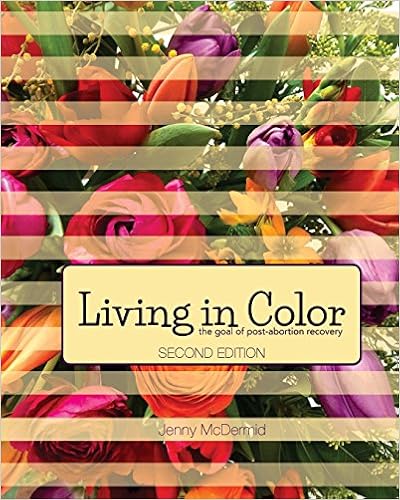
Living in Color (2nd Edition) is a post-abortion recovery and healing program designed for use by a small, facilitator-led support group. However, it is equally suitable for a person making her recovery journey alone, or in the company of a mentor, pastor or counselor. A Living in Color Facilitator's Guide is available for those leading support groups from www.pregcare.com. Dr Theresa Burke coined the phrase "forbidden grief" to describe the sadness and pain felt by many women following their abortion decision. This pain is seldom confined to the loss of a child: many also lose relationships, self-worth and hope for the future. These losses must be grieved and, as with all grieving journeys, this involves processing emotional responses such as relief, denial, guilt, shame, depression, anger and forgiveness. The post-abortive woman also needs to allow herself to "know" her child in order to say "goodbye for now." Having processed her grief, it is important to pay attention to what comes next. Many women discover that their healing journeys teach them many life lessons that contribute to increased strength of character, wisdom, vision and hope. The final chapter of the program celebrates the process of emerging from the "grey zone" of unresolved loss into a life of color, freedom, and joy. https://www.amazon.com/Living-Color-goal-post-abortion-recovery/dp/1453656596
Wednesday, January 02, 2019
A book review in Forreston, 1949

At least I think it was 1949. . . that’s the year the book was published. This book was made into a movie in 1952 starring Cary Grant and Betsy Drake.
I don’t think I read any of those books she recommended, but I do remember Jimmy Lewis who had a wonderful voice and white blond hair, and Davis Folkerts, a precocious piano player. Davis must have been about 10 years old when he performed for the ladies. He retired as professor of music from Central College in Pella, IA, in 2017 and was still playing the organ at 79. He learned to play the instrument in the sixth grade according to the local paper which covered his retirement 2 years ago.
I found this clipping inside her address book which seems to be from about 1990-2000. It’s full of names I remember, many who died that decade, according to her notes. I’m not sure how I inherited either the address book or the clipping inside it. I’m sure she didn’t put it in there.
But it’s fun to think of her at 37, giving a book review—I don’t remember her enjoying public speaking--getting out of the house and chatting with ladies of the community may have been an adventure. As I recall, the local library was a volunteer effort, open only a few hours a week, and run by my first grade teacher, Miss Flora.
Subscribe to:
Posts (Atom)


 Posts
Posts


