I usually ignore these memes, but I read it today, and it sort of sobered me. Especially thinking about those 99%. How many of these ring true for you, 99 % of those born between 1930 and 1946 (worldwide) are now dead. If you were born in this time span, you are one of the rare surviving 1% ers of this special group. Their ages range between 77 and 93 years old, a 16 year age span.
INTERESTING FACTS ABOUT THE 1% ers:
You are the smallest group of children born since the early 1900's.
You are the last generation, climbing out of the depression, who can remember the winds of war and the impact of a world at war that rattled the structure of our daily lives for years.
You are the last to remember ration books for everything from gas to sugar to shoes to stoves.
You saved tin foil and poured fried meat fat into tin cans.
You can remember milk being delivered to your house early in the morning and placed in the "milk box" on the porch.
Discipline was enforced by parents and teachers.
You are the last generation who spent childhood without television; instead, you "imagined" what you heard on the radio.
With no TV, you spent your childhood "playing outside".
There was no Little League.
There was no city playground for kids.
The lack of television in your early years meant that you had little real understanding of what the world was like.
We got "black-and-white" TV in the late 40s that had 3 stations and no remote. (Kids were normally the remote.)
Telephones were one to a house, often shared (party lines), and hung on the wall in the kitchen (no cares about privacy).
Computers were called calculators; they were hand-cranked.
Typewriters were driven by pounding fingers, throwing the carriage, and changing the ribbon.
'INTERNET' and 'GOOGLE' were words that did not exist.
New highways would bring jobs and mobility. Most highways were 2 lanes (no interstates).
You went downtown to shop. You walked to school.
The radio network expanded from 3 stations to thousands.
Your parents were suddenly free from the confines of the depression and the war, and they threw themselves into working hard to make a living for their families.
You weren't neglected, but you weren't today's all-consuming family focus.
They were glad you played by yourselves.
They were busy discovering the postwar world.
You entered a world of overflowing plenty and opportunity; a world where you were welcomed, enjoyed yourselves.
You felt secure in your future, although the depression and poverty were deeply remembered.
Polio was still a crippler. Everyone knew someone who had it.
You came of age in the '50s and '60s.
You are the last generation to experience an interlude when there were no threats to our homeland.
World War 2 was over and the cold war, terrorism, global warming, and perpetual economic insecurity had yet to haunt life.
Only your generation can remember a time after WW2 when our world was secure and full of bright promise and plenty.
You grew up at the best possible time, a time when the world was getting better.
More than 99% of you are retired now, and you should feel privileged to have "lived in the best of times!"
If you have already reached the age of 77 years old, you have outlived 99% of all the other people in the world who were born in this special 16 year time span. You are a 1% 'er"!
* * * * * *
My parents didn't get a TV until they could get color transmission from Rockford, IL--I think it was 1957 and I was already away at college.
No, don't remember Little League, but we had community "commercial leagues" sponsored by local businesses, and the American Legion sponsored teams. There was a Corbett Oil team (my dad sponsored it). For younger kids I think there were "junior" teams. Anyone else remember that?
Yes, I remember party lines. We were 59-L. My older sisters (teens) were telephone operators so we knew the gossip.
Walking to downtown and school was about same distance. Small and smaller towns.
Playgrounds were school grounds. Easy to get to. Also, streets and sidewalks were safe. If you were playing soft ball you'd just yell, CAR.
Not sure our lives overflowed with plenty, but I do remember our first refrigerator which replaced the ice box. Big boxes were fun.
Yes, polio was huge in my memory. Affected family and friends.
I don't recall a time of no international threats. We had duck and cover drills and classroom movies about "the bomb." All the theaters had WWII movies. Plus we had parents who remembered the Depression and lived accordingly.
And, although I never thought much about it at the time, we had pretty clothes. Today's closet for a young girl is full of sweats, T-s, and ugly shoes.
Showing posts with label 1940s. Show all posts
Showing posts with label 1940s. Show all posts
Thursday, August 22, 2024


Sunday, January 31, 2021
The candy bombers; the untold story of the Berlin airlift and America's finest hour
Our book club (on Zoom these days) will be discussing "The Candy Bombers" by Andrei Cherny this Monday. It's an absorbing book, and the author is a beautiful, graceful writer and consummate researcher. At first I thought I'd found someone who knew the similarities between Fascism and Communism--the flip sides of the same pancake, but after reading his bio (he's a Democrat and progressive with time in the Obama administration) he seems to be unaware of the dangerous path we're going down. Perhaps because this was published 12 years ago. He's the son of Czech immigrants.
It's frustrating that today's totalitarian Democrats keep referring to President Trump as a fascist, but perhaps they are just the CNN muddle brained social media arm chair historians, since Trump fits none of the check marks for a fascist. Our newest president who seems to be a stand-in for Barack Obama's third term is locked arm in arm with Big Tech--a much better fit the classic definition.
That said, I do remember the airlift that saved Berlin, and America's finest hour, as the subtitle claims. That's how we learned it in school. We were the good guys. I even remember some of the post WWII review Cherny provides and a few of the names who figure in this story, like Lucien Clay and James Forrestal. But I can't imagine how I remember. I was only 6 when the war ended, I didn't go to movies that much in the late 1940s that I would have seen news reels, and my family didn't have a TV. Perhaps we did read about it in American history classes as seniors, about a decade later. In any case, reading about what happened between the closing of the war and the beginning of the airlift in this book can certainly leave a bad taste in the mouth. Americans, and the other victors, were certainly not behaving in "the finest hour" image I learned in school. Germans were starving and dying of malnutrition while the victors were doing little about it, fulfilling Roosevelt's idea that they needed to be punished more severely than what happened after WWI in order to "learn a lesson."
Harry Truman has always been one of my favorite presidents, perhaps because he's the first one I remember. On p. 183 the author describes March 1948 after the Communists seized control in Prague. Truman was in the Florida Keys, and of course, the press was being critical for his being on vacation. Cherny notes a letter he wrote to his daughter, Margaret (another president who confided in his daughter), that "the situation was just like when Britain and France were faced with in 1938-9 with Hitler. A totalitarian state is no different whether you call it Nazi, Fascist, Communist or Franco Spain."
He wrote: "A decision will have to be made. I am going to make it. I am sorry to have bored you with tis. But you've studied foreign affairs to some extent and I just wanted you to know your Dad as President asked for no territory, no reparations, no slave laborers--only peace in the world. We may have to fight for it. The oligarchy in Russia is no different from the Czars, Louis XIV, Napoleon, Charles I and Cromwell. It is a Frankenstein dictatorship worse than any of the others. Hitler included. "
And that's what we're slipping into with the Biden administration. A sycophant media. Hold overs from the Obama administration who've been strategizing for 4 years to take us back to being government dependents. An oligarchy composed of powerful Big Tech companies who are closing down all expressions of conservative thought while the political parties seem helpless to control them.
Also, the inside negotiations and personality conflicts between many key players and the military and the politicians in DC which Cherny masterfully portrays are disturbing to read. I suppose that is common to every government with the petty disagreements, party loyalties, and idiosyncratic behaviors. I just haven't read that much and found it difficult.
There were 3 conventions that summer of 1948--the third was the "progressive" (Democrats) with Henry Wallace, who had been Roosevelt's v.p. in his 3rd term, but was pushed aside (thankfully) by conservatives in the Democrat party. I loved the description of the Progressives in 1948--nothing has changed:
"The delegates were young--the average age was 30 and many were in their teens. 3/4 of the delegates were new to politics (McGovern was 26). 2 out of 5 were labor union members . . . the mood was merry. Each day began with a sing-along of folk music. (Pete Seeger). . . at any moment during the proceedings, there would be numerous huddles on the convention floor forming around young men and women who had spontaneously begun strumming a guitar. . . The party platform called for an increase in the minimum wage, a strong action against racial discrimination, national health insurance, a Dept. of Peace, higher levels of farm supports, guaranteed pensions for older Americans. . ." p. 315
The U.S was already having problems with the Communist threat inside, and Wallace didn't have the slightest complaint about Soviet Communism, but found fault with the American government 's attempt to move against domestic communists. Any delegate at the progressive convention who wanted to slip a word into the platform that might be anti-Soviet, was shut down.
Yes, it does all sound very familiar.Sunday, December 20, 2020
Watching the Cheddar channel
I've seen the Cheddar app scroll by on my screen, so today I decided to try it. Sunday is not a regular news day, so I don't know how typical it is. It was offering a subscription to a service called Curiosity Stream. I came in the middle showing how a change in type face saved the New York transit system--Helvetica, one of my husband's favorite fonts. But it went on to discuss LEGEND which has been studies to show improvement in reading speed. I don't need an additional service, have too much TV now, but some good documentaries would certainly be a relief from some of the distasteful, overly sexualized and violent offerings. How the NYC Subway Was Saved By a Typeface on Cheddar
CuriosityStream to Go Public via Reverse Merger Deal on Cheddar
As seen on Cheddar--why is all the Great Christmas music from the 40s and 50s https://youtu.be/4bK1inqVb_Y

I've always thought "I'll be home for Christmas" (1943) is the saddest of all holiday songs.
Monday, December 31, 2018
Baby new year 2019—Monday Memories
My mother kept a "commonplace book," in which she pasted poems, cartoons, articles from magazines, and things she'd hand copied or typed from books. I see familiar names--McCall's, Chicago Daily News, Farm and Ranch, Christian Herald, and Rockford Morning Star. As a child I would sit and look through it often--a small, 3-ring black leather notebook. I particularly enjoyed the poem, "For a female cat named Horace," because it reminded me of my friend's cat "Butch" who populated Forreston, IL with kitties and the one about how to make a recipe taste like mother's--walk 5 miles before dinner. She may have been saving clippings in a box for years, but the first item was the baby New Year 1946 with a broom greeting old man 1945 giving him a terrible mess. So here it is again, Mom, for 2018-2019. The world is still a mess and we need you.
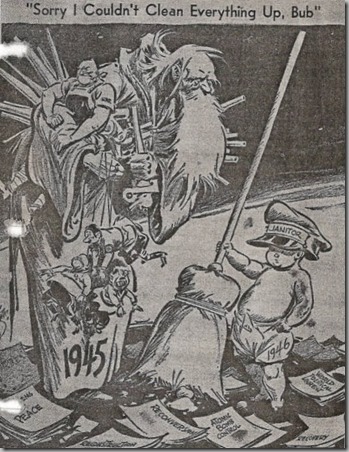
I wrote about her commonplacebook in January 2010, and noted:
“Her final hand written entry (in the scanned copy) is undated; but it was near the end of her life--perhaps the end of 1999. She died in January 2000. There is no attribution other than her name.
If
Each day we fill a page
The year a volume makes
These last ten books are very full
of joys
changes
sorrow
growth.
Gently place this year on the shelf--
if there is room.
Close the decade.
Wednesday, December 27, 2017
Cold remedies--Vicks or Numotizine?
Someone on Facebook today was writing about Vicks Vapor Rub as a cold remedy). It reminded me that my Mom always used Numotizine, which looks like thick pink peanut butter and she'd swab it on our neck and chest and wrap us up in an old towel or torn sheet. (What wasn't crocheted into area rugs was used as rags for cleaning or medical wraps.) By morning it had dried to chunks but seemed to work. So I looked it up on the Internet to see if it were still made--yes, it's a veterinary product for horses with sore or stiff legs! But I did find a few blogs that admired its assistance for bad colds. It's the heat, I believe. I personally think it was her love and concern that made us better, not that thick pink goo.
In those days the doctor made house calls, but was rarely called. Those from Mt. Morris, IL may remember Dr. Murray Dumont. Talk about house calls--Murray Trout told me he was delivered at home and named for Dr. Dumont. Dr. Dumont also delivered me, but in a Rockford hospital.

Sunday, December 03, 2017
5:30 a.m. tail lights
I glanced out the window this morning and saw a car moving slowly through the condo. A mom on newspaper duty. Just like I did, just like my mom did.
Actually, unless we had 4 feet of snow, my mom just gave us a warm breakfast, bundled us up, wrapped scarves around our faces, shoved on our leather and fleece snow boots, helped load the heavy Sunday Rockford Morning Star into our bags, and opened the door. But for three us, she had quite a work out before she could sit down with a cup of coffee and toast. My route was about 12 papers scattered at the SW of town with some farms--I was maybe 8 or 9. My sisters had the long routes with houses closer together.
My niece remembers that Mom told her she considered it good physical therapy for Carol after her bout with polio in 1949--riding her bike and walking with the bags of newspaper. Also playing the saxophone for breath control and building up her lungs.
Actually, unless we had 4 feet of snow, my mom just gave us a warm breakfast, bundled us up, wrapped scarves around our faces, shoved on our leather and fleece snow boots, helped load the heavy Sunday Rockford Morning Star into our bags, and opened the door. But for three us, she had quite a work out before she could sit down with a cup of coffee and toast. My route was about 12 papers scattered at the SW of town with some farms--I was maybe 8 or 9. My sisters had the long routes with houses closer together.
My niece remembers that Mom told her she considered it good physical therapy for Carol after her bout with polio in 1949--riding her bike and walking with the bags of newspaper. Also playing the saxophone for breath control and building up her lungs.
Friday, December 01, 2017
Friday Family Photo--Christmas songs
My great niece Catie who lives in Florida asked on Facebook what was our favorite Christmas song. I mentioned "I'll be home for Christmas" as a secular choice, and "Mary did you know" for religious, but then later I added this memory about White Christmas. It got so long, I decided to add it here along with a photo.
"White Christmas" is a favorite song, too. When your Grandma Yoder and I were little kids we lived in California, and that's the first time I heard that song--Christmas 1944. It had come out in 1942, so if I'd heard it before I was too little to remember. We went to a community center for a Christmas party (I don't think we had a church), and a group of teen boys sang it. Just about everyone in our community (Alameda, CA) was from somewhere else--and it was damp and foggy as usual in the Bay Area--so the song had a lot of impact. By Christmas 1945 we were back in Mt. Morris, the war was over, dad and his brothers, brothers-in-law, and cousins were home (about 500 men just from our rural area were in the military), the country had recovered from the Depression, and I still remember the gifts. In 1944 I'd gotten a small glass cat figurine, but by 1945 we had "real" presents--like a sled! One was the doll house that we 3 sisters were to share, and you and your mom as children played with it later in the basement of my parents' home on Lincoln St. My mom's camera was broken when I was little, so I have no photos of those Christmases, but I do have one of your Grammy Yoder in the snow in front of our house at 203 E. Hitt St. Probably winter 1940. She's the little one--she was very tiny for her age.

"White Christmas" is a favorite song, too. When your Grandma Yoder and I were little kids we lived in California, and that's the first time I heard that song--Christmas 1944. It had come out in 1942, so if I'd heard it before I was too little to remember. We went to a community center for a Christmas party (I don't think we had a church), and a group of teen boys sang it. Just about everyone in our community (Alameda, CA) was from somewhere else--and it was damp and foggy as usual in the Bay Area--so the song had a lot of impact. By Christmas 1945 we were back in Mt. Morris, the war was over, dad and his brothers, brothers-in-law, and cousins were home (about 500 men just from our rural area were in the military), the country had recovered from the Depression, and I still remember the gifts. In 1944 I'd gotten a small glass cat figurine, but by 1945 we had "real" presents--like a sled! One was the doll house that we 3 sisters were to share, and you and your mom as children played with it later in the basement of my parents' home on Lincoln St. My mom's camera was broken when I was little, so I have no photos of those Christmases, but I do have one of your Grammy Yoder in the snow in front of our house at 203 E. Hitt St. Probably winter 1940. She's the little one--she was very tiny for her age.

Saturday, January 30, 2016
Poverty 70 years ago compared to today
I've never seen a really good definition of structural or institutional poverty--probably because those are terms the left uses to criticize and demonize the right, so they lie about causes and solutions and ask for more money to throw at the problem. It's a great term for creating a straw man and then accuse someone else of knocking it down. The idea is that something within society is working against people to keep them from decent jobs and housing.
When I was a child, I actually knew poor children who were from poor families. In those days there were no wealth transfer programs, no school lunch, no welfare checks. We went to school together, and occasionally we played together. I don't remember any attending church (there were 3 churches, plus rural churches, so it's possible they did and I didn't know it). From my limited childhood understanding of economics, poor children had poor parents. In most cases I had never met their fathers, but had seen a mother--in those days (1940s/1950s) poor children had married parents, which is not usually the case today. The poor children I knew often didn't have underwear or socks, and their clothes were soiled and sometimes they smelled like urine. They did poorly in school. I knew children who were in foster care because their parents were too poor to take of them; I knew children who moved about every three to six months because their fathers were tenant farmers, and not very good ones because they drank. I knew children whose parents couldn't take care of them so they lived with their grandparents. I knew a few children that only had a mother, and she was often a waitress or just appeared occasionally. I noticed even in those days (I was maybe 8 years old by then), they had a vocabulary that included bad grammar, dirty jokes and words we weren't allowed to say. I knew one boy who had lost an arm in a farm accident, and another who was accidentally killed when he found his father's shotgun under a bed.
Of course, poverty is relative. Even my friends who weren't poor might have a dinner of soda crackers crumbled into a bowl of milk once or twice a week, had tongue sandwiches from butchering (gag), wore hand-me-down clothes from their cousins, and for Halloween a paper sack with a face drawn on it would be a suitable costume. Even families who weren't poor may have not had a home with an indoor toilet. For their once a week bath, the heated water came from the stove and was carried to the bathtub and three children might share the water. But being clean meant you weren't poor! The holes in our clothes were neatly patched and when they were outgrown they were given away, and if worn out, they were cut into strips and Mom crocheted a rug. Most of us who weren't poor had mothers who canned produce from gardens they had planted, weeded and harvested with the children's help, and we all wore dresses or trousers our mothers had sewn. But my goodness, we certainly didn't think we were poor, even if we only had one pair of shoes which had to last until our toes were squashed.
Now when I see poverty in Columbus, I still don't see institutional poverty. I see poor children with poor parents. The share of U.S. children living in poverty has actually increased by 2 percentage points since 2008. But unlike the 1940s these parents have lots of help from the state and federal governments--SNAP, Section 8 housing, WIC, school lunch and after school and summer time snacks, Medicaid, and all sorts of material aid from churches and non-profits, from food pantries to furniture to clothing to an automobile. Many of these poor families are headed by women. The majority are white. If they are lucky, they have an older "wise" woman in their life to help them negotiate the system. I met one the other day which was three generations and they were living in an unheated garage and were about to be evicted. But just like the children in the families I knew 70 years ago, the children are poor because the adults had made really bad decisions--about relationships, alcohol/drugs, education, and jobs. But especially relationships. The women become entangled with men who don't work or are petty criminals, then they are abused, and left with the children as he moves on to another woman or goes to prison. And the next guy she finds is more of the same. They are much better dressed than those I grew up with, but I can't forget the desperate look in the adults' eyes--the children don't seem to know they are poor.
The wealthy non-profits with well paid CEOs, the government bureaucrats and the academics in ivory towers seem to think that some are poor because others are rich. They want billions, no trillions, to close some sort of gap. It's like they've never looked at or talked to a poor family.
“Young people can virtually assure that they and their families will avoid poverty if they follow three elementary rules for success – complete at least a high school education, work full time, and wait until age 21 and get married before having a baby. Based on an analysis of Census data, people who followed all three of these rules had only a 2 percent chance of being in poverty and a 72 percent chance of joining the middle class (defined as above $55,000 in 2010.”
Ron Haskins of the Brookings Institution, testifying before Congress on June 5, 2012
When I was a child, I actually knew poor children who were from poor families. In those days there were no wealth transfer programs, no school lunch, no welfare checks. We went to school together, and occasionally we played together. I don't remember any attending church (there were 3 churches, plus rural churches, so it's possible they did and I didn't know it). From my limited childhood understanding of economics, poor children had poor parents. In most cases I had never met their fathers, but had seen a mother--in those days (1940s/1950s) poor children had married parents, which is not usually the case today. The poor children I knew often didn't have underwear or socks, and their clothes were soiled and sometimes they smelled like urine. They did poorly in school. I knew children who were in foster care because their parents were too poor to take of them; I knew children who moved about every three to six months because their fathers were tenant farmers, and not very good ones because they drank. I knew children whose parents couldn't take care of them so they lived with their grandparents. I knew a few children that only had a mother, and she was often a waitress or just appeared occasionally. I noticed even in those days (I was maybe 8 years old by then), they had a vocabulary that included bad grammar, dirty jokes and words we weren't allowed to say. I knew one boy who had lost an arm in a farm accident, and another who was accidentally killed when he found his father's shotgun under a bed.
Of course, poverty is relative. Even my friends who weren't poor might have a dinner of soda crackers crumbled into a bowl of milk once or twice a week, had tongue sandwiches from butchering (gag), wore hand-me-down clothes from their cousins, and for Halloween a paper sack with a face drawn on it would be a suitable costume. Even families who weren't poor may have not had a home with an indoor toilet. For their once a week bath, the heated water came from the stove and was carried to the bathtub and three children might share the water. But being clean meant you weren't poor! The holes in our clothes were neatly patched and when they were outgrown they were given away, and if worn out, they were cut into strips and Mom crocheted a rug. Most of us who weren't poor had mothers who canned produce from gardens they had planted, weeded and harvested with the children's help, and we all wore dresses or trousers our mothers had sewn. But my goodness, we certainly didn't think we were poor, even if we only had one pair of shoes which had to last until our toes were squashed.
Now when I see poverty in Columbus, I still don't see institutional poverty. I see poor children with poor parents. The share of U.S. children living in poverty has actually increased by 2 percentage points since 2008. But unlike the 1940s these parents have lots of help from the state and federal governments--SNAP, Section 8 housing, WIC, school lunch and after school and summer time snacks, Medicaid, and all sorts of material aid from churches and non-profits, from food pantries to furniture to clothing to an automobile. Many of these poor families are headed by women. The majority are white. If they are lucky, they have an older "wise" woman in their life to help them negotiate the system. I met one the other day which was three generations and they were living in an unheated garage and were about to be evicted. But just like the children in the families I knew 70 years ago, the children are poor because the adults had made really bad decisions--about relationships, alcohol/drugs, education, and jobs. But especially relationships. The women become entangled with men who don't work or are petty criminals, then they are abused, and left with the children as he moves on to another woman or goes to prison. And the next guy she finds is more of the same. They are much better dressed than those I grew up with, but I can't forget the desperate look in the adults' eyes--the children don't seem to know they are poor.
The wealthy non-profits with well paid CEOs, the government bureaucrats and the academics in ivory towers seem to think that some are poor because others are rich. They want billions, no trillions, to close some sort of gap. It's like they've never looked at or talked to a poor family.
“Young people can virtually assure that they and their families will avoid poverty if they follow three elementary rules for success – complete at least a high school education, work full time, and wait until age 21 and get married before having a baby. Based on an analysis of Census data, people who followed all three of these rules had only a 2 percent chance of being in poverty and a 72 percent chance of joining the middle class (defined as above $55,000 in 2010.”
Ron Haskins of the Brookings Institution, testifying before Congress on June 5, 2012
Thursday, October 22, 2015
Sounds like my mom
![12075076_10205634038306772_6500640645549617743_n[1]](https://blogger.googleusercontent.com/img/b/R29vZ2xl/AVvXsEgnm2Cwkua7ZB017EatzcQnYMx3f7iOiY89E-XgXBb6-64sfSJbE0B81UIRVNyiHFnq0TowoUiq4wZkEUNwsFksqBYzoy5tr5oaYgu830jTxYFgaH9e7E5AHi9KMOs8Z12tqccWAg/s1600-h/12075076_10205634038306772_6500640645549617743_n%25255B1%25255D%25255B3%25255D.jpg "12075076_10205634038306772_6500640645549617743_n[1]")
My mother (1912-2000) had this attitude about all housekeeping skills, and particularly was careful to look nice when Dad came home from work. When I think back to some of the complex outfits she made for her four children, I think this must have been part of the routine. Her mother had used a dressmaker or shopped in Chicago, so Mom didn’t learn sewing as a child, but it was necessary when the children came along during the Depression. We even had little dresses made from feed sack fabric. I never had a holiday or prom dress bought from a store—Mom made them all, a pale green organdy, the pink crystalline below (from my sister’s wedding) and a two piece with green linen top and white flocked skirt with pink flowers. She made my blue silk going away dress for my wedding (I had started it, but didn’t use the advice from Singer, and she had to finish it).

1955 bridesmaid dress, also prom 1956; my sister Carol had the same dress in yellow, and Mom made the wedding dress (which I then wore in 1960)

Dolls from the 1940s which I still have.

My brother Stan in cover-alls made from my father’s military clothes

Pattern of one of my favorite aprons I wore for 40 years made by Mom

My high school graduation dress which included a jacket
Monday, December 05, 2011
Monday Memories--Christmas in the 1940s
When I remember Christmas 1944, I'm aware that at that time, I remembered Christmas back in Illinois and I knew it was different, but 1944 is really the earliest clear memory. In 1944 Mother had moved her family of four little children in a 1939 Ford to a foreign land filled with people of many ethnicities and strange customs--California. It even smelled funny to me--Alameda and Oakland--you could smell the Bay and the ocean. My father was in the U.S. Marines and the country was at war.
On the one hand, it was a scary time for a little child, but on the other, it was fascinating. Ribbons of highway, miles and miles of flat land, eating in restaurants, sleeping in camps, strange bugs and animals, mountains, desert, the great Salt Lake, picking up hitch hiking soldiers to help with the driving, and always our strong Mother who seemed to have everything under control (but who was only 32 and had probably never driven outside of a few counties in Illinois.
We lived in a stucco ranch house in Alameda. We went to school with children of many types--Filipinos, Chinese, black, Oakies and Arkies, visited local sites like the San Diego Zoo (although that's certainly not close to Alameda--maybe it was San Francisco), and played with neighborhood friends. I can't remember a Christmas tree in that house, but I suppose we had one. I do remember Christmas caroling in the fog--that's how I know I had memories then of earlier Christmases--because I remember thinking how odd we didn't have snow. I recall going to a community gym where I think we had church, and hearing a group sing "White Christmas," which in those days, was a "new" anthem of nostalgia. Somewhere in the mix my mother's brother Clare was killed in China and my father shipped out so our reason for being there was over.
Dad came home when the war was over (to our house in Illinois) shortly before Christmas 1945--I seem to remember an announcement that he would be home for Christmas. What I remember are the glorious presents Mom had wrapped--and I do remember that tree and the excitement. A doll house and a sled--to be shared by all--but it seemed to me that she must have "broken the bank," and indeed, 30 years later my daughter and all her cousins had played with that same 2 story doll house in mother's basement--having been "redecorated" many times.
For Christmas 1946 we must have been in Forreston in the little farm house that didn't have a bathroom until Mother installed it, because I remember receiving my first Bible, a KJV which I still have. I think I remember going back to Mt. Morris and possibly Franklin Grove to have dinner and presents with my grandparents, but we did that many years, so I've sort of put those memories through a blender and filter. We were attending Faith Lutheran Church so it's possible we were in a Christmas pageant. We weren't Lutherans, but that church took us in and made us feel welcome.

Norma in 1946
By Christmas 1947 we had moved to a lovely 4 bedroom brick house with a big porch and yard. We girls all had paper routes, and it seems to me the snow was very deep. Christmas 1947 meant spending hours near the tree with my brother, shaking and handling presents, trying to guess what might be in them. The tree was real, and I recall some of the ornaments were Disney characters. I remember clothes hand made for my dolls from scraps left from the dresses Mom made for me. I still have some of them. The four of us sang in a quartet for community groups with my oldest sister the accompanist--Frosty the Snowman, Winter Wonderland and White Christmas. I don't think we had a lot of talent, but the Cuteness meter was off the charts, especially with my charming little brother.
At Christmas time at the Forreston school which contained all 12 grades, all the classes would gather in the hall and the principal, John I. Masterson, would read the Christmas story from the Bible--the Luke passage. As one of the younger students, I thought being together with the high school students was more awesome than the actual celebration.
Good times, good memories, thanks for reading.
On the one hand, it was a scary time for a little child, but on the other, it was fascinating. Ribbons of highway, miles and miles of flat land, eating in restaurants, sleeping in camps, strange bugs and animals, mountains, desert, the great Salt Lake, picking up hitch hiking soldiers to help with the driving, and always our strong Mother who seemed to have everything under control (but who was only 32 and had probably never driven outside of a few counties in Illinois.
We lived in a stucco ranch house in Alameda. We went to school with children of many types--Filipinos, Chinese, black, Oakies and Arkies, visited local sites like the San Diego Zoo (although that's certainly not close to Alameda--maybe it was San Francisco), and played with neighborhood friends. I can't remember a Christmas tree in that house, but I suppose we had one. I do remember Christmas caroling in the fog--that's how I know I had memories then of earlier Christmases--because I remember thinking how odd we didn't have snow. I recall going to a community gym where I think we had church, and hearing a group sing "White Christmas," which in those days, was a "new" anthem of nostalgia. Somewhere in the mix my mother's brother Clare was killed in China and my father shipped out so our reason for being there was over.
Dad came home when the war was over (to our house in Illinois) shortly before Christmas 1945--I seem to remember an announcement that he would be home for Christmas. What I remember are the glorious presents Mom had wrapped--and I do remember that tree and the excitement. A doll house and a sled--to be shared by all--but it seemed to me that she must have "broken the bank," and indeed, 30 years later my daughter and all her cousins had played with that same 2 story doll house in mother's basement--having been "redecorated" many times.
For Christmas 1946 we must have been in Forreston in the little farm house that didn't have a bathroom until Mother installed it, because I remember receiving my first Bible, a KJV which I still have. I think I remember going back to Mt. Morris and possibly Franklin Grove to have dinner and presents with my grandparents, but we did that many years, so I've sort of put those memories through a blender and filter. We were attending Faith Lutheran Church so it's possible we were in a Christmas pageant. We weren't Lutherans, but that church took us in and made us feel welcome.

By Christmas 1947 we had moved to a lovely 4 bedroom brick house with a big porch and yard. We girls all had paper routes, and it seems to me the snow was very deep. Christmas 1947 meant spending hours near the tree with my brother, shaking and handling presents, trying to guess what might be in them. The tree was real, and I recall some of the ornaments were Disney characters. I remember clothes hand made for my dolls from scraps left from the dresses Mom made for me. I still have some of them. The four of us sang in a quartet for community groups with my oldest sister the accompanist--Frosty the Snowman, Winter Wonderland and White Christmas. I don't think we had a lot of talent, but the Cuteness meter was off the charts, especially with my charming little brother.
At Christmas time at the Forreston school which contained all 12 grades, all the classes would gather in the hall and the principal, John I. Masterson, would read the Christmas story from the Bible--the Luke passage. As one of the younger students, I thought being together with the high school students was more awesome than the actual celebration.
Good times, good memories, thanks for reading.
Saturday, December 19, 2009
Are we at the end of a natural warming period
There are two strong memories from my childhood: the snow was very deep and we were at war most of the time. I was born at the end of a warming blip that had existed during most of the the lifetime of my parents (1916-1940) which was part of a larger trend that began around 1850 after a cold period of several centuries. Whereas their formative years contained memories of dust storms, shriveled crops and nights so hot in Illinois they couldn't breathe, I remember giant snow drifts and winters that seemed to last forever followed by warm, idyllic and pleasant summers. Of course, I was shorter then, so it wasn't that tough to say it was up to my waist. However, another warming blip began in the 1970s, and I can remember driving to Illinois in the winter with our children and not seeing a snowflake. I still remember the summer of 1988--it was so dry and hot in Ohio, the Bruces broke down and bought an air conditioner for our Columbus house, and took a lake cruise to get out of the heat of Lakeside. Now things seem to be getting cooler again with lots of ragged, wild weather around the edges. I wouldn't even think of driving to Illinois in the winter now--the last five years where I grew up have been brutal with deep snow. Here in temperate mid-Ohio we muddle through gray winters as we always have with one or two blizzards a year and then weeks of melting snow drifts. This morning I woke up to the sound of snow plows, but didn't recognize the noise. We may get 2-4" as the northeast is pummeled.
The other memory--that of war--is a reminder that we need to be vigilant. Hitler was marching through Poland (Polenfeldzug) when I was born. I believe our President was trying to work out some sort of "accord." During my youth and right up to the collapse of the USSR, some version of socialism has been the enemy of our republican form of government--either the National Socialism of Hitler, or the Communism of Lenin/Stalin/Mao--both of which chewed up most of Europe and Asia. The other, centuries old absolute loyalty to a monarch, was Japan, now a democracy. This is another thing that is cyclical. Our ignorance and forgetfulness. Socialism doesn't need armored tanks anymore.
The other memory--that of war--is a reminder that we need to be vigilant. Hitler was marching through Poland (Polenfeldzug) when I was born. I believe our President was trying to work out some sort of "accord." During my youth and right up to the collapse of the USSR, some version of socialism has been the enemy of our republican form of government--either the National Socialism of Hitler, or the Communism of Lenin/Stalin/Mao--both of which chewed up most of Europe and Asia. The other, centuries old absolute loyalty to a monarch, was Japan, now a democracy. This is another thing that is cyclical. Our ignorance and forgetfulness. Socialism doesn't need armored tanks anymore.
Thursday, November 12, 2009
Looking back at the origins of FHA
 The right margin of this interesting article from Woman’s Day about an early FHA backed mortgage is missing because my grandmother who clipped it was interested in the quilt pattern on the other side (Star and Ring). From the clothing and hair styles, I’d place it about 1948 because the husband isn’t in uniform and those drapes look familiar.
FHA has had an interesting history. On the one hand, it allowed generations of Americans to own their own homes, but the unintended consequences are it contributed mightily to our current recession brought on by the collapse of the housing market.
It was created in 1934 during the Great Depression because housing loan periods used to be much shorter with a final balloon payment, and when the economy failed, many people lost their homes. But there were also some fairly stiff standards on the quality of the home, a modest down payment and the ability of the buyers to pay. After 25 years or so, politicians decided this was unfair to African Americans who were being left behind in the decaying inner cities as whites moved out to newer housing stock (like in the picture of the Knudsen family home near Washington D.C.).
So that’s how we got all this “creative financing” with the seller, instead of the buyer, providing the down payment, but not really, because it actually came from a non-profit organization like a church or community group (think ACORN) which got the money from the government. In 2000, these types of mortgages made up less than 2% of FHA insured mortgages. By 2007, that percentage jumped to 35%. And I guess you know the rest of the story.
- “The FHA’s standard insurance program today is notoriously lax. It backs low downpayment loans, to buyers who often have below-average to poor credit ratings, and with almost no oversight to protect against fraud. Sound familiar? This is called subprime lending—the same financial roulette that busted Fannie, Freddie and large mortgage houses like Countrywide Financial.” WSJ, Aug. 11, 2009
But this is just a reminder that more government interference in the housing market is not necessarily a good thing. The current housing credit of $8,000 for “first time buyers” (and there’s tremendous fraud in this) is costing us taxpayers something like $48,000 for each one.
Incidentally, Dorothy Ducas, the author of the Woman's Day article had a very interesting career and would make an interesting topic for a thesis if it hasn't been done.
Wednesday, May 28, 2008
Summer time in the 1940s and 1950s
This is from a post I wrote about a year ago. It's easy to romanticize the past, but it does seem that today's youngsters are missing something. Free time? Perhaps we didn't have as much as it seems, at least not if you had my mother.- Yesterday the WSJ ran a parenting article about overscheduling children in their summer activities. In my mind's eye I replayed the dozen or so summers I remember when I was a child--they seemed to run forever--hot, hazy and relaxed with hours of finding shapes in the clouds and bugs in the grass and bubbles in the tarred streets for bare toes.
At first I couldn't imagine my mother managing my summers for me, but looking back I realize she was quietly (she was always quietly doing something) planning my schedule. In Forreston I attended summer recreation program at the community school for games, swimming and sports. From age 11-16 I attended summer camp at Camp Emmaus. In elementary school I had babysitting jobs; in high school I detasseled corn, worked at the drug store, at a feed company and the town library. I had a horse, or my friends did, and we rode them down hot, dusty roads. After age 14 I was dating and going on picnics at the Pines, to the roller rink, to movies out of town and locally. My church CBYF had weekly Sunday evening meetings; my girl friends and I had slumber parties; the town had summer band concerts (still does) where you bought bags of popcorn and hoped to see someone special even if you didn't hear a note; and there were 4-H projects to get ready for the county fair. And the projects Mom would invent to keep us busy! Gardening, canning, cleaning, cooking, sewing, laundry. Oh my! That could cut into a sleepy summer day's reading.

Update: I just noticed something in this photo, which is probably from 1952 or 1953. My bike is the only one with "standard handle bars" and the other three have the flared shape, which I always thought were from the late 1960s or early 1970s. I still use a bike with this type of handle bar.
Friday, May 18, 2007
Friday Family Photo

Yesterday the WSJ ran a parenting article about overscheduling children in their summer activities. In my mind's eye I replayed the dozen or so summers I remember when I was a child--they seemed to run forever--hot, hazy and relaxed with hours of finding shapes in the clouds and bugs in the grass and bubbles in the tarred streets for bare toes.
At first I couldn't imagine my mother managing my summers for me, but looking back I realize she was quietly (she was always quietly doing something) planning my schedule. In Forreston I attended summer recreation program at the community school for games, swimming and sports. From age 11-16 I attended summer camp at Camp Emmaus. In elementary school I had babysitting jobs; in high school I detasseled corn, worked at the drug store, at a feed company and the town library. I had a horse, or my friends did, and we rode them down hot, dusty roads. After age 14 I was dating and going on picnics at the Pines, to the roller rink, to movies out of town and locally. My church CBYF had weekly Sunday evening meetings; my girl friends and I had slumber parties; the town had summer band concerts (still does) where you bought bags of popcorn and hoped to see someone special even if you didn't hear a note; and there were 4-H projects to get ready for the county fair. And the projects Mom would invent to keep us busy! Gardening, canning, cleaning, cooking, sewing, laundry. Oh my! That could cut into a sleepy summer day's reading.
Obviously, this is not a summer photo, but my mother's camera broke around 1945 and we don't have many pictures of my childhood. There was no extra money to get it fixed, she once told me. I thought hanging upside down was just about the most fabulous trick, and it was performed on our back yard slide on Hitt Street in Mt. Morris. The two board and batten barns you see in the background were actually garages, but in those days, many barns from an earlier era had been converted. We had a "real" garage, one side for us and one side for our neighbors, the Crowells. The barn nearest in the photo was behind Mike Balluff's and Dick Zickuhr's homes, and the one further away I think was behind Doug Avey's house or possibly the Aufterbecks. At the left edge I think I can see a chicken coup. There were no horses in town, but a lot of people still had a few chickens for fresh eggs.
There are no leaves on the trees, and I'm wearing a coat, head scarf, and slacks which must mean it was cold. Little girls only wore slacks if it was really cold--the rest of the time we were in dresses. The coat was probably a hand-me down from one of my sisters. I think it was navy blue, double breasted with large white buttons, most likely made by my mother.
So maybe childhood schedules aren't so different. What do you think?
Monday, December 18, 2006
Monday Memories
Did I ever tell you about my brief, Christmas singing career?
This memory is a bit fuzzy, but I think it was for Christmas 1947 that my mother organized her four adorable children, 6, 8, 10, and 12, into a quartet and we performed for the various organizations and church groups in our little town of Forreston, Illinois. It was a very small town, so people must have heard us more than once. I'm not sure if Mother was overcome with ambition, or the townspeople were trying to make us feel welcome, or if there was a huge shortage of programming, or all three. My oldest sister played the piano, and the rest of us, little stair steps dressed in our Sunday best, faced the audience and sang, "Frosty the Snowman," "White Christmas," and "Winter Wonderland." My sister continues to perform as a church musician, but the rest of us had no talent and we outgrew cute. However, it was fun--and I still know the words.
You'll find lots of ways to modify your photos with beards, wigs, hats or antlers with this.
My visitors and those I'll visit this week are:
Friday, December 01, 2006
Friday Family Photo

Look at these little sweethearts, all dressed up in their caps and gowns to move up to the primary Sunday School class. I'm not sure of the year--maybe 1944 or 1945. We are standing there on the steps of the Mt. Morris Church of the Brethren, squinting into the sun. I'm the one with brown shoes and no curls, sigh. It really stunted my fashion sense. It was probably the only pair of shoes I had, and Deb and Barb and Diane also in the front row, being the only girls in their families, probably had two pair of shoes. All except Dick finished grade school and high school together. His father died and his mother remarried and moved away. My family moved away too in 1946, but came back when I was in 6th grade, and this is where I was baptized when I was 12 years old.
By the mid-1950s the church was bursting; the baby boom and a talented young preacher brought in many new members, especially young families. Our Sunday School class probably tripled. So a decision was made to build a new facility with a large sanctuary and 3 floors of classroom, a chapel, special youth room for the CBYF with a fireplace, a big commercial grade kitchen, fellowship hall, a library, offices for the staff, lots of parking and so forth. My parents were in their early 40s and were involved in every stage of building the new church, from raising money to sewing drapes and picking out paint colors. The building where this photo was taken was sold to a small group just getting started in Mt. Morris, the Evan Free.
Their roles are reversed now. The Evan Free is filling the old church, and the big Church of the Brethren has many empty pews and classrooms and an aging congregation. The young people who built it are now the elderly with special needs. I'm not a member there, so I have nothing to say, but I have heard many good things about their new pastor who just started a few months ago and that is hopeful.
Church of the Brethren
Mt. Morris, Illinois
Sunday School
vintage photographs
Friday, June 16, 2006
Friday Family Photo
Even most of my family couldn't tell you how these two photos are related. I'm guessing the b & w is 1940, but I have no idea what the occasion was. The children are my paternal cousins Kirby* and Melvin, Evelyn and Jimmy, my uncles Derril and Gene (my father's brothers), my two sisters, my uncle Ken (dad's brother-in-law) and a family friend who I think was Bud Wilson (I'm sure if Dad were alive he could provide a positive ID). However, my cousin Gayle, who is a maternal cousin, is sitting in the front. So perhaps Mom was babysitting, and maybe she took the picture, because the format size looks like hers--and it was in her box of photos.But did they all get in that little car? Probably not. I'm thinking it was a family picnic--maybe the annual "Tennessee Reunion"--held at a farm, and the car was just parked along the road.


The second photo shows the children (with spouses) and grandhildren of my two sisters (who are in the b & w photo) almost 60 years later with my Mom in 1999. My niece Karen, who's the family photographer, set it up and then got in the back row.
*More about Kirby and his music career on Monday Memories next week.
Subscribe to:
Posts (Atom)


 Posts
Posts


