Thursday, March 09, 2006

2257 The Armenian Genocide

Two weeks ago, PBS announced "that its upcoming documentary, "The Armenian Genocide," will be followed on some stations by a panel discussion featuring two so-called scholars who claim that the genocide is a myth. Worse, according to genocide historian Peter Balakian, PBS threatened to pull the documentary if he and another genocide scholar declined to participate "on the other side" in the panel discussion, which was taped in January. Although the documentary is not slated to run until April, programmers across the country are now deciding whether to air it at all, air it alone or air it with the taped debate."

Story in LATimes, an OpEd piece written by Aris Janigian (registration). Frankly, I didn't know any serious, intelligent person doubted the murder, rape, torture and starvation of millions of Armenians. Where do they think all these Armenian-Americans came from? If our political ties with the Turks are the reason, I'm just not impressed. Bad, bad PBS!

Janigian continues: "Why has PBS resorted to double-speak in regard to the Armenian genocide? The answer is simple: PBS is capitulating to politics. For years the Turks, America's so-called allies, have issued threats against any organization or country that challenges their quack reading of history. When the French recognized the Armenian genocide, the Turks recalled their ambassador to France, boycotted French products and canceled military contracts. They have threatened to withdraw strategic support from our country if we should dare make the same mistake."

Washington Post article

2256 Letters to the Editor

I write a lot of them. Then I get an e-mail back asking if my letter can be posted/published, and I always say NO. I have my opinion, but it is for their eyes only. Most recently I got responses from Wired, and a medical journal (can't remember which one). If your letter (of constructive, witty criticism) is published you get a stuffy response from the author of the article, or a snarky one from another reader who didn't even read past the first "however."

However, Architectural Digest publishes the most fabulous "letters to the editor"--they always make me want to go back and pick up that issue, because I never, never have a memory of the article or the issue being THAT terrific.

For example, the April letters about the January issue:

"The January 2006 was the best I've ever read. . ."
"It's work like that which makes your magazine the benchmark. . ."
"When I'm asked what I want for Christmas my reply is subscription to AD. . ."
"Never before have I read an issue cover to cover. . ."
"I have to tell you how much I enjoyed the January issue. . ."

From the March issue (I never, never give away my Hollywood issue, so don't ask), more on the January issue:

"By comparing the advice of the experts and incorporating their lists of dos and don'ts with my own tastes, I have embarked on an adverture. . ."
"Your January issue was remarkable. . ."
I loved the advice. . .on how to make small rooms appear bigger. . ."
"taken his consistently excellent work to new heights. . ."

Guess I'll have to go find the January issue. I don't remember it at all.


2255 A quick blogger tip

Have you ever had a problem getting blogger software to load your photos into your blog text? I often don't decide on a photo until I've written something and think it needs a little splash of color. So I look through my photos, upload, and nothing happens. I've discovered that if I upload it to an empty posting window, and then cut and paste that html into my drafted, ready-to-go post, it works like a charm. Another solution would be not to write so much, but what's the fun in that?

At the bottom of your posting window, there is a little line that reads "post and comment options." Click on that and you can adjust your time and date to reflect the day you assign. For instance I post my TT and MM the night before, but have often drafted and saved them a week in advance where they stay in draft mode but with the correct date so I can revise and think about them. If I want my TT or MM to stay on top for my short attention span readers who don't want to hunt for them, I change the time of the later posts during the day so they come before. If you only post once a day, this is not a problem. But what's the fun in that?


2254 Might be time to let go?

My children will tell you I was a hovermother--the eyes in the back of my head were on rotating antennae 24/7. I was everywhere at once. Our lives all would have been more peaceful if I'd just relaxed a bit (just as my mother told me). But I was in the novice tadpole class according to Sam Schulman's recent article "Letting Go." I'd be no match for today's parents--from the doorstep of the school to gymnastics, soccer, karate, piano, and dance. Tethered with cellphones, e-mail, text messaging? Sam reports that some college students are in touch with their parents by cellphone as many as 15 times a day.

"Yes, parents impart values. But values come from other useful sources, too. Hovering parents undermine the influence not only of other institutions like schools and churches but of peers. Being picked for a sports team, facing the first day at school or at a job, learning to handle the ups and downs of courtship, enduring the apprenticeship of almost any career--these are not only signs that our children are becoming independent adults, but acts of initiation that take them out of the family embrace and into the wider world.

The seemingly obvious notion that kids need to be left alone sometimes if they are to grow up has been so lost that more than one American university has been forced to station security guards outside freshmen orientation sessions to keep anxious parents out. There are no reports, encouragingly, of freshmen on the other side trying to pull their parents in."


Wednesday, March 08, 2006

2253 Soy products and fertility

As if we didn't have enough to worry about. Now we need to worry about soy based forumula? Apparently. There's a lot of women of child-bearing age who had soy formula as infants.

"Genistein, a major component of soy, was found to disrupt the development of the ovaries in newborn female mice that were given the product. This study adds to a growing body of literature demonstrating the potentially adverse consequences of genistein on the reproductive system. . .

The results of this study conducted by researchers at the National Institute of Environmental Health Sciences (NIEHS), part of the National Institutes of Health, in collaboration with an investigator at Syracuse University, are published in the January [2006] issue of Biology of Reproduction. " Full story here.

There should be more coming out soon. The National Toxicology Program, Center for the Evaluation of Risks to Human Reproduction (CERHR) will hold an independent expert panel meeting on “Genistein and Soy Formula” on March 15-17, 2006, at the Radisson Hotel Old Town, Alexandria, VA. For more information check the Federal Register: http://ntp.niehs.nih.gov/files/GenisteinSoyMtg.pdf. The NTP is an interagency program headquartered at NIEHS.


2252 Irish going home

Illegals going home? But this time it's the Irish. I didn't know we had such a small problem, but it was a big story in the LA Times, March 8. The Irish economy is booming; why shouldn't they go home if they are not here legally? Why is this story made to sound so pathetic and heart wrenching? I can still claim to be a bit Irish, although my Irish came in the 1730s and fought in the American Revolution. They beat the potato famine rush of the 19th century by over 100 years.


But in one of the unexpected effects of Sept. 11, Irish immigrants are leaving the United States in waves; they say the crackdown on illegal immigration, coupled with a booming Irish economy, has eliminated the advantages that drew them here.

Ten years from now, say activists pushing for immigration reform, there won't be Irish neighborhoods left in New York.

"Watch the various airlines heading for Ireland," said Adrian Flannelly, chairman of New York's Irish Radio Network, "and you can see the same type of grief and sorrow that there has been in the worst days of our history, where [immigrants] would leave everything behind them.

"The Irish in America are as old as America itself," he said. "In that sense, this is a disgrace."

Before dawn today, 17 buses were scheduled to leave Katonah Avenue for Washington, where Irish immigrants intend to press for passage of the Kennedy-McCain immigration bill. The legislation would allow all illegal immigrants to apply for legal status after paying their back taxes and working in the United States for six years.

The Irish government estimates that 25,000 of its citizens are living illegally in the United States, but immigration reform groups say the number is as high as 40,000.

The push to change U.S. immigration law came from Ireland, where politicians were hearing bitter complaints from voters whose relatives were living here illegally, said Niall O'Dowd, chairman and founder of the Irish Lobby for Immigration Reform. The group received a grant from the Irish government to pursue its mission.

"There's nowhere in the world where Irish citizens are more marginalized than the United States," said O'Dowd, publisher of the weekly Irish Voice.

The Irish-born population in the United States has been dwindling for years, from 251,000 in 1970 to 169,827 in 1990, according to the census. It has fallen sharply over the last four years, most notably between 2003 and 2004, when it dropped from 148,416 to 127,682.


Tuesday, March 07, 2006

2251 Self Help Books

The best thing that can be said about this genre is they sell. And sell. And sell. The sillier the title, the bigger the sales. I was in a bookstore today looking for a hard to find section and passed the self help section. I couldn't resist. I just had to jot down some of the titles.

  • Sham; how the self-help movement made America helpless
  • Why men never remember and women never forget
  • The guide to picking up girls
  • I used to miss him but my aim is improving
  • Babe bible
  • Life is short wear your party pants
  • What's it like being you?
  • Read my hips
  • Why can't you shut up?
  • You're wearing that?
  • Do I look fat in this?
  • The book of No
I'm guessing there is no advice in these books you couldn't get for free at this blog!

Playing tag with the cat

If you read this and you are a cat or have a cat, consider yourself tagged! HT St. Casserole. (Cute cat photo alert)


1. What's your favorite food?
I'll eat just about anything, but don't care much for stinky fishy canned cat food. I can hear cheese and always show up for that.
2. What is your favorite toy?
Shoe strings are nice, also apron strings. Mostly I just go after imaginery things.
3. What is your best trick?
I run through the house meowing after I eat.
4. What is your favorite human trick?
I entice them to kiss my nose through the banister. It never fails. I have them well trained.
5. What human rule do you break often?
Digging food out of the garbage disposal and sleeping on top of the white upholstered living room chairs.
6. What do you wish your human knew about you?
I wish they knew where I came from. I'm sure I have a pedigree somewhere and how I got lost and turned in at Cat Welfare is a very sad story.
7. What are you glad your human does NOT know about you?
I have my own blog and use the computer at night when they are asleep. I'm in the top ten at Truth Laid Bear and that would make my human jealous.

You are tagged!

Love from Whistle the Kitten

2249 Six months after Katrina

St. Casserole's neighborhood is slowly, slowly returning to normal and she has some happy things to report. It had been awhile since I visited, and was pleased to find:

"Our Pass Christian High School kids got prom dresses, accessories and tuxes from a high school in Connecticut.

The Humane Society of South Mississippi moved out of the Katrina damaged building into a great new facility. Grants, donations and labor from around the country came pouring in to help.

Our neighborhood Chinese restaurant re-opened and looks better than it did before the storm."

Her sense of humor is also in good shape. On Ash Wednesday she noted:

"Remember that March is Wear More Jewelry month so load it on. Keep your pedicures current and buy a new pair of shoes. Oh rats! It's Lent. Forget all that and get your purple on."

2248 Christians in a Jim Crow India

This week I came across the blog by LaughWrinkles who is a 21 year old Canadian protestant living in India on a mission assignment at a Catholic mission. She doesn't write often, but every story is riveting and educational. It is hard to imagine someone so young being so self-possessed and confident in her travels and strong in her faith--certainly not an image I have of myself at that age. In some ways it does remind me of the letters my sister Carol sent home about her year in Brethren Volunteer Service when she was 18. One, or I should say three, of the problems she encounters are prejudice against women, against westerners, and of course hostility toward Christians, who are a tiny minority and often of low caste.

When I posted her story at Church of the Acronym I received a comment from a blogger in India that included a story about a father in India whose daughter was killed (possibly a dowry dispute?). I was a little confused about the details, but looked at his website. Apparently there are new laws in India affecting the status of married women and custody of children and the right to abortion. The author finds these changes threatening. The English was difficult for me, so if you have another site to suggest, pass it along.

Meanwhile, in the January/February issue of Books and Culture there is an article, "The shackles of caste," about the Dalits of India. Although it's been over 50 years since the untouchable status was made unconstitutional, serious crimes against the lowest caste members still persist. Because India is a major player in the global economy and technically a "democracy," we need to care about this.

Prisoners of the Hindu caste system, India's 250 million Dalits face such indignities on a daily basis. According to Human Rights Watch, nearly 100,000 crimes of hate were committed against Dalits between 1994 and 1996 nationwide—including many cases of murder, rape, and assault as well as lesser crimes. Many more incidents were not reported. Observers believe that with the rise of rightwing Hindu fundamentalists in India, such attacks are increasing in frequency. And apart from physical assault, Dalits face systematic social, economic, and religious exploitation. India's pernicious caste system dwarfs South African apartheid, both in scale and in effect. Apartheid is gone, but caste remains.

A new book, Dalit Freedom—Now and Forever, chronicles the Dalits' ages-long plight. Written by an Indian Christian and supplemented by commentary from notable Dalit leaders, it issues a ringing call not only for political liberation but also for spiritual liberation. And it makes the case that these two freedoms go together. . .

The caste system is Jim Crow on steroids. While human-rights activists have campaigned against apartheid in South Africa and genocide in Rwanda, Sudan, and Serbia, they have had surprisingly little to say about caste in India. If divestment was the right approach in freeing blacks in Africa, why is it not in freeing Dalits in India, which is increasingly tied to the global economy? The upper castes reap almost all the benefits of globalization and thus would have to pay attention if economic sanctions over caste became an issue.

This relentless oppression undermines India's claim to be the world's largest democracy, just as the persistence of systematic racial discrimination in the United States long after the abolition of slavery flagrantly contradicted America's democratic ideals.


2247 What was the key to real social distinction in early 19th century England?

Last night our book club met to discuss our current read, Mr. Darcy's Daughters, by Elizabeth Aston, a 2003 sequel to Jane Austen's Pride and Prejudice.

"It is the year 1818, twenty-one years after the stirring events of PRIDE AND PREJUDICE. Mr Darcy and Elizabeth have gone to Constantinople, while their five daughters descend on the dangerous and dashing world of Regency London. The world is changing, but opportunities for women are limited, as intelligent,
independent-minded Camilla soon discovers - and Society is unforgiving of those who transgress its rules.

The sisters are assailed on all sides by the temptations of London, with its parties and balls, gossip and scandals, intrigues and schemes, not to mention the inevitable heartbreaks arising from proximity to so many eligible - and ineligible - men." Orion book site


We had a great turn out and a lively discussion. Our discussion leader last night is a teacher of high school Spanish and English and came well prepared with a "pre-test." She had a list of 25 questions about the era on understanding the social etiquette of early 19th century England. As her source, she brought along a title none of us had seen, and it is a treasure for figuring out certain references, What Jane Austen ate and Charles Dickens knew. The answer to my above question is land ownership, and that was taken from her list.

Although everyone agreed a sequel is never as good as the original, even those who enjoyed the story (I did) thought it was a bit contrived to have Mr. Darcy and wife Elizabeth (main characters of Pride and Prejudice) take off for a year abroad so the 5 daughters could live in London with relatives during the "season."

Our hostess had never read Pride and Prejudice, so she'd also purchased and read that as well as our selection and declared it the best novel she'd ever read--and she's been in this group for 25 years. Another member who'd read it in college over 40 years ago said the same thing. Guess I'll have to read it.

Aston has written two other books about the Darcy family, Exploits and adventures of Miss Alethea Darcy, and The true Darcy Spirit, just released this year. The selection for April is, The Magdalene Gospel by Mary Ellen Ashcroft.


Monday, March 06, 2006

Monday Memories


Monday Memories

Did I ever tell you about
How my Grandparents lived in the 1920s?

My grandparents, living on a farm in Ogle County, Illinois, in the 1920s (many years before I was born), were far better prepared to deal with any disaster that involved interruption of basic services by a blizzard, tornado or terrorist attack than I am. They were not technology-dependent, they didn't see themselves as victims, and some of their children didn't even know they were poor.

My grandparents were tenants on a farm that didn't have running water or electricity. They used corn cobs in the kitchen cook stove and coal or oil in a space heater for the main room. All water for cooking, cleaning and bathing was drawn from a cistern. They owned an automobile which had an engine most men and boys of that era knew how to repair. Illinois did not yet license drivers, so even children drove cars if they were tall enough. They had a crystal radio and kerosene lamps. Their draft horse was available for bad weather days when the unpaved roads were impassable. A small gasoline motor powered some simple machinery, like the washing machine, and clothes were hung outside to dry. Outdoor privies weren't pleasant, but they did the job--smelly in the summer and chilly in the winter and the Sears Roebuck catalog could be used for light reading or toilet paper.

My grandmother always canned enough beans, corn and tomatoes from the large garden to get the family through the winter months; root crops like carrots, onions, turnips and potatoes were stored in the cellar; the few dairy cows supplied the family with milk, cream and butter, and the extra milk and male calves were a cash crop to buy items not raised on the farm like sugar and flour; hogs were butchered with the help of neighbors to make sausage, bacon, hams, chops and lard; cows were not butchered, so they didn't eat beef; the chickens laid eggs, and the tough, older hens later were served over biscuits.

Although they raised nine children, my grandparents never sent anyone to the doctor or hospital. None of the children were vaccinated and antibiotics hadn't been invented yet. When a new baby arrived, the older children went to the neighbors to spend the night and the doctor came to Grandma. All of the children worked at jobs appropriate for their ages--taking care of babies, setting the table, drawing water, cleaning the house, washing dishes, weeding the garden, swatting flies (no screens), feeding cattle, chopping wood, mucking stalls, or helping younger children by being their mother's eyes (my grandmother was blind). No need for Grandma to be a soccer mom--the children were too busy being essential to the family. That probably took care of self esteem worries too. My father was the oldest and he didn’t remember any toys, not even a bike or a baseball bat. However, there were always other children around to play with--siblings, cousins and neighbors--so Grandma didn't need a calendar to track their social activities.

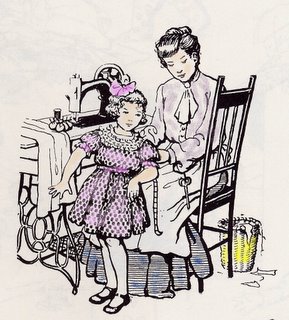
When the children needed clothes, aunts and cousins would drop by to help with the sewing using a foot pedal sewing machine, catching up on the family news and gossip. There wasn't much variety at meal time, but the gravy could be watered down if the dinner table included a less fortunate visitor, as it often did. Not too far down the road was the little Pine Creek Church of the Brethren the children attended with their mother and they were educated in a one room school.

My grandparents, who died in 1983, loved every 20th century advancement that made their life easier--perhaps appreciated them more than the grandchildren and great-grandchildren (there are over 100 of us). Grandma, who nursed all her babies, thought women were crazy not to bottle feed if they could. They were "early adapters" in some areas and owned a car and a radio long before many of their neighbors. About 10 years after leaving the farm, they built a Lustron home, the ultimate in modernity in 1950 with radiant heat and built-in appliances and furniture. You would never have been able to convince them that life was better “in the old days.”

Links to Other Readers and Monday Memories
1. Bonita in Montana, 2. Joan who loves English and is learning Spanish, 3. D. who is getting a new template soon, 4. Ladybug, 5. Veronika transplanted to the midwest,
6. Katherine with the lovely smile, 7. Jeremy, 8. Nancy, 9. Dawn, 10. Beckie riding her bike, 11. Rowan and her baby, 12. MamaKelly and her baby, 13. Shelli and her Prince, 14.

(If you participate, leave your link in the comments and I'll post it here)

Click here for the Monday Memories code


Trackbacks, pings, and comment links are accepted and encouraged!


Post in the comments if you want to be on the MM blogroll!


2245 Signs of the times

The growing fields of pediatric obesity and pediatric otolaryngology. I collect first issues of journals. I'm really sorry that this one is the new sign for our times. It is not in my collection, and I don't think I'll write Taylor and Francis to ask for it.

The International Journal of Pediatric Obesity is a new, peer-reviewed, quarterly journal devoted to research into obesity during childhood and adolescence. The topic is currently at the centre of intense interest in the scientific community, and is of increasing concern to health policy-makers and the public at large.

The aim of the International Journal of Pediatric Obesity is to rapidly establish itself as the leading journal for high quality papers concerned with:

  • Epidemiology and population-based studies of overweight in childhood
  • Clinical management of overweight and obese children and adolescents
  • The recognition and treatment of co-morbidities linked to pediatric obesity
  • Measurement and diagnostic issues in assessing child adiposity.
  • And so forth here.

The International Journal of Pediatric Obesity will be available in both print and online versions and the first issue will be published in March 2006.

The journal is owned by the International Association for the Study of Obesity, a not-for-profit charitable body linking over 50 regional and national associations with over 10,000 professional members in scientific, medical and research organisations."

And USA Today has a very disturbing article about parents in their 40s so addicted to their music downloads at dangerous decibels that they are risking not only their own hearing but that of their children. The story features Pete and Judy Nelson and their 13 year old twins--the poster family for deafness or at least impaired hearing. As I've mentioned several times at this blog, my blind grandmother told me her hearing loss (which she experienced in her late 80s) was a worse disability than the loss of her eyesight which happened in her teen years.

Listening to MP3s at 120 decibles is way over the damage caused by a chain saw or a pneumatic drill. I considered this child abuse. The parents are totally irresponsible, not only with their own hearing, but their children's.

2244 Ovinephobia

Fear and horror of all things relating to sheep. That's why Brokeback didn't get the Oscar nod. The media kept calling them "cowboys" when they were shepherds. An easy mistake, I suppose when your top 5 contenders are Hollywood's idea of decades old morality tales. They couldn't cast two gay guys to play shepherds cowboys or a transsexual actress to play Felicity Huffman's role? What kind of a discrimination business are they running on the left coast? Where's Tab Hunter and Richard Chamberlain when you need them?

We were in Westerville last night visiting friends from church (if I had to drive 40 minutes to get to church, I'd change memberships), so I didn't know who won at the 78th Academy Awards until this morning when I picked up USAToday. To tell you the truth, I would have missed it even it I'd been home; I thought it was next week.

Sunday, March 05, 2006

2243 Was there no way to stop her

from killing her little girl? Six year old Abigail Gilda Volpe was killed by her drunk mother in a pick-up truck that rammed a tree not far from here last Wednesday. Another driver notified the police and was following the erratic driver reporting on what she was doing. I believe I heard on the news that Kelly Volpe had 11 DUIs. The news story said she had no license and her husband had removed the plates from the car and taken the car keys, but somehow she was driving AND drinking at the same time. WBNS story here.

I'm wondering where our vigilant county children's services was. The woman obviously had a record that screamed "I'm incompetent and might kill my child." In another story that's been all over our newspapers for months, a couple lost custody of their 11 special needs children because they had chicken wire around their beds (called cages in the news stories). All those children were taken from their parents (who are trying to get them back) and placed in foster homes. Why wasn't little Abigail taken from the home for protection if her father couldn't protect her from her mother? A drunken parent is a lot more dangerous for a child than one who keeps a handicapped child restrained.

From March 4 Columbus Dispatch: Since the crash that killed 6-year-old Abigail Volpe last week, Perry Township Police Chief Robert Oppenheimer has looked at her mother’s arrest record with anger and disbelief. Dating to the 1980s, it includes at least six drunken-driving convictions, repeated license suspensions, convictions for forging drug prescriptions and a host of other traffic offenses.

A week after the Feb. 24 wreck, Oppenheimer said he and his officers continue to sort out Kelly Volpe’s string of court appearances and convictions. He has found paperwork for six drunken-driving convictions; he thinks there are eight. When Volpe crashed shortly before 8 that night, her license was suspended.

"I guess my question is, what is she even doing behind the wheel?" he said. "Nothing’s worked for her, and look what happened: She killed somebody.
"Somewhere along the line, you have to bang ’em so hard they’re not going to do it." . . Yesterday, Abigail’s small casket sat next to pink and purple balloons at Holy Trinity Lutheran Church in Upper Arlington.

"It’s really broken our hearts to see a little innocent thing die," Oppenheimer said.

2242 Appalachian Heritage Sunday

was celebrated last Sunday at St. John's Episcopal Church on W. Town Street. There are 40 counties in the Episcopal Diocese of Southern Ohio that are in Appalachia. A lot of Columbus speaks with a soft southern drawl. They gathered in the children and grandchildren for a rememberance of their roots.

2241 You've probably met Mr. Pyle

Whether you're a teacher, or a librarian, or a store manager, or a supervisor of a brake shop, you've got one of these guys to deal with. They make going to work generate thoughts of changing jobs. This one happens to be a special ed teacher. He's always expecting someone else to be doing his job.

"The guy is a poster child for what is wrong with a minority of teachers, specifically in special education. Teaching is hard work, no doubt about it. Most of us roll up our sleeves and go to work doing many thankless tasks. But there are some who will whine and complain about every single thing and then wonder why they don’t get paid more. It’s for the kids. We serve them and their parents, not the other way around."

However, The life that chose me will certainly give you a new appreciation for special ed teachers. To see what his "typical day" is like scroll to the bottom of this page.

Saturday, March 04, 2006

2240 My navel and my jaw

Looking through vocal sites on the internet, I came across The Vocalist.org site with all sorts of drop down windows and some instructions on breathing, and listening, and exercising. I think I know how to think about my jaw, but I've never had to imagine my navel, except maybe when pregnant when it was moving on ahead of the rest of my body. Therefore, I'm having some difficulty figuring out just where this pipe organ is.

"The two places to think about are:

Lower abdomen
Jaw

All the support should come from the lower abdomen. That's where it should all be "happening". Think about anything above the navel as a huge flexible organ pipe. You shouldn't be doing anything conscious with muscles above the navel until you get to the jaw. Everything in between should work on its own without your intervention if you get the lower abdomen working (this is an oversimplification - but let's stick with it at the moment - basically, what you're going to do above the navel and below the jaw has more to do with POSTURE and allowing things to do what they do naturally by NOT trying to interfere than with actively trying to control anything - INCLUDING the diaphragm).

The jaw needs to work like a well-oiled hinge. This means no rigidity, no tension, no clamping shut nor forcing too far open. The tension you feel in your throat, I am willing to bet, is due in large part to tension in the jaw and the back of the tongue ("throat" tension usually means back of tongue tension, which is directly influenced by jaw tension). Secondarily, if your chest is "collapsed" rather than lifted (not forced up muscularly, but *lifted* - a sense that you're gently lifting the breastbone off the top ribs - if you think of your rib cage as an accordion, think about keeping it stretched apart, rather than squeezed together - but the feeling should be, as I said, one of LIFT, rather than anything involving really stretching, which implies tension).

If the chest is up and the support is active below the navel, you'll find that mysteriously the jaw doesn't want to work as hard to articulate vowels and consonants."

The Vocalist

2239 Encounter at the coffee shop

The Roast Mistress is chatting again at the coffee shop--about a book. Go figure! And Rosabelle has a message for the government about her pantry.

2238 Her Daddy

"My daddy had one true love in his life. He fell in love when he was 12 years old, and now, at 67, he still loves with all his heart and soul, this one passion that has been by his side ever since. Her name is alcohol. She is beer. She is brandy. She is very little else, but that is enough. It encompasses enough to satiate his need for her. He never cheats on her or abandons her. He holds her in the highest esteem and protects her with all his ability. He will do anything to ensure her safety, her presence, and her love for him. He left his wife for her. He left his children for her. Oh how he loves her! And he thinks she loves him." Read her whole post here.

How sad to have wasted his whole life and disappointed all who knew him.