Showing posts with label 1960s. Show all posts

Saturday, March 11, 2023

Jesus Revolution and Isaac Watts

I haven't seen the new movie "Jesus Revolution" yet but reading through the history of the movie and the era, I realize it coincided with the years we became involved in the church in the late 1960s, first at First Community Church in 1967, then at Upper Arlington Lutheran Church in 1974, both in suburbs of Columbus, Ohio. So, our participation was more with small service groups within established churches, than with the worship movement. Whether or not we were aware of it, we were participating through prison reform, a fair housing group, marriage encounter groups, Cursillo, and the move at UALC to add a contemporary worship program to the regular Sunday schedule (which we no longer attend) beginning on week-nights crowded into the fireside lounge with guitar music.
 
This morning I was reading about Isaac Watts, born in the 1600s, and who as a teen-ager decided church music was too stuffy and boring and began to write his own hymns, which became very controversial, outraging many older church goers, but which also became extremely popular and spoke to the needs of the people. He wrote over 600 hymns, many we still sing today (Joy to the World, When I survey the wondrous cross), and paved the way for the more prolific Charles Wesley, who wrote thousands of hymns.

The Wesleys, John and Charles, went on to awaken and evangelize our country in the 18th century, and so the tradition of periodic movements to refresh and revitalize Christianity continues. And we saw it again last month in Asbury, KY.

Sunday, December 11, 2022

Dumb and dumber--the Democrats and Climate Change

In the 1960s, I was young and dumb. Can't believe the nonsense I fell for (or over) The Population Bomb was a 1968 book written by Stanford University Professor Paul R. Ehrlich and his wife, Anne Ehrlich and everyone I knew was reading it. Silent Spring came out i 1962, but I don't think it had the same impact, even though Rachel Carson's unproven, unscientific blather killed millions of African children. Ehrlich predicted horrible outcomes including food shortages. Well, we've got all the food we need to feed the world (actually did then too) and it's bad government policy that is starving or creating shortages today, not the climate. Look at what we're going to face with ESG, or what Netherlands and Sri Lanka are going through now not from a shortage of fertilizer, but from a government edict that they can't use it. Democrats are evil, Republicans are weak and useless, and our capitalist/corporate CEOs are rubbing their hands with glee. And although that's our party system, the global warming/climate change nonsense is world wide. Those who won't starve will probably freeze.

Thursday, March 31, 2022

I'm a little teapot, short and stout

The second set of every day china that I purchased was a Franciscan set in 1969. Franciscan Cantata is from their Whitestone Line. It was produced from 1965 to 1972. It has a white background with olive colored leaves and blue and turquoise flowers. I just loved it. My most vivid memory about this pattern is I had set the table and was ready waiting for my mother-in-law and sister-in-law Jean and her two daughters Julie and Joan to arrive for a visit from Indianapolis. They had a terrible time finding our home on Abington Road because there is another Abington on the northeast side of Columbus, and ours was on the northwest side. They spent hours driving around the city looking for us. All I have left of the large set is a little tea pot, and I keep it on the counter next to the coffee pot. I looked at some china resale sites, and tea pots must be fairly rare, because I didn't see any. It must have been overlooked when I gave this set away (when or where I don't remember), so it is still with us.

 https://gmcb.com/franciscan_archive/index.php/library/franciscan-dinnerware-and-art-ware/

Franciscan Ware, or Franciscan Pottery as it was first named in 1934, was manufactured by Gladding-McBean and Company of Glendale, CA. Scores of different styles and patterns were produced. In 1962 Gladding McBean and Company merged with the Lock Joint Pipe Company and became Interpace. Franciscanware was produced in California until 1984 when the facility at Glendale was closed and all production moved to England. Johnson Brothers of England then produced some of the patterns in England (later some patterns/pieces were produced in Japan, China and Portugal). It is important to note that not all pieces carry a “Franciscan” mark. Unless you are familiar with a particular pattern, you may not recognize it as “Franciscan.” (Hill House Wares)


“I’m a Little Teapot” Lyrics (1939)
I’m a little teapot
Short and stout
Here is my handle
(one hand on hip)
Here is my spout
(other arm out straight)

When I get all steamed up
Hear me shout
“Tip me over
and pour me out!”
(lean over toward spout)

I’m a clever teapot,
Yes it’s true
Here let me show you
What I can do
I can change my handle
And my spout
(switch arm positions)
Just tip me over and pour me out!
(lean over toward spout)

Friday, February 12, 2021

Paying the college loans for those who signed for them

I worked at the local public library and the drug store when I was in high school.  In summers and during the school year in college I worked various part time jobs--usually the college library.  My parents provided most of the cost going without since 3 of us were in college at the same time. Dad would have considered it an embarrassment to take money from the government. Then when I got married during my senior year, my parents provided me with a loan which we paid back in a year or two. 

College education costs became a huge bubble since those days (1960s), worse than the real estate bubble of 2007-08, and mainly because the government flooded the colleges with loan and grant dollars. The colleges and universities just raised tuition and built more buildings and cut back state support. Academe has continued that bad planning by luring young people away from those colleges that could have benefitted them in order to meet federal requirements for minority enrollments. And with slight of hand academe "counted" foreign students whose governments were paying for their educations in their minority quotas.  The American minority students took on loans they could never pay back and never got those good jobs without the degrees they were promised. This is what happens when we think someone else will pay, and since it isn't the government's money, they just throw it at anything and anyone that moves.

There is no free lunch.

Monday, December 07, 2020

Quick peek at cousin Kirby on Shindig

My cousin Kirby Johnson (from Byron, IL) was a member of the Wellingtons, a boy band which became a back up group on Shindig a 60s TV show that featured live music by up and coming musicians (like Aretha Franklin and Roy Clark, Righteous Brothers, Marianne Faithful).  This is a link to a 1991 retrospective, and Kirby appears around minute 10 and 18.

https://youtu.be/KdO4TP21Xys

I’ve wrote a blog about the group, originally called The Lincolns because they met as fraternity brothers at the University of Illinois. Collecting My Thoughts  Kirby Johnson died in 1999.

Wednesday, September 16, 2020

The Census and critical race theory

Why did the Left oppose a citizenship question on the 2020 census? Why wouldn't the government want to know during enumeration how many are citizens? For over 40 years various interest groups have been artificially dividing us into racial and ethnic groups--they've created victim groups based on the Civil Rights movement and Act of 1964. There's a lot of money involved just for the pickin', and ready made jealousy and finger pointing that can be used for agitation and demanding more.

By emphasizing citizenship (but not ethnic ties), the government tells all people, but especially immigrants and their children, that it is concerned with their relationship not with the land of their ancestors but with the land to which they now belong. But how can you build grievances with such an outlandish idea.

https://www.heritage.org/government-regulation/report/eliminating-identity-politics-the-us-census?

The Census Bureau’s National Advisory Committee on Racial, Ethnic and Other Populations (NAC) was created by Barack Obama in 2012. But not out of whole cloth, it was birthed in the "1960s and 70s, when the census office first began to create National Advisory Committees on race and ethnicity. It was in those heady days of postmodernism’s birth—when Marxism in its academic form was embarking on “the long march through the institutions”. The definitions of ethnic groups were etched into law. Each of the pan-ethnic groups that racial activists and government functionaries were adding to the census and other government surveys at the time (“Hispanics,” “Asians,” “Pacific Islanders,” etc.) were the subjects of a special census committee, starting in 1974. Four decades later, the Obama administration pulled all the difference committees into one giant NAC." We almost got (or maybe it's still in the works) MENA, Middle East and North Africa so yet another group could get a piece of the budget pie and a slice of power.

I suppose you could call it part of Obama's legacy. Suspicion, jealously, bean counting, inventing new words for differences, redistributing wealth based on grievances through special grants and poking "whites" (anything from Swede to Welsh to Spanish to Serbian) in the eye. When you understand how critical race theory academics have helped create identity groupings, you'll be better prepared to understand the distrust and unrest among artificially created groups are being churned today.

https://quillette.com/2018/10/23/inside-the-us-government-agency-where-identity-politics-was-born/?

Thursday, July 16, 2020

The young are always messed up

I found another "Little Library" on my walk this morning. Good thing because the librarians our taxes pay for are cowering behind their computers (like our pastors). I picked out "Give war a chance" by P.J. O'Rourke, c. 1992, now almost 30 years old. Wow. He's not a favorite writer, but I did see one essay that I found interesting--at least the opening paragraph. He's an aging boomer from Ohio who doesn't like Trump. He's now like a pet for the liberals who don't realize that their country has been stolen from them. Anyway, this paragraph was right on, as we said in the 70s.

SECOND THOUGHTS ABOUT THE 1960s

What I believed in the Sixties

"Everything. You name it and I believed it. I believed love was all you need. I believed you should be here now. I believed drugs could make everyone a better person. I believed I could hitchhike to California with 35 cents and people would be glad to feed me. I believed Mao was cute. I believed private property was wrong. I believed my girlfriend was a witch. I believed my parents were Nazi space monsters. I believed the university was putting saltpeter in the cafeteria food. I believed stones had souls. I believed the NLF were the good guys in Vietnam. . . and so forth . . . With the exception of anything my mom and dad said, I believed everything." p. 90

The usual stuff kids think, but that was somewhat revolutionary in the 60s, even looking back with a little tongue in cheek snark. Those 60s guys are now the grandparents of the ones roaming the streets with detailed plans to break windows, close businesses, hit police with baseball bats, and demand recognition for auto zones. O'Rourke's generation almost sounds charming, because in our minds' eye we know they finally matured after the grown ups stepped in.

Not today. The screaming, hysterical white college-educated women who have joined in with the gang thugs and Antifa to make no lives matter are not about to back down or go home to mommy. Those born in 1997 are a very different ilk from those born in 1947 like O'Rourke. These charmers have grown up with the schools tearing down everything the boomers thought they had to rebel against. In order to rebel against anything, by the time they get to college, it all has to be torn down to the last statue, church and Broadway musical so the latest totalitarian dictator can take over. And not by voting--that's so 1960s--it must be violence.

Monday, April 27, 2020

Down on the farm, 1969


Our children loved our vacations at my mother's farm located between Franklin Grove and Ashton, IL. My niece Cindy sent this treasure. I'm thinking this is June, 1969 and Cindy's family was living there. We'd come down ( we always said "down" when traveling from Mt. Morris to Franklin) to check out the remodeling progress. Eventually my mother created a wonderful retreat type facility for church groups. So Phil was about 7 months old in this photo. My nieces and our son Stan (deceased) were all within weeks of each other in age. That's Cindy on the far left. Squished and wiggling in her cousin's arms is our Phoebe. The guy with red hair is Bob.

Monday, January 14, 2019

Letters to Governor Reagan, 1967

I’ve been reading through the letters that Californians wrote to their governor (Ronald Reagan) in 1967—52 years ago.  I remember that year well—it’s the year I met accidentally the personnel librarian from OSU on the fourth floor of the University of Illinois Library, in Urbana, Illinois, and he offered me a job in Columbus, Ohio.  But my husband would need a job, I responded, and he said there was a guy in his Sunday school class that needed a draftsman.  And the rest is history. Every time I drive by that church on Bethel Road I think of that, and say a little praise, because our lives changed completely that year.

https://reagan.blogs.archives.gov/2017/10/19/1960s-student-movement/

The blogger’s comments (seems to be an employee/intern of the Reagan library) are not helpful, but the letters and news clippings are fascinating.  A college was giving credit for attending a protest (against the Viet Nam war). The Bolsheviks at UC Irvine were sponsoring a dance.  A 21 year old wants Reagan to get with the times and be more progressive.

By putting these letters on the internet with names and addresses where they can be copied or used, I’m wondering if they violated copyright law.  In the U.S.  the physical piece belongs to the receiver (addressed person), but the information belongs to the writer.  Since the one writer gave his age, and company name, I was able to look him up.  Makes me wonder what has happened to the hundreds of letters to editors, writers, and politicians I have written over the last 60 years!!

Monday, May 29, 2017

Zbigniew Brzezinski Is Dead

Zbigniew Brzezinski is dead and Lionel Nation can say nothing good about him.  I actually met him when I worked at the Center for Russian language and Area Studies back in the 1960s. The Association for Slavic, East European and Eurasian Studies was run out of our office, and my boss Ralph T. Fisher, Jr. and Brzezinski were on the board together.

https://www.youtube.com/watch?v=3iIzxwnW0fo

Lionel says he is directly responsible for the rise of Al-Qaeda and ISIS.  So does Lew Rockwell.  Even if you read the fawning stories in the liberal press, take a closer look. They seem to agree that much of the mess we have today goes directly back to his days of power. Brzezinski hated Russia--he was a Pole. And he was Obama's advisor, under whom our relationship with Russia deteriorated to the point that the reset button of Hillary's became a bomb.

 https://www.lewrockwell.com/2017/05/no_author/real-story-zbigniew-brzezinski/


Friday, May 19, 2017

Friday Family photo--Good bye vintage clothes

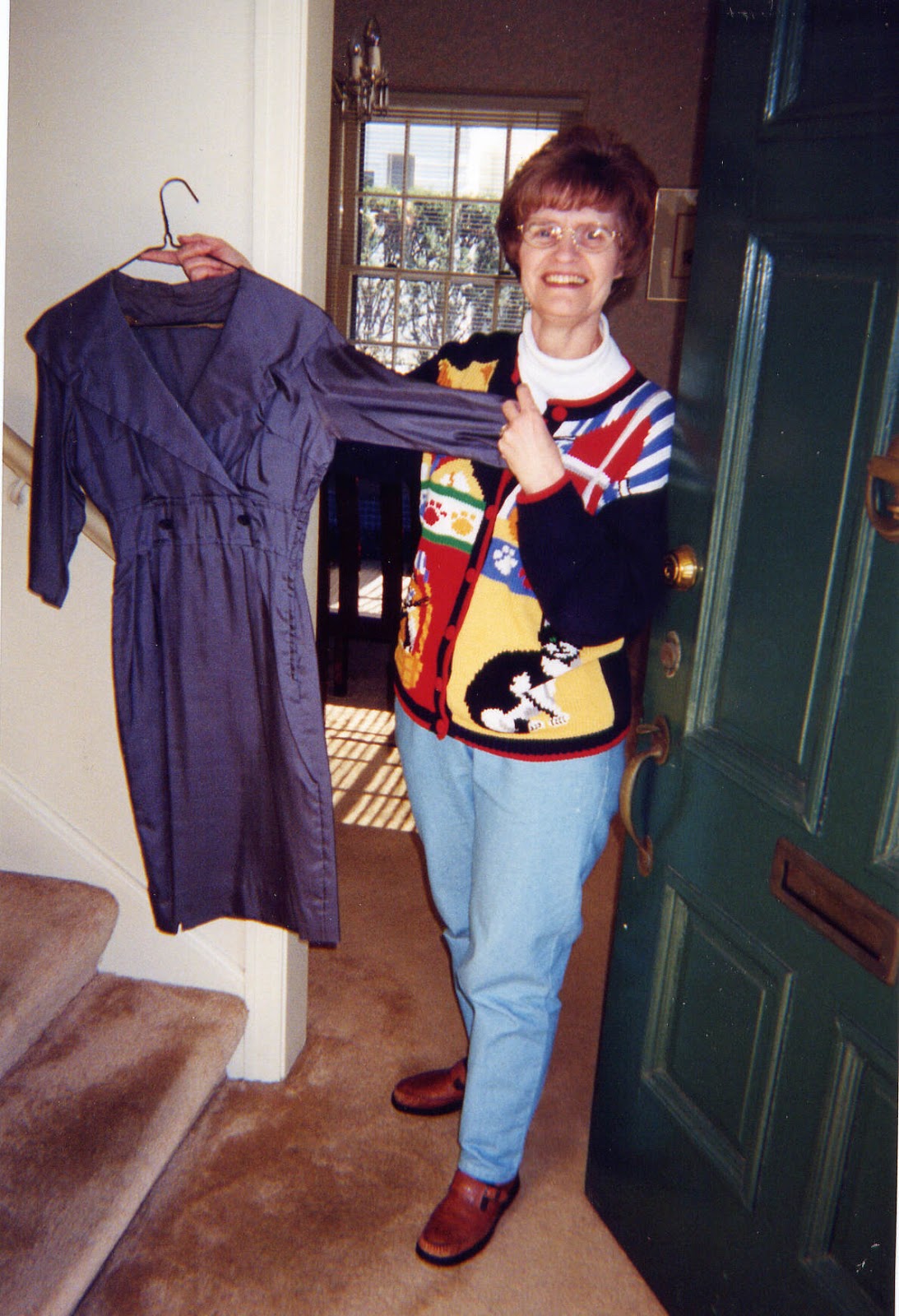
For many years I've had a clothing stash of dresses I've enjoyed wearing. It's time to send them along to wherever old clothes go to die, some over 60 years old, some made by my mother. I was going to try to find some cute young thing with a 23" waist to model them, so I could take a photo, but decided to search my photo archives to see ME wearing them.

I think the oldest dress I have isn't in the closet, but on a shelf.  And I don't actually have my dress from 5th grade, but I do have my cloth doll's matching dress.  Both were made by my mother and were identical.  I think the reason the doll dress survived almost 70 years is because by the time Mom made it, I was no longer playing with dolls. Mother made the Sue doll with the yellow yarn hair, but our neighbor Ruth Crowell who had no children made the "white doll," which has always been called that.  I never gave it another name. I also never played with it, so it survived.  It was Blue Doll I loved to death. The chair in the photo is from my great-grandmother's home near Ashton, IL, was painted by my grandmother, and then it was refinished and recaned by my mother in the 1970s. The secretary was made for my husband's grandparents over 100 years ago and is now in our son's home.
 I don't think I ever had a purchased, commercially made formal.  This lovely white faille with a bright red bow was made for the 1955 Christmas dance at my high school.  I'd also just had a new hair cut, going from long to short, so I was feeling like a model. Phoebe modeled it in 1981, probably 8th grade, but even at 13 she was bigger than I was at 16.
My mother made these jackets for me before I left for college. I actually wore the red and grey one to a 1950s birthday party for my sister-in-law Jeanne last year and since scarlet and grey were the OSU colors, I also wore it a few times in the 1990s. My sister Carol had a similar corduroy jacket in brown and yellow; she was attending Goshen College in Indiana and I was attending Manchester College 50 miles away. Mom also made twin bed coverlets and bed skirts for our dorm rooms--mine were pink and grew, all the rage in 1957, but I'm not sure about Carol's.
Our first big date was for the St. Patrick's Ball at the University of Illinois in 1959 for which I wore a borrowed red lace dress belonging to dorm mate Sally Siddens who didn't have a date. But for that dance the next year I wore this beige, brown and gold jersey dress with a big crinoline. Since I was well over 140 lbs then, I thought it might fit me for a 50s party in 2016, but couldn't even get close to zipping it.
When I got married in 1960, I'd planned to make my "going away" dress, but not only was I not a good seamstress, but I chose a difficult fabric--silk.  So a week before my wedding I bundled everything up and took it back to Mt. Morris where my mother finished it for me. I bought a hat that matched perfectly.
My niece secretly mailed my wedding dress to my daughter for our 50th wedding anniversary party in 2010--I was so thrilled to see it after 50 years.  But then there was a problem about what to do with it.  She didn't want it back!  So it resided with my other dresses for 6 years in a bag in the closet, until I finally took it to the cancer resale shop.
This pale blue sheath I bought in 1957 in Ft. Wayne, IN, when I was a student at Manchester College. Don't recall the event, probably a lecture since MC didn't sponsor dances, but I wore it many years.  Here we are in 1962 with our son Stanley.
 I have two items in the closet for which I have no photos. In 1963 I bought a light blue and white, 3 piece knit suit, and still have it.  And my favorite winter coat was red and its with the vintage clothes.  The dry cleaners ruined the buttons, so I didn't wear it after 1968.  Both the suit and the coat showed the influence that Jackie Kennedy had on women's fashion in the 1960s. I think the coat was probably purchased in 1962 or 1963.

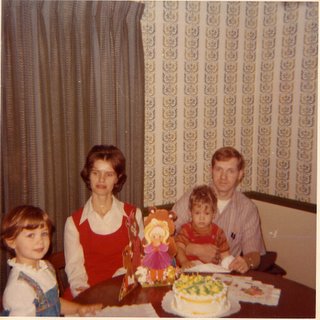
For a New Year's Eve party in 1965 I made a snappy red wool dress with a ruffle, sewn in my kitchen at 108 E. White St. in Champaign. We didn't have many occasions to go to parties, so I later took the ruffle off and wore it as a jumper for a number of years. The photo with the children and the deruffled party dress is their birthdays in 1969.
I made Phoebe and me matching dresses for her baptism in 1968, and her dress is packed away with her baby clothes and stored in her basement, and my dress is in my closet. White flocked sheer cotton. It was a hot day in June.  Because I was baptized in Church of the Brethren, as were my parents, grandparents, and great grandparents on both sides, and their practice is to baptize adolescents and adults, we had no sweet little dresses passed down from grandmother to mother to baby.
For our 10th wedding anniversary party, I wore this black pants suit--the only slacks among the vintage dresses.  They were all the rage then, and I loved it.  I wore again in the 90s for some retro event at OSU--don't remember what it was. But it's still in the closet.
Here we are in formal wear for a 1974 Christmas party with Couples Circle 50 of First Community Church. That was also one of my favorite hair styles. I think Jane Fonda made it popular. Bob was so thin in those days, we bought that suit in the Boy's Department of Lazarus.
The class of 1957 had its 30th class reunion in 1987, and I wore my all time favorite, a teal and coral floral polished cotton. I'm in the front row seated far left.  Big shoulder pads, full cut skirt.  Loved that dress. I was a very bad time in my life, but when I wore that dress I felt like a princess. We don't dress up any more for our class reunions.
I had a lovely deep teal silk, with soft pleats at the waist, self belt, probably purchased around 1985 or 1986. It is a size 8 which is how I'm guessing at the year.  I was taking an aerobics class and was quite trim in those days.  My daughter wore it, and my teal suit (obviously liked that color) to have her senior photos taken.  I can't find a photo of my wearing it,  but I remember wearing it to an AIA party we went to with Ken and Connie Becker.


Big hair, big shoulders. I'm not sure what year I bought this lovely cream colored silk 2 piece with a full, flowing skirt, but it made a wonderful dance dress, something we were still doing in those days. This photo is from 1988, so it was toward the end of its era.  But I peeked inside the storage bag, and there is was.  Can't show it off with this head shot.
For several years our church, UALC, sponsored a wonderful Christmas dinner with musical entertainment.  In 1991 we took Ron and Nancy Long, old friends from FCC and Lakeside, as our guests.  I had a black velvet outfit with beads and bangles that I just loved.  Some years later, I separated the top and bottom, and bought a near skirt for it that wasn't so tight and uncomfortable.  Still have the top in my vintage closet. I also have a lovely silk dress the same color as Nancy's in my vintage collection (see above), but don't seem to have a photo of me wearing it.  Those deep jewel colored silk dresses were very popular for several years.
 In 1993 the Corbett descendants of Joe and Bessie had a family reunion in Mt. Morris, over 100 attending, and we stayed at a B & B in Franklin Grove where this photo was taken with our son-in-law Mark. This is not what I wore to the reunion, but it definitely was on the trip and in the vintage closet. Linen and polished cotton in coral and taupe with applique on bodice.
Later that year I wore my pink pleated, two piece Mother of the Bride dress at our daughter's wedding. The next year I wore it again at a niece's wedding in Florida, however, MOB dresses don't have many uses.  Usually, they are too fancy.  Also had pink shoes, pink hose and pink purse dyed to match.
The oldest dresses I have in my "currently still wearing" closet will be 8 years old this summer having purchased them in 2010. Last fall I sent to the resale shop my sheer black dress I worse at my sister-in-law's wedding in 2006 (seen above in the photo with the mannequin, so that's where we are today. No more vintage closets.

Today I attended the funeral of Kathy Heinzerling who was at some of the parties where I was wearing these dresses 40-50 years ago.  Appropriate for walking down memory lane.

Sunday, February 12, 2017

Looking back on Alan Bloom looking back

In Alan Bloom’s book, "The Closing of the American Mind” (1987)--a book that began as an essay and became a best seller--he discusses how the meaning and acts of sex and sexuality changed between the 50s and 60s and the 80s, and that the college students he knew saw a sexual arrangement as convenient, but not lasting or a commitment. “They are roommates with sex and utilities included in the rent.” (p. 106). 

With the looming strike of women (they are angry about the election of Trump and mad at the Electoral College) and the January 21 Women’s March in DC, I think he missed his mark in thinking the “rights” push was over.  It’s not over because it's never over for the Left which needs a victim, and over 50% of the population are women and 57% of the college graduates since the 90s are women.  For the Left  no matter what progress women, homosexuals or transsexuals make, there’s always a new victim to be found which can be folded into the original goal.  The push to normalize sex with children is the most recent one, as polygamy or polyandry will just be too boring and acceptable since sex with adults has lost all meaning. Relativism, Bloom said, makes students conformist and incurious. Their supposed open-mindedness closes their actual minds. And that continues as the students of the 80s are the parents and professors of today's college students.

Bloom writes about relationships in the mid-80s: “Men and women are now used to living in exactly the same way and studying exactly the same things and having exactly the same career expectations.  No man would think of ridiculing a female premed or prelaw student, or believe that these are fields not proper for women, or assert that a woman should put family before career.  The law schools and medical schools are full of women, and their numbers are beginning to approach their proportion in the general population.  . . The battle here has been won. . . They do not need the protection of NOW (p. 107)  And he goes on to note that not only do his students have nothing to learn about sex from their parents, but also believe they have nothing to learn from old literature or history  [and I would add the Bible, but he doesn’t] so when they have problems with relationships, they have nothing to go back to.

Although Bloom's book was a best seller, other academics became alarmed--he was called a racist, sexist, homophobe (although he was probably gay said a close friend after Bloom died), a Nazi--well, you know the routine.  He was practically Trump!  After 200 reviews of the book, the academics began having conferences about it!  Which makes me think, maybe I should put it back on the shelf and choose another title to withdraw.  Since I've blogged about this a year ago (at my book blog) I'm not making much progress reducing the crowded bookshelves.

Thursday, February 19, 2015

What did a high school record tell about a PhD holder 50 years ago?

In today's climate of providing women extra assistance for education  a report written in 1965 provides an interesting look back. 

When boxing and pitching files a few years ago, I came across a copy of National Academy of Sciences, National Research Council. 1965a. High School Ability Patterns: A Backward Look From the Doctorate. Prepared by L.R. Harmon. Washington, DC. It had been withdrawn from the OSU Library and I’d apparently picked it up at a book sale.  NAS went to a lot of trouble to do this research and I think Mr. Harmon got several publications out of it. 

It's a study of high school aptitude and achievement of PhDs of 1959-1962 (i.e., folks a few years older than me). It samples 20,440 doctorate-holders, men and women, compares them with randomly-selected classmates, and looks at sex, grades, rank and IQ scores as well as type of school, size of class, and region.  It is a fascinating study but I don't know if anyone paid any attention to it or adjusted any educational goals accordingly. Harmon’s other publications for NAS on the topic of doctorates  have numerous cites in ISI, but I think this study only had two when I looked. His study doesn't include race or economic information.

Here’s what Lindsey R. Harmon reported from all that data.

  • In high school, these graduates were about 1.5 standard deviation above the mean of the general population, and 1 standard deviation above their classmates.
  • There was a positive relationship between school retention rate through the 12th grade and eventual doctorate attainment rate by students in those schools.
  • Among the schools, independent schools' students measured highest, then denominational schools, then public schools.
  • It was possible to sort about 40% of the high school students into their eventual doctorate fields solely on the basis of their high school information.
  • Girls' mean GPA in all areas was higher than boys (even among the non-doctorate controls), but boys' intelligence test scores were better (boys had a higher drop out rate which culls the less intelligent students).
  • Girls (who went on to get doctorates) outscored the boys in high school math and science.
  • Married, female doctorates by any index were brighter than men in the same fields of specialization.
  • They also outperformed (in high school records) single women--in both GPA and mental tests. 
  • Married men's GPA and mental tests, however, were lower than single men.  There was a lot of speculation about these differences.

So, is there life after high school?

Other publications by Harmon on this topic are listed in this bibliography.


Update: Although I can't be sure since the obituary doesn't list publications, I think this is the obituary for Lindsey R. Harmon author of the above cited publication and many others on college graduates.

Monday, July 22, 2013

We got an eyeful at the coffee shop

We all stared as she walked by at the coffee shop. She was over 6' tall. She wore high heels. Blonde hair in a pony tail. But the dress was a tight sheath, with short sleeves and the hem was just about at the knees. “Very revealing,” I thought. Then thought again. We all wore that look in the late 50s, early 60s.

                  image

Thursday, February 02, 2012

R. Emmett Tyrrell, Jr. on the 60s

"As I wrote last week, Newt is a 1960s generation kid. Allow me to elaborate. That generation -- my generation -- was the most ballyhooed generation raised in the 20th century, and it was -- at least in politics -- a failed generation. Gingrich, the Clintons, Al Gore, and the rest of the 1960s hustlers began their political careers in college when they were the first generation to actually believe that student government was on campus to govern. The weak Liberal administrators went along with them and gave them a say in the running of their universities. The universities have yet to recover. Yet, beyond the damage they did to the universities was the damage they did to themselves. They became the most self-absorbed generation of narcissists ever heard of. From their student government days to their days in national politics they all lived out a fantasy. Now it is over. It would be eminently fitting if Romney won the presidency and set the country on course in 2012. He is from the normal half of that generation, a man who was a student in the 1960s and afterwards a businessman, until he had secured his fortune and entered public life in middle age. By then the Clintons and Newt had been supping at the public trough for years."

Yep.

Except for Obama. He's not one of them, but he definitely exceeds their narcissism. Even as prepared as we were having seen, heard and experienced it for years from co-workers, friends and politicians, we've never quite seen anything like him.

Monday, September 19, 2011

Glenn Beck provides the genealogy of Days of Rage

If you don't subscribe to GBTV, you missed Glenn Beck's monologue on the Days of Rage this past week-end (it fizzled miserably), back, back way back to the Weather Underground of 1969. He updated us on Jeff Jones, Mark Rudd, Tom Hayden, Carl Davidson, and of course, Bill Ayers and his wife Bernadine, and what they're doing today. Noted that Tom Hayden is teaching at Occidental in California, where the Obama transcripts are being held hostage. Here's a web site that will do about the same--it's a good read.

Guest Post: Tracing the Origins of the Days of Rage Protest « RickMick

However, don't discount the Days of Rage--which ended up on the steps of the Smithsonian instead of Wall Street, I think he said. The Weathermen started small too, and four of them managed to bomb a building of the University of Wisconsin and kill and injure people. And have you ever read a more apologetic marker for violence? If I were the family of that dead grad student, Robert Fassnacht, I'd sue for such a limp, vacuous account of this tragedy.


This article updates what happened to the dead, injured, and perps.

Saturday, December 11, 2010

If you wait long enough


everything comes back in style. But I'd probably have to take out the crinoline in the 1960 dress.

Friday, April 23, 2010

Morphing Agnew into Obama

Since 1960 when I became voting age (21 then) I've heard and seen a lot of politicians. I've been trying to remember what president has been as condescending, whiny, hostile, insincere, two-faced, arrogant, flippant, contemptuous of other viewpoints, and such a bald faced liar about transparency as our current White House resident during this period in our history. And I think I’ve found him at Old Hickory’s Weblog description and remembrance of good old Spiro Agnew, President Nixon's first vice president who resigned in disgrace.

Thanks, Old Hickory, for the stern finger pointing photo and this phrase: "bullying, faux-populist tone" because I've been trying to come up with a phrase to describe his chastising, eye-flashing, finger wagging mannerisms, and after reading through your Agnew piece, I’ve found just the right essay. And with just a few strike throughs, you have other phrases I can use.

"throws out a standard article of Party doctrine"

"today's bipartisanship means that some Democrats Republicans do what the Republicans Democrats all want"

"he used that race as his segway for talking about race that"

"This is the Vice President talking about the government his Party heads as though it were some alien force that the Republican President was struggling to control"


"Then he takes his audience into the heart of darkness in their worldview, to the evil doings of The Liberals capitalists"

"The first thing that strikes a former Mississippian liberal like me is the astonishing amount of projection of unpleasant and antisocial traits onto The Liberals The Conservatives. These descriptions applied to the everyday behavior and attitudes of the segregationists wealthy of the day today."

That last sentence is enigmatic. He's accusing the Evil Ones of wanting to excuse crimes committed by the disadvantages Wall Street, again without actually naming any of these risible liberals conservatives who supposedly think that.

Agnew's Obama's speeches are significant because they show what came to be the dominant authoritarian sentiment of today's Republican Democratic Party at a time when "the Sixties" were are still happening. Agnew Obama was is the darling of the conservative leftist culture warriors in of 1969. [Bill Ayers, Days of rage, etc.]

Tuesday, June 16, 2009

On Mustangs and other wild things

A friend of mine is thinking about buying a 60s-something Mustang, although he is 70-something. So for him I'm rerunning the Thursday Thirteen blog I did about our cars several years ago, skipping ahead from #1 to #10, the Mustang.

1. We started married life in 1960 with a 1951 Oldsmobile 88. This car used to stall at intersections in Indianapolis and I'd get out and open the hood and jiggle something to get it going, occasionally with a push from the next guy in line.
Just Married 1960, 1951 Oldsmobile

8.-10. In 1986 I replaced the 9 year old Buick with a 1983 (or maybe 1981) maroon Buick 4 dr. Skylark which had all the luxury options, plush unholstery, sound system, etc. Possibly the most comfortable sedan we ever had, but being a used car it had some mechanical problems.

Which gave me an excuse to buy my dream car--a 1987 red Mustang, which I had wanted lusted after since my brother bought one in 19631964 1/2. I had a tenure track job at the university and was wallowing in empty-nest grief--so I deserved some happiness, right? However, the night I drove it off the lot it rained buckets, and I discovered that the Mustang model had no gutter around the door frame so if you opened the door after a rain (and it rains a lot in Ohio), you got soaked as the water sheeted off the roof. I hated my dream car, and because it was low to the ground, it also just killed my back. Couldn't wait to unload it.
1987 Mustang in same location as the 1951 Olds photo. See how much the trees grew in 28 years

I sold it to a woman from Worthington who wanted a car for her teens to drive to school. I think she owned it two weeks before they wrecked it.

The Mustang hurt my back whether I was the driver (getting in) or the passenger, however, driving was less painful because I had something to hang on to.

Tuesday, February 10, 2009

Right, right, right, um, right, exactly, OK, right

That was the voice of the interviewer I heard off camera during a video interview of a "conversation about Vietnam and Iraq with the author and Lt. Col. Rick Welch of the U.S. Army Reserve, who is currently [no date but possibly 2007] on assignment in Baghdad."

http://sgurvis.com/sixties/60s_video.php

Sandra Gurvis who put this together to promote her book, "Where have all the flower children gone," appears to be a local writer. I wandered into her memoirs about the 1960s and the Vietnam War via a restaurant review. It gives me new respect for television interviewers, even the ones I don't care for. Filmed interviews need quality editing, lighting, background, staging, music, voice, etc. Gurvis didn't make the case why she was trying to compare the conflicts in Vietnam and Iraq. She jumped in to quash his positive points about why the U.S. forces were in the middle east. Having worked for 18 months in Iraq reconciling different cultures, he was polite and patient, so his performance was more professional and informed than hers. She had no content or expertise, interjecting myths, half-truths, and hyperbole from the 60s and anti-war rhetoric that made little sense in this "conversation."

This was a good lesson. Whether interviewing or simply sharing ideas in conversation, I need to resist the urge to interject little words to let the speaker know I am listening. It actually has the opposite affect.