Saturday, March 11, 2006

2266 Six visitors

We live in the middle of a metropolitan area of about a 1.6 million people, in suburbia, with the newer suburbs spreading out many miles beyond us. But here's what was in our back yard in January. Six deer. Two rivers flow through Columbus, and I think they hang around the flood plains and river beds, working further down into the city. We have two creeks surrounding our complex which eventually flow into the rivers through many trees, so the deer make their way here. Grazing as they go. Sometimes bringing the babies. If they try to eat my flowers, they'll be disappointed, or have stomachs of iron. I plant only artificial blooms.

2265 Trying to keep up

with the choir is a challenge. Sunday we'll be singing "Fairest Lord Jesus," which they've apparently done before, because the music was handed out Wednesday evening, we did a quick run through, and then moved on to preparations for Easter. Many of these people have been singing together over 20-30 years--maybe more. This is actually one I remember from when I sang in junior choir as a child, which I wrote about in my Thursday Thirteen (although a different arrangement). I have a set of 3 CD's called Passionate Worship, 60 best loved hymns. One disc is "Jesus Our Savior" with the painting, The Garden of Promise by Thomas Kinkade, and selection 3 is "Fairest Lord Jesus," so I've been La la-ing in the car with it.

Having my son's Midi is a big help. Here's how it looks in the guest room. The new carpet helps muffle the sound. The cat sits right outside the door while I practice. At least she isn't howling!

2264 The bracelet

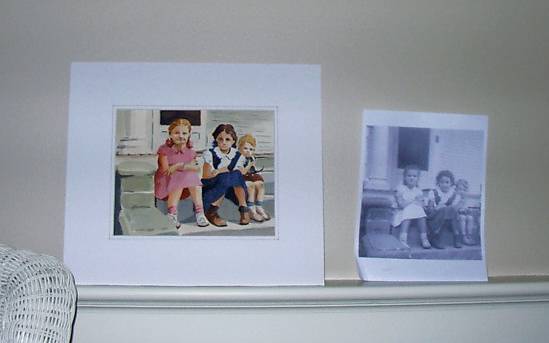
is the title I've given this painting.


It started as a black and white photograph of five children and a grandfather sent to me by my friend Sylvia. (My little brother didn't like to play with us, otherwise there would have been six children.) I cropped it to three children, and if I get really brave, I might try the five. Sylvia was wearing roller skates and I couldn't quite figure that part out with the shadows. Shoes and feet and fingers are hard enough--I just didn't feel ready for skates. Sylvia lived on a farm and says she loved to "come to town" where she could use her roller skates and her bike on hard surfaces. Roller skating in the gravel or riding a bike in a pasture was tough! Earlier view.

JoElla and I lived in the big town of Forreston, about 1,000 residents. I couldn't see a cat in the photo, but JoElla's cat was very prolific, and probably the feline ancestor of every kitty in northern Illinois, so I added "Butch" (Bertha Matilda Pussycat Elvira Mouser Mouria) in Richard's arms. I'm calling it "The bracelet" because I was so surprised to see it in the photo. It was probably my only piece of adornment and I was very proud of it. It had been given to me by my Sunday School teacher in the town from which we moved. Then the latest issue of Watercolor has a fabulous painting of two children sitting on a porch step that really almost made me want to throw this one away. It is realism beyond realism--the kind that goes beyond the photograph to show more than a photo tells. Oh well, this works on a greeting card which is how I'll use this. My sister will probably get one next week.

When we grew up, JoElla became my college roommate and later my Maid of Honor in my wedding. The last time I saw her was in 1996 when I visited her in Seattle where she was the President of a company that researches opinions and products. Sylvia, the little girl with the beautiful curls and roller skates who is NOT in the painting, is an RN and church musician, living in my hometown, and we had coffee together in October when I visited my sister and brother.

Friday, March 10, 2006

2263 Good-bye Yellow Brick Road

may be just about the best blog you'll ever read about how we got from vinyl to i-Pod in the lifetime of a 32 year old. As a child he made cassette tapes from his parents' records; he remembers when he discovered CDs and replacing the tape deck in his car; and his first experience with MP3, then iPod and iTunes.

"Like many revolutions, this one happened quietly for years, and then snapped into sharp focus in one instant. For me, it was a party here at the house. Heather and I had friends over and we were all standing around in the living room. A few of the guests started pouring over my CDs - these physical reminders, this luggage I've carted around for years. They were reading off the names, the titles, and I had a sudden revelation: I hadn't bought a CD in years. Many years.

My CDs had become this snapshot of who I was, like carrying around a driver's license with a 5 year-old photo where you're wearing old glasses and a shirt you wouldn't be caught dead in now. And here I was displaying them like a shrine in an immense tower in my living room."

Read the whole amazing, interesting story.

At least it was a eye-opener review of technology for me. The last time we were up-to-date in the recorded music department was when we had a big old 4-door '69 deep green Olds with an 8-track tape deck and two baby seats in the backseat. And I thought we'd arrived!

2262 "Together, America can do better"

Rosa Brooks in the LATimes [registration] writes on March 10 about the Democrats sloganeering:

"You can do better" is what you say to a dim child whose grades were even worse than expected. Is this really the Democrats' message to the nation: that we don't need to be quite as pathetic as we now are, though excellence is certainly beyond our reach?

This slogan speaks not of hope but of hopelessness, of scaled-down ambitions, of dreams deferred and dreams denied."

Brooks has got a point; silly me, I just thought it didn't sound grammatical or accurate. I can see "Together, Americans. . ., but . . . singular? It sounds like they've left out something--Canada? Mexico? Aren't we the United States?

"And as a message, "Let America be America again" [Kerry's discredited campaign slogan] sure beats "Hello, you've reached the Democratic Party. We're not home right now." " [Brooks]

Or, "we're out to lunch," works for me.

2261 Is there life after forty?

Today's 40-somethings are sometimes having their first babies, so I don't think this is as much a worry as 60 years ago when Robert M. Yoder wrote, "Is there a life after forty," for the Saturday Evening Post (Nov. 15, 1947). However, I have come across some Thursday Thirteeners in their late 30s who mention turning 40 with some dread in their "about me" section of their blogs. My kids occasionally mention it because one will turn 40 in 2007 and the other in 2008--not too far away from 2006. So here's some words from Yoder about turning 40.

  • Forty is the real Awkward Age; you are old enough to realize that you would look silly doing things you are still young enough to wish you could do.

  • Forty is when young girls. . .start calling you "mister" . . .

  • At forty you clearly aren't twice as smart as you were at twenty, and it is certainly more like two thirds of being sixty than it is like being four times ten.

  • Forty is half of being eighty, which would suggest that forty is the adolescence of old age.

  • At twenty you would climb a sixty-foot tree to get a leaf some girl said was pretty. At forty you'd . . .buy her a single ticket to the nearest arboretum.

  • At twenty, if a friend got thrown into jail for espousing some cause, you would organize mass meetings and demand to be thrown into jail with him. At forty you would telephone the precinct captain or the judge's sweetie and get action faster.

  • At twenty, if a girl gives you a long, direct look and smiles, you look into the next mirror to see why you are so attractive. At forty you look to see who's behind you or what's unbuttoned.

  • At thirty, you notice you are putting on a little weight. . .so you play handball two nights a week, cut down desserts and alcohol, and sweat off four pounds. At forty you take another drink, order pie a la mode and make a note to get pleated trousers.

  • At twenty, if nine p.m. finds you at home, you are sore. At forty, if the phone rings after seven, you wish whoever is coming would pick a night you didn't want to [listen to the radio--obviously a reference to the 1940s].

  • At twenty you welcome a chance to dive off a bridge, rescue a drowning man and be a page one hero. At forty, if you did not get drowned trying, you would clip the man twice--once to rescue him and once for ruining your good suit.

  • At twenty you will drive ninety miles an hour for 200 miles through a snowstorm to see one particular girl. At forty you would phone any girl who's home, invite her to come over by cab, and resent it if you miss the 11 p.m. news broadcast.

  • At twenty you'd work nights for a week to avoid missing a party. At forty you wouldn't stay out after midnight for anything up to and including one of the orgies of Imperial Rome, and even there you would have heard the stories.

  • At forty you realize you are not coasting, but just skidding.


  • I remember thinking my 40s were pretty great, but then my kids turned 16 and made the rest of that decade miserable. My 50s were really good and I did lots of wonderful career related things, but the 60s and retirement are terrific.

    So, friends, don't sweat turning 40. Or 50. Or 60.

    2260 Mortality after the hospitalization of a spouse

    The recent death of Dana Reeve, wife of Christopher Reeve, who with her husband established a foundation to battle spinal cord injuries, has reminded us again the terrible toll on the health of the care taker.

    The February 16, 2006 issue of the New England Journal of Medicine published a study, "Mortality after the hospitalization of a spouse," in which it was shown that the negative effect on the caregiver spouse varies by the type of illness, length of time, and the gender. Mortality for a husband who has a wife who is hospitalized is higher in almost all cases than for wives whose husbands are hospitalized, but particularly for hip fracture and dementia.

    Just the hospitalization (not the death) of a spouse puts the caregiver at risk for death almost as high as if the spouse had died--particularly within the first 30 days. But this would indicate the stress level of those with spouses who have serious illnesses. When I read the article I photocopied it for our UALC minister who works with our older members. My own theory on why this risk would be particularly high during the first 30 days is that it takes a while for the social and support network to kick in--for adult children to arrive to help, for friends to start doing what friends do, for church members to send cards, visit, and offer transportation and for the care giver to adjust to a new routine. Therefore, I think this article needs to be in the hands of every church that has a large percentage of older memers. Many public libraries carry NEJM--go take a look today.

    From the abstract: "Results: Overall [of the 518,240 couples in the study], 383,480 husbands (74 percent) and 347,269 wives (67 percent) were hospitalized at least once, and 252,557 husbands (49 percent) and 156,004 wives (30 percent) died. Mortality after the hospitalization of a spouse varied according to the spouse's diagnosis. Among men, 6.4 percent died within a year after a spouse's hospitalization for colon cancer, 6.9 percent after a spouse's hospitalization for stroke, 7.5 percent after a spouse's hospitalization for psychiatric disease, and 8.6 percent after a spouse's hospitalization for dementia. Among women, 3.0 percent died within a year after a spouse's hospitalization for colon cancer, 3.7 percent after a spouse's hospitalization for stroke, 5.7 percent after a spouse's hospitalization for psychiatric disease, and 5.0 percent after a spouse's hospitalization for dementia. After adjustment for measured covariates, the risk of death for men was not significantly higher after a spouse's hospitalization for colon cancer (hazard ratio, 1.02; 95 percent confidence interval, 0.95 to 1.09) but was higher after hospitalization for stroke (hazard ratio, 1.06; 95 percent confidence interval, 1.03 to 1.09), congestive heart failure (hazard ratio, 1.12; 95 percent confidence interval, 1.07 to 1.16), hip fracture (hazard ratio, 1.15; 95 percent confidence interval, 1.11 to 1.18), psychiatric disease (hazard ratio, 1.19; 95 percent confidence interval, 1.12 to 1.26), or dementia (hazard ratio, 1.22; 95 percent confidence interval, 1.12 to 1.32). For women, the various risks of death after a spouse's hospitalization were similar. Overall, for men, the risk of death associated with a spouse's hospitalization was 22 percent of that associated with a spouse's death (95 percent confidence interval, 17 to 27 percent); for women, the risk was 16 percent of that associated with death (95 percent confidence interval, 8 to 24 percent).

    Conclusions Among elderly people hospitalization of a spouse is associated with an increased risk of death, and the effect of the illness of a spouse varies among diagnoses. Such interpersonal health effects have clinical and policy implications for the care of patients and their families."

    Thursday, March 09, 2006

    Thursday Thirteen


    Thirteen things I like about singing in the choir.

    When I planned my retirement in 2000, my list of activities was long and detailed--art, writing, travel, volunteering, study--it was even posted on my website (since taken down). Choir wasn’t on the list--for good reason. I didn’t sing much. Actually, it was closer to "never" than to "much." Not only was I not singing, I was losing my ability to read music. Our church uses screens rather than hymnals, and I'd given my piano to my daughter. When I was employed as a librarian, I taught classes, attended meetings, discussed reference and bibliographic problems with library users, supervised my staff and went to lunch with colleagues. By 6 p.m., I only wanted to collapse--not talk or sing. After retirement, I didn’t talk much at all--sometimes not for hours or all day and soon I was also losing my speaking voice. So last fall I decided I would join the church choir that had started a new schedule in a location that was convenient for me. Then I got bronchitis, so I didn’t start until February 2006. Here’s 13 things I like about singing in the choir.

    1. I loved liked singing when I was young.

    2. I have many memories of “junior choir” in church as a young child and the “Treble Clef” choir in high school, so it is a bit of a stroll down memory lane to be singing again.

    3. I grew up in a home with music and I miss that. I even sang in a little quartet with my siblings. Only one of us had the talent and determination to become a musician and it wasn't me, but I did take piano lessons and play trombone as well as participate in choirs.

    4. I think my weak vocal chords might benefit from some exercise, just like my other body parts.

    5. Music may also be good for the brain cells and learning to breathe correctly can‘t hurt either.

    6. The choir members are a fun loving, delightful group. They know how to laugh, but they can really get down to business. Some are professionals.

    7. The director, Mike Martin, is fabulous. I’m learning a lot (that’s good for you too). He’s the director of music at a local high school and a wonderful pianist.

    8. Worship with the choir feels more intimate and focused than when sitting in a pew. We have prayers about our task and each other‘s concerns, discussion of the meaning of the words, and devotions after rehearsal. Because we sit in a loft behind the congregation we are free to join our families in the sanctuary when we are finished with the anthem.

    9. In worship, God is the audience and we are the performers--all of us. The hymns sound better to my ear when I’m surrounded by terrific sopranos and tenors. We sing at the two traditional services (we have eleven) and those have the beautiful hymns with the good words.

    10. I love sitting within a few feet of the piano and pipe organ and watching the musicians. There's a lot going on behind the scenes that I didn't know about and I'm impressed.

    11. When I hang out with talented people like the choir members, I hope some of it might rub off on me and I‘ll get better. If you want to play better tennis or golf or chess, always play with those who are better than you.

    12. Thankfully, no one has asked me to audition, but I'm pretty sure I’ll never be a soprano again. I’ve moved to the alto section, and they are nice too.

    13. Scripture says to “Make a joyful noise,” so I’m really confident I can at least do that. Joyfully.

    Visitors and other Thirteeners: 1. Anvilcloud from Canada, 2. Carol, a reading specialist 3. Tanya, from North Queensland 4. Dariana, a new grandmother and more on the way, 5. Elle, a UK knitter, 6. Denise, who has free templates, 7. Wystful1 who is a retiree and a grandmother, 8. TNChick, who is from the great state of Tennessee, 9. Melli who is limber and losing, 10. Jade, Arizona domestic diva, 11. Veronika from nearby Indiana, 12. Dawn, a country girl, 13. Carmen looking for an agent, 14. Jane the reader, 15. Mar blogging from Spain, 16. FrogLegs with a very interesting medical history, 17. Stacey's in the supermarket, 18. Nicole on a roller coaster, 19. Eph2810, living in AZ, missing Germany 20. Lingerie Lady who votes early and often, 21. d. Roe, not feeling love today, 22. Chickadee, hoping for a new job 23. Kimmy, with all the facts, 24. Courtney with a huge pile of books, 25. Mamma M trying Flylady, 26. Lindsey taking quizes, 27. TutuBent reviewing her life, 28. Lily Bleu who loves movies, 29. Katherine, who loves her hubby, 30. Kdubs taking photos, 31. Lazy Daisy who's a friend to many, 32. Mama Kelly, 33. JK who's had a touch of flu, 34. Mama Bee, not even 30, 35. Angel, a real hockey fan, 36. Ardice with linkage, 37. Scouser, thinking more topics,


    (TT banner courtesy of Novelist in Training)

    Get the Thursday Thirteen code here!


    The purpose of the meme is to get to know everyone who participates a little bit better every Thursday. Visiting fellow Thirteeners is encouraged! If you participate, leave the link to your Thirteen in others comments. It’s easy, and fun! Be sure to update your Thirteen with links that are left for you, as well! I will link to everyone who participates and leaves a link to their 13 things.

    Trackbacks, pings, comment links accepted!

    2258 Peggy and Ben pick on George

    No, not our president, but a man who looks like he's thinking of following in another handsome movie star's footsteps. George Clooney. Peggy Noonan comments on his Oscar speech (which I missed along with most of the United States).

    "Orson Welles had a canny respect for the audience while maintaining a difficult relationship with studio executives, whom he approached as if they were his intellectual and artistic inferiors. George Clooney has a canny respect for the Hollywood establishment, for its executives and agents, and treats his audience as if it were composed of his intellectual and artistic inferiors. (He is not alone in this. He is only this year's example.)

    And because they are his inferiors, he must teach them. He must teach them about racial tolerance and speaking truth to power, etc. He must teach them to be brave. And so in his acceptance speech for best supporting actor the other night he instructed the audience about Hollywood's courage in making movies about AIDS, and recognizing the work of Hattie McDaniel with an Oscar. . . He doesn't even know he's not heroic. He thinks making a movie in 2005 that said McCarthyism was bad is heroic.

    In an odd way [the Clooney generation] haven't experienced life; they've experienced media. Their films seem more an elaboration and meditation on media than an elaboration and meditation on life. This is how he could take such an unnuanced, unsophisticated, unknowing gloss on the 1950s and the McCarthy era. He just absorbed media about it. And that media itself came from certain assumptions and understandings, and myths." Peggy Noonan

    Peggy is more nuanced and kind than Ben Steyn: " “I’m an old-time liberal and I don’t apologize for it,” Clooney told Newsweek. Good for him. And certainly, regardless of how liberal he is, he’s “old-time”. I don’t mean in the sense that he has the gloss of an old-time movie star, the nearest our age comes to the sheen of Cary Grant in a Stanley Donen picture, but that his politics is blessedly undisturbed by any developments on the global scene since circa 1974. . . In Good Night And Good Luck, he’s produced a film set in the McCarthy era that could have been made in the Jimmy Carter era. That’s to say, it takes into account absolutely nothing that has come to light in the last quarter-century – not least the relevant KGB files on Soviet penetration of America." Steyn on Screen

    2257 The Armenian Genocide

    Two weeks ago, PBS announced "that its upcoming documentary, "The Armenian Genocide," will be followed on some stations by a panel discussion featuring two so-called scholars who claim that the genocide is a myth. Worse, according to genocide historian Peter Balakian, PBS threatened to pull the documentary if he and another genocide scholar declined to participate "on the other side" in the panel discussion, which was taped in January. Although the documentary is not slated to run until April, programmers across the country are now deciding whether to air it at all, air it alone or air it with the taped debate."

    Story in LATimes, an OpEd piece written by Aris Janigian (registration). Frankly, I didn't know any serious, intelligent person doubted the murder, rape, torture and starvation of millions of Armenians. Where do they think all these Armenian-Americans came from? If our political ties with the Turks are the reason, I'm just not impressed. Bad, bad PBS!

    Janigian continues: "Why has PBS resorted to double-speak in regard to the Armenian genocide? The answer is simple: PBS is capitulating to politics. For years the Turks, America's so-called allies, have issued threats against any organization or country that challenges their quack reading of history. When the French recognized the Armenian genocide, the Turks recalled their ambassador to France, boycotted French products and canceled military contracts. They have threatened to withdraw strategic support from our country if we should dare make the same mistake."

    Washington Post article

    2256 Letters to the Editor

    I write a lot of them. Then I get an e-mail back asking if my letter can be posted/published, and I always say NO. I have my opinion, but it is for their eyes only. Most recently I got responses from Wired, and a medical journal (can't remember which one). If your letter (of constructive, witty criticism) is published you get a stuffy response from the author of the article, or a snarky one from another reader who didn't even read past the first "however."

    However, Architectural Digest publishes the most fabulous "letters to the editor"--they always make me want to go back and pick up that issue, because I never, never have a memory of the article or the issue being THAT terrific.

    For example, the April letters about the January issue:

    "The January 2006 was the best I've ever read. . ."
    "It's work like that which makes your magazine the benchmark. . ."
    "When I'm asked what I want for Christmas my reply is subscription to AD. . ."
    "Never before have I read an issue cover to cover. . ."
    "I have to tell you how much I enjoyed the January issue. . ."

    From the March issue (I never, never give away my Hollywood issue, so don't ask), more on the January issue:

    "By comparing the advice of the experts and incorporating their lists of dos and don'ts with my own tastes, I have embarked on an adverture. . ."
    "Your January issue was remarkable. . ."
    I loved the advice. . .on how to make small rooms appear bigger. . ."
    "taken his consistently excellent work to new heights. . ."

    Guess I'll have to go find the January issue. I don't remember it at all.


    2255 A quick blogger tip

    Have you ever had a problem getting blogger software to load your photos into your blog text? I often don't decide on a photo until I've written something and think it needs a little splash of color. So I look through my photos, upload, and nothing happens. I've discovered that if I upload it to an empty posting window, and then cut and paste that html into my drafted, ready-to-go post, it works like a charm. Another solution would be not to write so much, but what's the fun in that?

    At the bottom of your posting window, there is a little line that reads "post and comment options." Click on that and you can adjust your time and date to reflect the day you assign. For instance I post my TT and MM the night before, but have often drafted and saved them a week in advance where they stay in draft mode but with the correct date so I can revise and think about them. If I want my TT or MM to stay on top for my short attention span readers who don't want to hunt for them, I change the time of the later posts during the day so they come before. If you only post once a day, this is not a problem. But what's the fun in that?


    2254 Might be time to let go?

    My children will tell you I was a hovermother--the eyes in the back of my head were on rotating antennae 24/7. I was everywhere at once. Our lives all would have been more peaceful if I'd just relaxed a bit (just as my mother told me). But I was in the novice tadpole class according to Sam Schulman's recent article "Letting Go." I'd be no match for today's parents--from the doorstep of the school to gymnastics, soccer, karate, piano, and dance. Tethered with cellphones, e-mail, text messaging? Sam reports that some college students are in touch with their parents by cellphone as many as 15 times a day.

    "Yes, parents impart values. But values come from other useful sources, too. Hovering parents undermine the influence not only of other institutions like schools and churches but of peers. Being picked for a sports team, facing the first day at school or at a job, learning to handle the ups and downs of courtship, enduring the apprenticeship of almost any career--these are not only signs that our children are becoming independent adults, but acts of initiation that take them out of the family embrace and into the wider world.

    The seemingly obvious notion that kids need to be left alone sometimes if they are to grow up has been so lost that more than one American university has been forced to station security guards outside freshmen orientation sessions to keep anxious parents out. There are no reports, encouragingly, of freshmen on the other side trying to pull their parents in."


    Wednesday, March 08, 2006

    2253 Soy products and fertility

    As if we didn't have enough to worry about. Now we need to worry about soy based forumula? Apparently. There's a lot of women of child-bearing age who had soy formula as infants.

    "Genistein, a major component of soy, was found to disrupt the development of the ovaries in newborn female mice that were given the product. This study adds to a growing body of literature demonstrating the potentially adverse consequences of genistein on the reproductive system. . .

    The results of this study conducted by researchers at the National Institute of Environmental Health Sciences (NIEHS), part of the National Institutes of Health, in collaboration with an investigator at Syracuse University, are published in the January [2006] issue of Biology of Reproduction. " Full story here.

    There should be more coming out soon. The National Toxicology Program, Center for the Evaluation of Risks to Human Reproduction (CERHR) will hold an independent expert panel meeting on “Genistein and Soy Formula” on March 15-17, 2006, at the Radisson Hotel Old Town, Alexandria, VA. For more information check the Federal Register: http://ntp.niehs.nih.gov/files/GenisteinSoyMtg.pdf. The NTP is an interagency program headquartered at NIEHS.


    2252 Irish going home

    Illegals going home? But this time it's the Irish. I didn't know we had such a small problem, but it was a big story in the LA Times, March 8. The Irish economy is booming; why shouldn't they go home if they are not here legally? Why is this story made to sound so pathetic and heart wrenching? I can still claim to be a bit Irish, although my Irish came in the 1730s and fought in the American Revolution. They beat the potato famine rush of the 19th century by over 100 years.


    But in one of the unexpected effects of Sept. 11, Irish immigrants are leaving the United States in waves; they say the crackdown on illegal immigration, coupled with a booming Irish economy, has eliminated the advantages that drew them here.

    Ten years from now, say activists pushing for immigration reform, there won't be Irish neighborhoods left in New York.

    "Watch the various airlines heading for Ireland," said Adrian Flannelly, chairman of New York's Irish Radio Network, "and you can see the same type of grief and sorrow that there has been in the worst days of our history, where [immigrants] would leave everything behind them.

    "The Irish in America are as old as America itself," he said. "In that sense, this is a disgrace."

    Before dawn today, 17 buses were scheduled to leave Katonah Avenue for Washington, where Irish immigrants intend to press for passage of the Kennedy-McCain immigration bill. The legislation would allow all illegal immigrants to apply for legal status after paying their back taxes and working in the United States for six years.

    The Irish government estimates that 25,000 of its citizens are living illegally in the United States, but immigration reform groups say the number is as high as 40,000.

    The push to change U.S. immigration law came from Ireland, where politicians were hearing bitter complaints from voters whose relatives were living here illegally, said Niall O'Dowd, chairman and founder of the Irish Lobby for Immigration Reform. The group received a grant from the Irish government to pursue its mission.

    "There's nowhere in the world where Irish citizens are more marginalized than the United States," said O'Dowd, publisher of the weekly Irish Voice.

    The Irish-born population in the United States has been dwindling for years, from 251,000 in 1970 to 169,827 in 1990, according to the census. It has fallen sharply over the last four years, most notably between 2003 and 2004, when it dropped from 148,416 to 127,682.


    Tuesday, March 07, 2006

    2251 Self Help Books

    The best thing that can be said about this genre is they sell. And sell. And sell. The sillier the title, the bigger the sales. I was in a bookstore today looking for a hard to find section and passed the self help section. I couldn't resist. I just had to jot down some of the titles.

    • Sham; how the self-help movement made America helpless
    • Why men never remember and women never forget
    • The guide to picking up girls
    • I used to miss him but my aim is improving
    • Babe bible
    • Life is short wear your party pants
    • What's it like being you?
    • Read my hips
    • Why can't you shut up?
    • You're wearing that?
    • Do I look fat in this?
    • The book of No
    I'm guessing there is no advice in these books you couldn't get for free at this blog!

    Playing tag with the cat

    If you read this and you are a cat or have a cat, consider yourself tagged! HT St. Casserole. (Cute cat photo alert)


    1. What's your favorite food?
    I'll eat just about anything, but don't care much for stinky fishy canned cat food. I can hear cheese and always show up for that.
    2. What is your favorite toy?
    Shoe strings are nice, also apron strings. Mostly I just go after imaginery things.
    3. What is your best trick?
    I run through the house meowing after I eat.
    4. What is your favorite human trick?
    I entice them to kiss my nose through the banister. It never fails. I have them well trained.
    5. What human rule do you break often?
    Digging food out of the garbage disposal and sleeping on top of the white upholstered living room chairs.
    6. What do you wish your human knew about you?
    I wish they knew where I came from. I'm sure I have a pedigree somewhere and how I got lost and turned in at Cat Welfare is a very sad story.
    7. What are you glad your human does NOT know about you?
    I have my own blog and use the computer at night when they are asleep. I'm in the top ten at Truth Laid Bear and that would make my human jealous.

    You are tagged!

    Love from Whistle the Kitten

    2249 Six months after Katrina

    St. Casserole's neighborhood is slowly, slowly returning to normal and she has some happy things to report. It had been awhile since I visited, and was pleased to find:

    "Our Pass Christian High School kids got prom dresses, accessories and tuxes from a high school in Connecticut.

    The Humane Society of South Mississippi moved out of the Katrina damaged building into a great new facility. Grants, donations and labor from around the country came pouring in to help.

    Our neighborhood Chinese restaurant re-opened and looks better than it did before the storm."

    Her sense of humor is also in good shape. On Ash Wednesday she noted:

    "Remember that March is Wear More Jewelry month so load it on. Keep your pedicures current and buy a new pair of shoes. Oh rats! It's Lent. Forget all that and get your purple on."

    2248 Christians in a Jim Crow India

    This week I came across the blog by LaughWrinkles who is a 21 year old Canadian protestant living in India on a mission assignment at a Catholic mission. She doesn't write often, but every story is riveting and educational. It is hard to imagine someone so young being so self-possessed and confident in her travels and strong in her faith--certainly not an image I have of myself at that age. In some ways it does remind me of the letters my sister Carol sent home about her year in Brethren Volunteer Service when she was 18. One, or I should say three, of the problems she encounters are prejudice against women, against westerners, and of course hostility toward Christians, who are a tiny minority and often of low caste.

    When I posted her story at Church of the Acronym I received a comment from a blogger in India that included a story about a father in India whose daughter was killed (possibly a dowry dispute?). I was a little confused about the details, but looked at his website. Apparently there are new laws in India affecting the status of married women and custody of children and the right to abortion. The author finds these changes threatening. The English was difficult for me, so if you have another site to suggest, pass it along.

    Meanwhile, in the January/February issue of Books and Culture there is an article, "The shackles of caste," about the Dalits of India. Although it's been over 50 years since the untouchable status was made unconstitutional, serious crimes against the lowest caste members still persist. Because India is a major player in the global economy and technically a "democracy," we need to care about this.

    Prisoners of the Hindu caste system, India's 250 million Dalits face such indignities on a daily basis. According to Human Rights Watch, nearly 100,000 crimes of hate were committed against Dalits between 1994 and 1996 nationwide—including many cases of murder, rape, and assault as well as lesser crimes. Many more incidents were not reported. Observers believe that with the rise of rightwing Hindu fundamentalists in India, such attacks are increasing in frequency. And apart from physical assault, Dalits face systematic social, economic, and religious exploitation. India's pernicious caste system dwarfs South African apartheid, both in scale and in effect. Apartheid is gone, but caste remains.

    A new book, Dalit Freedom—Now and Forever, chronicles the Dalits' ages-long plight. Written by an Indian Christian and supplemented by commentary from notable Dalit leaders, it issues a ringing call not only for political liberation but also for spiritual liberation. And it makes the case that these two freedoms go together. . .

    The caste system is Jim Crow on steroids. While human-rights activists have campaigned against apartheid in South Africa and genocide in Rwanda, Sudan, and Serbia, they have had surprisingly little to say about caste in India. If divestment was the right approach in freeing blacks in Africa, why is it not in freeing Dalits in India, which is increasingly tied to the global economy? The upper castes reap almost all the benefits of globalization and thus would have to pay attention if economic sanctions over caste became an issue.

    This relentless oppression undermines India's claim to be the world's largest democracy, just as the persistence of systematic racial discrimination in the United States long after the abolition of slavery flagrantly contradicted America's democratic ideals.


    2247 What was the key to real social distinction in early 19th century England?

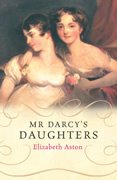
    Last night our book club met to discuss our current read, Mr. Darcy's Daughters, by Elizabeth Aston, a 2003 sequel to Jane Austen's Pride and Prejudice.

    "It is the year 1818, twenty-one years after the stirring events of PRIDE AND PREJUDICE. Mr Darcy and Elizabeth have gone to Constantinople, while their five daughters descend on the dangerous and dashing world of Regency London. The world is changing, but opportunities for women are limited, as intelligent,
    independent-minded Camilla soon discovers - and Society is unforgiving of those who transgress its rules.

    The sisters are assailed on all sides by the temptations of London, with its parties and balls, gossip and scandals, intrigues and schemes, not to mention the inevitable heartbreaks arising from proximity to so many eligible - and ineligible - men." Orion book site


    We had a great turn out and a lively discussion. Our discussion leader last night is a teacher of high school Spanish and English and came well prepared with a "pre-test." She had a list of 25 questions about the era on understanding the social etiquette of early 19th century England. As her source, she brought along a title none of us had seen, and it is a treasure for figuring out certain references, What Jane Austen ate and Charles Dickens knew. The answer to my above question is land ownership, and that was taken from her list.

    Although everyone agreed a sequel is never as good as the original, even those who enjoyed the story (I did) thought it was a bit contrived to have Mr. Darcy and wife Elizabeth (main characters of Pride and Prejudice) take off for a year abroad so the 5 daughters could live in London with relatives during the "season."

    Our hostess had never read Pride and Prejudice, so she'd also purchased and read that as well as our selection and declared it the best novel she'd ever read--and she's been in this group for 25 years. Another member who'd read it in college over 40 years ago said the same thing. Guess I'll have to read it.

    Aston has written two other books about the Darcy family, Exploits and adventures of Miss Alethea Darcy, and The true Darcy Spirit, just released this year. The selection for April is, The Magdalene Gospel by Mary Ellen Ashcroft.