Showing posts with label coupons. Show all posts

Thursday, July 14, 2022

I never intended to be a writer, but have been doing it since I was a child. In college I "majored" in other things, although nothing that pays well, like library science. In a blog in 2008 I was writing about two of my favorite topics--food and money.
"In the early 1980s I was writing about food budgets, coupons, sweepstakes, and other ways to play with your food, just as I do today in my blog, but using an electric typewriter, a bottle of white-out, research in the OSU Agriculture Library, and a photocopy machine to issue my own newsletter, "No Free Lunch." I was interviewed on a local TV talk show, spoke to women's book clubs, a faculty lunch group at OSU, and I was featured in the local suburban newspaper. However, because my theme was in some ways anti-business and chiding the consumer for poor planning, I was not in great demand as a speaker or writer. You can't tell business that their methods are suspect and consumers that they are not behaving rationally and expect to be popular!

I was just as opinionated then as a liberal Democrat as I am today as a conservative Republican. I wrote a lot about how government and food conglomerates worked together to confuse or hurt the consumer and put the local food companies at a disadvantage (and I hadn't heard of a Wal-Mart). I was really hard on "food writers" in the magazines who always encouraged coupons and prepared foods. Actually, I still feel that way, but now wonder why Democrats continue to lull voters into thinking even more government control of their lives and wallets is beneficial. And I see how increased regulation of business hurts the little guy, and especially the poor."
Based on Biden's fuel policies, we'll probably be lucky to have food on the shelves to buy, but if you're concerned about inflation, you can still save a bundle by contributing your own labor, just as I wrote in 1981. These days, you'd also save a lot by discontinuing take-outs or eating out with your family. Even for us as a couple eliminating our Friday night date as we did during the Covid lockdowns saved us about $200 a month.
 
That said, if I thought my kids needed baked snacks (they were deprived and got raw sliced veggies and fruits) that weren't full of chemicals, sugar and salt, I'd keep an eye on this lady. Food Babe. She's very pretty and Hawaiian.  Homemade Goldfish Crackers With Organic Ingredients (foodbabe.com)  She must be OK because there are other web sites set up to attack her.


Wednesday, May 31, 2017

Net neutrality, coupons and capitalism

 Many political conservatives or alternate voices in medicine, history and science are going to YouTube, pod-casts, alternative media to be heard, and to get around the blatant media bias filled with Trump hate and Climate scares. Every day I find new sources--some just awful (bad voice quality, bad IT) and some very good.  Meanwhile when I log in the search engine front pages lie about "net neutrality" and how we need it. No, THEY need it to keep the alternative viewpoints and start ups back. The "wild west" internet is what made these giants like Google, Yahoo, Amazon, etc., and like all good capitalists who become Democrats in order to fight competition that made them great, they want to put up the barbed wire fences with the government's help. Lots of lobbyists make their livelihood with this.

Forty years ago when I was writing about the coupon scams, it was the same deal. The largest companies put out the most generous offers so they could block the newer products which couldn't afford that kind of advertising in the cut throat grocery business.. Customers fall for coupons every time--can't believe that companies don't exist to "save" you money. Voters are similar. Capitalism works when the big guy eats or stops the little guy. It's still better than government transfers, but you need to understand the game.

 https://mises.org/library/net-neutrality-scam

 https://www.youtube.com/watch?v=MGtq7Ou-RrY

 https://www.youtube.com/watch?v=5Z_nBhfpmk4

Tuesday, April 21, 2015

Consumer Reports says coupons save money—they don’t

"All told, consumers saved $3.6 billion by using coupons [out of $310 billion], which makes it difficult to understand why only 59 percent of subscribers we surveyed used manufacturers coupons." (Consumer Reports).

Oh, let me count the ways American consumers are fooled into using coupons that

  • 1) cover up price increases,
  • 2) introduce yet another new product we don't need,
  • 3) convince us to buy processed rather than steaming or grilling it ourselves,
  • 4) deliver us into obesity with a bazillion snack offerings, etc. etc.

Yes, I know, I can't convince you that food companies don't stay in business by giving away their products, or that coupons add to the cost of your food, so just continue to fool yourselves--with the help of the media that prints or distributes the coupons. The first coupon was a wooden nickel.

Tuesday, August 09, 2011

ABC suggests there is a free lunch (coupons)

ABC News last night was pushing coupons as a way for Americans to save money in “these difficult times.” The usual coupon queen interviews--trying to convince you that companies on stay in business to give away stuff. Manufacturers use coupons to grab a larger share of the market, and since they don’t build brand loyalty, they primarily just reduce competition, and eventually raise prices for everyone as there are fewer companies to compete for your dollar. And since ABC ‘s advertisers are also the promoters of these schemes, this really wasn’t a news story at all but a pay-off for their sponsors and owners.

Whether it's Groupon, the newest version on the internet, the wooden nickle the oldest from my grandparents' days, or S&H green stamps your mother stuck in little books, . . . I tell you for the umpteenth time THERE IS NO FREE LUNCH!

Saturday, October 10, 2009

Alternative to coupons

I found the article--it was in the September 2, 1981, Upper Arlington News--about 28 years ago. Here's the points I made.
  • I did the research after a conversation with co-workers who felt guilty that they didn't clip coupons, or didn't like it.

  • At the time I was a librarian in the OSU Agriculture Library and had access to little known publications that provided the answers.

  • If homemakers would use their time in preparation instead of coupon clipping and sorting and parties, they would save much more and serve their families better food.

  • Coupons were most often available for highly prepackaged food which are the most expensive.

  • I attributed women's (housewives) need to do this to being convinced they needed a paycheck to feel valuable (remember, we were only 10 years into the rush to go back to work as a result of the women's movement). "Clipping, filing, storing, redeeming--why it is just like office work, and you sometimes even get a check in the mail for your efforts. At last there is tangible reward for all your efforts," I said.

  • Homemakers are given a false sense of contributing to her family's economic well-being by being convinced that she's saving money.

  • The writer found my food budget very interesting--"she feeds her family of 4 (including a teenage son and daughter) for $50 or less a week. That's less than the government figures a family of four using food stamps must spend."

  • I'd gradually changed my shopping habits to include more fresh items and I "shopped the walls" for produce, dairy and meat avoiding the sea of prepackaged foods found in the center aisles.

  • I didn't drive around looking for bargains, read labels, bought generic brands.

  • Our children thought "real cheese" tasted funny when I made the change, so I recommended making changes gradually and ease the family into healthier, lower cost eating.

  • And of course, because I was a librarian, I recommended some books, "The supermarket Handbook" by the Goldbecks, and "Diet for a small Planet" by Frances Moore Lappe, and More with Less Cookbook by Doris Longacre. I still use the Longacre book occasionally.
I get a chuckle out of today's greenies who think they invented this.

Speaking of old letters--a 1981 thank you

I mentioned I found a 1993 letter I'd written to "The Lutheran" about 15 Health Care values and principles. I also found a 1981 letter thanking me for my views on coupons which apparently stemmed from an article about me in the Upper Arlington News (or possibly the Columbus Dispatch, don't remember). [Loyalty cards are just the more up to date form of couponing.] This woman "got it." But not many do. If there's anything harder than convincing the American public that the government doesn't create jobs, it's convincing them that businesses don't exist to give away their products. She wrote:
    "Thank heaven someone has finally spoken out to say what I have thought about couponing for some time now! Although I am not a Northwest area resident, I work in the area, and saw the article about your views in this week's paper.

    Since I am a working mother who drives 36 miles each way to and from work everyday, I don't have a lot of time to read anything other than the essentials, or to learn new skills (i.e. couponing), but I kept asking myself why everyone else seemed to be able to save so much with coupons (or at least that is what the avalanche of articles about couponing would lead you to believe), when I could rarely find coupons for anyting I buy other than Pampers.

    I didn't think I was dense (I have a degree in home economics, although I am not working as a home economist at this time), but either I was not cooking like all those who were couponing, or I had missed the boat somehow, because I never found coupons for fresh fruits or vegetables, whole wheat flour, meat or frozen vegetables that weren't suced, friend, or practically pre-digested!

    Thanks for your views speaking out for those of us who seem to be losing out to all the convenience food junkies. I can only guess that the myriad of articles pertaining to nutrition and good health are falling on deaf ears, if they are noticed at all. Why is it that the extremists always seem to get the most press? In this case, the convenience food freaks must just have more time for publicity than those of us who are spending time preparing good, wholesome meals. Thanks again for your well-reasoned input into a subject which has been irritating me for some time now."
Update: I checked this woman on google and found her at the Plaza of Heroines at Wichita State University to honor everyday women who are heroines in people's lives.

Friday, July 24, 2009

Watermelon gum, or why I hate coupons

You just can't win with a coupon. I received a plastic, looks-like-a-credit-card coupon from Staples for $10. (Paper coupons are the size of a dollar bill; the original coupon was a wooden nickle--it's inflation.) First I went to the wrong store--it was store specific and apparently they were only sent to certain zip codes. Then the item I wanted, rechargeable batteries, was $19.99, and the minimum amount was $20. I asked the floor clerk about that, and he said Yes, it would count because of taxes. Nope. The check-out clerk said I had to buy something else. So I grabbed a pack of gum, which turned out to be $1.49 watermelon flavored, sugar free, with pieces so small it will get lost in my ample mouth. (I have all my wisdom teeth.) But I did win, in a way. I left the store with only what I came in to buy. Coupons aren't about reducing prices; they are about bringing you in. Or taking you in. Who, but the government, could stay in business by giving stuff away?

Sunday, January 11, 2009

Really bad advice for saving on food

The Extension Office at the University of Illinois has a special web page on financial advice, which includes saving on your food dollar. The worst possible advice is to suggest clipping coupons (or using a loyalty card). Here’s my e-mail to them:
    Dear Debra,

    I see on the web site for financial advice that clipping coupons is suggested as a way to save on food costs. Coupons are a marketing scheme--in the long run it is very deceptive. Coupons, now often shaped like credit cards, are the size of a dollar. They most often are used for promoting 1) processed food, 2) to cover price increases, and 3) to introduce a new product, which is probably a variation of one already on the shelf, like a Ritz cracker in a different shape. Coupons help the printing companies, the ad designers, and the workers in 3rd world economies who count them, but they don't help the American consumer. The smart consumer should plan menus, stick to a list, shop the walls, stay out of the snack and soft drink aisles and contribute her own labor to reduce food costs. Loyalty cards also increase food costs as do games and sweepstakes. The first coupon was a wooden nickel, and you know what we say about those.

Thursday, May 22, 2008


13 ways to burn calories if you're a coupon queen

Today's Cranky Consumer in the Wall St. Journal reviews "best sites for coupon clipping" and reports only 1% of coupons are ever redeemed. Coupons, sweepstakes, rebates and loyalty cards are all part of the same marketing program to convince buyers that producers want them to save money. The original coupon (over 100 years ago) was a wooden nickle. Now many of them look like credit cards or you can spend even more by printing them off the internet. Here's some exercises to burn calories while you "save."

1. Exercise discretion (125)
2. Jump on the bandwagon (75)
3. Push your luck (80)
4. Race against the expiration date (100)
5. Fish for coupons in your purse (35)
6. Stuff the envelope (30)
7. Hunt for stamps (55)
8. Jog your memory for the offer (75)
9. Run around after specials (350)
10. Chase bargains (250)
11. Fly off the handle at the store manager (250)
12. Wade through the paperwork (100)
13. Grab the last offer (100)

Coupons don't cut your costs; they cover price increases, introduce new products and try to put the competition out of business so they can raise prices later.

Wednesday, May 21, 2008

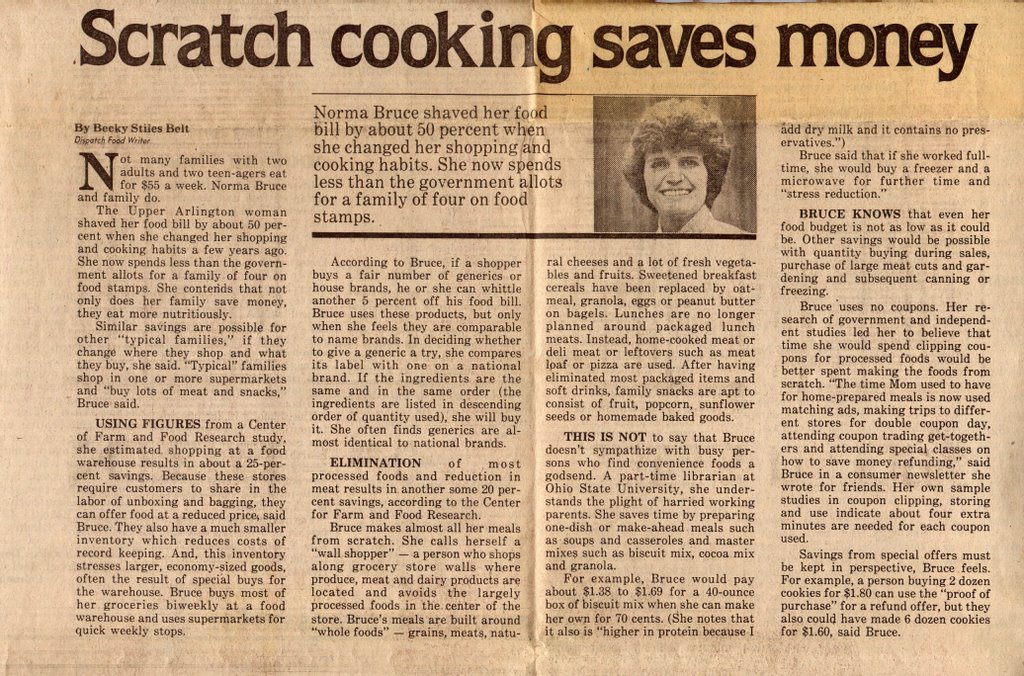
Cooking from scratch saves money

And still does.

More about coupons, sweepstakes, refunding, over-lays, price increases. Everything except loyalty cards and internet coupons, which didn't exist in 1982.

Sept. 29, 1982, Columbus Dispatch

Thursday, May 08, 2008


Put those scissors down, babe!

Clipping coupons will not put money in your gas tank. But that's what I heard on a TV feature last night. Even in tough economic times, it's hard to convince Americans that food companies, health and beauty industries and super markets, to say nothing of the airlines, are not in business to SAVE you money, but to get you to SPEND money. Coupons, loyalty cards, sweepstakes, green stamps and wooden nickles are just flip sides of the same pancake--marketing. What is the purpose of marketing? Right. To get you to spend money to support a business and its stockholders or investors. It's not evil at all. In fact, in the long run, marketing is a good thing. But right now, until someone comes up with a decent energy plan that allows new refineries or drilling for oil (we've got plenty) or cutting regulatory red tape, you may have to let go of some favorite shibboleths. Here are the basics.

1. Before leaving the house to shop, check your refrigerator or pantry. Make a list if you're a list maker (I'm not), but have an idea what you NEED. A NEED is not a WANT. Repeat that several times as you enter the store.

2. Go to one store where you know the layout, the quality and the staff.

3. Pick up the weekly flyer on the way in, look at the loss leaders, but buy them only if you've done #1.

4. Do not buy in quantity (for more than 2 or 3 weeks) unless you live 50 miles from the store and need to save on gasoline. Most people who regularly buy in quantity also have a weight problem. Your extra pounds will add to the gas bill and health costs. There are psychological reasons people buy in quantity that have nothing to do with saving money, but it's a good excuse.

5. Shop the walls, although this is harder to do than it used to be (creative design and moving merchandise to make you wander around is one method used to separate you and your money). Buy fresh if you can; if you're cooking for one or two, sometimes frozen is more nutritious because fresh will lose its nutrients sitting around waiting for you to get an inspiration.

6. Don't use a coupon unless it is attached to the item, or you ALWAYS buy that product. For instance, I just love Era laundry detergent and I buy it whether or not it is on sale. But I would use a $.50 off coupon, realizing that it means the price is going up and this is to ease the pain.

7. Stay out of the snack food section. There's not a single item in there you or your family need. Snacks are all empty calories, high sodium, high fat, delicious and guaranteed to make you want more and spend more. Just don't go there. Don't even accept a sample! In some stores this will cause several detours (but exercise is good). I've been shopping at Marc's recently, and you can't get to the real food without going past the snack aisles which are huge, or detouring through cheapy remaindered stuff, which is as addictive as snacks, at least for this shopper.

8. Make your own low fat items by adding water to the jar and shaking. That doesn't work with cookies or pudding, but you get my drift. Low fat almost always means the first ingredient is water.

9. At home use 6 or 8 oz. glasses instead of 12 or 16. You'll never notice the difference or miss the calories. It's not so much the size of the container you buy as it is the portions you put on the table that save you money.

10. Shop on Monday if you can. Lots of markdowns for meat that haven't passed the due date for freshness and safety.

11. Shop early in the day.

12. Don't go to the store hungry. A fist of coupons and no breakfast is a recipe for disaster.

13. Keep in mind that coupons and loyalty cards are supporting a huge industry--and those workers might suffer as you cut back--it involves investors, executives, middle management, designers, office staff, ink suppliers, paper goods, newspaper and magazine companies, the people in 3rd world economies who make their living counting them, and even the stores who may have to hire an extra part timer to account for the slow down of the other staff who have to pause and examine your coupon or card. But be firm--right now it's your family or theirs. Stand tall and put down those scissors.

Saturday, December 08, 2007

Remembering why I hate coupons

Generally, I refuse to play games with my food--coupons, sweepstakes, loyalty cards, filling out forms on the internet, etc. But this week we got a coupon for our favorite pizza place up the road. Well, it's not really our favorite--that one is in Grandview and since we moved in 2002, it takes too long to get there. But this one is pretty good. Anyway, there was a "$1.00 off any size" coupon. So even though we really didn't need a pizza tonight (we ate out last night), I called one in. The price had gone up about $3! That's the primary use of a coupon--to cover up a price increase. And I know that because I used to write and interview about these scams, but it still makes me mad. Based on other price increases, it shouldn't have gone up more than $.40. It's you global warminists doing this, you know--putting corn in our gas tanks instead of our cows.

Monday, September 04, 2006

Monday Memories: My 10 minutes of fame

Recently I wrote about the Hillbilly Housewife and her food budget. In September 1982 I was front and center of the food section of the Columbus Dispatch, "Scratch cooking saves money," written by Becky Stiles Belt. It says, "Not many families with two adults and two teen-agers eat for $55 a week. Norma Bruce and family do. . . She spends less than the government allots for a family of four on food stamps. She contends that not only does her family save money, they eat more nutritiously.


"Bruce makes almost all her meals from scratch. She calls herself a "wall shopper"--a person who shops along grocery store walls where produce, meat and dairy products are located and avoids the largely processed foods in the center of the store. Bruce's meals are built around "whole foods"--grains, meats, natural cheeses and a lot of fresh vegetables and fruits."

The article goes on to mention that I worked part-time and sympathized with harried working parents--that I saved time by preparing one-dish or make-ahead meals such as soups and casseroles and master mixes such as biscuit mix, cocoa mix and granola.

The big issue for me, which was down played in the article because of advertising revenue, was that I never used coupons. "Her research of government and independent studies led her to believe that time she would spend clipping coupons for processed foods would be better spent making the foods from scratch. 'The time Mom used to have for home-prepared meals is now used matching ads, making trips to different stores for double coupon day, attending coupon trading get-togethers and attending special classes on how to save money refunding,' said Bruce in a consumer newsletter she wrote for friends. Her own sample studies in coupon clipping, storing and use indicate about four extra minutes are needed for each coupon used."

I was also interviewed on this topic on a radio talk show, and in a morning television spot, and invited to speak at ladies' luncheons. I don't think anyone believed me, because people want to believe in a "free lunch."

Ah fame. It is such a fleeting thing.

Click here for the Monday Memories Code, Blogroll, Graphics, & Other Information


Trackbacks, pings, and comment links are accepted and encouraged!

My visitors this week are:
Mrs. Lifecruiser, Friday's child, Nea, Nightingale, Reverberate58, The Shrone, Ma, Chelle Y. Irish Church Lady, Randy Kirk, Susan, Gincoleaves, American Daughter (be sure to read her on-line journal by the same name)