The e-mails of alarm about the Obamacare intention and HR 3200 just keep coming. Baby-boomer seniors need to take a deep breath and reexamine what they really believe about life and viability, because although rationed care is a concern in this bill, and should be, many are outraged by the thought of "counseling" for end of life care. Oh, they may point out its other failures and Bogey man features, like the huge increase in the bureaucracy that will be making decisions about their lives, but that periodic counseling feature is a real stick in the craw feature. It's not a huge stretch from rotator cuff surgery at 65 so you can continue playing golf to a new heart valve at age 90 so you can continue walking around the block and enjoying the great-grand babies. But think about it. Even those who didn't vote for the most anti-life President we've ever elected, who never wrote their congressman or carried a poster at a pro-choice rally, may have gone squishy along the continuum of aborting a fetus with Down Syndrome to removing the feeding tube from Grandpa because "he wouldn't want to live this way."
Well, now it's our turn isn't it? Now we're the ones about which someone unknown and nameless is debating--our viability and life-worthiness. Doesn't feel so good, right? In case you've never thought of it, none of us is "viable" without the help and care of others--our family, our friends, our employer, our drug companies, our truckers, our farmers, our merchants, etc. We're all just as much "parasites" as that developing fetus in the womb. If for some reason you were dropped on Mouse Island on Lake Erie without clothing, food, water, matches, or tools of any kind, you'd soon find out just how "viable" you are, whether 20 years old or 80. Oh, maybe you'd survive August or September on berries or an occasional dead fish that floats past--it is after all a fresh water lake--but January and February, if you lived that long, would be a bit chilly as the Civil War prisoners on Johnson's Island discovered looking at near-by Sandusky across the bay.
Also, it's past time for a lot of seniors to remember Medicare, Medicaid, SCHIP, WIC etc. are socialized medicine. They are out of control precisely because they are government programs, and what the government gives it can take away at the stroke of a pen, or smack of a gavel. Seniors need to be careful what they ask for or destroy. You didn't vote for tort reform, you didn't object when the government began limiting what it would pay doctors and hospitals, you didn't cry foul over regulation of certain professions or industries that drove good people out, you didn't look through those itemized invoices in the thousands for a day or two of care that dropped in your mail box 6 months later, you didn't ask questions when technology and drug research outran the bioethics arguments, so now it's time to pay the piper. I fear the price is more than you'll want to pay.
Tuesday, August 04, 2009


Monday, August 03, 2009
Lakeside Cottage Architecture pt. 7
The Ross Hips, pt. 3
The Ross Hips, pt. 2
The Ross Hips, pt. 1

These homes face the lake and Perry Park (renamed on the 100th anniversary of Perry's victory in 1812) along 2nd Street and one on Elm Avenue. Most have the angled window to provide a good view.


These Ross Hips are on Cherry. For porch renovations, there are many styles on a Ross. There are four on Cherry between 2nd and 3rd.
 This Ross cottage on Elm just grew and grew.
The Ross Hips, pt. 2
The Ross Hips, pt. 1

These homes face the lake and Perry Park (renamed on the 100th anniversary of Perry's victory in 1812) along 2nd Street and one on Elm Avenue. Most have the angled window to provide a good view.


These Ross Hips are on Cherry. For porch renovations, there are many styles on a Ross. There are four on Cherry between 2nd and 3rd.
 This Ross cottage on Elm just grew and grew.
The leftist protests--where are they?
Dennis writes: "Still waiting for the endless anti-Obama protests by Code Pink, Hollywood, and mainline media pundits. As least in Iraq the world honestly thought they had WMD. No one thinks Afghanistan has WMD.
The fact is that all the anti-war protests during the Bush administration were not really anti-war. They were Leftist charades designed to discredit a President they didn't like.
Unfortunately for America, it worked."
The "economy fixes" are also a charade. It has never been his intention to put people back to work. I'm not holding my breath waiting for the left MSM to ask him any tough questions.
The fact is that all the anti-war protests during the Bush administration were not really anti-war. They were Leftist charades designed to discredit a President they didn't like.
Unfortunately for America, it worked."
The "economy fixes" are also a charade. It has never been his intention to put people back to work. I'm not holding my breath waiting for the left MSM to ask him any tough questions.
Chamomile Lemonade

At the herb class last week we received a recipe for chamomile lemonade so yesterday I made a pitcherful in my "new" pitcher bought last year at the antique show. Tasted pretty good.
3/4 C cane sugar (I used much less)
2 Tbs. grated lemon zest
5 Tbs. fresh or dried chamomile flowers or 6 chamomile tea bags
3/4 C lemon juice (I just squeezed the lemon)
lemon slices for garnish
Combine sugar, lemon zest, and 2 cups water in a saucepan and bring to a boil, stirring to dissolve sugar. Remove from heat, and add chamomile flowers. Cool.
Strain chamomile mixture into a 2-qt. pitcher, stir in lemon juice and 3 cups water.
Serve over ice with lemon slices, or store, covered, in refrigerator up to 5 days.
Plans for week 7 at Lakeside
This is "Peace and Justice" week at Lakeside--programing I usually avoid (sort of white man's burden modernized), so I have the whole week to look at other topics. This morning at 10 a.m. there is a "walking tour" of the east end. I walk there all the time, but usually don't know what I'm looking at. Then in late afternoon we're going to a social reception for a group of which my husband is a member. We wanted to see the movie this week, "My life in ruins" about a woman who is a tour guide in Greece, but that conflicts with "The closer," my husband's favorite show (watches at a neighbor's since we don't have cable here). So I'm not sure what night we'll go--maybe Wednesday. On Tuesday Gretchen is giving a talk on aprons at 1:30 at Green Gables--not sure if I have to join to hear that. Wednesday at 3:30 there's a book review of 3 cups of Tea which our book club is doing this year. There are pre-symphony talks on Tuesdays 7-8. On Wednesday afternoon also at 2:30 is our herb class tea at the hotel. There was an art class I was considering M-Th, but met at 6 p.m., so maybe I'll just stay home and practice what I learned in the last two! And then there are all those books--bagful for one dollar--I bought yesterday.
Sunday, August 02, 2009
CBS covers Lakeside
Friday night someone told us Lakeside had been on the news. We missed it, but here it is.
Watch CBS Videos Online
Watch CBS Videos Online
High Calorie day at Lakeside
Sunday morning we go to the Patio Restaurant for a pancake and eggs. Most people know Brent and Heidi are famous for their donuts, but frankly, the pancakes are the best on the peninsula, or maybe the Northcoast. So what is that with dripping butter and hot syrup? 1,000 calories? Then this afternoon was the ice cream social and band concert on the hotel lawn. The day had started cool and cloudy, but by 2:30 the sun was brilliant and the sky cobalt blue (I took art class last week and relearned my colors). The servings were generous--so big in fact I ate both scoops of butter pecan ice cream but only a few bites of the chocolate cake with caramel icing. We sat in rocking chairs on the sidewalk in the sun.
All of a sudden it was 3:30 and I was getting sleepy listening to the marvelous band music, in the warm sun, with a cool lake breeze. But I remembered at the last minute the Women's Club Book Sale and headed over there with a $10 bill. Didn't need it because by then the books were going for a grocery bag for $1.00. Not much left, but I did pick up a first edition of Letters of Edna St. Vincent Millay. I checked it on the internet and found one that pretty much matched what was in my sack:
All of a sudden it was 3:30 and I was getting sleepy listening to the marvelous band music, in the warm sun, with a cool lake breeze. But I remembered at the last minute the Women's Club Book Sale and headed over there with a $10 bill. Didn't need it because by then the books were going for a grocery bag for $1.00. Not much left, but I did pick up a first edition of Letters of Edna St. Vincent Millay. I checked it on the internet and found one that pretty much matched what was in my sack:
- LETTERS OF EDNA ST VINCENT MILLAY
MacDougall, Allan, ed.
Harper & Bros, NY, 1952. Hard Cover. Book Condition: Fair. No Jacket. First Edition. 8vo - over 7¾" - 9¾" tall. LC# 527291. 384pp, index. Grey paper boards, green cloth spine, gold lettering on fading spine, wear to edges and corners; foxed on lower fore-edges and small amount on front and back covers, fading at edges, initials on front end paper, slight tanning of pages.
$20.00 plus shipping
- "Arthur darling,
This will be one of the most unpleasant letters you ever received, and I'm sorry. But it's time I got this matter off my chest and onto yours, where it belongs. . .
Dear Lulu [Llewelyn Powys]
I am so sorry about your brother [died 1936]. I think about it, and I say to myself, "There is nothing to say". Yet perhaps there is something to say, only I don't know what it is. I am the last who could teach you how to fit into the pattern of your life the death of someone you love; I have no skill at this."
Let’s not confuse summer jobs programs with “recovery”
- "President Barack Obama promised green jobs to be funded through the American Recovery and Reinvestment Act, and those federal stimulus dollars are the focus of a new program in Beloit that's putting young people to work and saving energy." Story from Beloit, Wisconsin.
In the 1980s I worked on a contract program funded by the JTPA (Job Training Partnership Act, which replaced a public works jobs program, CETA, 1974-1982) and the Ohio Bureau of Employment Services (or was that Unemployment? Labor?). I was a Democrat; my boss was a Republican and also my aerobics instructor; her boss was a Republican; his boss was a Democrat at the cabinet level; her boss was Governor Gilligan, a Democrat and the father of former Kansas Governor Sebilius, now head of HHS of the Obama administration. I believe the President at that time was a Republican named Reagan. The problem with all these federal jobs programs is that either they train for jobs that aren't there, or they are the actual jobs with nowhere to go. Either way, the poor usually stay poor with the government's help. This Wisconsin ARRA program is a jobs program, almost guaranteed to go nowhere. I think 5 young adults are "energy advocates." They are teaching people to do what our mothers taught us back in the 1950s.
- "Members of a team of five from the Beloit area are called Energy Advocates. They are all between 18 and 24 years old, and their job is teaching others to save energy and money.
"(We remind people to) turn off their appliances when they're not using them. You're still pulling energy in just because they're plugged in," said Sharome Crawford.
Crawford uses devices like kilowatt readers, energy efficient light bulbs, low-flow shower heads and sink aerators to help residents cut costs.
"You're going to have the full capacity of water, and it's going to keep your bills low," he said, displaying the low-flow sink aerator.
The Department of Workforce Development program gives these young workers training for future careers."
I learned so much in that 6 mo. JTPA job--about how hard some lower level, career government employees work, and how others who do nothing were appointed because of connections and donations to the party (either). My job specifically was in a training program to get seniors (over 55) re-employed and re-trained because the recession during the Carter years was not unlike today's but with both high inflation and high unemployment. We worked through the Private Industry Councils (PIC) and the Area Agencies for Aging. Even though I was a novice at government largesse and wealth transfer, even I could see that dollars were taken from the taxpayer, filtered through a variety of huge departments in Washington like Labor, then partially returned to the states, and then to various levels within the state, and counties, each agency and official (and contract worker like me) getting a cut along the way.
Lakeside cottage architecture, pt. 6
The Ross Hips, pt. 2
The Ross Hips, pt. 1
My first experience with a Ross cottage was the one we rented our first vacation week in Lakeside in 1974, although I didn't know it until I checked the address at the archives on Saturday. Also, my friend Nancy who first told us about Lakeside lives in one on 2nd Street which her parents bought in 1946.
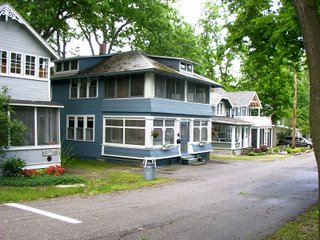 Our first place was 228 Plum--a four family and our rent was $45/week. This home has since been turned into a double--or maybe it was originally a double and had been changed to house more families. There was also a sleeping porch at the rear--no air conditioning or fans in the early 20th century, so sleeping porches with push out shutters to let air in were essential.
The ones on either side of 228 are not Ross Hips, but the two further down at 2nd and Plum are, one has been redesigned to have a second story gabled roof porch, not my favorite for a hip roof, however, it gives them a wonderful, open view of the park and lake.
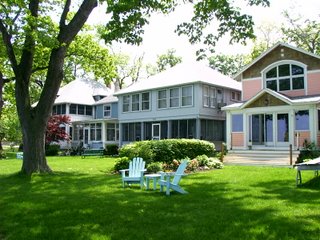 I believe this was our rental the next summer, also a four family and was lakefront, so we had some great views when the storms rolled in. The two to the left of it are also Ross Hips, the one called Northeaster borders the tennis courts and sits where the old power site was.
 Sunrise on July 18, 2009
The Ross Hips, pt. 1
My first experience with a Ross cottage was the one we rented our first vacation week in Lakeside in 1974, although I didn't know it until I checked the address at the archives on Saturday. Also, my friend Nancy who first told us about Lakeside lives in one on 2nd Street which her parents bought in 1946.
 Our first place was 228 Plum--a four family and our rent was $45/week. This home has since been turned into a double--or maybe it was originally a double and had been changed to house more families. There was also a sleeping porch at the rear--no air conditioning or fans in the early 20th century, so sleeping porches with push out shutters to let air in were essential.
The ones on either side of 228 are not Ross Hips, but the two further down at 2nd and Plum are, one has been redesigned to have a second story gabled roof porch, not my favorite for a hip roof, however, it gives them a wonderful, open view of the park and lake.
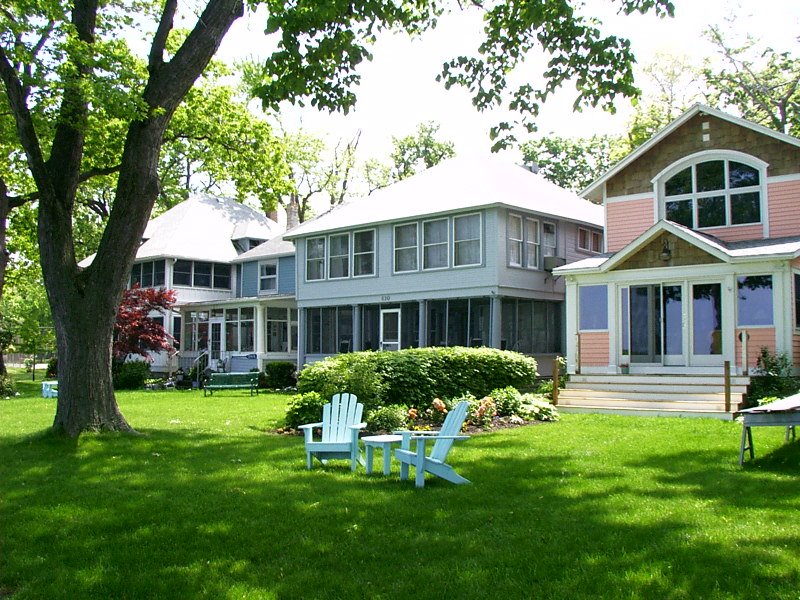 I believe this was our rental the next summer, also a four family and was lakefront, so we had some great views when the storms rolled in. The two to the left of it are also Ross Hips, the one called Northeaster borders the tennis courts and sits where the old power site was.
 Sunrise on July 18, 2009
Front page and center--NYT features soldier suicides
Isn't it nice the NYT wants to feature a suicide story front page with a 3 column wide photo about a 2007 death of Jacob Blaylock. Of course, no bias against the war or soliders on their part, right? The death of any soldier or former soldier, during combat or later from mental illness, is tragic. In WWI there were battles whose names we don't remember that wiped out 7,000 men in a few days--I'm sure the survivors had a difficult time the rest of their lives wondering "why did I live?." However, after you get past the "ain't it a shame that we're at war" theme and you get into the story, you find the featured soldier had many demons. ". . . the elements for disaster were in place long before he went to war." So it wasn't just the death of 2 in his unit or combat (he was in a transportation unit). Financial troubles, huge marital and custody battles, a sensitive nature, moody, the butt of jokes and teasing, apologetic, but musical and poetic. Into the second page, which many don't read, "Researchers of military suicide find not a single precipitating event, but many." "Soldiers who kill themselves are also likely to have a history of emotional troubles. . . "
So the reporter's mined that hole, and moves on to "screening." Why was he even in the Army? He'd been discharged once for mental health issues, but was "called back up when the Army was desperate for troops." NYT also got ahold of his VA private health records for treatment for depression--whether from someone inside or a family member, it doesn't say, but that's just a hint about privacy and health.
Then there's an itsy bitsy chart on the third page. Army suicides were well below the civilian rate up through 2004, and began to rise above the civilian rate in early 2007. Do you suppose the constant drum beat in the media and Congress-- Murtha, Pelosi, et al--against them had anything to do with their sense of mission, self-esteem and willingness to sacrifice, especially if they were fragile to begin with?
So the reporter's mined that hole, and moves on to "screening." Why was he even in the Army? He'd been discharged once for mental health issues, but was "called back up when the Army was desperate for troops." NYT also got ahold of his VA private health records for treatment for depression--whether from someone inside or a family member, it doesn't say, but that's just a hint about privacy and health.
Then there's an itsy bitsy chart on the third page. Army suicides were well below the civilian rate up through 2004, and began to rise above the civilian rate in early 2007. Do you suppose the constant drum beat in the media and Congress-- Murtha, Pelosi, et al--against them had anything to do with their sense of mission, self-esteem and willingness to sacrifice, especially if they were fragile to begin with?
Saturday, August 01, 2009
Another one who has read the HR 3200 bill
Letter from Edward Lynch, candidate for Congress from FL.
Dear Friend,
As you know, President Obama has been pushing his “Universal healthcare” plan. There have been a lot of people saying many different things about this new healthcare plan. Therefore, I felt the need to do what our congressmen and women have not done and read all of the healthcare plans out there. Let me tell you, as you can imagine, it was not easy reading. I wanted to be able to give you the ammunition (facts) to reply to those that want to know why we oppose the plan.
First, let me state that I do believe that we need to make sure that every LEGAL American citizen has access to the best healthcare system in the world and that it is affordable for everyone. Let me also state that, after reading the bills that are being considered, if the healthcare plan was a good plan, I would let you know that. That being said, the proposals set forth in the house (H.R. 3200)and in the senate are very bad for America for the following reasons:
1. We simply can not afford it. The Congressional Budget Office states that even with higher taxes on high income earners and penalties on employers who don’t provide coverage, the plan will fall $239 billion short of covering its cost of over $1 trillion. That is their best case scenario without the bill being completely scored.
2. It will not cover everyone. The Congressional Budget Office estimates that over 17 million people would remain uninsured AFTER this plan is implemented.
3. You will not be able to shop for or obtain private insurance if you do not have private insurance prior to the bill being passed. This is somewhat clearly stated on pgs. 16 and 17 in section 102(a)(1)(A).
4. After a 5 year grace period, all private insurers that are still in business will be required to offer a “qualified health benefits” plan based on government standards. The problem is whether or not the “government standards” will exclude private insurers. This on page 17, section 102(b)(1)(A).
5. No new policies will be allowed to be written by a private insurer after the public option becomes law. Also page 17.
6. Every five years, the elderly will have to attend a mandatory “advanced care planning consultation” for an “explanation by the practitioner of the continuum of end of life services.” The consultation will be conducted more frequently if a significant change in health condition; including diagnosis of a chronic, progressive, life limiting disease, terminal diagnosis, life threatening injury or upon admission to a skilled nursing or long term care facility. In other words, if you are old, you will be consulted about what your options will be if you get sick, if healthcare would not be an option (see #7). This starts on page 425.
7. Page 501 of the bill starts a section that indicates that $1 billion will be spent on “comparative effectiveness research” which is how the government evaluates relative merits of various treatments. In other words, rationing. This is tantamount to the government determining whether or not you are worth getting a particular treatment depending on your prognosis or age. Sec. 1401 Part D
8. This plan would allow for government funded abortions. Since this bill would cover all procedures, abortion is included. There is no exception for abortion.
9. Members of congress and unions would be exempt from this plan and not have to be a part of the healthcare plan. Recently, John Fleming, introduced H.R. 615 that stated that members that vote in favor of a government run healthcare must enroll under the public option. No democrat would sign on. If it is not good enough for congress, it is not good enough for us! This is section 3116.
10. $500 billion will be cut from senior healthcare to help pay for this bill. This will weaken Medicare, an organization already in trouble due to insufficient funds.
11. Hospitals and private healthcare facilities will not be able to collect money from the government plan unless they are “public” facilities.
12. Businesses will be fined over 8% of an employee’s salary if they do not provide healthcare insurance for their employees. Sec. 313.
13. Individuals that do not have health insurance will be fined an amount that will encourage them to purchase the government plan. Sec 401 Part VIII Subpart A Sec. 59B.
14. All “people,” legal or not, will be covered under this plan and identification cards will be issued. These identification cards will not be based on social security numbers.
These are some of the proven reasons why I could never support a bill like this. These are irrefutable facts, things that our present government does not want our citizens to be aware of, which is why they are trying to pass this bill as quickly as possible. The more we find out about the bill, the worse it gets. As I stated above, we need to reform our healthcare system, but this is not the way. In this case, doing nothing is better than passing this bill. It will hurt seniors, businesses and families.
Dear Friend,
As you know, President Obama has been pushing his “Universal healthcare” plan. There have been a lot of people saying many different things about this new healthcare plan. Therefore, I felt the need to do what our congressmen and women have not done and read all of the healthcare plans out there. Let me tell you, as you can imagine, it was not easy reading. I wanted to be able to give you the ammunition (facts) to reply to those that want to know why we oppose the plan.
First, let me state that I do believe that we need to make sure that every LEGAL American citizen has access to the best healthcare system in the world and that it is affordable for everyone. Let me also state that, after reading the bills that are being considered, if the healthcare plan was a good plan, I would let you know that. That being said, the proposals set forth in the house (H.R. 3200)and in the senate are very bad for America for the following reasons:
1. We simply can not afford it. The Congressional Budget Office states that even with higher taxes on high income earners and penalties on employers who don’t provide coverage, the plan will fall $239 billion short of covering its cost of over $1 trillion. That is their best case scenario without the bill being completely scored.
2. It will not cover everyone. The Congressional Budget Office estimates that over 17 million people would remain uninsured AFTER this plan is implemented.
3. You will not be able to shop for or obtain private insurance if you do not have private insurance prior to the bill being passed. This is somewhat clearly stated on pgs. 16 and 17 in section 102(a)(1)(A).
4. After a 5 year grace period, all private insurers that are still in business will be required to offer a “qualified health benefits” plan based on government standards. The problem is whether or not the “government standards” will exclude private insurers. This on page 17, section 102(b)(1)(A).
5. No new policies will be allowed to be written by a private insurer after the public option becomes law. Also page 17.
6. Every five years, the elderly will have to attend a mandatory “advanced care planning consultation” for an “explanation by the practitioner of the continuum of end of life services.” The consultation will be conducted more frequently if a significant change in health condition; including diagnosis of a chronic, progressive, life limiting disease, terminal diagnosis, life threatening injury or upon admission to a skilled nursing or long term care facility. In other words, if you are old, you will be consulted about what your options will be if you get sick, if healthcare would not be an option (see #7). This starts on page 425.
7. Page 501 of the bill starts a section that indicates that $1 billion will be spent on “comparative effectiveness research” which is how the government evaluates relative merits of various treatments. In other words, rationing. This is tantamount to the government determining whether or not you are worth getting a particular treatment depending on your prognosis or age. Sec. 1401 Part D
8. This plan would allow for government funded abortions. Since this bill would cover all procedures, abortion is included. There is no exception for abortion.
9. Members of congress and unions would be exempt from this plan and not have to be a part of the healthcare plan. Recently, John Fleming, introduced H.R. 615 that stated that members that vote in favor of a government run healthcare must enroll under the public option. No democrat would sign on. If it is not good enough for congress, it is not good enough for us! This is section 3116.
10. $500 billion will be cut from senior healthcare to help pay for this bill. This will weaken Medicare, an organization already in trouble due to insufficient funds.
11. Hospitals and private healthcare facilities will not be able to collect money from the government plan unless they are “public” facilities.
12. Businesses will be fined over 8% of an employee’s salary if they do not provide healthcare insurance for their employees. Sec. 313.
13. Individuals that do not have health insurance will be fined an amount that will encourage them to purchase the government plan. Sec 401 Part VIII Subpart A Sec. 59B.
14. All “people,” legal or not, will be covered under this plan and identification cards will be issued. These identification cards will not be based on social security numbers.
These are some of the proven reasons why I could never support a bill like this. These are irrefutable facts, things that our present government does not want our citizens to be aware of, which is why they are trying to pass this bill as quickly as possible. The more we find out about the bill, the worse it gets. As I stated above, we need to reform our healthcare system, but this is not the way. In this case, doing nothing is better than passing this bill. It will hurt seniors, businesses and families.
When the left does something stupid
they can always blame talk radio. Like that end of life counseling.
Lakeside Cottage architecture, pt. 5
The Ross Hips, pt. 1
 A hip roof, if the house were square, would look like this. A hip roof is practical and solid, ideal for stormy, windy, rainy areas and hurricane alleys. Also their overhangs can provide a lot of shade. Usually, the early 20th century hip roof, two story houses in Lakeside have a triangle shape to the street (the width), and a trapezoid shape for the length, the lots being much deeper than they were wide. On the east end of Lakeside which is some 30-40 years younger than the west end, there are 20 houses I'm calling them "Ross Hips" because W.D. Ross of Fremont, Ohio, built them beginning around 1907, maintaining them as rentals until his death in the 1940s. At that time they passed to his sons until sometime in the 1950s. One son, Harry Ross, wrote the book "Lake Erie and its Islands."
I think for the era in which they were built, and the general modesty, culture and goals of Lakeside, they were really quite magnificent. All have been remodeled, reshaped and most covered in vinyl siding during the last 90-100 years, but if you look at the roof and the lines you can still see what Lakesiders experienced for many years.
William DeWitt (W.D.) Ross was a teacher and superintendent of schools in Fremont, following in the footsteps of his father, William Ross, the longest serving superintendent (until 1906) and for whom Ross High school is named (Port Clinton News Herald, Aug. 30, 2006). He was a graduate of Oberlin and attended the University of Chicago. He gave up teaching after 10 years due to illness and began developing the east end of Lakeside around 1907. In the archive records (a big thank you to Jan Stephenson who found his obituary and the lot transfer records for me) are recorded the various lot sales and the advertisements for Ross Cottages, each of which had its own name. An obituary for W.D. reports that he died in October 1943, and within 5 hours of his death, his wife Evalyn also died. The properties passed to his sons, and then in the later 1940s and 1950s, were sold outside the family. However, some of the early transfers were also recorded in the name of his mother, his wife and his sister-in-law.
The houses on Plum and Ross Court facing Perry Park and the tennis courts down to the lakefront were apparently some of the earliest built. They had wonderful open porches with an angled window on the first floor to take advantage of the view. There had been a power plant on this site and there are no lot numbers recorded when he purchased the large tract. At some point there had been a bicycle racing track on this land.

From the clothing in this undated photo, I'd guess this is pre-WWI.

And here they are 100 years later.

The second house from the left has a gable roof and is not a Ross house. Notice the angled windows--many Ross houses even south of 2nd had these to provide a lake view. These houses all had a bathroom and kitchen, fireplace, electric lights, plastered walls, and were furnished to sleep 8-10, with living room and dining room and kitchen equipment. Quite different from "old" Lakeside where some homes had no interior walls, no indoor bathrooms, and resembled "wooden tents."

Except for having its porch enclosed, "The Noreaster" facing the lake still looks much the same today. The one next to it has had a gabled 2nd floor porch added which really changes its look. Shutters, of course, were never original to this style of architecture, but are a common "update." All the houses have had the porches enclosed, some more successfully than others. Many have managed to save the angled window, although sometimes if the porch was extended, it now resides inside the porch or was cut down to peek hole. Wood steps rotted, so most Lakeside homes now have concrete steps, which shift and move, or begin lifting the porch as tree roots get under them.
When we bought our 1943 cottage in 1988 thinking we'd remove the inappropriate 1980s factory built porch, we learned the previous owner had a variance, and we wouldn't be able to replace it if we removed it. So sometimes you have to stay with a remodel or do-over due to code changes.
 A hip roof, if the house were square, would look like this. A hip roof is practical and solid, ideal for stormy, windy, rainy areas and hurricane alleys. Also their overhangs can provide a lot of shade. Usually, the early 20th century hip roof, two story houses in Lakeside have a triangle shape to the street (the width), and a trapezoid shape for the length, the lots being much deeper than they were wide. On the east end of Lakeside which is some 30-40 years younger than the west end, there are 20 houses I'm calling them "Ross Hips" because W.D. Ross of Fremont, Ohio, built them beginning around 1907, maintaining them as rentals until his death in the 1940s. At that time they passed to his sons until sometime in the 1950s. One son, Harry Ross, wrote the book "Lake Erie and its Islands."
 I think for the era in which they were built, and the general modesty, culture and goals of Lakeside, they were really quite magnificent. All have been remodeled, reshaped and most covered in vinyl siding during the last 90-100 years, but if you look at the roof and the lines you can still see what Lakesiders experienced for many years.
William DeWitt (W.D.) Ross was a teacher and superintendent of schools in Fremont, following in the footsteps of his father, William Ross, the longest serving superintendent (until 1906) and for whom Ross High school is named (Port Clinton News Herald, Aug. 30, 2006). He was a graduate of Oberlin and attended the University of Chicago. He gave up teaching after 10 years due to illness and began developing the east end of Lakeside around 1907. In the archive records (a big thank you to Jan Stephenson who found his obituary and the lot transfer records for me) are recorded the various lot sales and the advertisements for Ross Cottages, each of which had its own name. An obituary for W.D. reports that he died in October 1943, and within 5 hours of his death, his wife Evalyn also died. The properties passed to his sons, and then in the later 1940s and 1950s, were sold outside the family. However, some of the early transfers were also recorded in the name of his mother, his wife and his sister-in-law.
The houses on Plum and Ross Court facing Perry Park and the tennis courts down to the lakefront were apparently some of the earliest built. They had wonderful open porches with an angled window on the first floor to take advantage of the view. There had been a power plant on this site and there are no lot numbers recorded when he purchased the large tract. At some point there had been a bicycle racing track on this land.

From the clothing in this undated photo, I'd guess this is pre-WWI.

And here they are 100 years later.

The second house from the left has a gable roof and is not a Ross house. Notice the angled windows--many Ross houses even south of 2nd had these to provide a lake view. These houses all had a bathroom and kitchen, fireplace, electric lights, plastered walls, and were furnished to sleep 8-10, with living room and dining room and kitchen equipment. Quite different from "old" Lakeside where some homes had no interior walls, no indoor bathrooms, and resembled "wooden tents."

Except for having its porch enclosed, "The Noreaster" facing the lake still looks much the same today. The one next to it has had a gabled 2nd floor porch added which really changes its look. Shutters, of course, were never original to this style of architecture, but are a common "update." All the houses have had the porches enclosed, some more successfully than others. Many have managed to save the angled window, although sometimes if the porch was extended, it now resides inside the porch or was cut down to peek hole. Wood steps rotted, so most Lakeside homes now have concrete steps, which shift and move, or begin lifting the porch as tree roots get under them.
When we bought our 1943 cottage in 1988 thinking we'd remove the inappropriate 1980s factory built porch, we learned the previous owner had a variance, and we wouldn't be able to replace it if we removed it. So sometimes you have to stay with a remodel or do-over due to code changes.
Cottage cheese
No, I'm not going to write about women my age wearing shorts. I mean the edible kind. My daughter left a carton of cottage cheese here--no room in the cooler. So I opened it the other day; then my eye fell on the list of ingredients--looked like a high school chemistry lab experiment.

- cultured non fat milk
nonfat milk
cream
salt
whey
food starch (corn)
guar gum
sorbic acid (to prevent mold)
citric acid
carrageehan
natural and artificial flavor
locust bean gum
tetrasodium pyrophosphate
monopotassium phosphate
enzymes
but it is
Gluten free!
- cultured skim milk
cream
salt
Vitamin A palmate

Now they’ve gone too far in bashing the Bushes
Laura was always fresh faced and lovely in my eyes. Remember all the Hillary hair internet sites? Seems her hair dresser doesn't enjoy being left out.
"It took Laura Bush four years to finally look good. It's taken Michelle Obama two months. She wears fake eyelashes that are beautiful. She can't do those herself." (Hillary’s former hair dresser.) Meow.
Paul L. Williams writes for the Canadian Free Press and he‘s one of those talking heads experts called in on the various cable and broakcast chatty news shows. He lists TWENTY TWO (22) personal assistants, secretaries, coordinators, and deputy-whatevers and their salaries here. Considering the economic times and her non-office, she certainly is a big spender--and I don’t think the gardener or make-up artist were even on that list.
The Obama handlers seem to be keeping Michelle under wraps so she doesn’t behave stupidly, like someone close to her, and mess up plans for legislation with falling poll numbers. Maybe all this staff is a pay-off for keeping quiet? She knows how rough those Chicago handlers can get. Look what they're doing to the Blue Dogs!
Michelle Obama is the first First Lady to hire a full-time makeup artist. Ingrid Grimes-Miles travels with her and is credited with making her eyebrows look less "angry,” but an Obama spokesman is quick to point out this salary is out of their personal funds. ?? Does that mean what supporters have donated instead of the ordinary taxpayer?
"It took Laura Bush four years to finally look good. It's taken Michelle Obama two months. She wears fake eyelashes that are beautiful. She can't do those herself." (Hillary’s former hair dresser.) Meow.
Paul L. Williams writes for the Canadian Free Press and he‘s one of those talking heads experts called in on the various cable and broakcast chatty news shows. He lists TWENTY TWO (22) personal assistants, secretaries, coordinators, and deputy-whatevers and their salaries here. Considering the economic times and her non-office, she certainly is a big spender--and I don’t think the gardener or make-up artist were even on that list.
The Obama handlers seem to be keeping Michelle under wraps so she doesn’t behave stupidly, like someone close to her, and mess up plans for legislation with falling poll numbers. Maybe all this staff is a pay-off for keeping quiet? She knows how rough those Chicago handlers can get. Look what they're doing to the Blue Dogs!
Michelle Obama is the first First Lady to hire a full-time makeup artist. Ingrid Grimes-Miles travels with her and is credited with making her eyebrows look less "angry,” but an Obama spokesman is quick to point out this salary is out of their personal funds. ?? Does that mean what supporters have donated instead of the ordinary taxpayer?
Friday, July 31, 2009
The Lakeside-Mt. Morris connection
 One of the most famous Lakesiders has a connection to Mt. Morris, Illinois, where I graduated from high school, and my parents, paternal grandparents and great grandparents lived most of their lives, and where my parents and maternal grandparents attended college. John Heyl Vincent, one of the founders of the Chautauqua Movement (adult education, Sunday school teacher education), a Methodist bishop and author of many books, was once the pastor of the Methodist church in Mt. Morris, and attended the Methodist Rock River Seminary, which was located in Mt. Morris (later changed hands and became Mt. Morris College, a Church of the Brethren school when the Methodists established Northwestern). He and his wife began their married life in Mt. Morris shortly before the Civil War.
- "John Heyl Vincinet was born 23 February 1832. He was educated at academies in Milton and Lewisburg, Pennsylvania, began to preach at the age of eighteen, completed his training for the ministry at Wesleyan institute, Newark, New Jersey, and in the four years' theological course of the New Jersey conference, into which he was received in 1853. He was ordained deacon in 1855 and elder in 1857, when he was transferred to the Rock River conference, serving as pastor in Chicago, Galena [President Grant attended his church], and elsewhere [that would be little Mt. Morris] till 1865. In that year he established the "Northwest Sunday-School Quarterly," and in 1866 the "Sunday-School Teacher." He was appointed general agent of the Methodist Episcopal Sunday-school union, and in 1868 was elected by the general conference corresponding secretary both of the union and of the tract society, in which posts he was continued till 1884. He was the editor of the Sunday-school publications of his denomination, conducting the "Sunday-School Journal," published in New York city, with such success that its circulation rose from 16,500 to 160,000, while that of his lesson-books has been nearly 2,500,000 copies. In 1873, with Lewis Miller, of Akron, Ohio, he projected a Sunday-school teachers' institute for the purpose of preparing teachers for their work by means of lectures and drills. The institute first met at Chautauqua, New York, in August, 1874, and has since assembled each year in the same place. It has extended beyond the limits of its original design, and given rise to allied institutions, which, as well as the Sunday-school assemblies and the international lessons, extend their benefits to members of all Christian bodies. The Chautauqua literary and scientific circle, which prescribes courses of reading for all classes of people, was founded in 1878, and within a few years had 100,000 students on its rolls. In connection with this the Chautauqua university was established, a summer school in which lectures on most of the arts and sciences are given, and of which Dr. Vincent, who received the degree of D. D. from Ohio Wesleyan university in 1870, and that of LL. D. from Washington and Jefferson in 1885, has been chancellor from the beginning. At the general conference of 1888 he was elected a bishop. Among his published works are "Little Footprints in Bible Lands" (New York, 1861); "The Chautauqua Movement" (1886)" "The Home Book" (1886)" " The Modern Sunday-School" (1887); and "Better Not" (1887)." Appleton’s Encyclopedia (on-line)
When my parents were young, traveling Chautauquas were popular, and there were tent Chautauquas in both Franklin Grove and Dixon, Illinois which provided plays, operas, monologues, speeches, and music for several weeks in the summer for rural people. Movies, radio and the Great Depression pretty much killed the tent Chautauquas. Today there are 12 permanent Chautauqua communities.
The other Chautauquas
Andrews, North Carolina
Bay View, Michigan
Chautauqua, New York
Colorado Chautauqua Association
DeFuniak, Florida
Monteagle, Tennessee
Mount Gretna, Pennsylvania
Ocean Grove, New Jersey
Ocean Park, Maine
The Florida Chautauqua
Waxahachie, Texas
Democrats didn't read it; Republicans did
 The House Republican Conference has compiled a list of the new boards, bureaucracies, commissions, and programs created in H.R. 3200, “America’s Affordable Health Choices Act.” These bureaucrats will control every aspect of our nation’s health care system – and these bureaucrats will destroy the best health care system in the world. Here is what the Democrat’s health care bill monstrosity will create (HT Traditional Values Coalition):
53 new federal bureaucracies
Health Benefits Advisory Committee (Section 123, p. 30)
Health Choices Administration (Section 141, p. 41)
Qualified Health Benefits Plan Ombudsman (Section 144, p. 47)
Program of administrative simplification (Section 163, p. 57)
Retiree Reserve Trust Fund (Section 164(d), p. 70)
Health Insurance Exchange (Section 201, p. 72)
Mechanism for insurance risk pooling to be established by Health Choices Administration Commissioner (Section 206(b), p. 106)
Special Inspector General for the Health Insurance Exchange (Section 206(c), p. 107)
Health Insurance Exchange Trust Fund (Section 207, p. 109)
State-based Health Insurance Exchanges (Section 208, p. 111)
“Public Health Insurance Option” (Section 221, p. 116)
Ombudsman for “Public Health Insurance Option” (Section 221(d), p. 117)
Account for receipts and disbursements for “Public Health Insurance Option” (Section 222(b), p. 119)
Telehealth Advisory Committee (Section 1191, p. 380)
Demonstration program providing reimbursement for “culturally and linguistically appropriate services” (Section 1222, p. 405)
Demonstration program for shared decision making using patient decision aids (Section 1236, p. 438)
Accountable Care Organization pilot program (Section 1301, p. 443)
Independent patient-centered medical home pilot program under Medicare (Section 1302, p. 462)
Community-based medical home pilot program under Medicare (Section 1302(d), p. 468)
Center for Comparative Effectiveness Research (Section 1401(a), p. 502)
Comparative Effectiveness Research Commission (Section 1401(a), p. 505)
Patient ombudsman for comparative effectiveness research (Section 1401(a), p. 519)
Quality assurance and performance improvement program for skilled nursing facilities (Section 1412(b)(1), p. 546)
Quality assurance and performance improvement program for nursing facilities (Section 1412 (b)(2), p. 548)
Special focus facility program for skilled nursing facilities (Section 1413(a)(3), p. 559)
Special focus facility program for nursing facilities (Section 1413(b)(3), p. 565)
National independent monitor pilot program for skilled nursing facilities and nursing facilities (Section 1422, p. 607)
Demonstration program for approved teaching health centers with respect to Medicare GME (Section 1502(d), p. 674)
Pilot program to develop anti-fraud compliance systems for Medicare providers (Section 1635, p. 716)
Medical home pilot program under Medicaid (Section 1722, p. 780)
Comparative Effectiveness Research Trust Fund (Section 1802, p. 824)
“Identifiable office or program” within CMS to “provide for improved coordination between Medicare and Medicaid in the case of dual eligibles” (Section 1905, p. 852)
Public Health Investment Fund (Section 2002, p. 859)
Scholarships for service in health professional needs areas (Section 2211, p. 870)
Loan repayment program for service in health professional needs areas (Section 2211, p. 873)
Program for training medical residents in community-based settings (Section 2214, p. 882)
Grant program for training in dentistry programs (Section 2215, p. 887)
Public Health Workforce Corps (Section 2231, p. 898)
Public health workforce scholarship program (Section 2231, p. 900)
Public health workforce loan forgiveness program (Section 2231, p. 904)
Grant program for innovations in interdisciplinary care (Section 2252, p 917)
Advisory Committee on Health Workforce Evaluation and Assessment (Section 2261, p. 920)
Prevention and Wellness Trust (Section 2301, p. 932)
Clinical Prevention Stakeholders Board (Section 2301, p. 941)
Community Prevention Stakeholders Board (Section 2301, p. 947)
Grant program for community prevention and wellness research (Section 2301, p. 950)
Grant program for community prevention and wellness services (Section 2301, p. 951)
Grant program for public health infrastructure (Section 2301, p. 955)
Center for Quality Improvement (Section 2401, p. 965)
Assistant Secretary for Health Information (Section 2402, p. 972)
Grant program to support the operation of school-based health clinics (Section 2511, p. 993)
National Medical Device Registry (Section 2521, p. 1001)
Grants for labor-management programs for nursing training (Section 2531, p. 1008)
Note from Norma: GW Bush was certainly no slouch when it came to expanding the federal government, but Obama's current cycle makes him look like he was in training wheels. Have you ever wondered why, if the government can deliver such great health care at a reasonable cost that 1) Congress and the White House aren't going to use it; and 2) why is Medicare and Medicare which are gov't plans are in such terrible financial shape?
Friday family photo--reunion at the Pines

If you know my family, you'll know who these people are. And if you don't, well, you probably don't care. L to R: Gene, Joyce, Janet, Stan and Lois.
What's the proper greeting?
 Bill, a senior citizen who grew up where I did, asks in an e-mail list, some I know, some I don't
- "All the noise by the public has delayed Washington's direction and activity on the health care bill. They are now starting to horse trade to get something acceptable to get this passed. The democrats have offered to soften the impact on small business in hopes of satisfying the republicans. And there are other offerings as well.
HOWEVER, have you noticed there is no mention of softening the impact on the seniors. Obama still stutters when people question this issue. The seniors are still going to take it on the chin with health care rationing and politician control of services offered. They cannot change this as this is where the big cost savings are hidden to support the expansion of services to others.
The senate and house members are about to go home for their summer vacation. This means they will be in their local offices a great deal. They are going to get an ear full. Very little will be positive toward doing any thing to make changes. Now here is my point.
Today every correspondence and communication by most has been fairly positive and non threatening, just stating one's opinion. We are about to take the gloves off and get very nasty. The politicians who are for this bill and pushing (Mostly Democrats) are well known. Those who oppose (mostly Republicans) are also well known. The next attacks after their summer holiday must be toward those who are for and are pushing; even if they do not directly represent you in your state. These folks must get a big picture of the size of the back lash which all politicians will feel as a result of this health care proposal. My problem is I am struggling to come up with a greeting line to address them on written letters that sets the tone."
Dear . . . .fill in the blank. Bill suggests "Dear Senior slayer" or" Dear death deliverer". But Rusty chimes in with "Dear Asshole." And Richard agrees with Rusty.
Clunker cars

Do you suppose this Bentley loves Obama gets 18 mpg? Could the owner qualify for a tax break from me who drives a 2002 Dodge Van that gets 26 mpg on the road, is a real workhorse, and doesn't hurt my back? (As near as I can tell from the model, this one gets about 10 in the city, 17 on the road).
Subscribe to:
Posts (Atom)


 Posts
Posts


