Sunday, February 04, 2007

3440 A proud grandma

A girlfriend (yes, we still say "girl" at our age) showed me the photos of her new grand daughter at about one hour old. She arrived 10 days early, very shortly after her mom's shower. Gorgeous, pink, and chubby with straight black hair and eyes, she is bi-racial, her father a Nigerian and her mother an Irish American. Her skin will darken some as she gets older, but right now she's a match with mom, not dad and because of the way we view people in this country by custom, culture and government edict, she will always be counted as African-American for the census, medical studies, scholarships, school diversity programs and employment opportunities. We have such an established bureaucracy dependent on keeping our citizens divided into groups, she may never in my life time be able to just be who she is.

African Americans are now the second largest minority group in the US--Hispanics are first. Many of the U.S. black population, like my friend's son-in-law, are recent arrivals--in fact 8 percent. According to the New York Times (reported at City Journal), more African immigrants have arrived voluntarily since 1990 than the number who once came as slaves. These immigrants, too, have far higher employment and education levels than native-born blacks. Barack Obama's name is out there for President. His father, although never a citizen, was born in Africa, and married an American and Barack was raised in Hawaii. Both his parents had advanced degrees. You can't say anything about his father only seeing him twice or being a Muslim or you are declared a racist, so just go read his autobiography or read a liberal blog which will tell you the same thing, but won't be called racist. Unlike some who have called him "privileged" because of private schooling, I'd say growing up without dad to help you sort through life's problems and hurts removes you from that definition.

Meanwhile, Diddy Daddy dawdles and hasn't married his "long time girlfriend," the mother of his new twin girls (and his older son) and Diddy didn't marry the mother of his oldest son. I feel a poem coming on. . . Poor Diddy's kiddies/Diddy or did he/you be one sad dad/You be P. Diddy. The failure of some highly visible and successful celebrities to become real fathers contributes to the poverty of the women and children left with Uncle Sam by young men who imitate the bling and strut of the diddy daddies of this world.

Technorati: , , ,

Saturday, February 03, 2007

3439 Move over Well-Dressed Librarian

Look what's in Greg's closet.

3438 Using Blogger's New Features

I'm starting to get into it now. The photo load is looking different and gives me a tiny view to show it's there (code is much longer, however); I'm loving the new template save feature because it's so fast; the new labeling feature is cool, although it only labels my stuff, so if I want subject headings for my own, I'll have to go back; Cathy tells me the RSS feed for my blog now works; and it's nice to be able to see, from the index, which entries have comments. I'll probably still do technorati tags--not trying any of the others. Who knew so many people wanted to be cataloguers--

"A December 2006 survey by the Pew Internet & American Life Project has found that 28% of internet users have tagged or categorized content online such as photos, news stories or blog posts. On a typical day online, 7% of internet users say they tag or categorize online content." From DigitalKoans

My first job as a librarian was cataloging Russian books from the PL480 plan. Ah, the machine tractor station romance novels--I wonder if anyone ever read them. I still put things on the conveyor belt at the supermarket by category. Taxables. Dairy. Meat. Fresh produce.

3437 Just the write notebooks

Most of my blog entries are drafted on paper--unless you have written something on your blog that leads me to some research, or I read something in an on-line publication. (Ms. Loyal American Living in Europe [see comments] thinks I live in Iowa and don't read anything--woo, woo, is he wrong not only about me but about how well informed Iowans are!) So I have to have just the right note book and a #2 BIC pencil. I like spiral bound, hard cover, about 5 x 7, wide line. The one I'm using right now has blue paper, and I can't wait to use it up. Hard to read what I wrote. I thought I'd swoon when I saw these nice horse covers at CVS. There were only two, and a Google search indicated the company had been purchased since they were made, and I didn't see them on the web site. So I went to another CVS and found a bunch of them, plus some with a light house for only $2. I didn't really need 4 new notebooks, but with 10 blogs, you never know. One notebook lasts about 8 weeks. So I'm all set till Fall.


The Bruce Angel


I wonder if this guy stole our family angel from the Elwood Cemetery in Indiana.

HT Everton's Genealogy Blog

Technorati: ,

Friday, February 02, 2007

3435 Does Charity really begin at home?

Two recent issues of Kiplinger's used this phrase to mean teaching children to be charitable, so that's what I'll address, although I always thought it meant giving close to home.

In my experience, demonstrating or teaching charity doesn't necessarily mean the lesson is understood or acted upon. I think it depends on whether the person (the grown up child of charitable parents) is active in a community of faith--a church, synagogue or mosque. Based on what I've observed in our family, a real mixed bag of church membership and attendance, and recent research, generosity and charity are tied closely to faith, not what you learned as a child.

Between us, my husband and I have six siblings, two adult children, and fourteen nieces and nephews. We had six parents (his were divorced and remarried), and I knew four of my grandparents and two great grandparents, and he knew three of his grandparents (his grandfather was widowed quite young). So that's my tiny sample which ranges from 7th to 10th generation American.

I knew my paternal great-grandparents (d. 1949 and 1963), but know little about their finances except that they lived modestly and were generous with their grandchildren. Great-grandma Leanor not only slipped candy to us, but gave my father a downpayment to buy his first house in the late-1930s. My great-grandfather (mother's side) was a very generous donor--he gave money to build the Wichita Church of the Brethren in the early 20th century, but lived in Illinois, and contibuted real estate in Chicago to the church to build a hospital. My husband's maternal grandparents and my maternal grandparents were very strong, active church members, his were Presbyterians and mine Church of the Brethren. They were also generous donors to the church and to various causes, and helped out family members, too.

My husband's parents (both couples) were wonderful people, but neither continued with the Presbyterian tradition, or any church involvement after childhood. If they ever donated to anything, it would have been something like Cancer Society, Lung Association or a buck for someone walking the neighborhood for March of Dimes. They didn't take their children to church, but my husband's grandparents took over. My parents remained active in the Church of the Brethren, and baptized and raised their children in that denomination. I don't know what went on later in their life, but when I was a young adult, I know they were giving about 15% of their income. My father scared us in his mid-80s when he decided to gather up donations and take them in his van (driving alone) to an Indian reservation in the Dakotas. My parents cancelled each others' votes at the polls, but were both very generous with church, community organizations and family members.

My husband and I have tithed our gross income for over 30 years, but we gave very little to anything when we weren't members. I think three of our six siblings are also active in churches and generously contribute--we're all there for worship weekly and participate in various ministries. Then we have two siblings who might be in a church for a baptism, funeral or wedding, but don't attend or give. They are more than generous with immediate family, however. One sib is missing in action, and we haven't seen him in years; it's my thought if he can't make it to a family dinner or answer his phone, he's probably not going to church either.

Moving on down the family tree, our own two children don't attend church and don't contribute to a church, and probably donate very little to any community organization. Of our 14 nieces and nephews I think 4 are active members in a church, and although I've never asked, I'm guessing they all are more generous than the ones who don't have a church home. Two of them (children of the MIA sib) have spiraled downward into low income jobs, out of wedlock babies and government assistance. Their own parents (divorced) had no involvement in church as children or as adults, and when this niece and nephew did attend church, it was with their aunts and uncles, because their grandparents also didn't attend.

Randy Alcorn says ". . . fifteen percent of everything Jesus said related to money and possessions. He spoke about money and possessions more than heaven and hell combined. The only subject Jesus spoke of more often is the Kingdom of God. Why? Because the Scriptures make clear there is a fundamental connection between a person's spiritual life and his attitudes and actions concerning money and possessions."

You can take a child to church, but you can't give him your faith. And charitable behavior stems from the faith. If it has worked out differently in your family, God bless 'em. It won't get anyone into heaven, but it will help some organization's bottom line.

3434 Global warming vs. climate change

One is a political, social and economic juggernaut designed to bring down global investments, high employment and capitalism, requiring hysteria and lemming like behavior; the other is a scientific, measurable fact, something that has been going on since Ohio was covered with glaciers, Lake Erie was flooding Cleveland, and Greenland was green, requiring some humility, hard science and common sense.

Animal rights vs. animal welfare

One is a political movement designed to bring down or stop medical research and pharmaceutical companies, various industries and capitalism in general; the other is a compassionate, moral and scientifically sound way to treat animals for the best interests of people.

Feminism vs. women's rights

One is a far reaching political movement designed to stomp out certain patriarchal cultures and behaviors by replacing them with matriarchal forms just as repressive and capitalism in general; the other suggests that although not a better or more moral species, women have a lot to offer society especially in government and business.

Pro-choice vs. pro-life

One is a political movement in which struggling people fearing loss of convenience and power, destroy the weakest and most frail, often with cruel and painful methods, choosing death today; the other is a spiritual movement in which struggling people decide to do what is difficult today, believing that life is sacred, choosing death 90 years from now.

Undocumented workers vs. illegal aliens

One is a political and social term used by most politicians, business CEOs and union officials, all looking for more votes, higher profits, or more members; the other is the term the rest of us use for the people flooding across our borders, swamping our social services, taking our jobs and sending money back to their villages to prop up a corrupt and failing government, primarily run by people of Spanish European ancestry whose ancestors used to control most of North and South America and now want it back.

Technorati: , , , ,

3433 Good advice

We're in the second month of 2007 and I'm still up with my New Year's Resolution, which was to read through the Bible. I'm using the NIV The One Year Bible (1986, Tyndale). Sometimes it is necessary to have "the talk," and just look what Proverbs 6:30-26 (today's selection) provides us parents! Thousands of years old and it is right on the mark.

My son,
keep your father's commands and
do not forsake your mother's teaching.
Bind them upon your heart forever;
fasten them around your neck.
When you walk, they will guide you;
when you sleep, they will watch over you;
when you awake, they will speak to you.
For these commands are a lamp,
this teaching is a light,
and the corrections of discipline are the way to life,
keeping you from the immoral woman,
from the smooth tongue of the wayward wife.
Do not lust in your heart after her beauty
or let her captivate you with her eyes,
for the prostitute reduces you to a loaf of bread,
and the adulteress preys upon your very life.

Wow, God. I couldn't have said it better myself.

Thursday, February 01, 2007

Poetry Thursday #5

Today's assignment--a poem with math terms. Plane geometry in my sophomore year in high school was the only math class I ever liked. So here's the poem.

In geometry class
by Norma Bruce
Feb. 1, 2007

You're the only one I ever loved.
Degenerate and full of sin--
your height, your legs
and references to horizontal.
I so me try.

It wasn't meant to be.
I was too square and plane--
just a double cone
melting under Golden spiral rays.
I some try.

You were one dimensional,
between radical and mean,
with just the line
to touch my obtuse midpoint--
Is o me try.

Before I go on a tangent--
Upon reflection
I no longer flip over your
face or cute little axis.
You are zero to me now.


3431 More on early retirement

Seems I was the only one who thought Sheryl McCarthy in the Forum section of USA Today was expecting too much protectionism for her older worker status yesterday. The comments following her Opinion forum tell some mighty sad stories of well-qualified, highly educated and superior employees put out to pasture much too early.

So was I just being an old meany, or did I have a little personal experience? Let me offer three examples, as the spouse of an unemployed worker, the superviser doing the hiring, and the government employment trainer.

My husband lost his job in 1976 while he was still in his 30s. It's terribly traumatic when you've got two little kids to feed and clothe and a mortgage, car payment, etc. but no job. We were not a two income family, we had a tiny savings for emergencies, and the paycheck stretched to about the 29th of the month. You've heard of the Great Depression? 1977-79 was the era of The Great Inflation (Carter was president and I think we had a Democratic congress). In the building trades, we were dead in the water a few years before the worst recession since the 1930s (1981-82, until Reagan got his tax cuts in place and turned things around). Big firms were gobbling up jobs they would have sneered at even two years earlier, leaving nothing for the smaller firms. My husband was only out of work three weeks, but emotionally it took years for him to recover. He was griped by fear and lost a lot of weight dropping below 130 lbs. Although he was hired by a good firm and eventually became a partner and owner, the personal dynamics were awful (and he's a very easy guy to get along with), but the earlier scare kept him there until 1994 when he left to start his own firm as sole practitioner.

In 1978 I took a wonderful contract, part-time position in the OSU agriculture library working in the agricultural credit field and there was enough money in the grant (Dept. of State) for me to hire a clerical assistant to do the typing, binding of documents, and filing. One of the candidates I interviewed was 10 years older than me and taking post graduate work to get a PhD in economics (my background was languages, not business). She was desperate for a job--any job. She was so incredibly over qualified it wasn't funny, and she hoped she'd left clerical work in her past. I hired a work-study undergrad. I simply didn't feel comfortable supervising a woman better educated and older than me--but I also believe it was not a job for a PhD candidate. The 19 year old loved it, did a terrific job because she had had many similar jobs (and I was a great boss), graduated and moved on.

In 1983, just as the economy was starting to pick up, I took a JTPA (formerly CETA) funded contract, part-time position with the Ohio Department of Aging helping agencies and organizations who would retrain older people to find new jobs. Many businesses hadn't made it through those bad years of the late 70s early 80s and older workers had trouble even preparing resumes. I learned two critical things about older workers: First, we can learn new skills and methods, but after age 25 it's like teaching a child with learning disabilities--it takes longer and needs to be approached from a variety of angles; Second, if you're unemployed and going to look for work, you need to put in 40 hours a week looking--your new job is to get a job. The way you submit resumes is different today, but you still need to get down to business immediately and not let up on the search.

Because I had so many part-time and temporary jobs, I've also learned over the years that when you're gone, it's over. Don't expect office or professional friendships to last unless there is something besides work holding it together, like church or hobbies. They'll all be trying to hang on to their jobs too, needing current professional contacts that can assist them. You'll have fewer hurt feelings and remorse if you just let it go.

3430 Goal!

It's been four months, but today I got to the 20 lb weight loss. I call it my "broadband" gain--I put on 20 lbs not when I retired, but when we got RoadRunner and I started blogging in October 2003 (now have 10 blogs). Way too much sitting--much more than when I worked. I hadn't lost an ounce since early December, then in the last 8 or 9 days, lost 3 lbs. In 1983 I lost 20 pounds after I joined an aerobic dance class--nothing happened for about 6 months. It was great fun, and I loved the class, but eventually there were scheduling problems, instructors changed, I went back to work, etc., and the pounds started to return. In 1993 I had to shave a few pounds for my daughter's wedding. Both of those times I was thinner than today, but I was also younger. Fat is a natural filler for wrinkles, and a cushion for blog bottoms. So, I don't think I'll go any lower.

Wednesday, January 31, 2007

3429 Temperature's dropping

I've been getting a lot of hits to my frozen car door entry, sometimes 12 a day. Today a Canadian reader left me a message to check out this gadget. For all I know, he owns the company, but if you're having problems, at least take a look.

3428 A message from the troops' families

"Our men and women in harms way cannot afford the U.S. to be sending defeatist news to them. It only gives encouragement and emboldens our enemies - the terrorists! Now is the time for Americans to Unite and speak out for a successful completion of the mission in Iraq and Afghanistan. Success that would ensure the security for the future of the U.S.

I ask you today to write/email/call your congressional leaders. Encourage them to drop the Nonbinding Resolution - it will serve only 1 purpose - to further endanger the men and women who have placed their lives on the line for us - for freedom! We need to challenge Congress to look at all the consequences of failure - and start talking WINNING! You can't win a Super Bowl if you don't play the last quarter! You certainly cannot win a war if you speak as though you've already lost."

Families United

Here's a surprise

Would you survive in the wild?
Your Result: Yesiree!....
 

You could live in the wild if you wanted to! You know what to eat, do, and stay away from! You could get shelter, food, water fast and easy-and the right treatments to injuries, snake bites etc...You know the outdoors like the back of your hand!!

Wouldn't last 2 minutes!.....
 
Maybe........
 
Not to sure...
 
Most likely you'll survive....
 
Would you survive in the wild?
Quizzes for MySpace


HT Born Again Redneck

3426 A warning about attacks against children

I don't like to post things that I haven't researched, so I'll direct you over to American Daughter and let Nancy explain how she got this very scary information.

3425 Unintended consequences

of the women's movement and drumming up support for choice thirty years ago.

". . . according to the intermediate projections of the Social Security Trustees, by 2030--by which time most of the baby boomers will have retired--the ratio of those of working age to those sixty-five and older will have fallen from five to about three. By that time, older Americans will constitute about 19 percent of the U.S. population, a greater share than of the population of Florida today." Ben Bernanke, Remarks, "The Coming Demographic Transition: Will We Treat Future Generations Fairly?" The Washington Economic Club, Washington, D.C., October 4, 2006

3424 Too young to retire?

Sheryl McCarthy in the Forum section of USA Today (1-31-07) writes about the woes of being a pushed-out, down-sized journalist living on income from part-time jobs and free lancing who wants a "real job." She writes,

". . . we're being prematurely marginalized, even though we have skills that are useful to the economy" and she wants "U.S. companies to stop discriminating against willing and qualified older workers for the jobs that are available."

No, Sheryl, your journalism skills, your network of contacts, your technological know-how, and your cultural mind-set are no longer useful to U.S. newspapers, magazines, and the publishing industry in general. Even some of the facts you supply for your article, don't support your argument, such as there are more people over 55 working full time today than a decade ago, and that the search time to find a job for 50+ is only 15 days longer than younger workers. And lack of mobility could have a lot to do with that.

You mention in your article that before age 58 you worked 17 years for the same newspaper, watching others being shown the door, then it happened to you. You've known this was coming for almost two decades, and what did you do? How long did you think the party would go on before the bar closed? You are a baby boomer. From the time you entered kindergarten, every public service, agency and church in the country from your public school, to the college and universities, to the county and state agencies to the federal government have been looking out for you, opening doors for you with new rules and regulations and adjusting projections and benefits.

When you were 35, how many younger workers, the new grads, did you mentor? How many older workers were you including in your lunch get-togethers or focus groups? Were you adding your older co-workers to task groups you chaired, or helping them in workshops, or stepping aside so they could get the career advancement at your expense? I doubt it.

Step into the shoes for 5 minutes of the HR person (whose job is also on the line daily). MPOW employs 20 people in the writing and communications department, and one person retired whose salary and benefits cost the firm $75,000. The HR reviews 3 candidates, all with strong resumes.
  • 1) New college grad (2006), salary range begins about $35,000 + benefits, has huge college loans to pay, still young enough to want to pursue other goals and locales if the opportunity were to come up--maybe Mumbai or LA.
  • 2) Recent college grad (ca. 2001) with four solid years of work experience, some post-graduate courses, no unexplained absenses in the work record with former employer (which could indicate health problems or lack of commitment to the career); glowing references including names known to HR person (similar age), and some web and software design experience; salary range begins at about $43,000.
  • 3) 58 year old who graduated from Columbia in the early 1970s, very strong resume with reputable journals and newspaper all in the metropolitan Northeastern U.S., now all defunct; can use a laptop and PC but has few other computer skills; no recent course work or foreign assignments; wants $60,000 to even start talking, because "I'm worth it" attitude.
Well, I'd choose #2--she's not green or showing up for work still in party mode, but has useful work experience with a solid network and HR hopes she'll stick around and help the company grow. There's enough money in the piggy bank to hire her with some left over for a part-timer or free lancer who won't require benefits--maybe that #3 candidate who also applied for the job. HR gets a bonus for hiring smart.


Tuesday, January 30, 2007

Tax cuts soak the rich

Not really, but the tax cuts on capital gains of 2003 increased tax revenues by 68%, according to the Congressional Budget Office. I've been looking for a good summary rather than the huge report for a link. But here's a graph of just how far off the CBO has been in their estimates. The forecast for 2006 was $57 billion, but actual receipts were $110 billion. Maybe they were weather forecasters in an earlier life?

So what happened? Lowering the rate, according the WSJ, provided incentive to sell, and that meant money to reinvest which meant more growth, which meant more jobs, which meant more taxes for our Congress to spend.

Even if it means more tax money, it still makes Democrats mad because they don't want anyone in the top percentage of wealth (except Kerry and Edwards) to get a break. So they're still talking about repealing the "tax break for the rich." They'll have some 'splaining to do since the rich now pay even more.

Ten Myths About the Bush Tax Cuts—and the Facts. Check the full story at Heritage Foundation

Myth #1: Tax revenues remain low.
Fact: Tax revenues are above the historical average, even after the tax cuts.

Myth #2: The Bush tax cuts substantially reduced 2006 revenues and expanded the budget deficit.
Fact: Nearly all of the 2006 budget deficit resulted from additional spending above the baseline.

Myth #3: Supply-side economics assumes that all tax cuts immediately pay for themselves.
Fact: It assumes replenishment of some but not necessarily all lost revenues.

Myth #4: Capital gains tax cuts do not pay for themselves.
Fact: Capital gains tax revenues doubled following the 2003 tax cut.

Myth #5: The Bush tax cuts are to blame for the projected long-term budget deficits.
Fact: Projections show that entitlement costs will dwarf the projected large revenue increases.

Myth #6: Raising tax rates is the best way to raise revenue.
Fact: Tax revenues correlate with economic growth, not tax rates.

Myth #7: Reversing the upper-income tax cuts would raise substantial revenues.
Fact: The low-income tax cuts reduced revenues the most.

Myth #8: Tax cuts help the economy by "putting money in people's pockets."Fact: Pro-growth tax cuts support incentives for productive behavior.

Myth #9: The Bush tax cuts have not helped the economy.
Fact: The economy responded strongly to the 2003 tax cuts.

Myth #10: The Bush tax cuts were tilted toward the rich.
Fact: The rich are now shouldering even more of the income tax burden.

Can cartoons help you understand our monetary system?

The New York Federal Reserve Bank has been publishing educational cartoon booklets for 50 years. Saturday’s WSJ had an article about them, and noted that some are pretty good, and some not so. The writer thought some were suitable for younger children than the age rating. I browsed the catalog, and the prices are very reasonable--quantity for classroom use, and I think they would be great for libraries and homeschoolers. My public library doesn't own any of them, but I've sent the suggestion to their round file.

Titles in the comic book series as of the NY Fed website in 1999 included:

The Story of Banks;
The Story of Checks and Electronic Payments;"
The Story of Monetary Policy;
The Story of Money;
Too Much, Too Little, (on the origins of the Federal Reserve System);
A Penny Saved;
Once Upon A Dime;
The Story of Foreign Trade and Exchange;
The Story of the Federal Reserve System.

But more have been added at the catalog home page:

The Story of Consumer Credit,
The Story of Inflation,
Wishes and Rainbows (supplement to a film, Boston Federal Reserve)

While I was looking for these titles in the computer catalog of the PL, I again faced the frustration of its messed up alphabetic sort system--some titles that begin with "THE" sort that way--not all, just enough of them to throw off your search. "The story of banks" brings up "The world. . .", "Thea's", and "Theater." Other times you actually need the word "The" or the title doesn't appear. Also in searching "Federal Reserve" as an author, I learned that its economic periodical the library used to own is now available on-line, but the catalog doesn't provide the hot link. Any library software that can't hot link to free publications needs to upgrade.

Can't wait for the cartoon version? Read in the Jan-Feb 2007 issue of Review (Federal Reserve Bank of St. Louis) "Understanding the Fed," by William Poole.

Educate yourself, your organization, your employees, your ethnic or religious group or your students with these resources, cited in Ben Bernanke's Testimony about Financial Literacy before the Committee on Banking, Housing and Urban Affairs, U.S. Senate, May 2006--tours, workshops, curriculum packages, essay contests, DVD and video instruction.


3421 Good, must read summary of Iraq options and politics

Although the Wall Street Journal is rated the most liberal among MSM for its general news coverage, you can find an alternate view on the editorial page and Readers' Comments. Today has two excellent editorials, one by Bret Stephens on "Options in Iraq," and the other by Fouad Ajami on "The American Iraq."

Stephens points out the five most popular options for the war: 1) Withdraw immediately (Murtha); 2) Cap the troop levels at 140,000 and withdraw by January 2009 before she takes over as President (HR Clinton); 3) Redeploy with limited missions and seek diplomatic openings with Syria and Iran (Hagel and Biden); 4) Advocate for partititon of Iraq (Peter Galbraith); 5) Surge troop numbers in toughest areas and keep them there indefinitely (President Bush), the only strategy of the five that aims at victory, or gives the Iraqi people a chance not just for democracy, but a life.

I never hear the war protestors or the peace advocates count the cost of the Iraqi people for the first four options. Terrorists and insurgents are Muslims (Sunnis and Shia) killing each other--many women and children. Why would they stop if the US troops left? This has been going on since about the 7th century--long before George Bush looked at the Clinton administration's intelligence information for WMD and decided in Saddam's hands they were a threat. The anti-war types hide behind a phony concern for "our troops."

There are centuries of hostility between Shia and Sunni according to Ajami's article. Even if we left tomorrow, the Genie will not go back in the bottle. "The old notion that the Sunnis of Iraq were a martial race while the Shia were marked for lamentations and political grievance has been broken for good."

3420 Home Alone

Normally, I would post this at Coffee Spills, where yesterday's entry would lead you to a great site for alpaca clothing. However, this blog is my "opinion journal," so today I want to mention here what I overheard there.

I was at my usual spot at Panera's, listening to classical music, enjoying the fire and reading the Wall St. Journal. Two women I see there about once a week sat at the next table, also by the fire, our chairs nearly touching. I hear them talking, then realize one woman is talking quietly on her cell phone to her son, who is still at home waiting to be picked up by the school bus. It's dark in central Ohio at 6:30 a.m., and today is bitterly cold. She's sweetly reminding him to open the front door so the bus driver knows he is in the house, and to be sure the porch light is on. She also reminds him to turn off the TV before he leaves, and then she signs off with something lovey-dovey, and starts to chat with her friend.

I hear her tell her tablemate that she and her kids communicate better by e-mail and IM than they do face to face. Gee, I wonder why?

And I have tears in my eyes thinking about a little boy at home alone, in the dark, waiting for the school bus while Mom enjoys a cinnamon crunch bagel and coffee with a friend. Did he have breakfast? Does he need to review the spelling words? Will the dog get out? Will he "forget" to wear his gloves?

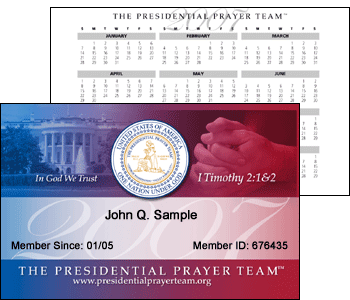
3419 The Presidential Prayer Team

Dear John: I'm more than happy to be a team member, to pray daily for our President, the Congress, SCOTUS, and all the bureaucrats. However, I'm not going to send you money. Nope. Absolutely not. I believe I've given and given and given. Not that I haven't gotten a lot back, mind you. Love those interstates, national parks, libraries, a clean Lake Erie and the refund I'll get this year for the Spanish American War phone tax. But for prayer, well, it just seems a little tacky to ask for money for something the Bible tells us to do. Sincerely, Norma

Monday, January 29, 2007

3418 Helen Shapiro

While I was preparing dinner, the TV was on in the living room and I walked in to see what the movie was--I heard a young man's voice I didn't recognize. It was (I think) a 1961 or 62 movie, but the young man was a teen-age girl. I thought it was a put on, but my husband insisted it wasn't that kind of movie. "I think she's British and she just has a deep voice." I went back to cooking and insisting that was a man's voice. When the credits scrolled I jotted down her name and looked her up on Google. I was so wrong! Helen Shapiro, in the early 60s was the top female pop artist in Britain, shared the stage with the Beatles, was on the Ed Sullivan Show and recorded "It's my party" before Leslie Gore did, but it wasn't promoted. She was a teen-age phenom, and still has a following as a jazz singer.

In 1987 she became a Christian and you can see her current material at her website Manna Music.

Helen as a teen-ager--and what a deep voice! You'll see why I was confused.

Cold, cold city, this Columbus

It's a bit nippy--23 F, wind chill 10 F. My fingers are stiff. The thermostat is a room away, and God only knows where Al Gore and his hot air bandwagon are. So the cat jumps up in my lap while I type, and for awhile I have warm thighs. . . and lots of cat hair as she settles in for a long winter's nap.


Cat hair on the keyboard
cat hair on the floor
cat hair in the vacuum
It won't hold anymore.

Cat hair on the bedspread
cat hair in the sink
cat hair on my best clothes
and not just where you'd think.

Cat hair on my shoulders
cat hair in the pears,
cat hair up the stair well
and on the dining chairs.

Cat o mine, I love you
could not do without
But keep your hair, dear heart,
and not so round about.

Monday Memories--digitized ancestors

There are not many in my immediate family interested in genealogy, but if I point, they'll look. I want to mention a wonderful source for your memories available only through your public library (if it subscribes), The HeritageQuest Online, a book collection made up of 7,922 family histories, 12,035 local histories and 258 primary sources with the 1790-1930 census images. It has been on microfilm for some years, but few libraries owned it because of the high cost. It is a ProQuest product and can be accessed at subscribing libraries (I use Upper Arlington Public Library) or by remote access using your own computer and library card. Sometimes library consortia buy it and make it available to the entire state system (I'm not sure about Ohio and whether what I access is in a consortia).

I came across this source just browsing at my library about two weeks ago. I suppose it was publicized, but I hadn't seen it or wasn't doing genealogy just then. The quality and depth is breath taking. You can search by people, place and keyword; you can browse titles with bibliographical data and links. I could easily use the indexes and find the correct pages of the on-line books within this database. Printing the right page was a bit tricky, but considering that in the past you might have had to travel hundreds of miles to examine these sources after frustrating hours of tracking them down, what's a few dollars for printing?

Also at my library, and maybe yours, is the Ancestry.com collection. It duplicates some of Heritage Quest, has some really nice browsing features, but the images aren't as good. My library doesn't allow remote access, but here is a link to the one at Columbia University just so you can see what's in it.

These sources are where I found the photocopy (not just record) of my grandfather's WWI 1918 draft card from Lee County, IL; my great grandfather's public land purchases; the Revolutionary War pension petition by the widows of my don't-know-how-many gggg grandfathers in Virginia; the address of the house where my husband's great grandmother lived in Beaver Co. PA before her husband disappeared. Folks, I've seen a lot of on-line material in my professional and personal life with libraries, and these--for the memories--just blew me away.

Because of name changes, our female family members are difficult to track, so have fun looking for your "lost mothers" in an ever growing digital universe of sources.

P.S. There are also many state archives free on the internet for which you don't need any library access.

, , , ,


My visitors and those I'll visit this week are:
Anna, Becki, Chelle, Chelle Y., Cozy Reader, Friday's Child, Gracey, Irish Church Lady, Janene, Janene in Ohio, Jen, Katia, Lady Bug, Lazy Daisy, Ma, Mrs. Lifecruiser, Melli, Michelle, Paul, Susan, Viamarie.

3415 Mathematically challenged

It's no secret. Numbers are not my field. I took algebra and geometry in high school and managed to graduate from college with zero math, getting caught in a net of new requirements when I was in my mid-30s as I decided to update my teacher's certificate (I never used it), which by then had a basic math requirement. So when I saw this week's poetry topic. . . "to think as mathematicians, to equate. While we do equate our world with words when we write poetry, I think a prompt like this, to see the world as a mathematical equation. . ." I'd already blacked out by the end of the instructions.

However, even with my math challenged brain I sensed something was wrong with the meat prices this morning. If meat is about to pass its due date for safety, it is marked down, and if you get to the counter at the right time, you can pick up some bargains. I watched the clerk with her little calculator this morning paste the mark-down stickers on the meat.

Something looked a little odd, but not being able to compute in my head I just selected the items that looked good, not noticing that 1 lb. hamburger at $2.89 was now reduced to $.90 which the label said was 40% off or $1.07/lb. I wish I'd bought several. A one pound package that costs $.90 is obviously, $.90/lb, and $1.07 isn't 40% of $2.89--so everything on the sticker was mixed up. I picked up .55 lb of boneless ribeye which was originally $13.49/lb reduced to $8.18/lb and the label said "you pay $3.60 instead of $7.42". I did buy two, because although I can't figure numbers, my heart was beating "bargain, bargain." A similar thing with the stew meat. I'm not sure what sort of calculator/label printer the meat department clerk had, but it definitely went to school with me.

If I weren't so math challenged, I would have pointed out the mistake to someone, but didn't figure it out until I got home and was putting the groceries away.

Sunday, January 28, 2007

My Aristocratic Title

My Peculiar Aristocratic Title is:
Venerable Lady Librarian the Loquacious of Withering Glance
Get your Peculiar Aristocratic Title


I tried on several--thought this one fit best. What's your title?

HT In Season Christian Librarian

Saturday, January 27, 2007

3412 Sweet Land

Tonight we went to see Sweet Land at the Grandview Drexel. That's my third movie in three weeks--twice to see Dream Girls and then this low budget indy which has been slowly building in popularity since its release in 2005. It is based on a 1989 short story by Will Weaver. "A Gravestone Made of Wheat" and is about a Norwegian immigrant farmer in southwestern Minnesota who receives a mail-order bride from Norway, only to discover she's a German who had recently moved to Norway. It is not a "Hollywood" product, and is a beautiful love story of Olaf and Inge as they struggle against the community's prejudice and the moral standards of that era.

The movie begins with Inge's death as an old woman in the 80s, reflects back to the Viet Nam era when Olaf dies, and then starts over with them as young strangers who fall in love around 1920. They encounter prejudice and suspicion in Olaf's strongly Lutheran Norwegian community (it takes place shortly after WWI) and can't marry because her papers are not in order.

Although it's an exceptionally well done film with a wonderful love story and beautiful photography depicting lush farmland and warm friendships, I can't help wondering if there will ever be a film made for commercial release that depicts Christians or even Americans in a positive light? The rural Minnesotan Lutheran congregation insists on speaking only English, even though many of them know Norwegian and the pastor can speak German. As I've come to expect in any film or TV production, everyone but the Christians exhibit Christ's love. There is one very minor character who appears at the beginning and the end whose heart is in the right place--he's of course, an outspoken Socialist.

Inge and Olaf's love story starts and ends with war--WWI and VietNam. The land struggle shows the two of them, both immigrants, harvesting acres of corn by hand, pitted against the modern age of machine farming just developing as farm markets inflated by the war collapse. Yes, and the big, bad commercial interests gobbling up the little guys--and the banker is a relative, a Lutheran sharing the pew on Sunday with the man whose farm he'll auction on Monday.

In what must be the tiniest of sub-plots, there are even two Native Americans, probably from a near-by reservation, helping the banker displace the farmer with 9 children about to be auctioned off his land. The director, Ali Selim, is of Arab parentage doing a xenophobia film when suspicion of Arabs is high, and it's a carbon neutral film (for environmentalists). Ah, the feelgoodiness of it. Oh, it's a good story, absolutely, a story of love and overcoming, and change as the community eventually comes to their aid, but sometimes I just get so tired. . .


3411 Gentlemen, please remove your hats

We went to a nice, not elaborate, restaurant last night for Greek cuisine instead of our usual Rusty Bucket (Sports Bar) date. Dinners $15-25, wait staff all dressed in black and well groomed. The attire was casual, but clean jeans and Christmas-present-shirt type. Almost no one in cut offs and sweats. In white slacks and a red jacket, I might have been the most over-dressed. It's a happy place with fake Greek decor--naked statues, grape leaves, that sort of stuff. The tables are filled with Friday after work comrades, widow friendships and family groups.

Does it sound sort of antiquated and old fashioned, like manners; is it too much to expect a guy to take off his baseball cap in a full service restaurant in the evening? The guy at the next table never took off his cap. I couldn't tell if he was with his mom or his date, or if his IQ was a bit low--it was sort of dark. Grow up fellas. Little League is over.


3410 The 10 books no one would lie about

Why would anyone lie and say they'd read these books but didn't? I can see people lying about reading anything, but these? According to a story at 24dash.com , Brits do.


1. The Lord of the Rings - J.R.R Tolkien

2. War and Peace - Leo Tolstoy

3. Wuthering Heights - Emily Bronte

4. Men are from Mars, Women are from Venus - John Gray

5. 1984 - George Orwell

6. Harry Potter and the Philosophers Stone - J.K Rowling

7. Great Expectations - Charles Dickens

8. Jane Eyre - Charlotte Bronte

9. The Da Vinci Code - Dan Brown

10.Diary of Anne Frank - Anne Frank


I read War and Peace, parts of it in Russian, and saw a couple of versions of the movie. I read the John Gray book--I think I got it for $.50 at a used book sale. This reminds me, our book club is reading Great Expectations by Dickens for February, and I haven't started it yet. No lie. And I think it will be my first Dickens book. My background in American and British literature is the pits.

HT Readers Read.

Friday, January 26, 2007

3409 Wash your hands and other good stuff

I heard on the news today that the "cruise ship virus" has hit some Columbus hospitals--both patients and staff. The recommendations are that people wash their hands when around patients, preparing food, or using the bathrooms. Duh!

Did you know there are an estimated 1.4 million salmonella infections annually in the U.S.? Most are food borne, but many are acquired from animals, particularly pet rodents, such as hamsters, mice or rats. Another reason to wash you hands after handling animals, particularly at the pet store. NEJM 356:21-8 (January 4, 2007)

Nearly 20% of automobile crashes involve driver sleepiness unrelated to alcohol, and the total direct and indirect costs of sleepiness and sleep disorders amount to hundreds of billions of dollars annually in the U.S. An estimated 50-70 million Americans have sleep-related problems. This information was included in a review of Sleep disorders and sleep depreivation: an unmet public health problem, published in 2006 by the National Academies Press, published in NEJM 356;2, January 11, 2006. You can read the summary and chapters here. I personally think this book belongs in your public library--it's not very expensive--because the recommendations involve national issues and policies. Mine would only have to give up one cook book or one Elvis title to buy it. Hand washing won't help you sleep better, but good sleep hygiene will.

3408 You can't marry your dental hygienist

or optician, or massage therapist because current law in some states won't even let you get acquainted. Even if you change doctors, you're prohibited from any contact for two years. You can't even date her sister or brother! Read Eugene Volokh in Opinion Journal to see how far we've gone with that bugaboo term "health care provider/practitioner," and sexual harrassment. This makes Victorian manners and morals look positively decadent.

And you alternative medicine folks aren't off the hook. In Minnesota "the law applies to a wide range of alternative health care practitioners, and not just massage therapists [where a suit was brought by the former husband of a woman who married her former client under this crazy law]. In particular, it covers people who practice "(1) acupressure; (2) anthroposophy; (3) aroma therapy; (4) ayurveda; (5) cranial sacral therapy; (6) culturally traditional healing practices; (7) detoxification practices and therapies; (8) energetic healing; (9) polarity therapy; (10) folk practices; (11) healing practices utilizing food, food supplements, nutrients, and the physical forces of heat, cold, water, touch, and light; (12) Gerson therapy and colostrum therapy; (13) healing touch; (14) herbology or herbalism; (15) homeopathy; (16) nondiagnostic iridology; (17) body work, massage, and massage therapy; (18) meditation; (19) mind-body healing practices; (20) naturopathy; (21) noninvasive instrumentalities; and (22) traditional Oriental practices, such as Qi Gong energy healing."

Thursday, January 25, 2007

Poetry Thursday #4

Our prompt this week is "Why I love poetry." In 153 words or less. I don't have a "poetry base;" no courses, no publications. But I love it when poetry nails it. Sometimes it's only a line or a phrase, but there's a connection. An ah-ha moment. Yesterday I read a poem about an Irish WWI airman who died in Italy (Yeats). It's today's news almost 90 years ago.

This week I was reading "The Best American Poetry, 2006," guest editor, Billy Collins. On pp. 30-33, there is a poem by Amy Gerstler, "For my niece Sidney, age six." She begins with Margaret Davy in 1542 being boiled to death for poisoning her employer, an item she came across reading the 1910 Encyclopaedia Britannica. She uses it to launch a poem about what simmers in the crock-pot of her head, and moves on to speculate that her untamable, curious niece may someday like Martin Luther nail theses to a door (about which she also read that day in the encyclopedia).

I used to own 7 sets of encyclopedias. My favorite which I still enjoy browsing with a cup of coffee belonged to my grandfather--the 11th edition of the Encyclopaedia Britannica published in 1910 (I also own the 12th and 13th). It's printed on tissue thin paper and bound in black leather which is crumbling a bit on the spines.

In this poem, Gerstler writes about owning 5 sets of encyclopedias. . .

"That's the way I like to start my day;
drinking hot black coffee and reading
the 1910 Encyclopedia Britannica.
Its pages are tissue thin and the covers
rub off on your hands in dirt colored
crumbs (the kind a rubber eraser
makes) but the prose voice is all knowing
and incurably sure of itself. . . "

Connect!


3406 The violence around us

If you're wringing your hands about the violence in Baghdad, Babel and Baqouba open your local metropolitan newspaper. I've seen the violence statistics for California compared to Iraq. But things have been rough this past week in mild-mannered Columbus, OH, test market of the country.

Over the week-end at the movie theater about 2 miles north of here where we like to go for $1.00 admission, Delmar gunned down his wife Ernestine, killing her, after tracking her and their two daughters down. Then he put the shotgun in his mouth and killed himself. Eric from the homicide squad said, "They'd been having some problems." No! Really?

I was waiting in line at the post office yesterday (again, my neighborhood) and a woman customer told the clerk she was changing her daughter's address for mail delivery because a number of apartments on Dierker Rd. had been broken into, so her daughter was moving in with her for awhile.

There was a police chase 2 days ago from Wilmington to Columbus that finally ended at a bridge over one of our rivers. One perp jumped out of the car and over the guard rail. There's not much ice on the river, but it's terribly cold. They dragged the river for some time, and finally found him yesterday. All caught on video for the evening news, of course. The two other burglary suspects, both with records and weapons, aren't divulging their buddy's name.

A store owner, Abdel Shalash a father of two, was shot and killed by some teenagers for $150.

A school bus driver was stopped for a traffic violation yesterday and police found cocaine on the bus--he was on his way to pick up kids. I didn't know Columbus outsourced this task to private companies, but apparently he had a long record of problems. Today none of the buses are running because that company isn't sending out any of its drivers. I hope they aren't just pouting and are checking their security files.

Habitat for Humanity homeowners in central Ohio are being scammed by mortgage companies to refinance from 0% to 8.99% and take their equity for cash with closing costs of $7,000.

A 16 month old baby was beaten to death a few months ago, and they've finally charged her father's girlfriend. Parents were never married, of course.

50 year old Chris Wright got life for stabbing to death a man who rushed to the aid of a neighbor Wright was robbing.

There's a lot of sin and violence out there. Just open your paper.

3405 Sandy Berger, keep out

There has been a library at Queen's College, Oxford, ever since its foundation in 1341 by Robert Eglesfield, Chaplain to Queen Philippa, consort of Edward III. The current building was built at the end of the 16th century, and has about 50,000 volumes in the lending library, and 100,000 in rare books, printed before 900 and over 500 manuscripts, of which 50 are mediaeval.

The latest newsletter reminded "members" who have entry cards of the security procedures:

Security
Please remember:


· Do not let anyone 'tailgate' you into
the Library.

· Do not hold the door open for anyone
entering when you are leaving.

· Do not offer to swipe your card so
that someone else can get in,
whatever they say.

Bags
All bags other than the smallest handbag
must be left on the shelves to the right of the
front door. No bag capable of holding a book
must be brought into the Library.

No mention of pants, socks or undershorts as receptacles for anything other than the usual body parts. But I'm guessing with medieval manuscripts, they are a bit more vigilant than our National Archives staff was about document stuffing.

List of rules from the library's website.

3404 What I didn't and did find at the library

Your kid got a paper due next week? It isn't just the journals and books that lack balance, perspective and diversity. You might want to browse the digitized sources, especially if you are homeschooling. The titles may not be what you remember from your school days. Publishing firms are bought and sold; editorial boards change direction; standards of reliability must meet market demands. Someone had to compile and write them, too--someone with a point of view, someone your children will be citing as an authoritative source. Recently I took a quick spin through "Annals of American History which is produced by Encyclopedia Britannica."

I can log on at home, but I was at the library. By clicking to Religion, I found the first paragraph set the tone:

"America was first colonized by religious exiles, who found in the New World their first opportunity for religious liberty. The United States, as a result, became the first country in the Western world to make an effective separation between church and state, as well as the first to write into its basic law the principle of religious toleration. This enormous diversity of religion is one of the hallmarks of the country."

So that's the framework. What will be the focus? Essays, articles and documents that don't meet the standard of tolerance and separation of church and state. How Indians were mistreated by missionaries. Brief (skimpy) one page articles on major Protestant denominations like the Presbyterians and Methodists bringing their history all the way up to--about 1800 in this source--and huge coverage of very minor organizations and movements of the 20th century I've never heard of (toleration and diversity, right?)

Original documents? That's what Annals does. It's just extremely selective. And if a kid is writing a paper, it's much easier to use this source than pull paper sources. (Although if there are recent compilations in paper, they too will be sifted and filtered to be politically acceptable to the left.) There's an eight page article in Annals by Clarence Darrow about what to expect from different religious groups if you seat their members on a jury; some court cases that reflect poorly on Christians; and a selection of "scholarly" articles, mostly negative about people of faith.

By using the timeline, I was able to pull up the 2003 gay Bishop document of the Anglican Church. I'm not well informed about the Anglicans, but I'm guessing there have been a few other achievements in the last decade. The timeline stops with 2003, although the copyright of the database is 2007. Has nothing much has happened in the last three years? I was a bit surprised to find that the Thomas Jefferson/Sally Hemings paternity debate was deemed worthy of inclusion (actually not surprised at all), and that "Fast Food Nation" was a historical treasure--and not even exerpts from the book, but pieces of an on-line interview. The USS Cole story didn't make the cut that I could find.

So I turned to the reference shelves and looked through some of the handsome, hard bound multiple volume sources. The three volume, 50's in America by Salem Press (2005), had no entry for Christianity at all, but Stan Freeberg got in. No denomination, not even Roman Catholics, had an entry. I took a peek at Modern America 1914-1945 by Facts on File (c1995, but purchased by the library in 2005). In the Table of Contents I found a section on Religion. The first topic of 4 subdivisions? Women and the Church.

3403 Great cat photos

Crazy Aunt Purl writes longer entries than I do. Her husband left her and the cats (she's gorgeous, funny and knits), but she hangs in there entertaining the blog troops and creating fabulous knitzy things.

"Being rejected sucks. Being abandoned sucks. Being alone and almost-divorced sucks. Of course, not having to clean up after anyone ever again ... is PRICELESS." Crazy Aunt Purl

Wednesday, January 24, 2007

3402 Do what it takes

to get the homeless off the streets. USA Today has a good article today (1-24-07) on what programs are working for the homeless in large metropolitan areas. Last week (1-18-07) the Wall St. Journal had an article about successful programs like "Ready, Willing and Able," which has saved NY a lot of money by getting the homeless into permanent housing and jobs. Getting the hard core 10% off the streets into safe housing units, not temporary shelters, without the carrot to reform their lives first, is working and is cheaper than other programs. It also helps restore businesses in the neighborhood, or at least gives them a chance. I know this irritates both the left and the right. Some on the right want the homeless to "earn it," and on the left, the do-gooders think we should expect nothing from them.

From a Christian point of view, Matthew 25 never says you do this (offering shelter, clothing, food) in order to reform someone. It might; it could; but probably won't. Homelessness at its root really isn't about being without homes, but being confused, sick, brain damaged from alcohol and drugs, mentally ill, mentally retarded and a prison system that dumps ex-cons on society with nothing to do. No six month government grant run by a 25 year old social worker is going to "fix" weird uncle Harry. We're reaping the harvest of misguided social ideas of the 60s and 70s which closed institutions and put people on the streets.

Some think if you make decent housing available without demanding the homeless change their lifestyle first, their numbers will increase. How many alcoholics do you know personally who stop drinking because someone tells them to? Do you know what we're getting with the present system? Public libraries with people who smell so bad they drive away anyone else who would use the newspaper or computer. Urine filled stairwells in the city. Hostile people begging. Cardboard shelters under by-passes. No accessible restrooms for the rest of us because stores or buildings don't want the homeless creating filth. Enclaves of mentally deranged people sleeping on heat grates. "How's that working for you?"

Permanent housing and assistance grants work better than shelters (which many homeless are afraid of because of violence). It will continue to work until it decreases the number of homeless so much that their advocates and the bureaucrats start losing government funding; then they'll find something else to ask for with their favorite phrase, "Yes, but. . . "

3401 Caring Service from Staples

Mr. Cloud wrote this past week about several incidences which indicated the little guy wasn't getting very good service from businesses and governments. I agreed with most of his points.

However, we had an odd thing happen yesterday that has restored my faith in the chain store, even though the clerk had made a mistake thinking we'd made a mistake.

My husband is going to Haiti on a mission trip in February, and in addition to helping with building and maintenance, he will be teaching a perspective drawing course for students studying English (although a very poor country, most of the children learn four languages). He doesn't know how many will be taking this optional unit, but he's preparing 60 packets of handouts, so I suggested he take the originals to Staples [office supply store] which has always done an excellent job on my blogs (yes, I have my blogs bound). He added a title page with the name of the school "Institution Univers" There were TWO messages left on our answering machine from the staff asking if we had misspelled Univers, and they wouldn't print until they heard back from us.

I smiled, but was touched to get that kind of service.

Are liberals ruining Wal-Mart?

And in another, unrelated item, I'll just mention my favorite giant American success store--Wal-Mart. I love Wal-Marts, and although I don't like the super stores as much as the older "just huge" stores, and nothing around here matches what you find in Arkansas, I visited the grand opening of one on Friday near here. I think Wal-Mart has been so pressured by bad publicity from the left, that they are losing their touch. Either that, or Columbus' unemployment rate is so low, it is hard to staff stores.

I actually had an African cashier who couldn't speak English. I only bought a bunch of bananas and thought it had rung up incorrectly and asked her to recheck the per pound price. She was obviously confused, so I repeated my question. She looked up, pointed at the ceiling. I again asked her to check the price. She smiled, took the label off and pressed some keys. She smiled and nodded. I smiled and nodded (didn't do well in math so had no idea if it was correct). I took the sales slip and the bananas to the customer service. The slip clearly said, TWO ITEMS, and I only had one bunch of bananas. That much math I know. I got my refund and left the store.

Then yesterday we stopped there again looking for various items on the Haiti list. Knee pads. Didn't have them. 12' measuring tape. Didn't have it. Carpenter apron. None. Bug repellent. Check in grocery. One young man we asked had a speech impediment and such poor English (but he was one of our own) that we could hardly understand him. I spoke to four or five staff people, and all were on loan from other stores in the Columbus metro area, one was from Delaware (north of Columbus).

3400 Best selling books for youth

How often is a best seller for young people actually written by someone under 18 or even 21? The USA Today Best-selling books for 2006 list for young people has Christopher Paolini's Eragon as number one and his Eldest: Inheritance Book II was fourth. I'm not sure I read books for youth even when I was a teen and I claim total ignorance on this genre and mysteries and fantasies.

What I find fascinating is Paolini's background. Farm raised, and home schooled, he finished high school by age 15. He'd also had a few failed attempts (by age 15) at novel writing. In this interview for other teens interested in writing, he mentions, sort of off hand as though everyone does this, the depth of reading he'd done (before age 15) in Teutonic and Old Norse history in order to have the background for his characters, language and country.

He says when he was little he didn't want to learn to read--didn't think it was important, but that his mother was persistent and patient (a former teacher).

"Then she took me to the library. It's easy to write those words now, but they cannot convey how that single event changed my life. In the library, hidden in the children's section, was a series of short mystery novels. Attracted by their covers, I took one home and read it eagerly. I discovered another world, peopled with interesting characters facing compelling situations." Can you imagine how busy he must have kept the Interlibrary or Regional Loan department at his public library?

When he had his first book self-published after years of drafts and editing, the family marketed it themselves--beginning with talks at libraries. These parents obviously had a lot of faith in their boy! I think I heard an interview on the radio where he said they'd mortgaged their home to do this. But don't quote me.

"The Paolini family spent the next year promoting the book themselves. Beginning with talks at the local library and high school, they then traveled across the U.S. Christopher gave over 135 presentations at libraries, bookstores, and schools in 2002 and early 2003." His webpage

Someone who bought it brought the title to the attention of a publisher, who signed him, and by mid-2004 Eragon had sold over 1 million copies.

3399 The Mexican model

More Albanians reside beyond Albania's present borders than within them. Remind you of anyone around here?
see "The Chicago Connection," by Allison Stanger, The American Scholar, Autumn 2006.

3398 Silly word choices

An article on full body scans for skin cancer for female veterans I noticed this odd phrasing, "We found that 16% of subjects would refuse the examination if the primary care provider were of the opposite sex, whereas 38% would not refuse but be less willing to be examined. "

Seems that whole sentence could be tightened up a bit by using the term, "male doctor."

And who knew our brave women soldiers were so squeamish around men?

Archives of Dermatology. 2006;142:312-316.

Tuesday, January 23, 2007

3397 Cooking the blog

No one cares what you had for lunch is a book for bloggers, the premise being that bloggers run out of things to write about when all they can think of is what they ate for lunch. This has never happened to me--having nothing to write about--although I have on occasion written about my lunch. Here's our dinner menu today.


Sweet sour meatballs (fully leaded)
Tender crisp fresh asparagus
Baked butternut squash with drizzled maple syrup (sugar free)
Chocolate peanut butter pie (low fat, low sugar)

To make the meatballs you first have to leave the computer--probably when Blogger.com is acting up. Go to the kitchen and mix in a sauce pan one 15 oz can of sauerkraut, one 12 oz. jar of chili sauce, and one 16 oz can of whole cranberry sauce (sizes make no difference). Remove half of it from the pan and put it in the freezer for another day. Makes a wonderful topping for a boneless pork roast. While the mix is warming up, check the computer to see if Blogger is working, and if so, download that picture before it quits.

Go back to the kitchen and tear and crumble in a bowl at least two pieces of stale bread and let it dry a little while you go back and finish your blog entry. Oh, turn off stove and remove the sauce because you might forget and it will scorch.

If you forgot to remove the Cool Whip from the freezer earlier (for the pie), do it now! Put cream cheese on the counter to soften. Later, add 2 eggs to the bread crumbs and 1/2 package of dry onion soup. It will have all the seasoning these meatballs will need. You now have a really disgusting looking yellow mess in the bowl and something yummy smelling on the stove. Return to computer for awhile.

Next, add one and a half pounds of ground chuck to the bread crumbs and thoroughly mix. Shape into 10 nice sized meatballs, and lightly brown for a few minutes. Spray a casserole dish with a non-stick (I use olive oil), and arrange the meatballs. Pour the sauce over the meatballs, completely covering them. Put in the oven at 375 for at least 45 minutes. Check your e-mail.

Return to the kitchen to make the pie. Cream together one cup of creamy, natural peanut butter with one cup of Splenda and one teaspoon vanilla. Add half an 8 oz carton of sugar free Cool Whip. Mixture is a bit stiff especially if blogging has impaired your muscle tone. Pour mixture into a purchased chocolate graham cracker 9" crust. You can make your own if you don't blog. Put it in the frig to firm, 'cause you're running late now.

Go back to computer and check for errors. Now it is time to get the veggies ready. Put some water to boil in tea kettle. Peel and cut the butternut squash into small pieces, put in small casserole sprayed with non-stick, dab a bit of butter and drizzle some sugar-free maple syrup over it and put in oven with meatballs. (About 15 minutes, with the last 5 or so at 400 after you take out the meatballs.) Wash and cut the asparagus and put in small pan. About 5 minutes before serving, add the hot water to the asparagus and return to a brisk boil; turn off heat and cover. Remove pie from frig, warm a tablespoon of sugar-free hot fudge in microwave and drizzle it over the peanut butter filling; return to frig. Take meatballs out of the oven and reset at 400 to finish the squash for 5 minutes. Set table, feed cat, call husband to table.

Makes about 10 meatballs. Freezes well, or makes great sandwiches the next day.

3396 Who knew?

WASP is shorthand for White Anglo-Saxon Protestant. It's a very useful acronym and I think sounds a whole lot better than SWAP, if you rearrange the word order*. I know it has been misused in a snarky way for certain rich northeastern presidential candidates, but as one whose ancestors were Scots-Irish, English and German and married to a Scot, it works well. So I was a bit taken aback to find out that WASP is used in the medical literature to mean "Wait and See Prescription," used with antimicrobial therapy.

That was definitely the medical treatment I had as a kid.

*Or, White Aging Saggy People.

3395 Are you living in the fast lane?

Karen Quinn wants to talk. She's got a contest and you can reach her by video, essay or e-mail, or just send one line, but you've got to get it in by February 16. I've looked through the list of prizes, and I'm here to tell ya, this is one fabulous contest. This is Karen's way to market her new book, Wife in the Fast Lane. Pretty clever.

Here's a sample of a one-liner:

"I was coloring my hair, sending a file to the office, answering a students question on the phone that “just can’t wait”, and helping a 2 year old heifer have her first calf."

If you're from the city you probably didn't know "heifer" is the word for a cow that hasn't been a mommy yet. Or that there are 55 different words in English for sheep. I guess cattle get to claim that word "heifer" right up to the time the little guy pops out. Sounds like the way some people use virgin, doesn't it?

I've never lived in the fast lane--don't even know where it is or how to get there. Anyone got a map? Keep it. I've spent my life carefully arranging my schedule, saying NO to things I really didn't want to do, and avoiding high maintenance people who would chew up my free time. As it says in my bio, somewhere, "My motto is you can have it all, just not all at the same time."

Monday, January 22, 2007

3394 Respect your brain

The library notified me that there was a book waiting for me that I had requested (placed a hold several weeks ago when someone else had it checked out). I had no recollection of the book, and didn't remember when or why I requested it. The title? Making a good brain great, by Daniel G. Amen, MD. Hmmm. Looks like I needed it, doesn't it?

I leafed through it and noticed the chapter on brain injury. In 1989 my daughter was in an automobile accident--hit by a drunk driver while waiting at a stop sign. I think I blogged about it some time back. Since you aren't told much on the phone at 3 a.m. except to come to the hospital, I was fully expecting to claim a body when we got there. Even as I type this, my heart rate has soared from the stress of remembering that awful night. She was in ER with a concussion, but was sent home after a few hours. She had years of trouble resulting from that "mild concussion" and a huge hassle getting the other driver's insurance company (Nationwide) to pay up. She started stammering, was depressed, tested very low on IQ tests (done for the court), and developed debilitating migraines. She told me the other day that she had a few sessions with a neuropsychologist (also court ordered) who taught her some cognitive skills to work around the injured area. Even today, she will occasionally use what he taught her if she feels a migraine coming on, and her speech cleared up and she's her old self at problem solving and intelligence.

So I was interested to read in Dr. Amen's book that many people have had brain injuries and don't know it--particularly from falls and sports like biking, snowboarding, sledding and skating. He writes:

"A concussion or mild "traumatic brain injury" (TBI) is far more than just a bump on the head. According to the American Academy of Neurology, "There is no such thing as a minor concussion." A study from UCLA found that "the level of brain glucose use in people who suffered mild concussions was similar to that in comatose, severely brain-injured patients. . . Even mild head injuries result in major changes to the brain's metabolism and could make victims susceptible to more serious damage from a repeated blow."

Dr. Amen advises parents to never let their child knock the soccer ball with his head--heading drills, in which a child's head is knocked repeatedly, are of greater concern to pediatricians than is the occasional head-punt in a game. A study of adult soccer players found 81% had impairment of attention, concentration, memory, and judgment when compared to non-players of similar age and circumstances. He says football players are struck in the head 30-50 times per game and regularly endure blows similar to those experienced in car crashes.

Dr. Amen, who has seen over 30,000 brain scans, says: "I would not let my children hit a soccer ball with their heads, play tackle football, or snowboard without a helmet. I encourage my own kids to play tennis, golf, table tennis, and track. Your brain matters. Respect and protect it."

Monday Memories--Remembering Mother

January 24 will be the seventh anniversary of my mother's death. I remember getting the call at my office in the library at OSU and the overwhelming feeling of desolation and abandonment. But also I felt relief. She had died as she lived--with peace and dignity. Here's what I wrote about her in 2004 when her second cousin Marianne who lived in Iowa (their grandparents were siblings) returned a batch of her letters to me.

"I didn’t wait until Mother's death to canonize her as some have done with their parents. I've always known I had an exceptional mother (well, not counting those awful teenage years when I knew everything and she knew nothing!). And I've never known anyone who thought otherwise. She was, however, a rather private person, kept her own counsel, I think is the phrase. Didn't dabble in controversy. Didn't gossip. Didn't argue. So her letters from 1975 to 1998 are less than forthcoming. Weather report. Crop report. Grandchildren report. Health report (as they aged).

Each year Mother wrote Marianne promises or near-promises to travel to Iowa so they could see each other in person, but as far as I can tell from the letters, this only happened for Thanksgiving in 1988, although the Iowans did visit in Illinois in the late 70s.

Since Marianne was her cousin and also Brethren, she did share some thoughts on their common heritage on Christmas: "[at a 1978 retreat] no one of Brethren background could recall Christmas trees except at our country school programs. Most of us hung up stockings as children. Christmas dinners with relatives and programs at church and school seemed bigger than our present celebrations. Gifts were mostly homemade. We had lots of fun and excitement as we remembered."

She fretted a little on Memorial Day 1975 that she and her sister were the only ones left to place flowers at the grave sites of parents and brother, grandparents, aunts, uncles and cousins, something their mother had always done. In 1987 she recalls visiting in Iowa her great Aunt Annie as a young child--"the comb honey served at meals and the fat feather mattress we slept on reached with a little foot stool. I wish I might have known them at a later age when memories wouldn’t be so dim and one could appreciate more."

Finally, in 1998, Mother writes Marianne that "I try to tell Amy (granddaughter, early 30s) stories about the family [learned from Marianne's mother] so someone remembers how the George family spread out and came west."


Remember to pass along those family stories to your children and grandchildren. Monday Memories is very useful for that.


My visitors and those I'll visit this week are:
Anna, Becki, Chelle, Chelle Y., Cozy Reader, Debbie, Friday's Child, Gracey, Irish Church Lady, Janene, Janene in Ohio, Jen, Katia, Lady Bug, Lazy Daisy, Ma, Mrs. Lifecruiser, Melli, Michelle, Paul, Susan, Viamarie.

3392 A spanking law proposed

Democratic assembly woman of California, Sally Lieber, wants an anti-spanking law. As near as I can tell, she has no children, but is a "guardian" of a cat which is very smart. What do you want to bet she believes in "a woman's right to choose" and all sorts of animal rights. OK to kill the little duffers if it's inconvenient for them to be born, but not swat their bottoms if they're smacking another kid in the head with a shovel on the playground. I just love the consistency of liberals, don't you? Spanking bill

Sunday, January 21, 2007

15 questions to ask if you want to marry

These questions appeared in the New York Times. Maybe we were too young, but I don't think we asked any of them--we sort of went on faith that the other was a good person--and being a woman I just figured I change what I didn't like. We talked about short term stuff--what was his draft number, should we rent a furnished or unfurnished apartment, which one of us would use the car and which would take the bus. Was there enough money for the first month's rent. However, we married young. If you are 35 or 40, there's a lot of water under the bridge and mountains out of molehills to cross, so you'd better ask some questions. I've rearranged them for my priorities based on over 40 years experience, and added my comments in brackets. All these questions are asked only if you believe you truly love the person, of course.

December 17, 2006 New York Times
Questions Couples Should Ask (Or Wish They Had) Before Marrying

Relationship experts report that too many couples fail to ask each other critical questions before marrying. Here are a few key ones that couples should consider asking:

9) Have we reached a clear understanding of each other’s spiritual beliefs and needs, and have we discussed when and how our children will be exposed to religious/moral education? [Is she/he a committed Christian? Does she/he commune on the golf course or with a congregation and clergy?]

6) Can we comfortably and openly discuss our sexual needs, preferences and fears? [Does she/he expect a cohabitation probationary period before marriage--a sure route to divorce? If she/he has been unfaithful, will it change?]

2) Do we have a clear idea of each other’s financial obligations and goals, and do our ideas about spending and saving mesh? [How much debt does she/he have? Is she a shopaholic who needs to spend for mental health? Does he/she gamble? Has she/he been looking to the future or just likes to spend as you go?]

1) Have we discussed whether or not to have children, and if the answer is yes, who is going to be the primary care giver? [Does she/he already have children; what kind of parent is she/he; will you be expected to be a parent or just a stand-by babysitter with no say; what are the custody arrangements?]

11) Do we value and respect each other's parents, and is either of us concerned about whether the parents will interfere with the relationship? [Is he/she in a family business? Do her/his parents live close? Are her/his parents married to each other? Are there siblings?]

3) Have we discussed our expectations for how the household will be maintained, and are we in agreement on who will manage the chores? [Whose standards will determine "fair," or "clean," or "on time."]

4) Have we fully disclosed our health histories, both physical and mental? [Does she/he have health insurance? Unpaid medical bills? Preexisting conditions for which you'll be responsible? How much time spent with a shrink?]

5) Is my partner affectionate to the degree that I expect?

8) Do we truly listen to each other and fairly consider one another's ideas and complaints? [Don’t forget the non-verbal communication--sulking, slamming doors, driving like a maniac, flirting, procrastinating, etc.]

10) Do we like and respect each other's friends? [Does she/he even have friends or are you it?]

12) What does my family do that annoys you? [Get over it.]

13) Are there some things that neither are prepared to give up in the marriage? [Does he/she hate your hobbies and leisure activities? What about your pets?]

14) If one of us were to be offered a career opportunity in a location far from the other’s family, are we prepared to move? [Are your job skills and training readily transferable to another geographic area? Mountain guide in Iowa; scuba diver in Nebraska, for instance.]

15) Does each of us feel fully confident in the other's commitment to the marriage and believe that the bond can survive whatever challenges we may face? [How many times has she/he been married and what's your limit?]

7) Will there be a television in the bedroom? [Huh? Is this a which way to roll the toilet paper question or a sex question?]