618 When he says "Shush," you listen!
Greg likes Rush Limbaugh, corn on the cob, camping by the lake, and would like it if both cellphones and student loans would go poof. He's a librarian, hear him roar!


This item has been cross posted at my other blog, Church of the Acronym.
ULAC


De-coding DaVinci
Today's paper reported that $167 million was spent in Ohio on campaign ads for all federal, state and local races, and that Cleveland alone accounted for $77 million, second only to Los Angeles ($84 million). Five Columbus TV stations pulled in more than $30 million. As an Ohioan, I can testify that our media got wealthy in the months, weeks and days before the November 2, 2004 election. I could have accepted Kerry as President toward the last, just to have the campaign ads over.
So I looked at the summary report by Campaign Media Analysis Group. Based on the hysteria and accusations of a large clutch of homophobic fundamentalist voters, the ad revenue doesn't add up to that conclusion at all. Over $239 million dollars were spent on approximately 365,000 television ads about the ECONOMY (jobs, taxes, Social Security, tort reform). Next most important on the ad front was HEALTHCARE with over 325,000 ads totalling over $230 million spent. The WAR ON TERROR was third, with about $130 million spent on ads in the Presidental campaign. Gay Marriage spending was barely a blip, being outspent by Indian Gaming six times over.
The Democrat 527s outspent the Republican 527s by a huge margin, $66.5 million to $10.9 million. Kerry led in internet ad spending by 50%, and I'm sure campaign gurus will be looking at those dollars carefully--1) could they have made the race close, or 2) would the money have been better spent elsewhere, or 3) did the DNC enter that arena too late (RNC was outspending on the internet until September).
To have access to details, you'll need to be a subscriber, but the main site, has lots of interesting information.


Christmas 1985

Picnic at Marblehead

Twice (April and November) I've blogged about deer on the interstate west of Columbus. Reports are that 201 humans were killed in 2003 as a result of collisions with deer--up 27% from the previous year. Sixty of those deaths were motorcyclists--and they weren't wearing helmets. Seatbelts weren't worn in many of the vehicle accident deaths. In 14 of the 147 accidents involving cars/trucks, the deer struck by one car flew through the windshield of an oncoming car.
Our backyard deer are beautiful, but dangerous on the highways.
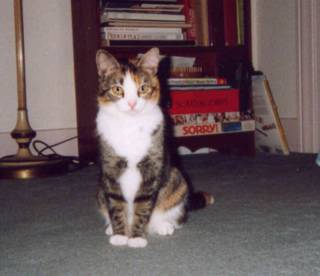
Today's WSJ evaluates self-cleaning, automatic cat litter boxes. The author begins: "Even cat haters can agree that felines have one advantage over other house pets: They bury their business."
No, not all cats. Ours doesn't. She has two peculiar elimination behaviors. 1) She backs up as close as her legs will allow to the sides of the container, which means everything coming out, goes onto the floor, and 2) she never rearranges the litter when she's finished, choosing instead to stand on the edge of the box and paw at the air. She looks pretty silly, especially if she's very careful and continues this for a few minutes.
The first problem we solved by having a cat litter box that looks more like a small trunk or storage box--sides are about 12" high. There is no solution for the second problem, except to get there as quickly as possible with a scoop and air freshener. In all other categories she is the perfect pet--beautiful, loving, frisky, and she can tell time--an hour before breakfast or dinner, she will remind us not to forget her.
She's also one of the few adult cats you'll see who is not overweight. She weighs 7 lbs, 3 ounces, and has no droopy abdomen and doesn't look like a small fat sausage with toothpick legs, like my grandkitty.
You've heard of the strawman? Apparently, I own a straw cottage that some educators have tried to huff and puff and blow down, but I didn't notice it until yesterday when it came up on a search.
Here’s what I wrote in February about the dollar value of a college education.
“I thought I would die of a broken heart when BOTH my children decided not to go to college--actually, refused is a better word. I was the third generation in my family to go to college--and I was on the faculty at a fine university. OK, I thought. A few years in the market place and they'll come around. Didn't happen. So we spent the college money on a summer cottage--no kidding--and eventually they'll reap the benefits of that since it has appreciated from $53,000 in 1988 to about $200,000 according to our latest tax assessment.”
But here is what Joanne Jacob’s gleaned out of that paragraph for her education blog and titled the subject line, “College vs. Cottage.”
“Norma's kids skipped college, and the family is richer as a result. The college money went to buy a summer cottage, . . “ Nothing about my dreams, hopes and fears for my children--just a sharpened pencil and a bank book.
In my blog I went on to estimate what the dollar cost of a college education at a state university would be worth in 45 years had I invested it and held for them--far more than the $600,000 life time advantage an education is supposed to provide, and she quotes that.
“Say we had invested $20,000 (the cost in the mid-80s of a state university education) in the stock market for 45 years, until their retirement age. Would they have that $600,000 to cushion their golden years? No, they'd have $1,604,000 using the conservative figure that over time, stock investments level out at about 10% a year, even factoring in the wild ride of the 90s.”
Sixteen people weighed in. Most missing the point (as did the people who e-mailed me directly). I never said I was talking about anything except the dollar value the “experts” apply to a college degree. One reader said, “well college costs more now. It was a state university.” How does that change the formula or argument?
Another said, “if you’ve got a college degree, then you have more to invest.” Obviously, one of the things, in theory, you obtain with college, is the smarts to invest wisely (a huge leap, I know), but I think that is factored into the $600,000 advantage college grads have over high school grads.
Another reader said, “what about all the other things gained by college--appreciation of the arts, flexibility, portability of skills, etc.” even though I’d said at the outset I was not addressing anything but the $600,000 figure that is PROMOTED as one of the primary advantages of a college education.
Someone else said, “why didn’t she put the money in the market instead of a cottage.” Wow. Some people don’t get the point do they?
After reading through all the comments, I realized many of the commenters hadn’t clicked to my blog to read it, and if they did, they didn’t actually really read it or understand it. It is terribly threatening to educators to suggest some of their favorite theories need a second look (and since I was one, and admit I was wrong, I can say that).
Strike two against a college degree. Causes faulty and incomplete reading.
U.S. Military conflicts
2003-2004 Iraq War
2001-2002 Afghanistan (Al-Qaeda)
1999 Kosovo
1995 Bosnia
1994 Haiti
1990-1991 Persian Gulf
1965 Dominican Republic Intervention
1961-1973 Vietnam War
1950-1953 Korean War
1941-1945 World War II
1917-1918 World War I
1916-1917 Mexican Punitive Expedition (Pancho Villa)
1914 Tampico and Vera Cruz Incidents in Mexico
1900 Boxer Revolt (China)
1899-1902 Philippine Insurrection (Philippine-American War)
1898 Spanish-American War
1861-1865 American Civil War
1857-1858 Utah War
1848-1858 Third Seminole War
1846-1848 Mexican War
1841 Door Rebellion (Rhode Island)
1839 Aroostook War (Canadian lumbermen and American settlers)
1836 Texas War of Independence
1835-1842 Florida War; also known as the Second Seminole War
1831-1832 Black Hawk War
1780s-1890s Indian Wars including
1811 Battle of Tippecanoe;
1846-1868 Navajo Wars in New Mexico and Arizona;
1855-1858 Yakima Washington, Oregon, Idaho;
1866-1890 Sioux and Cheyenne Wars in the Dakotas and Montana;
1870-1886 Apache Wars in Arizona, New Mexico, and Mexico;
1872-1873 Modoc War in California;
1877 Nez Perce Wars in Idaho and Montana in 1877
1817-1819 Seminole War
1812-1815 War of 1812
1801-1805 War with the Barbary Pirates
1794 Whiskey Rebellion (Pennsylvania)
1791-1800 Quasi-war with France (Atlantic Coast and West Indies)
1786-1787 Shays Rebellion (Massachusetts)
1775-1783 Revolutionary War
1774 Lord Dunmore's War (in Virginia, Pennsylvania and Ohio
1771 War of the Regulators (North Carolina)
1763-1764 Pontiac's Rebellion
1754-1763 French and Indian (Seven Years War)
1760-1761 Cherokee Uprising (Carolinas)
1744-1748 King George's War
1739-1742 War of Jenkins' Ear (Georgia and Florida)
1715-1716 Yamasee War (South Carolina and Georgia)
1702-1713 Queen Anne's War (War of the Spanish Succession)
1689-1697 King William's War (War of the League of Augsburg)
1676 Bacon's Rebellion (Virginia)
1675-1676 King Philip's War
When I checked my site meter the last several days I discovered that searches for Lawrence ODonnell (MSNBC) accounted for about half of all google searches that directed to my blog. That's odd, I thought. I mentioned him on October 23 after he'd gone bonkers over Swiftboat Vets and was screaming "Liar," but had no idea what he'd done recently. Well, apparently he's really gone off the deep end again (or, as usual?) and suggested the blue states secede. So that probably caused all the google searches, which in turn caused a ripple at my web site.
I hope someone has shown him the county maps. The counties would have to secede, not the entire state. Look at Illinois. It would appear that the Chicago suburbs went for Bush, but the St. Louis suburbs (in Illinois) went for Kerry, even thought the metropolitan counties are strongly blue. Bush won 2.51 million sq. miles with 150.9 million population, and Kerry won 511,700 sq. miles with 103.6 million people. And the red counties have all the agricultural land! What will the blue counties eat? And what movies will those of us in the red counties see? Oh dear, we've lost Hollywood. How tragic.
Do the number of hits on a blog matter? For those who sell ads, absolutely. There is an entire cottage industry of bloggers and software that count and evaluate blogs. "The current arbiter of the blogosphere as a whole is the Truth Laid Bear Ecosystem, an index of registered blogs whose evolutionary animal metaphor implies an ecological logic at work. Blogs are ranked by incoming links from other blogs registered in the Ecosystem making this a good analogy for a closed, but ever expanding, ecosystem operating in wider ecologies of the Internet. Blogs are ranked hierarchically from top predator InstaPundit described as a Higher Being down through tiers including Playful Primates, Flappy Birds, Lowly Insects all the way to Insignificant Microbes that subsist without a single incoming link to their name. Despite the animal metaphors the Ecosystem might be thought of as a Great Chain of Being as much as assertion of Linnean relationships. This is not only a description of energy flows but a catalogue of varying social status and influence in the blogosphere." Into the Blogosphere article. It is interesting to check out Bear and search the various blogs you like to read.
When I changed my site meter to not count my own visits to my site, there was a huge drop in the charts at Bear (I was already crawly scum), but there doesn't seem to be any standard for this-- whether you count yourself as a visit. But without my own visits, I get about 70 page hits a day.
Today I came across “Into the Blogosphere” which calls itself the “first scholarly collection focused on blog as rhetorical artifact,” saying that blogs represent the power of regular people to use the Internet for publishing. It is hosted on the University of Minnesota Libraries website. I haven’t quite figured out how to use the site, but have noted a few inconsistencies in the plan.
Although one of the beauties of blogging (I have five) is there is no peer review, this particular site says that - - -
“The ethos of blogging is collaborative and values the sharing of ideas; bloggers are not dependent on publishers to get their words out.”
And then goes on to use a peer review process to evaluate blogging.
“Yet, as most scholars recognize, the peer-review process is important. Peer review provides a needed check and balance on information; it helps ensure the quality of research and the connection between individual research and the profession as a whole. . .”
Am I correct in thinking their “peer review” process is to provide the authors cache when promotion and tenure review comes up--intended for those write about blogs as a communication form, and not those who actually write blogs. Anyone know?
Here’s a sample sentence or two pulled out:
“In all likelihood, Weblogs will be incorporated into most major media organizations in some capacity if their popularity remains sufficiently high and user figures increase. However, a true blog revolution remains a future phenomenon at best. For the foreseeable future, Weblogs seem well positioned to continue to do what they do best: to allow a forum for open and autonomous debate about media texts in the discursive space that they provide and to function as a real-time virtual feedback loop fostering an interactive debate about the veracity of media texts.” Weblog Journalism: Between Infiltration and Integration, Jason Gallo, Northwestern University .
Notice the references to “future” --we don’t know “future” if we don’t know the "now" for the article, do we? Was this written in 2002 or 2004, January or December? Makes a difference in my interpretation. I can find dates on the comments (I assume these are the peers), but not the articles themselves.
It would be nice to know date of publication for citing purposes, rather than use the date of research (September 2003) buried in the text for this kind of material:
“Color alterations, changing the base color of a common weblog template, are present in 33.8% of the weblogs (Figure 1). Of those that used templates that had been altered for color, 57.7% (n=30) had female webloggers while 40.4% (n= 21) had male webloggers and one of unknown gender (1.9%).” Common Visual Design Elements of Weblogs, Lois Ann Scheidt and Elijah Wright, Indiana University at Bloomington
2. Tighten registration procedures
3. Demand transparency from electronic machine manufacturers
4. Mandate voter-verified paper trails for every electronic voting system
5. Fix the absentee ballot mess.
6. Make early voting easier.
7. Smooth the Election Day rough edges. (This would vary by state.)
The current down cycle for jobs began in July 2000. A stimulus package was proposed but not supported by President Clinton. By the time Bush took office in January 2001, 217,000 jobs had already been lost and by the time his economic plan became law in June 2001, job loss was around 600,000. His tax cuts didn’t go into effect until August 2001.
Two examples of positive moves by business, using advances made possible by the internet.
Hand written inventory forms no longer necessary. “In the past, when the 100 sales reps of TaylorMade visited the 10,000 golf shops around the U.S., they would spend nearly two hours a day counting the titanium drivers and 9 irons left in inventory before filling out order forms by hand. That all changed in January when TaylorMade doled out handheld devices that sport bar-code readers and Internet connections. Now reps simply point the handheld at the bar code on each club to automatically tally inventory. Then they can focus on helping the retail customer boost sales. Sales-rep productivity is up 25%. And the system helped boost sales this year, allowing TaylorMade to beat rival Callaway as the world's No. 1 golf-club seller.” Business Week. http://businessweek.com/magazine/content/03_47/b3859623.htm
Multiple computer systems that can’t communicate have been replaced. “In the mid-'90s, the appliance maker Whirlpool, after expanding around the globe, was stymied by hundreds of computer systems that couldn't talk with one another. Whirlpool couldn't figure out how many products to make or to hold in inventory. Today, there's far less guesswork at the $11.8 billion company. Nearly every Whirlpool site worldwide is linked by e-business software. This has helped cut inventories from 15% of sales in 1997 to 12% today.” Business Week.
http://businessweek.com/magazine/content/03_47/b3859637.htm
But keep in mind, improved productivity means fewer jobs in one place, and more jobs somewhere else. The company that supplies the paper inventory forms for the salesmen may eventually take a hit as more firms use this system. Fewer staff in the home office are needed to process the information. Shortened sales call time may mean larger sales territories and fewer salespeople. Fewer computer support people may be needed at Whirlpool if there are fewer competing systems that need constant attention. Salespeople and software designers of the older, less effective systems, may be hitting the streets looking for work. Maybe that means fewer people going out for lunch in the business location, less demand for wait staff; maybe those computer support people will live in India instead of Indiana; maybe the improved productivity will hurt the competition and some of its people will suffer.
Poor Jane Smiley. She’s been seriously hung out to dry by Liberal Larry. And he’s the better writer.
And so forth, as he outlines how liberals will bring conservatives back into the fold, to bridge the gap, so to speak.I compiled a list of ten people I know who voted Republican and gave them each a call, in which I basically laid out the real heart of the progressive philosophy in simple terms they could understand.
"RACIST BIGOT GAY-BASHING FASCIST MORON!" I screamed into the phone after dialing my first number. "BIGOT FASCIST RIGHT-WING IDIOT HATEMONGER!!!!"
"Why are you screaming at me?" Grandma asked. "This state went to Kerry anyway."
"NO THANKS TO YOU, YOU INTOLERANT EVANGELICAL NAZI WHORE!" I shouted.
"Jeezus!" Grandma gasped.
"STOP FORCING YOUR RELIGION ON ME YOU NAZI BIGOT MORON!" I demanded, and hung up the phone. Jesus indeed!


 Posts
All Comments
Posts
All Comments